zenpundit.com » war

Archive for the ‘war’ Category

Three from Haaretz on the Temple Mount

Sunday, October 7th, 2012

[ by Charles Cameron — growth and mainstreaming of Rebuild the Temple movements in Israel, parallels with perceived slights against the Prophet of Islam, volatility of the situation ]
.

You saw the New York Times headline, New Clashes at Site in Jerusalem Holy to Both Muslims and Jews? That was just a taste, here’s more of the story:
.


.

Haaretz has posted three pieces in the last couple of days about the movement to build a Third Temple on the Temple Mount / Noble Sanctuary in Jerusalem. I’ll give you the title, link and brief summaries of for the two shorter pieces, and some significant quotes from the Longer one.

**

I’d also like to suggest considering the issues here as analogues of those in the recent “blasphemy” incidents.

We might think in terms of freedom of speech being akin to freedom of worship — but we should also consider the dangers inherent in what would likely be perceived as a huge provocation, in what may be the most volatile hot-spot on earth.

Consider: building the Third Temple might involve the destruction of the Al-Aqsa Mosque, whether by an act of God or by human intervention. Whether it would or not is in dispute, as we shall see — but as we shall also see, attempts to destroy it have already been made…

Bearing that in mind..

**

1: Temple Mount Faithful: From the fringes to the mainstream

Once consigned to messianic extremist fringes, movements fighting the ban on Jewish
prayers on Temple Mount are now endorsed by moderate rabbis. Even the Education Ministry has taken sides by encouraging pupils to visit the site.

If that’s accurate, it’s a significant shift in relation to what my American-Israeli journalist friend Gershom Gorenberg called in his book about the Mount, The End of Days, “the most contested piece of real-estate on earth” — for a quick overview of the importance of the site, see my piece of that name from July of this year.

**

2: Jerusalem Magistrate’s Court: Jews should be allowed to pray on Temple Mount

Police currently enforce the Muslim ban on Jewish prayer at the site, citing security concerns.

Put those two pieces together, and you have a sense of momentum gathering for an epic clash, one which would have immense apocalyptic significance in terms of those eagerly awaiting a Coming One in each of the three Abrahamic traditions

**

3: Following the dream of a Third Temple in Jerusalem

More than 90 percent of Israel’s religious public wants to be allowed to pray at the Temple Mount in Jerusalem. Some groups, though, wish to go even further and build a Third Temple in place of the Al-Aqsa Mosque. What fuels the dreams of these Jewish extremists?

Shany Littman, the author of this impressive magazine-length piece which is behind a paywall on the Haaretz site but has been reposted here, expresses through the voices of a diverse group of people she met and talked with, the deep-seated longing behind the movement —

I pray for it three times a day and I wanted to take seriously what I say. I say, ‘Next year in rebuilt Jerusalem.’

and the theological logic behind that —

It is the heart of Judaism. Numerically, one-third of the 613 commandments are not fulfilled today because of the absence of a Temple. The Temple is the Jewish public sphere that we lost. I want a transnational Judaism, which will encompass all the commandments.

the sacred politics —

I want to take the movements to a place that is more sensible: a Temple-based state, where the state’s entire content revolves around the Temple.

the somewhat archaic-sounding motivations involved —

the fulfillment of the three commandments the Israelite nation was given in anticipation of its imminent entry into the Land of Israel: to appoint their king and establish his kingdom, to wipe out the seed of Amalek and to build their Holy Temple.

the progress that has already been made in terms of preparation —

only two vessels that are not yet ready are the Ark of the Covenant, which cannot be reconstructed because it contained the stone tablets from Mount Sinai, and the huge external altar, on which the sacrifices were performed.

and recent trends on the part of Israeli police and politicians that seem to show an increasing willingness to allow Jews to pray in what is, after all, their holiest of holy places.

**

I have been pondering these things, and I think we can helpfully, if carefully, draw a parallel between the extreme caution with which the Israelis have approached the issue of the potential for Jewish behavior — up to and including the possible removal of the Al-Aqsa Mosque and or Dome of the Rock — enraging not just Jerusalem’s Palestinians but the Islamic world, and the far smaller provocations of Charlie Hebdo, the puerile video, and the Qur’an-burning Revd. Jones.

Consider the rules and regulations invoked by the Israeli poloice on Jewish visitors to the Mount (compare also the rabbinic decree in the “traffic sign” at the top of this post):

Because this was the month of Ramadan, no food or drink was to be brought. Also forbidden were praying, bowing, kneeling, singing and anything that might disturb the public order. And have a good day.

Prayer is banned — have I heard that phrase somewhere before?

Prayer is banned because it would be blasphemous — the ironies, the echoes, the resonances and paradoxes here are endless.

**

To understand the depth of feeling here — and remember, we are only examining the Judaic side of the issue here, and there are other perspectives in play — let’s peer a little deeper into the sacred / sacral motivation:

Sacrifice, not a very “contemporary” word but one with strong, archaic / archetypal meaning, is the heart of the Temple’s purpose:

Animal sacrifice was the primary ritual activity in the Temple. Rivka spoke of the practice yearningly. “Today it is hard to understand what sacrifice is,” she said. “When a person errs, makes a mistake, sins ? instead of bringing himself, he brings a substitute; he brings either an offering or an animal whose blood atones for his soul. This is something we have lost today. The media always talks about korbanot [the Hebrew word “korban” means both “sacrifice” and “victim”] ? victims of traffic accidents, victims of the peace process, victims of terrorism. And I say to myself, despairingly, that there is a place for korbanot ? and it is here. And what is the root of the word ‘korban’? It is from lehitkarev, to draw closer. To draw closer to Hashem.

Indeed, the sacrifice of a red heifer is widely believed to be necessary to purify those who would enter the Temple grounds — note in this next paragraph the reference to the return of the Messiah:

According to religious belief, until the ashes of a red heifer are obtained, access to the courtyard of the Temple is prohibited for Jews (see Numbers 19:1-22 and Mishna tractate Parah). Water mixed with the ashes of a red heifer can cleanse people of the impurity of the dead, which clings to everyone. Tradition holds that there have been only nine ritually suitable red heifers, and that the 10th will appear upon the advent of the Messiah. The absence of the ashes of a red heifer, with the concomitant inability to become ritually clean, is one of the reasons that many Jews are unwilling to visit the Temple Mount. However, the Temple movement activists claim this is only an excuse, and that there is no problem obtaining a red heifer today.

**

Now back to “on the ground” realities — and risks, including the risks of terrorism and war.

This situation of contesting claims to one of the world’s most sacred sites the has been simmering for quite some time, and I think the gist of the three Haaretz articles could be read as “the stew’s beginning the bubble”.

For another glimpse of the potential volatility of the situation, we can turn to a decade-old piece by Jeffrey Goldberg in the NYT — though if the situation is as significant as I take it to be, you’d also be well-advised to read Gershom Gorenberg’s book The End of Days.

Back in 1999, Goldberg wrote a piece which carried the sub-head:

There are Jews who want to seize the Temple Mount by any means necessary. And Christians who want to see the Jewish Temple rebuilt — and destroyed to bring on Armageddon. And Muslims who will never give up the Dome of the Rock. Will the peace process be stalled by the apocalypse?

It’s a long magazine piece, and like Littman’s piece for Haaretz, well worth pondering. Here I’ll just pull a couple of excerpts that touch on how Temple movement participants view the possible repercussions of their actions. Gershon Salomon is the leader of one such movement, and not infrequently raises funds addressing Christian audiences.

“The mountain is within reach,” Salomon told me. “God is waiting for us to move the mosques and rebuild. The Jews may not be ready, but the Christians are.”

In Casselbery, I saw Salomon work the Christian congregants into a flag-waving — Israeli flag waving — frenzy. After, as the congregants lined up to give Salomon checks and even their jewelry to pay for rebuilding the Temple, I asked him, “Do you think these people believe that God will remove the Dome of the Rock, or that man must remove it?”
He smiled beatifically.
“They know that God will make this miracle happen.”
By the hand of man?
“Only God knows.”

[ … ]

I ask him how he would feel if someone blew up the Dome of the Rock.
“The question is, Why did they build their mosque on our holy mountain, anyway? Who gave them permission? God didn’t.”
Would you be saddened if the destruction of the Dome of the Rock led to war?
“I don’t think it will come to that. The Muslims know in their heart that this belongs to us.”
“But what if it did lead to war?”
Salomon smiled. “The Temple will be a reality. God has promised it.”
But what about war?
“O.K.,” he said impatiently, “so we’ll have a war.”

Returning to the Haaretz magazine piece, we can perhaps temper that last remark with a word of moderation.

Journalist Arnon Segal is the activist son of a member of the Jewish Underground of the 1980s — one of whose leaders, Yehuda Etzion, plotted to blow up the Dome of the Rock. His views are accordingly of considerable interest.

Contrary to the usual image of those who are involved with the Temple, they are a great deal more soul-searching and hesitant than people think. People did not want to join with Yehuda Etzion, who was the one who raised the idea [of blowing up the mosque].

“I think it is nonsensical to blow up [Al-Aqsa Mosque]. We would not have achieved anything by doing that. That is not how to solve issues. The Arabs are against the Jewish presence on the Temple Mount as such. If the State of Israel were to permit sacrifices to be made, that would already be enough to make me jump for joy. Obviously my inspiration is from home, but not from a fanatic place. I was not brought up to hate Arabs. But an as-yet unattained Jewish national purpose and the concept of the Temple Mount? those are definitely notions I got at home.”

Segal insists that the debate over the Temple Mount is basically an internal Jewish issue and is not related to the conflict with the Arabs. “I am not an enemy of the Arabs. I do not say that I don’t want Arabs on the Mount. Even Rabbi Dov Lior said that all nations are permitted to pray on the Mount. We will not tell others not to pray to God on the Mount, even though the Muslims do not respect our right to pray there. I am ready to leave them Al-Aqsa. But Al-Aqsa is not the whole Mount.”

And here is Segal’s pragmatic evaluation of the risk:

I don’t think the Arab states are lovers of Zion, even now; if they could destroy us, they would already have done it. The Temple Mount will not irk them more than other things.

Would you want to test that hypothesis in “real life”?

An Insurgency Coming to a Place Near You?

Tuesday, October 2nd, 2012

Mayor Rahm Emanuel has taken criticism for Chicago’s skyrocketing homicide rate which stands this year at a shocking 19.4 per 100,000 residents. This is roughly triple the murder rate in New York City, is worse than in perennially crime-ridden Oakland and is within shouting distance of  war-torn Afghanistan and Mexico, which are fighting vicious insurgencies. Even for Chicago, the current level of street violence is unusually brazen.

Chicago has always taken an ambivalent attitude toward it’s enormous, 100,000 strong, network of rival street gangs. Traditionally, part of the social fabric of Chicago’s ethnically divided wards, Chicago’s street gangs were far better organized and more ruthlessly disciplined than street gangs elsewhere, which allowed them a limited entree into participation in local politics. The Chicago Outfit from Al Capone’s day on controlled the votes in the old 1st Ward, ran several near suburbs like Cicero and recruited especially brutal sociopaths from the Forty-Two gang; the legendary Mayor Richard J. Daley in his youth had been a thug for the Hamburg Athletic Club, the Democratic Party’s election-time enforcers in the 11th Ward. In more recent decades, the Black P. Stone Nation/El Rukns were Federal grantees and a number of powerful street gangs today use the Black United Voters of Chicago as a front group and cut-out to make deals with local politicians and swing aldermanic races.

However disturbing the status quo may have been in Chicago, it is potentially changing for the worse. Much worse.

DEA BOSS: MEXICAN DRUG CARTELS ARE SO DEEPLY EMBEDDED IN CHICAGO, WE HAVE TO OPERATE LIKE WE‘RE ’ON THE BORDER’ 

The city may be nearly 2,000 miles from Mexico, but the country’s drug cartels are so deeply embedded in Chicago that local and federal law enforcement are forced to operate as if they are “on the border,” according to Jack Riley, special agent in charge for the Chicago Field Division of the Drug Enforcement Administration (DEA).

Because of Chicago’s location in the heart of the United States, its large Mexican population and its abundance of street gang activity, drug cartels have designated the city as one of its main hubs of operation in America, Riley told TheBlaze in an exclusive interview. Inevitably, the increasing presence of cartels has also contributed to the Windy City’s skyrocketing violent crime rates, the DEA boss revealed.

“My opinion is, right now, a number of the Mexican cartels are probably the most organized, well-funded, vicious criminal organizations that we’ve ever seen,” said Riley.

Right now, at least three major Mexican cartels are fighting for control of billions of dollars worth of marijuana, cocaine and heroin in Chicago. That includes the ruthless Zetas and the powerful Sinaloa cartel, run by Joaquin “El Chapo” Guzman, arguably the most wanted man in North America, and perhaps the entire world….

….“If I pitted the Italian organized crime groups against for instance, ‘Chapo’ Guzman and the Sinaloa Cartel, it wouldn’t be a fight,” he told TheBlaze. “In my opinion, Chapo Guzman is the new Al Capone or Scarface to Chicago. His ability to corrupt, his ability to enforce his sanctions and to really do with an endless supply of revenue is in my opinion far greater than older Italian organized crime.”

….The drug trafficking organizations are based in Mexico but, he explained, they have operatives in various cities across the nation. In Chicago, local gangs are used by cartels as a means to get their products onto the streets without putting their operations at risk, all the while raking in massive profits from drug sales. Cartels move every drug you can think of, including cocaine, marijuana, heroin and methamphetamines.

Overall, police records indicate Chicago’s murder rate is up 31 percent from 2011. Further, Mayor Rahm Emanuel in August requested federal assistance to combat violence and drugs. The Chicago Sun-Times reported on Aug. 31 that at least 82 people were injured or killed in shootings within a one week period, 10 in one night alone. Additionally, as of Aug. 23, there had been 351 shooting deaths so far in 2012….

Read the rest here.

The vast profit margin in illegal drug sales and the formidable manpower of Chicago street gangs have led the Mexican cartels to make a strategic choice to stay in the background, as hegemonic partners with local gangbanger street crews and not make the kind of flamboyantly ghoulish “narcocultas” attacks or DIY militarization typical of the Mexican criminal insurgency.  Sharing profits and letting locals run the major risks with law enforcement is a cartel strategy to avoid antagonizing the Federal government into treating their drug operations as ” international terrorism” with the draconian response that would imply, here, inside Mexico and further abroad. The same reason the cartels do not try to kill large numbers of American tourists or assassinate prominent Americans in Mexico, which they could easily do.

However, the cartels could shift from transnational organized crime activities to exporting narco-insurgency to America under a number of scenarios:

  •  Cartel vs. Cartel – a cartel losing to rivals in Mexico breaks the informal rule against high profile attacks inside the US by striking it’s enemies here, inviting a cycle of severe retaliation and drawing in local allies – Mexican Mafia, MS-13 etc.
  • Federal Squeeze – law enforcement gets really serious about systemically destroying a particular cartel, rooting out it’s illicit money stashed in the US banking system and legal investments and jailing everyone in sight under RICO and extraditing everyone else from Mexico. The narcos will employ “silver or lead” tactics to intimidate and co-opt local officials and whole communities and then escalate into symbolic terrorism.
  • US Intervention – American assistance to the government of Mexico against the cartels tips the balance in Mexico’s civil war to what the cartels see as an existential threat ( i.e. drone targeted killings) and the narcos respond with furious attacks against American soft targets intending to create high body count events.

There is nothing magical about the US-Mexican border that prevents the ghastly violence in Mexico from occurring here – it is a rational calculation by cartel leaders that such behavior is not worth the risk of a stand-up fight with the US military and intelligence agencies – the cartels are only just holding their own against the lesser capabilities of the government of Mexico However, if cornered and desperate, the cartels are capable of rapidly escalating the violence in specific American communities to 2006 -2007 Iraq insurgency levels – in places like Chicago. It could happen faster than anyone believes possible.

The political effect of this will be a riptide – and none of it to the good.

Bassford’s Dynamic Trinitarianism, Part II.

Monday, September 24th, 2012

In Part I.  we looked at a working paper by Professor Christopher Bassford that he he has posted at Clausewitz.com entitled  Tiptoe Through the Trinity, or, The Strange Persistence of Trinitarian Warfare.  As I said previously:

At 31 pages of analytic prose, diagrams and footnotes regarding the nature of  Carl von Clausewitz’s“fascinating” trinity; how Bassford thinks Michael Howard and Peter Paret got some important points in their translation of On War wrong ; the real meaning of Politik and on the perfidy of non-trinitarians – Bassford’s paper is not a quick read but a worthwhile one. I learned some important things about On War from reading this paper and had some uncertain speculations strengthened by Bassford’s expertise on Clausewitz and Clausewitzians.  I am not going to attempt a summary of so long and abstruse an argument, but I would instead like to highlight some of Bassford’s more valuable insights. There were also a couple of points where, in stretching to make analogies with other fields, I think Bassford may be going astray, as well as some commentary I might make regarding “non-state war”.

This paper will be more digestible if we blog the topics one at a time, in succession. 

Having previously tackled Bassford’s interpretation of the “fascinating” trinity and his argument for it’s dynamic nature, the time has come to observe how he explains a concept almost as important for understanding On War, what Clausewitz meant by “Politik“. We have all heard the often quoted maxim that Clausewitz said that “War was the continuation of politics by other means”, but what that sentence actually meant has been subject to both misunderstanding and debate. Here is Bassford:

….That leaves us with the problem of Politik. This is a huge subject, for it encompasses the entire issue of the relationship between it and war; perhaps 90% of debates about Clausewitz turn on it. Let us pause for a (long) moment and consider the meaning of those problematic words, Politik, politics, and policy.

Clausewitz seldom overtly defines Politik in any detail, and when he does so the definition is shaped to fit the immediate context. In translating Politik and related words, English-speakers feel compelled to choose between “politics” and “policy.” Some even prefer the much more specialized term “diplomacy,” which limits the discussion to relations among organized states—that is how Jomini’s Politique was usually rendered into English. Our choices can seriously distort Clausewitz’s argument. Clausewitz himself would probably have been very comfortable with the word “statecraft,” the broad zone of concerns and activities within which “statesmen” operate. But that term avails us no greater clarity and might even lock him exclusively into the state, where so many modern writers want to (uselessly) maroon him. We are interested in what Clausewitz meant by Politik, of course, but our focus here is even more on the question of what we mean by policy and politics. The latter two terms are related but far from equivalent. Each captures a part of the meaning of Politik, but even used together they do not cover quite the same ground.

…..1. Politics and policy are both concerned with power. Power comes in many forms. It may be material in nature: the economic power of money or other resources, for example, or possession of the physical means for coercion (weapons and troops or police). Power is just as often psychological in nature: legal, religious, or scientific authority; intellectual or social prestige; a charismatic personality’s ability to excite or persuade; a reputation, accurate or illusory, for diplomatic or military strength. Power provides the means to attack, but it also provides the means to resist attack. Power in itself is therefore neither good nor evil. By its nature, however, power must be distributed unevenly, to an extent that varies greatly from one society to another and within the same society over time.*25

2. “Politics” is the highly variable process by which power is distributed in any society:the family, the office, a religious order, a tribe, the state, an empire, a region, an alliance, the international community. The process of distributing power may be fairly orderly—through consensus, inheritance, election, some time-honored tradition. Or it may be chaotic—through intrigue, assassination, revolution, and warfare. Whatever process may be in place at any given time, politics is inherently dynamic and the process is always under pressures for change. Knowing that war is an expression of politics is of no use in grasping any particular situation unless we understand the political structures, processes, issues, and dynamics of that specific context…..

….The key characteristics of politics, however, are that it is multilateral and interactive—always involving give and take, interaction, competition, struggle. Political events and their outcomes are the product of conflicting, contradictory, sometimes cooperating or compromising, but often antagonistic forces, always modulated by chance…..

….War—like politics—is inherently multilateral, of course, though Clausewitz often uses the term sloppily in the sense of a unilateral resort to organized violence…..

….3. “Policy,” in contrast to politics, is unilateral and rational. Please do not confuse rationality with wisdom, however. As you may already suspect, there is no shortage of unwise policy out there. Policy (like strategy) represents a conscious effort by one entity in the political arena to bend its own power to the accomplishment of some purpose—some positive objective, perhaps, or merely the continuation of its own power or existence. Policy, is the rational and one-sided subcomponent of politics, the reasoned purposes and actions of each of the various individual actors in the political struggle.

….The key distinction between politics and policy lies in interactivity. That is, politics is a multilateral phenomenon, whereas policy is the unilateral subcomponent thereof.

….This makes policy and politics very different things—even though each side’s policy is produced via internal political processes (reflecting the nested, fractal *27 nature of human political organization).*28 This is not of merely semantic importance. The distinction is crucial, and there is a high price for confusion.

….In general, H/P’s word-choice reflects this logic, despite its strong bias towards “policy.” Whenever the context can be construed as unilateral, as in the Trinity discussion, we see “policy.” In Clausewitz’s final and most forcefully articulated version of the concept, however, the context is unarguably multilateral, with so strong an emphasis on intercourse and interactivity that, ultimately, even H/P is forced to use “politics” and “political”:

We maintain, on the contrary, that war is simply a continuation of political intercourse, with the addition of other means. We deliberately use the phrase “with the addition of other means” because we also want to make it clear that war in itself does not suspend political intercourse or change it into something entirely different. In essentials that intercourse continues, irrespective of the means it employs. The main lines along which military events progress, and to which they are restricted, are political lines that continue throughout the war into the subsequent peace. How could it be otherwise? Do political relations between peoples and between their governments stop when diplomatic notes are no longer exchanged?*30

….The clash of two or more rational, opposing, unilateral policies brings us into the realm of multilateral politics. Thus there really is no reason to avoid translating the Trinity’s politischen Werkzeuges literally, i.e., as “political instrument.”

That brings us to the problem of instrumentality. Force or violence is, of course, an instrument, in the sense of a hand-tool or weapon, of unilateral policy. War, however, must be bi- or multilateral in order to exist. Thus, while military force is indeed an instrument of unilateral policy, we should see war as an instrument of politics only in a very different, multilateral sense, as the market is an instrument of trade or the courtroom an instrument of litigation (“which,” as Clausewitz says, “so closely resembles war”)

….Clausewitz seems simply to assume that his readers will distinguish, on the fly, whether he is speaking in the unilateral or the multilateral sense. After all, he has stressed time and again the interactive nature of war, and, of course, his own language’s term Politik encompasses both our multilateral politics and our unilateral policy. But this casual stance results in constant confusion for the translator and the reader.

….We sometimes forget, of course, that Clausewitz’s magnum opus is not about policy or politics, nor about human nature or the nature of reality. It is merely a mark of the book’s profundity that these matters arise immediately in any serious discussion of it. In fact, Clausewitz himself dismisses the political complexities of policy in order to focus on his true subject, the conduct of military operations in war

….On the other hand, he’s offering some good advice here, not necessarily a prediction. It seems rather superfluous to suggest that perhaps Clausewitz actually grasped the facts that there is such a thing as bad policy, that bad policy has military consequences, and that this in turn may have consequences for both the political leadership and the community whose interests it is supposed to represent.

Clausewitz’s analogy to markets and litigation are interesting, partly because they are strained.  Still useful, but strained.

In the case of the former, the relationship is actually the reverse: trading is an instrumentality of economic relationships and economic laws which continue to operate even if their “natural” manifestations are suppressed by political power wielded by the state (i.e. the Soviet Union or North Korea could fix prices or set quotas but then had shortages, surplus goods and black markets instead). However, in CvC’s defense, he was still correct that there was a degree of parallel between economic competition and war and economics was then still in it’s infancy. Some of the classical economists had yet to become regarded as such by wrestling with their own conception of iterative, friction-generating, relationships. Furthermore, in Clausewitz’s day, the heavy hand of the state in economic life was traditional in continental Europe while “liberalism” (allowing freer markets) seemed like a radical innovation rather than an underlying mechanism behind an existing system of distortions.

The same might be said that litigation is the instrument of the courtroom or justice, but I am less sure here. Continental legal traditions and assumptions are sometimes very different from the Anglo-American legal systems based more upon common law and the evolution of judicial independence from the executive. And unfortunately, early 19th century Prussian royal courts are a subject beyond my competence. In any event, the adversarial and zero sum nature of litigation carries through in Clausewitz’s analogy.

In regard to Politik, I think Bassford has done an excellent job teasing out the ambiguities of a German word that does not translate or transliterate precisely into an English equivalent. He offers the reader a method for sensibly discerning when to use “politics” or “policy” in interpreting Clausewitz’s text and reasonably assumes that Clausewitz expected the reader to infer the correct meaning from the surrounding context. That’s how most of us write when dealing with multi-layered, abstract topics – we sacrifice exact clarity for useful brevity and expect (or hope) the audience will intuitively grasp the right nuance in our line of reasoning.

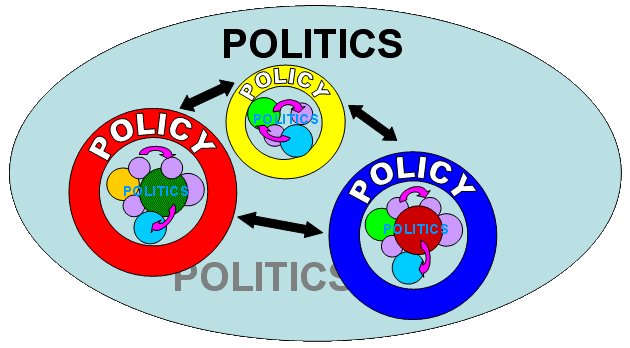
I am also intrigued by Bassford’s diagram. The representation of internal political dynamics is very useful but I am curious how he would weave a visual representation of strategy flowing from policy or (more accurately, policies) and strategy’s relationship with politics, beyond being subsumed. Many a potential strategy is stillborn in the tumult of bureaucratic-military politics, never mind the larger societal kind.

As complex as the text of On War sometimes seems, it really was a brilliant simplification by Clausewitz of the dynamics mediating conflict and war.

Lang, Francona et socii on an Israeli strike

Sunday, September 23rd, 2012

[ by Charles Cameron — a quick recap of Col. Lang & Lt. Col. Francona on the realities of an Israeli strike on Iranian facilities, 2006-2012 — and the recent WaPo trilogy ]
.

Nuclear and missile sites, 2008, credit: Stratfor

.
I posted here a while ago about what happens when “religious leaders talk of wiping nations off the map” — quoting the Iranian Ayatollah Khamenei and the Shas Rabbi Ovaida Yosef — and unobtrusively included the question:

Do the logistics back the rhetoric up?

Or so I thought.

**

Srikanth R of the Takshashila Cyber Strategy Studies team picked up on that supposedly unobtrusive question, though, so maybe it wasn’t so unobtrusive.

The thing is, it’s a solid, material, practical, down to earth realist’s question… and behind it, behind my dropping it into that post, is a memory of Col. Pat Lang, the blogger at Sic Semper Tyrannis, pointing his readers to that question quite a while back, in the form of a post by his one-time DIA deputy, Rick Francona back in 2006. Any “intelligence” in my question is strictly theirs.

I thought then, and I think now, that logistical considerations are as important as potential messianic-mahdist echo-chambers or statements by Israeli intelligence figures or American Chairman of the Joint Chiefs to bear in mind when considering the potential for an Israeli attack on Iran.

This is not an area that I consider myself informed about, so I thought I’d check back and see what Lang and Francona have had to say on the issue over the intervening years…

**

Rick Francona: flight routes, 2006

**

Here are a bunch of other places where Lang, Francona et socii discuss such matters, in what I believe is a sequence by date:

http://francona.blogspot.com/2006/03/iran-israels-air-strike-options.html
http://francona.blogspot.com/2008/06/iran-israels-air-strike-options-update.html
http://turcopolier.typepad.com/sic_semper_tyrannis/2008/06/overflight-clea.html
http://turcopolier.typepad.com/sic_semper_tyrannis/2008/09/ask-the-iraqi-g.html
http://turcopolier.typepad.com/sic_semper_tyrannis/2009/05/sounds-like-a-plan-iranisrael.html
http://turcopolier.typepad.com/sic_semper_tyrannis/2009/05/haaretz-article-on-iranian-realities.html
http://turcopolier.typepad.com/sic_semper_tyrannis/2010/11/israeli-planning-considerations-harper.html
http://turcopolier.typepad.com/sic_semper_tyrannis/2012/02/can_israel_stri.html
http://turcopolier.typepad.com/sic_semper_tyrannis/2012/04/an-israeli-iran-war-what-would-it-look-like-by-richard-sale.html
http://turcopolier.typepad.com/sic_semper_tyrannis/2012/08/yaalon.html

**

From that last URL, here’s the most recent map in the series:

**

And is that all?

Over the last few days the Washington Post has published a three-part “essay” on an Israeli strike on Iranian nuclear facilities. I’ve already quoted from David Ignatius‘ contribution in a comment on ZP, but that was about a different aspect of the thing. Here are links to the three parts:

Azadeh Moaveni, What if Israel bombed Iran? The view from Tehran
Anat Berko, If Israel bombed Iran, what would life in Tel Aviv be like?
David Ignatius, Lessons from an Iranian war game

**

Again, let me emphasize that I don’t know about logistics, but that I suspect Col. Lang does. You might think three points of view was enough to get a decent overview of the situation. You might believe that a war game conducted by a cluster of intelligent specialists would be enough…

Just for the record, Col. Lang obviously still thinks we’re missing the point. This is from his Sic Semper Tyrannis blog, today:

A general defect of the thing is the complete ignorance reflected of the actual limitations of distances, weapons, numbers of aircraft and missiles, Iranian air defenses, the lack of any recovery air fields between Israeli bases and the targets or SAR capability for the attacking Israeli force. Basic military knowledge of the situation is ignored in the manner common in politico-military strategic war games. In these “games” any reference to actual limitations are airily waved off as not germane. In this essay it is suggested that one option is for the US to “shoot down’ the attacking Israeli force before it passes beyond Iraq. The Joe Biden character angrily says that this is not an option. He is correct but not for the reason implied. In fact, since the completion of the US withdrawal from Iraq the US has no ability to do such a thing and neither do the Iraqis. The nearest USAF assets are in the Gulf or Turkey and the nearest US Navy assets are where the carriers may be. Look at the distances.

**

Comments?

Nir Rosen Among the Alawites

Thursday, September 20th, 2012

Controversial journalist Nir Rosen is, by my standards, a left-wing extremist with carcinogenic political views. On the other hand, he is also a fearless and skillful war correspondent who goes places to report where few others dare; as a result, Rosen is usually worth reading, particularly as he seldom is treading a well-worn path:

London Review of Books: Among the Alawites -Nir Rosen reports from Syria 

….When Abu Laith took me to Rabia itself, news of our arrival spread quickly. Thousands of residents staged a seemingly spontaneous but clearly sincere demonstration in support of the regime in the centre of town, next to a statue of Hafez al-Assad holding an olive branch and a sword. The statue, paid for by locals, was erected after the uprising started. Behind it was a massive poster with a picture of Hafez and Bashar. On it was written ‘Rabia is the lion’s den,’ a play on the word assad, which means ‘lion’. I was dragged from house to house so people could speak of their dead and wounded relatives, and of Rabia’s 42 martyrs. I told one group of local men that when I visited opposition strongholds like Baba Amr in Homs I always heard similar stories about fathers or sons being martyred. ‘Our sons were just going to work,’ an army colonel whose nephew was killed in Idlib said in reply. ‘There is a difference between killing a man going to work for the state and killing an armed man taking up weapons against the state. Is it peaceful demonstrators who kill five officers at a checkpoint?’

For the past year Rabia’s Alawites have clashed with neighbouring Sunni villages. Last summer the town’s students couldn’t travel into the city of Hama to take their exams because the opposition had blocked the road. Around thirty Alawite families from one nearby majority Sunni village have settled in Rabia, feeling it was no longer safe to stay where they were. The displaced families were disappointed with the government’s response. ‘We didn’t have any weapons or we would have fought back,’ one man told me. ‘They should have sent in tanks but the opposition blocked the roads. We want the state to solve our problems and the army to return us to our land. The army has to enter the villages, but the army is busy in Hama. Why is the state taking its time?’ Abu Laith’s father, a retired soldier, agreed. ‘Only the army can solve this,’ he said. ‘If we respond ourselves it will be seen as sectarian violence and other villages will join them against us. They will outnumber us.’

From Rabia I headed north-west towards Aziziya, a remote Alawite village which has clashed with the neighbouring Sunni village of Tamana. As in most Alawite villages, the majority of its men work in security or the army. Its Sunni neighbours all support the opposition, and opposition militias have been operating in the area since last spring. Salhab, the nearest town of any size, contains hundreds of displaced Alawite mothers and children who have fled the village. The fight between Aziziya and Tamana showed no sign of abating and in the town I found several families in a near hysterical state. A woman who’d recently reached Salhab shouted at me: ‘We left under fire! Our dignity is precious! Our leader is honourable! They are traitors! Everything for Bashar!’

The Alawites and Syria’s Christian minorities are not going to fare well if Syria falls to the increasingly Salafist-tinged opposition. Their back is against the wall. The Druze and Kurds, with potential ethnic allies in neighboring states, may have greater leverage if the Baathist regime collapses.


Switch to our mobile site