zenpundit.com » creativity

Archive for the ‘creativity’ Category

Bouleversé by forgiveness

Tuesday, January 8th, 2013

[ by Charles Cameron — not just “thinking outside the box” — how about upending the whole thing and seeing what shakes out? ]
.

FWIW, this isn't the world, nor is it upside down -- it's just a rather different map, eh?

.

A celebrated stanza by the Indian poet-saint Kabir — beloved of both Hindus and Muslims — asks:

Is there any guru in the world wise enough
to understand the upside-down Veda?

There’s a style of poetry used by Kabir and others to describe experience of the divine called “ulatbamsi” or the “upside down language” — and Linda Hess, Kabir’s great translator, writes of it as a language “of paradoxes and enigmas” — not too dissimilar, perhaps, to the koans or meditation paradoxes often encountered in zen training.

**

Boom! The French have the word “bouleversé” to cover the way we feel when suddenly our whole world seems turned upside down.

Maybe it’s a modern idea? Bob Dylan, I’m delighted to say, no longer belongs to Robert Zimmerman except for purposes of copyright — his songs have entered the cultural bloodstream. Here’s his version:

The battle outside ragin’
Will soon shake your windows
And rattle your walls
For the times they are a-changin’

The world often seems upside down, our values are often quite the reverse of what they might be if we had the kind of clarity that is implied in Samuel Johnson‘s celebrated quote:

Depend upon it, sir, when a man knows he is to be hanged in a fortnight, it concentrates his mind wonderfully.

And then there are those great ones for whom our world is manifestly unjust, manifestly topsy-turvy — or “through the looking-glass”, if you prefer.

I mean, what else can being “in the world, but not of it” be all about, if it’s not about a major shift in perspective?

**

I’m writing about this at such length because I just read one of those paragraphs that turns my own world upside down. It came in the middle of a long piece on “restorative justice” and it focuses on the power of forgiveness.

This particular paragraph describes how an Indian-American woman, Sujatha Baliga, came to see the unexpected power of forgiveness, and for her it occurred in a Buddhist context — but the power itself is beyond the boundaries of specific religions:

Baliga had been in therapy in New York, but while in India she had what she calls “a total breakdown.” She remembers thinking, Oh, my God, I’ve got to fix myself before I start law school. She decided to take a train to Dharamsala, the Himalayan city that is home to a large Tibetan exile community. There she heard Tibetans recount “horrific stories of losing their loved ones as they were trying to escape the invading Chinese Army,” she told me. “Women getting raped, children made to kill their parents — unbelievably awful stuff. And I would ask them, ‘How are you even standing, let alone smiling?’ And everybody would say, ‘Forgiveness.’ And they’re like, ‘What are you so angry about?’ And I told them, and they’d say, ‘That’s actually pretty crazy.’ ”

**

I like the dark blue “sky” and the “clouds” at the top of the map I began this post with — but then, I’m a mostly vertical human who seldom stands on his head, so it looks “natural” to me. But that’s simply a matter of my point of view.

I imagine maps like that one must please our friends “down under”.

**

A hat-tip to Hadar Aviram, whose California Corrections blog first pointed me to the article about Sujatha Baliga.

Congratulations!!

Tuesday, December 4th, 2012

To Lexington Green and James Bennett, for finishing their new book, America 3.0 – due out (I think) in 2013 published by Encounter Books.

A political vision for an era desperately short on imagination and needing statecraft of inspiration.

Doors within doors: Ibn Arabi, Henry Corbin and Tom Cheetham

Sunday, December 2nd, 2012

[ by Charles Cameron — a response to, and endorsement of, Tom Cheetham ]
.

Interior of the Touba mosque

**

If I only had one book to take with me, I’d pick Henry Corbin‘s Creative Imagination in the Sufism of Ibn Arabi, also available under the title Alone with the Alone. And I’d pick it, because — well, this poem of mine says it best:

No Place Special
.

I am baffled:
                 your muezzin calls me
with a call more resonant than any command
of sensible business, any
instrument, nay, of corporeal music,
to prayer in no place visible,
as if defining by example what
eyes in the back of the head might mean,
might see, ears on the inside
of the skull
mean, what
their music, not being
ears or eyes in the habitual sense at all.

Cliff.
        Not the sheer cliffs of fall
Of Hopkins’ poem, but cliffs sheer without any
word-hold by which to climb
celestialwards — as if
adamant, as if obsidian,
oblique to terrestrial gravity, this cliff
of hearing the call without seeing the mosque
,
without turning
around, inwards, some new way within.

I have ignored the lures, chased breath,
pressed my life into service, and —
as if a pressed life, even in service, were
death on display, a pinned butterfly —
withdrawn from pressing,
taken ease in the swell and ride
of life, loved much, seen
many to my great joy and felt richly
to my grief…
                  and the
muezzin yet calls, the baffle, the cliff
still between me and the attainment of garden,
tree and spring.

Corbin’s book is too high for me, but I feel the call. And Ibn Arabi — beyond my knowing.

**

Ibn Arabi is known as the Shaykh al-Akbar, the greatest shaykh, because his work towers higher and digs deeper into the soul than that of any other Islamic writer, saving only (perhaps) his contemporary the poet mystic Jalaluddin Rumi.

Stepping down from his heights, up from his profundities, we have in Henry Corbin an interpreter of great power — and since I find even Corbin requiring of me a depth of insight I can not yet grasp yet must read again and again across the decades, I am happy to have found his interpreter, Tom Cheetham.

And thus Tom Cheetham is a doorway for me into the doorway that Henry Corbin is to Ibn Arabi, himself a doorway into the profoundest mystery.

**

You can find Tom Cheetham’s four books here — I’d start with The World Turned Inside Out: Henry Corbin and Islamic Mysticism, and read them in the order of publication.

I have written this post to draw the attention of any who may be interested to Tom’s offer of an online seminar in Corbin’s work: The World of Henry Corbin – Online Learning.

I am considering the possibility of offering some kind of online learning program.
I would like to know:

(1) if there is interest,
(2) what topics people would be most interested in,
(3) what format or formats might be most useful, and
(4) whether people might be willing to pay a modest fee.

Any other comments or suggestions are welcome.

Contact me by commenting on this post or emailing me at
tcheetham@gmail.com
subject heading “Corbin Online Learning”

Very highly recommended.

On the HipBone and Sembl games: update

Thursday, November 29th, 2012

[ brief intro by Charles Cameron, then shorter version of Dr. Cath Styles‘ presentation of Sembl at the National Digital Forum in New Zealand, 20 November 2012 ]
.

Charles writes:

I’ve been working for almost twenty years on the development of a playable variant on Hermann Hesse‘s concept of the Glass Bead Game.

It’s an astonishing idea, the GBG — that one could build an architecture of the greatest human ideas across all disciplinary boundaries and media — music, religion, mathematics, the sciences, anthropology, art, psychology, film, theater, literature, history all included — and it has engaged thinkers as subtle as Christopher Alexander, the author of A Pattern Language [See here, p. 74]. Manfred Eigen, Nobel laureate in Chemistry and author of Laws of the Game [see here], and John Holland, the father of genetic algorithms [see here].

Here’s Hesse’s own description of the game as a virtual music of ideas:

All the insights, noble thoughts, and works of art that the human race has produced in its creative eras, all that subsequent periods of scholarly study have reduced to concepts and converted into intellectual values the Glass Bead Game player plays like the organist on an organ. And this organ has attained an almost unimaginable perfection; its manuals and pedals range over the entire intellectual cosmos; its stops are almost beyond number.

My own HipBone Games were an attempt to make a variant of the game that would be simple enough that you could play it on a napkin in a cafe, and has in fact been played online — and more recently, my friend Cath Styles has adapted it for museum play, and introduced the basic concept and our future hopes in a presentation at the National Digital Forum 2012, New Zealand — which you can see very nicely recorded in Mediasite format.

Do take a look — Cath makes a first-rate presentation, and I love the Mediasite tech used to capture it.

Since the slides are shown in a small window concurrently with Cath’s presentation, I’ve edited her presentation for Zenpundit readers, and reproduced many of her slides full-size with some of her commentary below.

**

Sembl, the game of resemblance

Cath speaking:

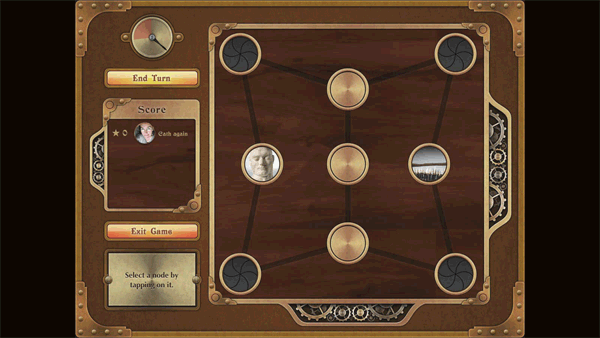
In its first form, Sembl is an iPad game, called The Museum Game, at the National Museum of Australia. We’ve just released it in beta as a program for visiting groups.

Cath then talks about feedback from children and adults about their experience of playing the game. Some kids homed in on the principle of resemblance, others emphasised the social side of the game. She talks, too, about their teacher, and her observations about the ways the game engaged her kids.

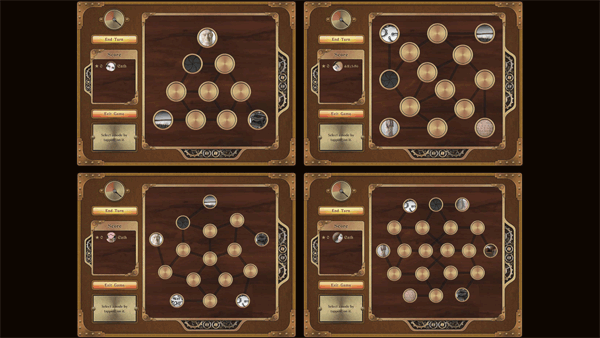
She then shows us various Sembl gameboards for iPad:

Sembl Museum gameboard for four teams of younger players

Four different Sembl Museum gameboards

Cath speaks:

But The Museum Game is just one form of Sembl. The Museum Game is played in real time, on site, and players take photos of physical objects to create nodes on the board.

The next step is to make a web-based form, that you could play at your own pace, and from your own place. Then, Sembl becomes a game-based social learning network, which amplifies the personal value of the game – it becomes social networking with cognitive benefits.

But it’s the bigger picture – of humans as a community – that I most want to explore: Sembl as an engine of networked ideas, or linked data.

Charles notes: I’m skipping the educational part — and the bit about my own role in the game’s development, to get to the core of her presentation as I see it: the cognitive facilitation it provides

Cath again:

Another way of saying this is that the Game provides a structure and impetus for dialogue, between the museum and visitors, between visitors and things, among visitors and between things. And this is not dialogue in the sense of an everyday conversation. It’s deeper than that. It’s a mutual experience of looking both ways, simultaneously.

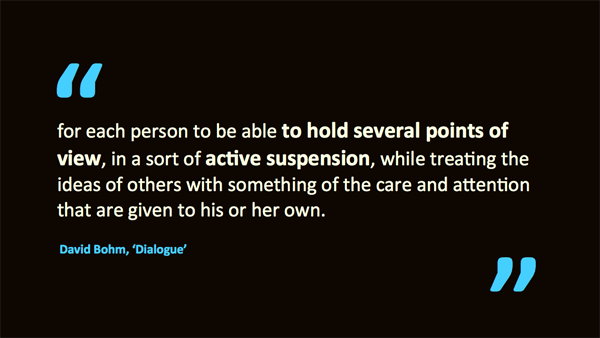
Cath next quotes David Bohm, the eminent quantum physicist:

to hold several points of view in active suspension – quotation of David Bohm

Cath speaks:

For Bohm, dialogue means holding several points of view in active suspension. He regarded this kind of dialogue as critical in order to investigate the crises facing society. He saw it as a way to liberate creativity to find solutions.

Cath then drops in an important topic header:

Toward a game-based social learning network

Cath:

The concept of Sembl, in its deepest sense, is social learning – game-based social learning. In its first instantiation, it is game-based social learning in a museum and – if things turn out as I hope they will – from next year it will be playable at any other exhibiting venue that has the infrastructure and the will to host games – galleries, libraries, botanic gardens, zoos and so on.

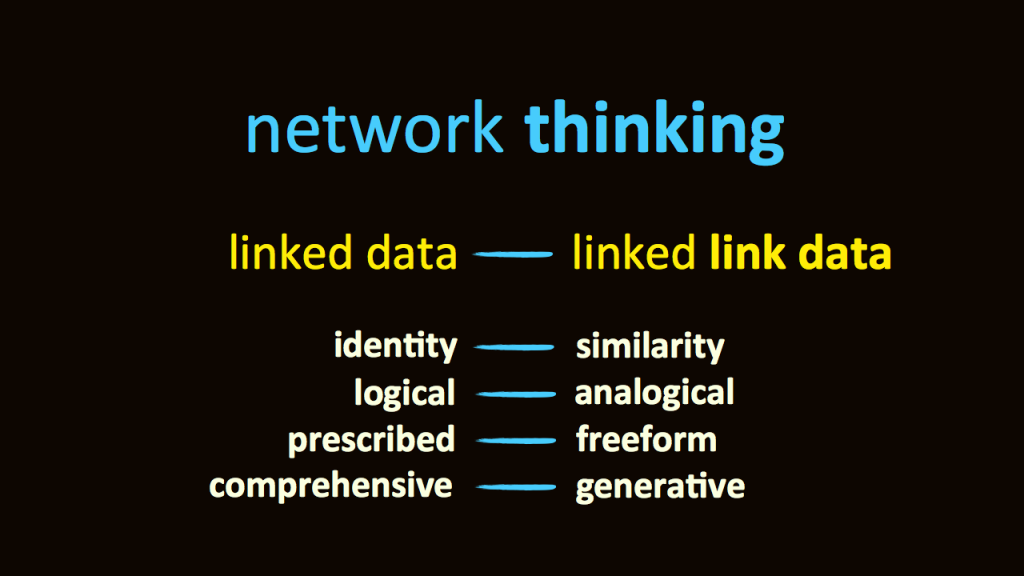
network thinking – how Sembl network links differ from traditional linked data links

A web-based form of Sembl can generate linked data with a difference. It’s linked link data, and quite different to normal linked data.

  • Instead of connections based on what a thing is – sculpture, or wooden, or red – Sembl generates connections based on a mutual resemblance between two things. Which, amazingly enough, is a great way of gaining a sense of what each thing is. And if your interest is to enable joyful journeying through cultural ideas, or serendipitous discovery, this approach just wins…
  • Instead of compiling logical links, Sembl cultivates the analogical.
  • Instead of building and deploying a structured, consistent set of relationships, Sembl revels in personal, imprecise, one-of-a-kind, free association, however crazy.
  • Instead of attempting to create a comprehensive and stable map of language and culture, Sembl links are perpetually generative, celebrating the organic, dynamic quirks of cognitive and natural processes.

But the most important way that Sembl is distinct from other systems of network links is that those who generate the links learn network thinking. Which is a critical faculty in this complex time between times, as many smart people will tell you.

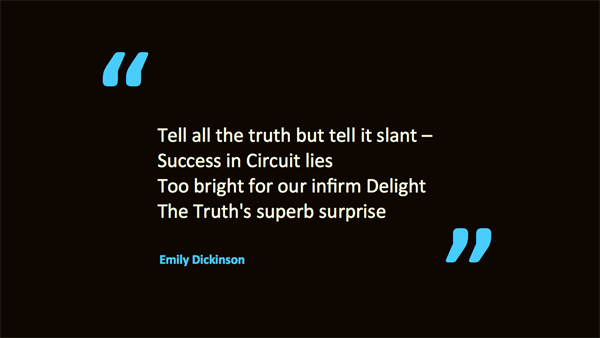
Poets have always known the virtues of analogy as a path to the truth.

Tell all the truth but tell it slant – poem by Emily Dickinson

Sembl promotes dialogic, non-linear thinking, and new forms of coherence.

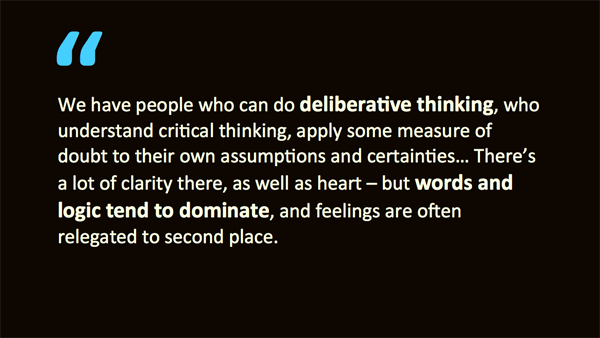
deliberative thinkers – quotation of Charles Cameron

It’s distinct from deliberative thinking, which is rational and causal and logical and linear.

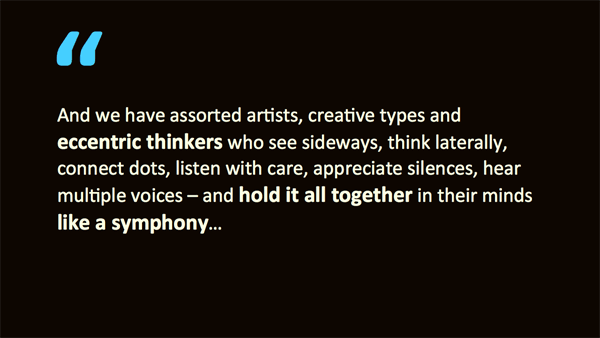
eccentric thinkers – quotation of Charles Cameron

It’s another kind of thinking, which might be informed by rational thought, but its purpose is not singular.

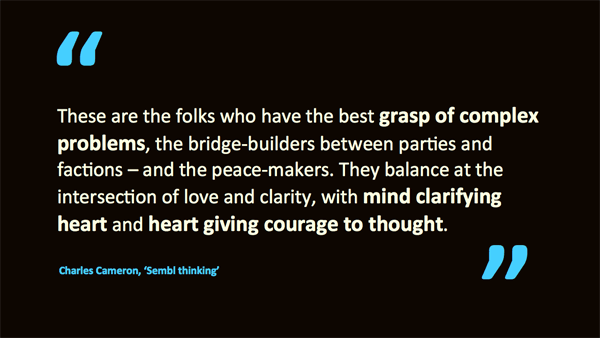
bridge-builders – quotation of Charles Cameron

You might say its purpose is to create – and cohabit – a state of grace, from which ideas simply emerge.

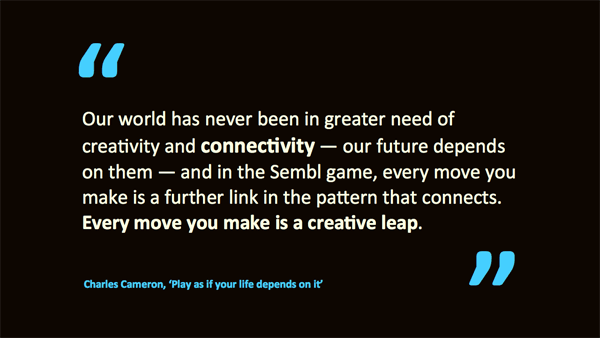
every move you make is a creative leap

If playing Sembl gives us practice in polyphonic thinking, if it helps cultivate connectivity and our capacity to find solutions to local and global problems, it is good value. As Charles says, every move is a creative leap.

Cath concludes:

If you’re interested in working with us to supply content, develop strategy or raise capital, we’re keen to talk.

And I can’t tell you how much I’m anticipating being able to invite everyone to play.

thanks

**

Cath can be reached via Twitter at @cathstyles, and I’m at @hipbonegamer. The Sembl site is at Sembl.net.

Next up: what Sembl has to offer the IC.

The Sounds of Silence and Your Own Mind

Tuesday, November 27th, 2012

Scott Shipman had an excellent book review post An Unknown Future and a Doubtful Present: Writing the Victory Plan of 1941 — a review-lite and a few questions in which he discussed the intellectual seriousness and evolution of war planner   Major Albert C. Wedemeyer as a military officer and strategist:

….Wedemeyer was an honor graduate of the Command and General Staff College, and his performance earned him the opportunity to attended the Kriegsakademie, the German staff college. However, coupled with impressive academic preparations, Kirkpatrick writes that Wedemeyer’s curiosity exposed him to a “kaleidoscope” of ideas and methods. Kirkpatrick summed-up Wedemeyer: “Competence as a planner thus emerged as much from conscientious professional study as from formal military education…” Going on to say:

In common with many of his peers, much of Wedemeyer’s professional and intellectual education was less the product of military schooling than of personal initiative and experience in the interwar Army.

Wedemeyer’s intellectual development was purposeful and paid off. In Wedemeyer’s deep study of his profession he used the prescribed paths, but also explored on his own. How common is that today? 

As often happens, the discussion can take an unexpected turn in the comments section. Lexington Green weighed in with this:

Think about George Marshall in China, traveling around on horseback.  No cell phone, no email.  The man could actually think.  Or Eisenhower meeting with Fox Connor to talk about the books Connor had him read. Telephone calls were not even common.  The military might do well to have two days once a quarter of silent retreats, only emergency communication permitted, with literally no unnecessary conversation, for groups of officers and non-coms, with some assigned reading and some self-selected on the same theme, then an open discussion after dinner. It would cost virtually nothing and would be an intellectual and mental oasis, and some good ideas might come out of it.  Religious silent retreats which last a couple of days and are truly life-restoring. This would probably be useful as well.

That in turn provoked this response from Marshall:

My sense is that many of us live, work, and fraternize in a culture of crisis. Everything is urgent. One response is to just shut off the moment we get some downtime. TV, drinking, schlock fiction, immersion in pop culture, video games, blog reading are some of the ways I’ve coped. I grew out of those as timewasters as I realized that I no longer had time to shut off if I wanted to do something.

But I still live in a culture of crisis. Almost everybody around me “has no time”. It doesn’t really matter what is being proposed, the sense of urgency kills all ambition toward progress. Defending myself and my space form this is a daily challenge – and some days I lose.

I’m visiting family this week on a long-scheduled “vacation” that has been interrupted by my office several times already, but always with the promise, “just this thing, Marshall, we don’t want to take you away from your family”. And these are the people I choose as my allies!

The culture of crisis doesn’t believe in people’s choices. It says that time will only be wasted, so we have to keep our people busy. After all, see how they spend their “free” time? Dissolute wastrels the lot of them. And then the culture of crisis tells us that we need to recharge by shutting off our minds. You need to vege out, man, you’re stressed; turn on the TV and have a beer, mate. Or else fire up your e-mail and write six more. And, hey, sorry about your insomnia, but it lets you get a jump on the day, amirite? [….]

The discussion moved on, but I have been mulling upon this exchange ever since.

The first thing that came to mind is that what we mean by “silence” really isn’t silent, what is really meant is that there is an absence of human voice pulling at our limited capacity for attention. Cognitive load is probably a real, if variable, limit on human cognition and the nature of hyperconnected information society is that all too frequently we are -and feel – “overloaded”.

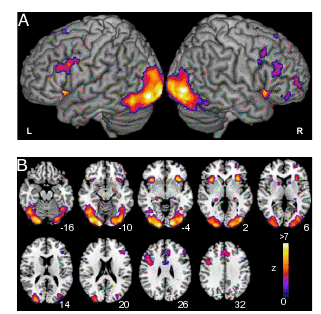
When human voices are absent the “background” environmental noise comes “forward” , natural (wind through trees, animals etc) or mechanical (various humms and clicks) that we unconsciously tune out as a matter of routine focusing on conversation or distracting hearsay, broadcasts and so on. The processing in the brain is significantly different depending on what kinds of sounds you are listening to, for example:

1. Listening to Music

2. Listening to Language

3. Listening to unpleasant sounds (nails on chalkboard etc.)

So eliminating human speech from your environment but not hearing (earplugs) itself allows other regions of your brain to become more active than usual, depending on whatever else you may be doing at the time (walking, chopping wood, smelling a flower, scanning the horizon and so on).  Your brain’s performance and how it varies when thinking under conditions of different combinations and levels of sensory stimuli – “crossmodal processing” – is not yet well understood as research is in early stages of investigation.

I will speculate here that what is important for enriching your thinking is that taking your brain out a linguistic-saturated environment (let’s include the “soundless noise” of intruding textual symbols as well from smartphones, iPads, laptops)  gives it an opportunity to operate differently for a time and establish new neuronal network patterns of activity. Various forms of meditation – which involves both silence and an intentional modulation of attention – also  alters normal  brain activity.

I will now go further out on a data-free analytical limb and hypothesize that making a practice of “silence” and/or meditation might improve your thinking by making moments of creative insight more likely. Studies on insight tend to show that as a cognitive event, insight  comes about as a kind of a “pulse” of activity and relaxation in the brain:

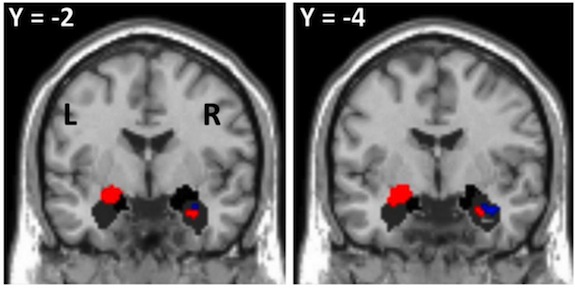
….Mark Jung-Beeman, a cognitive neuroscientist at Northwestern University, has spent the past fifteen years trying to figure out what happens inside the brain when people have an insight. Jung-Beeman became interested in the nature of insight in the early nineteen-nineties, while researching the right hemisphere of the brain. Mentions Jonathan Schooler. Jung-Beeman decided to compare word puzzles—or Compound Remote Associate Problems (C.R.A. Problems)—solved. He teamed up with John Kounios, a psychologist at Drexler University, and they combined fMRI and EEG (electroencephalography) testing to scan people’s brains while they solved the puzzles. The resulting studies, published in 2004 and 2006, found that people who solved puzzles with insight activated a specific subset of cortical areas. Although the answer seemed to appear out of nowhere, the mind was carefully preparing itself for the breakthrough. The suddenness of the insight is preceded by a burst of brain activity. A small fold of tissue on the surface of the right hemisphere, the anterior superior temporal gyrus (aSTG), becomes unusually active in the second before the insight. Once the brain is sufficiently focused on the problem, the cortex needs to relax, to seek out the more remote association in the right hemisphere that will provide the insight. As Kounios sees it, the insight process is an act of cognitive deliberation transformed by accidental, serendipitous connections. Mentions Joy Bhattacharya and Henri Poincaré. The brain area responsible for recognizing insight is the prefrontal cortex. Earl Miller, a neuroscientist at M.I.T., spent years studying the prefrontal cortex. He was eventually able to show that it wasn’t simply an aggregator of information, but rather it was more like a conductor, waving its baton and directing the players. In 2001, Miller and Princeton neuroscientist Jonathan Cohen published an influential paper laying out their theory of how the prefrontal cortex controls the rest of the brain. It remains unclear how simple cells recognize what the conscious mind cannot. An insight is just a fleeting glimpse of the brain’s huge store of unknown knowledge.

Another interesting data point to consider re: “silence” and insight is that the mental illness of schizophrenia, where delusions and other mental “noise” exists is significantly negatively correlated with insight.  Researchers are currently investigating if meditation can ease the symptoms of schizophrenia and other mental illnesses.

For myself, I find my best ideas come via insight when I am doing something primarily physical requiring steady but not all of my concentration and I am alone – working out, walking the dog, a household chore and so on. Relatively useful ideas can happen when I am reading or writing or debating (i.e. interacting with a text or a person), but they tend to be analytic and derivative, sort of an intellectual “tweaking” or “tinkering” but not ones that are fundamentally creative or synthesizing.

Lexington Green may be right – Silence is golden.


Switch to our mobile site