zenpundit.com » creativity

Archive for the ‘creativity’ Category

Sunday surprise 11: thinking outside the Amazon box

Sunday, December 8th, 2013

[ by Charles Cameron — since there’s no divine surveillance on this one day of the week, I can safely post something utterly trivial here without fear of The Wrath ]
.

If you’ve ever felt that Amazon mailing boxes were emblematic of the labor of Sysiphus, here’s your proof:

But wait — surely things can’t always be that bad? Next time you receive a box or three from Amazon, consider building a model Japanese temple:

From Brian Ashcraft at Kotaku:

What do you do with your Amazon cardboard boxes? Throw them away? An individual in Japan turned them into a one of Japan’s most famous temples, the Byodoin. The temple is a national treasure in Japan and is featured on the back of ten yen coins. NicoNico Douga user Upuaza Touryou took around five months to complete the sculpture, which is made up of over five thousand cardboard parts. Total cost? 300 yen or about US$3.

Heavy Metal: When Irregulars Go Armored

Saturday, November 2nd, 2013

[by Mark Safranski, a.k.a. “zen“]

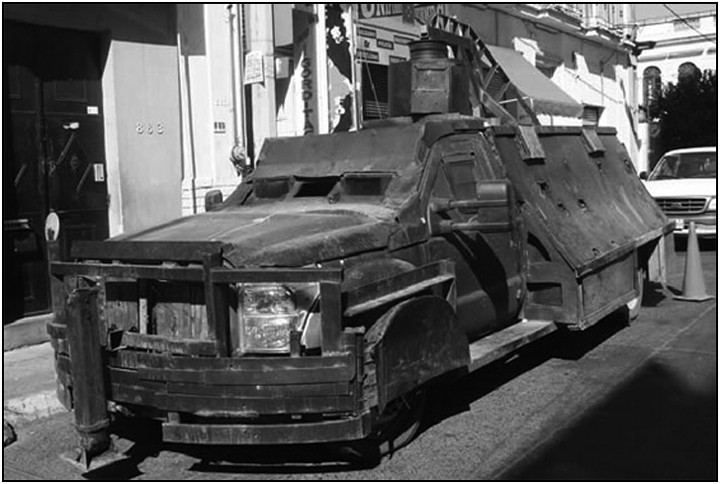
If the symbol of the 20th century insurgent was the AK-47 and a red banner, his 21st century counterpart may someday be recognized by the suicide belt and the “homemade tank”. Irregular fighters have always used light arms, civilian passenger vehicles and armor captured (or donated by) from conventional armies, but the ability to produce serviceable fighting armored cars is a new wrinkle. They could not stand up to an American or Russian tank company, of course, but they are not meant to do so.

Most prevalent and evolved in Mexico’s narco-insurgency where cartels use these “monsters” converted from SUVs and various types of light and heavy trucks to battle one another and as “troop carriers” but these DIY armored vehicles have also appeared in the recent Libyan and ongoing Syrian civil wars. Where heavy anti-tank weapons, air power and real tanks are scarce, these narco-tanks are useful additions to irregular combat power and convey an intimidating image to lightly armed police and the public.

Dr. Robert Bunker and Byron Ramirez, with the support of Small Wars Journal, Borderland Beat.com and the Foreign Military Studies Office at Fort Leavenworth, have a new scholarly compilation on the subject of irregular use of DIY armor in Mexico:

Narco Armor : Improvised Armored Fighting Vehicles in Mexico

….The wave of violence that has left thousands dead began in early 2005, when former Mexican
president Vicente Fox sent government troops to Tamaulipas to fight the cartels. For the past
seven years the government has ordered its military to fight the cartels directly, which, in turn,
has led drug cartels to improvise and develop their own methods of warfare to combat both
government troops and other competing cartels.

The extreme rivalry among various Mexican drug cartels for regional control of the drug trade
market has yielded an arms race. The following collection of articles and images addresses a
segment of the military technology utilized by violent non-state actors during this period: “narco armor” or, more accurately, improvised armored fighting vehicles (IAFV).

….Mexican cartel use of IAFVs and armored sport utility vehicles (ASUV) may yield some
important lessons for military counter-criminal insurgency efforts. Still, many unanswered
questions exist concerning the fielding of narco armor in Mexico. Reports of these vehicles
being fielded span roughly from mid-2010 to the beginning of 2012, with a spike in activity 5
surrounding them taking place around mid-2011. These vehicles had predominantly been utilized

in the Mexican state of Tamaulipas in engagements between the Zetas and Gulf cartels and in a
few other locales (see Map Locations). While it has been said that the Mexican government has
seized well over one hundred of these vehicles, only about two dozen photographic examples
exist per our research (see Picture Gallery).

….Given the apparent cessation of the fielding of narco armor since early 2012, quite possibly these vehicles have reached an evolutionary dead end, with more emphasis once again placed by the cartels on fielding more stealth-masked armored vehicles, such as armored SUVs, that better blend in with civilian cars and trucks so as to eluded identification and targeting by Mexican federal forces. Still, given the ever changing conflict waging in Mexico among the cartels and against the Mexican government, future resumption of IAFV employment will always remain a potential. 

Read the rest here.

During the Russian civil war (1917-1922), armored trains complete with heavy machine guns and artillery were used by both Bolshevik and White armies across the vast expanse of the Eurasian steppe and the armored train subsequently made spotty appearances in civil wars in China and Spain before fading away. This less likely to happen with homemade armor which is smaller and infinitely more mobile and can be created in a sufficiently large garage with time, elbow grease and a supply of scrap metal.

Teju Cole on Nairobi: death and birdsong, death and poetry

Thursday, September 26th, 2013

[ by Charles Cameron — on the topic of Nairobi there’s the news — and then there’s Teju Cole ]
.

Teju Cole, left, Kofi Awoonor, right -- photo credits Teju Cole & Peace FM Online respectively

**

We’re interested in creativity as well as natsec issues here at Zenpundit, so i thought it might be appropriate to see what a fine writer had to say about the hideous attack and siege of the Westgate mall in Nairobi — and perhaps more importantly, how he chooses to say it.

Teju Cole is a writer (“award winning” and rightly so) whose insightful and skilfully deployed tweets caught my attention some while back, and have only increased my admiration for him over time. I followed his twitterstream along with others while the events in Nairobi were playing out, and today read his New Yorker blog post covering much the same ground in greater detail.

What is striking to me about Cole’s approach — the approach of a fine writer, in Nairobi at the time, a friend and admirer of the Ghanaian poet Kofi Awoonor who died at the mall — is the care he takes to balance death with birdsong, death with poetry. In treating matters this way — and we can be sure he is every bit as deliberate in his use of 140 characters as he is in longer-form writings — he both gives a world of context to the small world of the mall event itself, and offers us hope to balance our despair and disgust.

Cole is reading from his novel Open City at the National Museum at the time the attack on the mall begins:

During the reading, as word of the attack filtered in, people answered their phones and checked their messages, but, onstage and oblivious, I continued taking questions from the audience

**

Here, then, I have pulled together most of the tweets Cole posted in recent days for your consideration, in the order in which he posted them… Together, they offer us a very different way to encounter tragic events from those presented by journalists or analysts.

.
Nature has entered the picture: next up will be death — the death of his poet colleague and friend, described first obliquely in the poet’s own words:

.
Then comes the first of two tweets in which Cole judiciously balances the tragically human and blithely natural worlds, including in his tweet a short soundscape in which those voices are woven together in counterpoint:

.

This one is grim — suitable, or a bit overstated, with its echo of the Holocaust? — a question best left to individual taste, perhaps:

.
And then his second polyphonic melding of sounds natural and human-made, joyous and terrifying:

.
He returns to his friend’s death…

.
And then again to birdsong, to the natural world, to the world in which the events of the past days are framed…

**

There is something powerfully moving about Cole’s tweeted reflections, and I believe they take their impact from the precision with which Cole himself frames and balances the horror with beauty.

Just today, my friend Jessie Daniels posted a tweet that caught my eye:

Teju Cole has gone from a tweet to a blog post on the New Yorker site in a matter of days. Here’s just a brief taster:

The massacre did not end neatly. It became a siege. In my hotel room, about half a mile from the mall, I was woken in the mornings that followed by the sounds of gunfire, heavy artillery, attack helicopters, and military planes. In counterpoint to these frightening sounds were others: incessant birdsong outside my window, the laughter of children from the daycare next door. I read Awoonor’s poems, and watched a column of black smoke rise from the mall in the distance. The poems’ uncanny prophetic force became inescapable. A section of “Hymn to My Dumb Earth” reads:

What has not happened before?
An animal has caught me,
it has me in its claws
Someone, someone, save
Save me, someone,
for I die.

.
But you should really read the whole thing: Letter from Nairobi: “I will say it before death comes”.
Book Review: The Authentic Swing by Steven Pressfield

Wednesday, September 25th, 2013

[by Mark Safranski a.k.a “zen”]


The Authentic Swing by Steven Pressfield 

Callie was kind enough to send me a review copy of Steven Pressfield’s new non-fiction book, The Authentic Swing. Much like the title implies, it is a book with an arc.

The Authentic Swing continues a theme Pressfield began with his excellent The War of Art, continued with Do the Work and Turning Pro of helping struggling writers, artists and others conquer their resistance and acquire the mature habits of mind to become creative, productive professionals. While the previous books were advice, The Authentic Swing is a demonstration. Pressfield breaks down for the reader the gestation and evolution of his first successful novel, The Legend of Bagger Vance and applies a granular eye to the creative process but does so without tipping his hand or writing a “cookbook”. Steve is employing all his gifts as a storyteller to lead and nudge the reader into understanding.

There are many parts in the book that I like, but the following is in my view the most important, despite being less colorful and more straightforward than others:

When Robert McKee was a young writer/director in New York, he got the chance to interview Paddy Chayefsky, the only person to have one two Academy Awards for original Screenplay (Marty and Network) Chayefsky shared this priceless nugget:

As soon as I figure out the theme of my play, I type it out in one line and scotch tape it to the front of my typewriter After that, nothing goes into the play that isn’t on-theme.

If  there is a single more powerful piece of wisdom for any writer, artist or entrepreneur, I don’t know what it is.

Theme.

Theme is everything.

Once we know the theme we know the climax, we know the protagonist, we know the antagonist, we know the supporting characters, we know the opening, we know the throughline.

I said before that I have a file in my computer titled NEW IDEAS. I have another THEME.  for each new project, I open a new file and title it THEME. I go back to this file over and over. I pile paragraph on paragraph, trying to answer the question, “What the hell is this book about?”

It’s hard.

Theme not only drives art, it drives a coherent life. It makes the disparate connected and gives actions unity. We see theme in great innovative companies, in the curriculum of our best university programs, at the core of great religions, in revolutionary political movements and a nation’s grand strategy. Charles Hill, drew on themes of classical literature to teach that very point about foreign policy. This advice is worth the price of the book alone.

The theme here is authenticity and allowing yourself to express it. Pressfield demonstrates this frequently by parable and metaphor, moving the reader toward the process of discovering authenticity without making the fact that it is a process confuse the reader with the expectation that it will be linear or easy, only natural. I don’t want to give away too much because it is fun to see how the vignettes unfold on build upon one another, obviously golf and the cultural context the sport provided for Bagger Vance is a large part of the book but that will not be a surprise. I will say that The Authentic Swing is a very elegant method of teaching.

Steve’s best non-fiction book since The War of Art.

Creativity and Ennui

Friday, August 16th, 2013

[Mark Safranski a.k.a. “zen“]

Creativity is a subject that has  interested me, going back to the days long, long ago when I was an art student. Creativity is only mildly correlated with IQ, but like “intelligence”, the deeper you delve into the study of  creativity and creative thinking the more “creativity” looks like a multifaceted, multidimensional and diverse set of capacities, habits and circumstances than it does a single, universal, characteristic or ability.

Creativity has been studied from a neuroscientific, psychological, evolutionary,  behavioral, economic and social perspective but what of creativity”s opposite?  What about Ennui?

From a cognitive perspective, the two may be flip sides of the same coin, note the correlation between highly   creative  people and incidence of depression. It may also be a sign of overuse of certain brain functions, like adrenal exhaustion from an excess of physical and mental stress over a long period of time. Creativity, being in “the flow” is intoxicating but it usually involves peak exertion which accumulates weariness. Exemplary performance in one area can also come at the expense of penalties in another area.

Or perhaps ennui is the natural, cyclical ebb and flow between generative conceptual fertility and barrenness, the brain preparing itself for the next creative “surge” to come?

When are you creative and when are you not?


Switch to our mobile site

