I am pleased to announce that I have accepted an offer from CEO Joel Zamel to join Wikistratas an analyst.
What this means, in essence, is that I will become a contributor of exclusive content to the Wikistrat site and will be collaborating on specific analyical products. In return, I will be able to feature some of their interesting pieces here, such items from future issues of their CoreGap Bulletin 11.04 [PDF]or video presentations by Dr. Thomas P.M. Barnettor other Wikistrat experts. Here is their current public sample:
Wikistrat will also become a sponsor of zenpundit.com (actually, the only sponsor,as I do not normally accept advertising). If you have been visiting Chicago Boyz lately for the ongoing Roundtable, you may have noticed a Wikistrat banner ad there; there will be one here at ZP soon as well.
If you have enjoyed reading ZP over the years, I encourage you to subscribe to Wikistrat – not just to see what I’m writing, or Tom, but to get in early into an interactive, analytical community that is going to grow rapidly in terms of talent and influence.
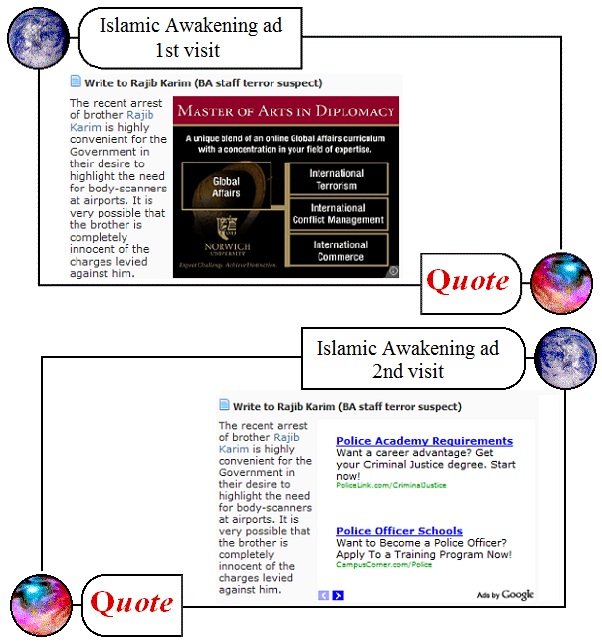
Let me get this straight. The pro-jihadist website Islamic Awakening is now receiving funds from a university that wants to train future diplomats and some schools for aspiring police officers?
If so, do these educational establishments imagine they’re recruiting from the pool of wannabe jihadists who supposedly frequent the site — or from folks already in the FBI and counter-terrorism business, who may by now be the site’s only remaining readers?
Either way, I’d say it’s a pretty subtle approach — and almost as much fun to stumble across as the Bold Christian clothing ad that I found on a previous visit to Islamic Awakening… do you remember that?
The fiction glorifies Sparta while the non-fiction is more critical than laudatory. I was struck by how much the fictional Sparta, in three stories I really love, did not match the history I’d been studying.
Did Pressfield make his story more palatable to his readership by soft-pedaling Helot slavery, radical conservatism and aristocracy, oligarchy and homosexuality and pederasty?
We moderns are very critical of the real, historical Sparta. Insofar as it stands in for Greece in the fiction above, it’s an inaccurate portrayal. To say nothing of all the problems with our view of the Golden Age of Athens…
Ah, the tension between history and myth.
Admiration for ancient Sparta was imprinted into Western culture because Sparta’s Athenian apologists, including Xenophon but above all Plato, left behind a deep intellectual legacy that includes a romantic idealization of Sparta that contrasts sharply with the criticisms leveled by Thucydides against Athens in The Peloponnesian War. The Melian Dialogueremains a searing indictment against Athens 2,500 years later but no equivalent vignette tells the tale of the Helots living under the reign of terror of the Spartan Krypteia. Plato’s Republic upholds oligarchic authoritarianism inspired by Sparta as utopia while Athenian democracy is remembered partly for the political murder of Socrates and the folly of the expedition to Syracuse. Somehow, ancient Athens lost the historical P.R. war to a rival whose xenophobic, cruel, anti-intellectual and at times, genuinely creepy polis struck other Greeks as alien and disturbing, no matter how much Sparta’s superb prowess at arms might be applauded.
I recently watched The Weather Underground, a 2002 documentary on the eponymous radical organisation active within the United States during the 1970s. The film may be of interest to those studying radicalisation, insurgency and political violence, as it effectively explores the rise, evolution and demise of a revolutionary organisation. It also raises some semantic/ethical questions about ‘who is a terrorist’.
….The use of violence for political messaging may be viewed as ‘terrorism’, and this is typically how the Weather Underground is understood. But is this accurate? Terrorist groups deliberately target civilians to scare or terrorise wider populations into a certain political behaviour. The WUO refrained from such action: they used violence against buildings rather than people, to symbolise their discontent with specific policies and actions, but without killing those held responsible. It was ‘propaganda of the deed’, but without the bloodshed. Accordingly, none of WUO’s attacks resulted in casualties (the one exception has not been definitively linked to the group), and for this reason alone, it is difficult to call WUO a ‘terrorist’ organisation.
Uh, no it isn’t. As the commenters at KoW are busy trying to inform Ucko, this narrative does not fit the facts of the history of the Weathermen.
David, I suspect, is not trying to romanticize the Weathermen here so much as force-fit them into his theoretical model of terrorism, possibly influenced by a tactical turn that was undertaken by the IRA to drive up financial costs for the British government while minimizing the bad press that and damage to their public image that had been growing from earlier, bloody, IRA bombings.
Just received a review copy courtesy of Dr. Bunker and James Driscoll of Taylor & Francis – could not have arrived at a better time given several research projects in which I am engaged.
The 237 page, heavily footnoted, book is organized into three sections: Organization and Technology Use by the narcos networks, Silver or Lead on their carrot and stick infiltration/intimidation of civil society and the state apparatus, and Response Strategies for the opponents of the cartels. Bunker’s co-authors Matt Begert, Pamela Bunker, Lisa Campbell, Paul Kan, Alberto Melis, Luz Nagle, John Sullivan, Graham Turbiville, Jr., Phil Wiliams and Sarah Womer bring an array of critical perspectives to the table from academia, law enforcement, intelligence, defense and security fields as researchers and practitioners.
Looks good – will get a full review here at a later date, but a work that will definitely of interest to those readers focusing on national security, COIN, 4GW, irregular or Hybrid war, terrorism, transnational organized crime and black globalization.
Zenpundit is a blog dedicated to exploring the intersections of foreign policy, history, military theory, national security,strategic thinking, futurism, cognition and a number of other esoteric pursuits.


 by Dr. Robert J. Bunker (Ed.)

