zenpundit.com » Communism

Archive for the ‘Communism’ Category

The East Rising

Sunday, July 3rd, 2011

Gifts from a generous Meatball:


Hardcovers too. Nice.

The Party: The Secret World of China’s Communist Rulers by Richard McGregor

Monsoon: The Indian Ocean and the Future of American Power by Robert D. Kaplan

I have already dived a few chapters into the McGregor book and it is very good. What makes it good is that is running counter to the message of the herd in terms of popular Sinology, which is to emphasize that China is a) uniquely Chinese with deeply introspective Confucian civilizational traditions (that’s modern PC-speak for “inscrutable”) and b) the brave new world of liberal, globalized, capitalism with a benign technocratic face.

Now there’s important truths in both of the popular mass messages on China, incompatible as they can be with one another. The economic rise of China in a globalized economy is the most important story of the last quarter of the 20th century and the first quarter of the 21st ( collapse of the USSR is second; the Soviets were beaten before they imploded and imploded largely because they knew they were beaten). China is also not like America, not even when they imported stock options, blue jeans, McDonald’s and the American jobs that used to create all those things. China’s civilization is truly of a dizzying depth, complexity and scale that is best compared to Europe rather than a specific country. That in itself, is important because it points to how ignorant the average American policy maker is, never mind the average American, about what makes their Chinese counterpart tick.

[ Sidebar: Perhaps the Obama administration assembling a new senior “China/East Asia” diplomatic and national security team that does not include a single official with any professional knowledge of China was unwise? How is that better than the Bush II administration shunning Arabists during the run up to and occupation of Iraq? It is not that these diplomats and officers are poor, they are smart and experienced, but none of them are China specialists. Or Japan specialists, for that matter and only one has expertise in Korean affairs. These are the region’s great powers! This is like turning EU/NATO policy over to diplomats who speak Hindi and Swahili ]

What McGregor is doing in The Party that is important is reminding Westerners that the Soviet experience, particularly the Leninist Party model, is still deeply embedded in China’s political DNA. Not in an ideologically Marxist, Khrushchevian, shoe-pounding sense but in a functional sense. In a structural sense. In an instrumental governance sense. In a networking theory sense. And all these characteristics, which are largely innately hostile or indifferent to the values of liberal democracy, continue to shape Chinese policy, leadership succession, national security, defense strategy and geopolitical outlook to this day.

That doesn’t mean China is itching for a war with the United States, but it means they are playing a longitudinal strategic game where the first goal is to stay in power forever and the next is to advance one’s position relative to others.

We are the other.

China is not an enemy but she is no friend or ally of the United States either, yet it is the most important relationship the US has to manage for the next thirty years – and that relationship in a strategic context with rising India, Japan, South Korea and Australia.

It might help if America brought a team to the table that included people who could tell Han Fei Tzu from Mencius or spoke Chinese.
Rapturous times, neh?

Saturday, May 21st, 2011

[ By Charles Cameron — apocalyptic movements, best readings, budget shortfalls, lack of support for scholarship in crucial natsec areas — and with a h/t to Dan from Madison at ChicagoBoyz for the video that triggered this post ]
.
.
What with rapture parties breaking out all over, billboards in Dubai proclaiming The End and thousands of Hmong tribespeople in Vietnam among the believers, this whole sorry business of Harold Camping‘s latest end times prediction is catching plenty of attention. I thought it might be helpful to recommend some of the more interesting and knowledgeable commentary on Camping’s failed prophecy.

*

First, three friends and colleagues of mine from the Center for Millennial Studies at Boston University, about which I will have a further paragraph later:

Richard Landes of BU has a text interview here, and a TV interview here. His forthcoming book, Heaven on Earth, is a monumental [554 pp.] treatment of millenarian movements ranging “from ancient Egypt to modern-day UFO cults and global Jihad” with a focus on “ten widely different case studies, none of which come from Judaism or Christianity” — and “shows that many events typically regarded as secular–including the French Revolution, Marxism, Bolshevism, Nazism-not only contain key millennialist elements, but follow the apocalyptic curve of enthusiastic launch, disappointment and (often catastrophic) re-entry into ‘normal time'”.

Stephen O’Leary of USC wrote up the Harold Camping prediction a couple of days ago on the WSJ “Speakeasy” blog. He’s the rhetorician and communications scholar who co-wrote the first article on religion on the internet, and his specialty as it applies to apocalyptic thinking is doubly relevant: the timing of the end — and the timing of the announcement of the end. His book, Arguing the Apocalypse, is the classic treatment.

Damian Thompson of the Daily Telegraph is a wicked and witty blogger on all things Catholic and much else beside — the normally staid Church Times (UK) once called him a “blood-crazed ferret” and he wears the quote with pride on his blog, where you can also find his comments on Camping. Damian’s book, Waiting for Antichrist, is a masterful treatment of one “expecting” church in London, and has a lot to tell us about the distance between the orthodoxies of its clergy and the various levels of enthusiasm and eclectic beliefs of their congregants.

Three experts, three highly recommended books.

*

Two quick notes for those whose motto is “follow the money” (I prefer “cherchez la femme” myself, but chacun a son gout):

The LA Times has a piece that examines the “worldwide $100-million campaign of caravans and billboards, financed by the sale and swap of TV and radio stations” behind Camping’s more recent prediction (the 1994 version was less widely known).

Well worth reading.

And for those who suspect the man of living “high on the hog” — this quote from the same piece might cause you to rethink the possibility that the man’s sincere (one can be misguided with one’s integrity intact, I’d suggest):

Though his organization has large financial holdings, he drives a 1993 Camry and lives in a modest house.

*

Now back to the Center for Millennial Studies.

While it existed, it was quite simply the world center of apocalyptic, messianic and millenarian studies. CMS conferences brought together a wide range of scholars of different eras and areas, who could together begin to fathom the commonalities and differences — anthropological, theological, psychological, political, local, global, historical, and contemporary — of movements such as the Essenes, the Falun Gong, the Quakers, Nazism, the Muenster Anabaptists, al-Qaida, the Taiping Rebellion, Branch Davidians, the Y2K scare, classic Marxism, Aum Shinrikyo and Heaven’s Gate.

And then the year 2000 came and went, and those who hadn’t followed the work of the CMS and its associates thought it’s all over, no more millennial expectation, we’ve entered the new millennium with barely a hiccup.

Well, guess what. It was at the CMS that David Cook presented early insights from his definitive work on contemporary millennial movements in Islam — and now we have millennial stirrings both on the Shia side (President Ahmadinejad et al) and among the Sunni (AQ theorist Abu Mus’ab Al-Suri devotes the last hundred pages of his treatise on jihad to “signs of the end times”)…

Apocalyptic expectation continues. But Richard Landes’ and Stephen O’Leary’s fine project, the CMS, is no longer with us to bring scholars together to discuss what remains one of the key topics of our times. When Richard’s book comes out, buy it and read it — and see if you don’t see what I mean.

Or read Jean-Pierre Filiu‘s Apocalypse in Islam.  Please. Or Tim Furnish‘s recent paper.

*

And while it may not see Judgment Day or the beginning of the end of the world as predicted, what this week has seen is the end of funding of Fulbright scholarships for doctoral dissertation research abroad.  But then as Abu Muqawama points out:

hey, it’s probably safe to cut funding for these languages. It’s hard to see Iran, Afghanistan, Pakistan or anywhere in the Arabic-speaking world causing issues in terms of U.S. national security interests anytime soon.

Right?

So the CMS isn’t the only significant scholarly venue we’ve lost to terminal lack of vision.

Ronald Reagan Roundtable: “full of jovial doom” by Charles Cameron

Friday, February 11th, 2011

[ by Charles Cameron ]

Yesterday I made my post on the ChicagoBoyz roundtable about President Reagan’s enthusiasm for prophecies of the end times:

Knowing of my interest in matters apocalyptic, you wouldn’t expect me to pass up President Reagan‘s connection with Ezekiel and the Revelation of John of Patmos on an occasion such as this, would you?
.
Seriously:
.
I’m not entirely comfortable with the idea of people who believe in prophecy having their fingers on the triggers of nuclear weapons. Ronald Reagan was one such, and didn’t press the trigger — a fact for which I am profoundly grateful. Perhaps it was his “jovial” approach to “doom” that made the difference.
.
The story is actually quite fascinating…

and (quoting the Nuclear Age Peace Foundation, a group which advocates for nuclear disarmament):

According to his wife, Nancy, “Ronnie had many hopes for the future, and none were more important to America and to mankind than the effort to create a world free of nuclear weapons.”
.
President Reagan was a nuclear abolitionist…

Since that time, Lex has strongly critiqued my post, I’ve responded, and y’all are cordially invited to chime in…
.
*
.
But I didn’t want to clog that more serious business with what one might term “apocalyptic trivia” – even though such things can be interesting in their own right as samples of humor, conspiracy etc – so I’ll follow that up today with one of my DoubleQuotes here on ZP.

Another one for Zen and the Boydz

Sunday, February 6th, 2011

[ by Charles Cameron ]

Okay, the Reagan Roundtable is happening, and I hope to contribute to it later.  In the meantime, I don’t want to disrupt the flow at ChicagoBoyz, so I’ll continue posting my non-Reagan material here — since here at ZP we’re excerpting and hollering and supporting but not actually hosting the Roundtable, and since Egypt, after all, is not waiting for the Roundtable to be over before continuing on its path of discovery…

Having said which:

*

I’m not the only one who’s eye is caught by DoubleQuotes, I see.

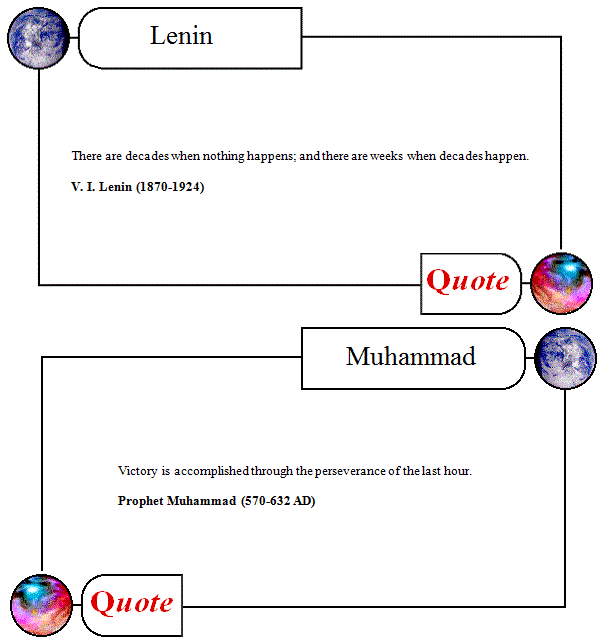
I ran across this one at the top of a piece by Esam al-Amin on CounterPunch entitled Mubarak’s Last Gasps, where al-Amin had made it his double epigraph — and even though I’m almost totally ignorant of the writings of Vladimir Ilyich and hope to keep things that way, I do think Quote #1 is quite a fine aphorism.

And having recently posted One for Zen and the Boydz here (remember that?), I really couldn’t resist this follow-up!

Very apt for the last few weeks.

Mind you, I think there’s an apocalyptic hint to Quote #2, which bears an interesting resemblance to Matthew 24:13:

But he that shall endure unto the end, the same shall be saved.

North Korea, Juche and “sacred war”

Monday, December 27th, 2010

[ by Charles Cameron ]

Okay, I am now clear that the correct translation of the Korean phrase that has sometimes been rendered “holy war” in recent news reports is in fact “sacred war”.

I’d been wondering just what an atheist state was doing threatening “holy” or “sacred” war…

*

Juche is the state philosophy of North Korea, and is considered to be the 10th largest religion in the world by the Adherents.com portal, ranking above Judaism, Baha’i, Jainism and Shinto. It developed out of Marxist-Leninism and has more recently incorporated Confucian elements.

Sunny Lee, writing in a 2007 article in Asia Times titled God forbid, religion in North Korea?, quotes Han Sung-joo, a former South Korean foreign minister, as saying “There is a deification and a religious emotional element [in juche] in the North. The twinned photos of Kim Il-sung and Kim Jong-il are everywhere. Every speech says Kim Il-sung is still alive. I think if I stayed another two weeks, I might even see Kim Il-sung. The country worships someone who is deceased, as if he were alive.”

One Christian site goes so far as to call Juche a “counterfeit Christianity:

Recognizing the power of Christianity, Kim wanted it to be directed at himself. So he took Christianity, removed God the Father, Jesus Christ and the Holy Spirit, set up himself, his wife and son as the new trinity, and called it Juche. At its core, Juche is a counterfeit Christianity that is deathly afraid of true version, and rightfully so.

I suppose a close comparison here would be with the cult which Robert Jay Lifton described in Revolutionary immortality: Mao Tse-tung and the Chinese cultural revolution.

*

In On Junche in Our Revolution, vol II (published in English, 1977), Kim Il Sung writes:

No military threat of the US imperialists, however, can frighten the Korean people. If, in the end, the US Imperialists and their stooges unleash a new war against the DPRK, in defiance of our people’s patient efforts to prevent a war and maintain peace and the unanimous condemnation of the peace-loving people of the world, the Korean people will rise as one in a sacred war to safeguard their beloved country and the revolutionary gains. They will completely annihilate the aggressors.

So the “sacred war” phrasing has been around for a while.

I hope to learn more — these in the meantime are some clues to be going on with…


Switch to our mobile site

