zenpundit.com » cognition

Archive for the ‘cognition’ Category

An Iridology of the Sciences?

Tuesday, January 4th, 2011

[ by Charles Cameron ]

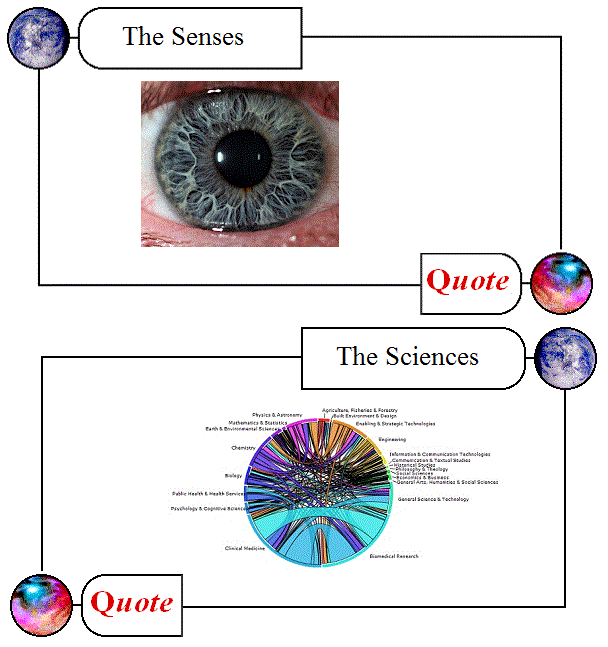
I for one am delighted to know that we can now play around with the iridology of the sciences, using the software available on the Science-Metrix Ontology Explorer site to view which fields have journals which cross-link to journals in other fields…

Seriously — that lower image is of the Field Citation Wheel that you can find, suitably enlarged for easy viewing, on that site.

*

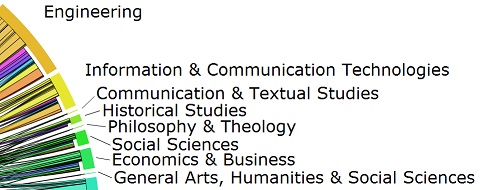
And it’s heartening for me to know, for instance — taking a closer look at the segment of that image that’s roughly east north-east — that scientific journals do have some links on their pages to works of theology or philosophy:


Engineering
, you’ll notice, has more links than history, philosophy, theology, the social sciences (even counting them twice), economics, business, the arts and humanities combined.

My own field, theology, has to share its thin segment with philosophy, and you can guess how small the number of links to articles on Islamic apocalyptic probably are…

Which is, in part, why I wonder whether a project like the ETH’s Living Earth Simulator will really manage to map such things as, well, a possible outbreak of global jihadist Mahdism and its consequences.

*

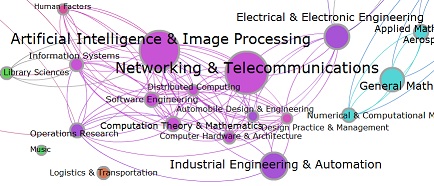
But then I look at another gorgeous graphic from the same source, focusing in on a part of the network of knowledge that interests me, and I can just faintly make out, lower left, entirely isolated, the field of music

What splendid isolation! That’s all of Bach, mind you – and all the Beatles, too.

*

Seriously, though:

  • It’s fascinating to be able to see how the various branches of knowledge cross-reference each other.
  • Visual data representation is a gorgeous, fantastic, field.
  • Mapping the all-of-everything is an irresistable lure for keen minds
  • I’m betting the humanities will prove to be at least as good at it as the sciences.
  • And I recall, not without a pang of regret, the time when my beloved Theology was Queen of the Sciences, and one might converse with Abelard on the streets of Paris…

A Baghdad DoubleTake and other matters

Friday, December 31st, 2010

[ by Charles Cameron ]

Zen recently posted a video of a terrific hour-plus-long speech by Doug Hofstadter – one of the best videos I’ve ever taken the time to watch – in which Hofstadter, the guy who brought us Godel Escher Bach and much more, talked about analogy and suggested that it’s at the very core of human cognition.

I posted a poem and some comments in response — they got a bit mangled in terms of formatting, which may be fixed by the time you read this – and Zen then posed a question:

Charles – there’s a large portion of visual imagery in the passage you cite: do you think the incorporation of imagery (thus activating a powerful region of the brain) enhances or distorts the underlying conceptual connection in an analogical construction?

That’s what set me off this time…

*

I think of a poem as a braiding of three strands: a strand of sound or music, a strand of image, and a strand of meaning. For convenience, I’ll usually include a fourth – wit – but it’s actually more like a pearl that can be threaded on the strand of meaning.

From my POV, the poem is thus essentially a screenplay for the mind’s eye – and if a poem begins with strong music, at the very least I’d like it to end with strong music, if it starts with wit or wordplay, I’d like it to end with that too, and if it has imagery, I’d like the images to unspool in a way not unlike the images in a movie…

When I’m reading poems by others, and particularly if I’m teaching a poetry class, I’ll sometimes notice a sudden disjunction in one of the three strands. If it’s clearly for effect, all’s well and good – but if it’s unconscious, unintended, it will always reveal an aspect of the poem that hasn’t been worked through yet, and applying conscious attention to it will result in the emergence of new material from the unconscious store that enriches the final product. Sometimes, that kind of attention reaches something that was psychologically difficult, a disjunction in soul if you like – and the result of moving through it to the finished poem can be very much like a breakthrough insight in therapy.

But “poetry is not a hospital” – if Apollinaire didn’t say that, and I used to think he did, I shall.

*

From my POV, therefore, there are analogies of sound, analogies of meaning, and analogies of image. There’s an analogy of sound between tomb and womb – we call it rhyme. There’s certainly an analogy of meaning – whence we come at birth, whither we go at death. And if you like, there’s an analogy of image – when I think of the “twinning” of those two words, I see life itself as running across a brief stretch of grass between two caves…

When as here, the analogy runs across all three braids, you have a very powerful “conceit” or poetic device.

The graphic match, together with sonic rhyme, between the visuals of a hotel room fan and the rotors of a helicopter at the beginning of Apocalypse Now parallels the sense of explosive heat and frustrated inaction of Captain Willard trapped in Saigon with the sense of freedom and clarity he feels when sent on mission up-river – again, an analogy in three strands.

*

But analogy can also cut across the senses in a different way. Here’s Hermann Hesse‘s view of the Glass Bead Game:

Throughout its history the Game was closely allied with music, and usually proceeded according to musical or mathematical rules. One theme, two themes, or three themes were stated, elaborated, varied, and underwent a development quite similar to that of the theme in a Bach fugue or a concerto movement . A Game, for example, might start from a given astronomical configuration, or from the actual theme of a Bach fugue, or from a sentence out of Leibniz or the Upanishads, and from this theme, depending on the intentions and talents of the player, it could either further explore and elaborate the initial motif or else enrich its expressiveness by allusions to kindred concepts.

Beginners learned how to establish parallels, by means of the Game’s symbols, between a piece of classical music and the formula for some law of nature. Experts and Masters of the Game freely wove the initial theme into unlimited combination.

That’s analogy cutting across disciplines, and across sensory modalities too.

There was a period of about a dozen years when I almost completely stopped writing poetry, and concentrated on devising a variant on Hesse’s game that would be playable on a napkin in a café – conceiving of it as an art that would combine tight form (think: sonnet, sonata) with the entire spectrum or palette of human thought, visual, verbal, numerical, aural.

Hesse again:

The Glass Bead Game is thus a mode of playing with the total contents and values of our culture; it plays with them as, say, in the great age of the arts a painter might have played with the colors on his palette. All the insights, noble thoughts, and works of art that the human race has produced in its creative eras, all that subsequent periods of scholarly study have reduced to concepts and converted into intellectual values the Glass Bead Game player plays like the organist on an organ. And this organ has attained an almost unimaginable perfection; its manuals and pedals range over the entire intellectual cosmos; its stops are almost beyond number. Theoretically this instrument is capable of reproducing in the Game the entire intellectual content of the universe.

And that was written before the world wide web allowed us to mingle visual, verbal, numerical and aural elements so directly in a single presentation.

You can imagine how delighted I was, therefore, to stumble upon Sven Birkerts‘ writing:

There are tremendous opportunities, and we are probably on the brink of the birth of whole new genres of art which will work through electronic systems. These genres will likely be multi-media in ways we can’t imagine. Digitalization, the idea that the same string of digits can bring image, music, or text, is a huge revolution in and of itself. When artists begin to grasp the creative possibilities of works that are neither literary, visual, or musical, but exist using all three forms in a synthetic collage fashion, an enormous artistic boom will occur.

That’s what the HipBone Games were all about…

*

That’s what I was reaching for, back in the days before I even called my games the HipBone Games — when they were still TenStones Games played on a board whose geometry I borrowed from the Sephirotic Tree – when I played TS Eliot‘s poem, The dove descending, in juxtaposition to Vaughan Williams‘ piece for violin and orchestra, The lark ascending

…matching music with poem, descent with ascent, dove with lark, and the natural world of the English countryside with the “wrought” world of Eliot’s London in the pentecostal Blitz.

I don’t think Stephen or I had web browsers at the time – we played that game using AOL’s early texting function, so the music was entirely in the mind…

And I still think of that game as one of the loveliest expressions of the “hipbone” art.

Hesse’s game really is, for me, the continuation of poetry by other means…

*

But then it turns out that analogy is an incredibly powerful aspect of human thought – and one that, IMO, we haven’t explored very deeply, perhaps precisely because it jumps silos and disciplinary boundaries, and creates fresh insight

…which is pretty much as Doug Hofstadter was suggesting in that video Zen posted.

And so this fundamentally analogical frame of mind — which I had developed in a poetic and aesthetic context and applied to the symbolism so dear to the poets, cultural anthropologists, analytical psychologists, and comparative theologians and the like — turned out to be highly applicable and seen as highly creative when applied to real world issues, when I got a job for a couple of years at a small think-tank just outside DC.

Because if linear causality is the warp of the weave of the world, acausal patterning is its woof (or weft) – and frankly, our current techno-civilization is hopelessly warped in the direction of warp, and has very little understanding of woof, of weft, of pattern — of what can only be learned from analogy.

*

Not that there doesn’t have to be enormous care taken to avoid over-reading parallels. But consider the immediacy of the impact of this DoubleQuote, which I composed in 2003:
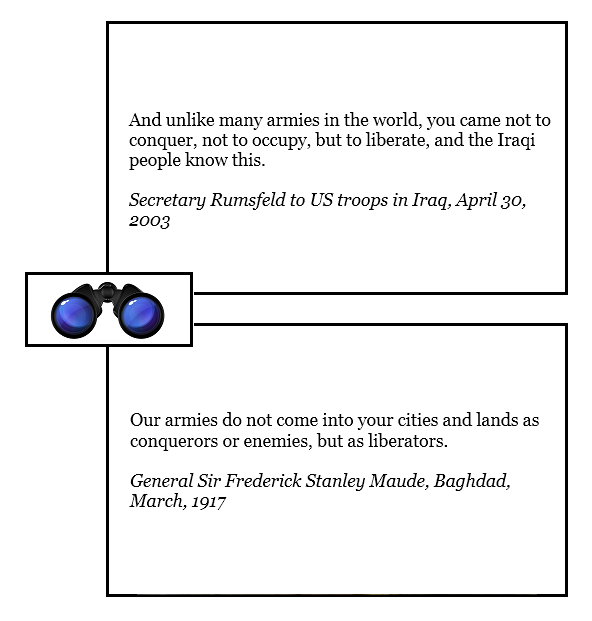
Eh, Zen?

Santayana echoes Marx refracts Hegel:

Hegel remarks somewhere that all great world-historic facts and personages appear, so to speak, twice. He forgot to add: the first time as tragedy, the second time as farce.

Those who cannot remember the past are condemned to repeat it

Seen from another angle: history has rhymes to match its reasons

Analogy as the Core of Cognition

Tuesday, December 28th, 2010

Book Mini-Reviews to Clear a Boundless Bibliographic Backlog!

Friday, December 10th, 2010

I have too many books that I have read that I would like to review that, realistically, I will never get to post on in conventional fashion. A fair number belong with Summer Series which seems ridiculous as it is two weeks to Christmas! Therefore, brace yourselves, as I commence the first, and hopefully only, Mini-Reviews post:

Play: How It Shapes the Brain, Opens the Imagination, and Invigorates the Soul by Stuart Brown, MD

Dr. Stuart Brown, scientist and psychiatrist, has written a short tome on the nature and cognitive value of play. While there is plenty of child social development information and “pop”self-helpish type chapters, ZP readers wil gravitate to the chapters on play’s vital role in creaivity and innovation ( which are not the same thing), scientific discovery and work. Also of interest are the spectrum of “play personalities” and the “dark side of play”. Not an academic book but a reasonable read on a deceptively complex subject.

The Collapse of Complex Societies by Joseph Tainter

A superb academic book, previously featured and reviewed in the blogosphere by John Robb and Joseph Fouche, The Collapse of Complex Societies embarks upon a critical examination and partial de-bunking of theories that purport to explain the “sudden” fall of great empires, such as Rome or the vanishing of the Mayans. With caveats, Tainter settles on declining marginal returns from increasing societal investment in complexity as a rough proximate cause capable of subsuming a ” significant range of human behavior, and a number of social theories” under it’s rubric. Highly recommended.


The Bin Ladens: An Arabian Family in the American Century by Steve Coll

A biography of the Bin Laden family, this book does not come close to matching the impact or importance of Coll’s previous instant classic, Ghost Wars. There are many interesting trivialities about the divergences between the “religious and the hard Rock Cafe wings” of the Bin Laden families, and intriguing nuggets about political matters such as the 1979 takeover of the Grand Mosque and the connections between the Bin Ladens and elite figures inside the beltway but anyone looking for insight into Osama bin Laden will be disappointed. The most infamous member of Saudi Arabia’s dominant non-royal business clan is a subdued figure in this biography. Coll’s superior skills as a wordsmith and reporter manage to make the book a pleasant page turner.

The Death and Life of the Great American School System: How Testing and Choice Are Undermining Education by Diane Ravitch

Conservative education scholar and historian Diane Ravitch lays out the demise of the movement for high curricular standards in public education that she once championed and it’s transmogrification under NCLB into a punitive system that is slowly imposing an unprecedentedly narrow and dumbed down national curriculum focusing on basic math and reading skills, featuring gamed  test results, highly paid lawyer-consultant insiders and perverse incentives for public and charter schools alike. A depressing but important read.

WikiLeaks: Critical Foreign Dependencies

Thursday, December 9th, 2010

[ by Charles Cameron ]

The most interesting part of the WikiLeaks-posted State Department Request for Information: Critical Foreign Dependencies, it seems to me, is the part that ties in with Zen’s recent post Simplification for Strategic Leverage.

Zen referenced Eric Berlow‘s recent TED talk to the effect that sometimes a complex network can be made effectively simple by reducing it to the graph of nodes and links within one, two or three degrees of the node you care about and wish to influence.

“Simplicity often lies on the other side of complexity”, Dr Berlow says, and “The more you step back, embrace complexity, the better chance you have of finding simple answers, and it’s often different than the simple answer that you started with.”

*

This resonates neatly with a few things I’ve been thinking and talking about for some time now.

1. There’s the need for visualization tools that don’t operate with as many nodes as there are data points in a database like Starlight — I’ve been wanting to reduce the conceptual “load” that analysts or journos face from thousands, sometimes tens of thousands of nodes, to the five, seven, maybe ten or twelve nodes that the human mind can comfortably work with:

What I’m aiming for is a way of presenting the conflicting human feelings and understandings present in a single individual, or regarding a given topic in a small group, in a conceptual map format, with few enough nodes that the human mind can fairly easily see the major parallelisms and disjunctions, as an alternative to the linear format, always driving to its conclusion, that the white paper represents. Not as big as a book, therefore, let alone as vast as an enormous database that requires complex software like Starlight to graphically represent it, and not solely quantitative… but something you could sketch out on a napkin, showing nodes and connections, in a way that would be easily grasped and get some of the human and contextual side of an issue across.

2. There’s the fact that the cause is typically non-obvious from the effect. In the words of Jay Forrester, the father of stocks and flows modeling:

From all normal personal experience, one learns that cause and effect are closely related in time and space. A difficulty or failure of the simple system is observed at once. The cause is obvious and immediately precedes the consequence. But in complex systems, all of these facts become fallacies. Cause and effect are not related in either time or space… the complex system is far more devious and diabolical than merely being different from the simple systems with which we have experience. Though it is truly different, it appears to be the same. In a situation where coincident symptoms appear to be causes, a person acts to dispel the symptoms. But the underlying causes remain. The treatment is either ineffective or actually detrimental. With a high degree of confidence we can say that the intuitive solutions to the problems of complex social systems will be wrong most of the time.

3. There’s the need to map the critical dependencies of the world, which became glaringly obvious to me when we were trying to figure out the likely ripple effects that a major Y2K rollover glitch – or panic – might cause.

Don Beck of the National Values Center / Spiral Dynamics Group captured the possibility nicely when he characterized Y2K as “like a lightening bolt: when it strikes and lights up the sky, we will see the contours of our social systems.” Well, the lightning struck and failed to strike, a team from the Mitre Corporation produced a voluminous report on what the material and social connectivity of the world boded in case of significant Y2K computer failures, we got our first major glimpse of the world weave, and very few of the possible cascading effects actually came to pass.

I still think there was a great deal to be gleaned there — as I’m quoted as saying here, I’m of the opinion that: “a Y2K lessons learned might be a very valuable project, and even more that we could benefit from some sort of grand map of global interdependencies” – and agree with Tom Barnett, who wrote in The Pentagon’s New Map:

Whether Y2K turned out to be nothing or a complete disaster was less important, research-wise, than the thinking we pursued as we tried to imagine – in advance – what a terrible shock to the system would do to the United States and the world in this day and age.

4. That such a mapping will necessarily criss-cross back and forth across the so-called cartesian divide between body & mind (materiel and morale, wars and rumors of wars, banks and panics):

You will find I favor quotes and anecdotes as nodes in my personal style of mapping — which lacks the benefits of quantitative modeling, the precision with which feedback loops can be tracked, but more than compensates in my view, since it includes emotion, human identification, tone of voice.

The grand map I envision skitters across the so-styled “Cartesian divide” between mind and brain. It is not and cannot be limited to the “external” world, it is not and cannot be limited to the quantifiable, it locates powerful tugs on behavior within imagination and powerful tugs on vision within hard, solid fact.

Doubts in the mind and runs on the market may correlate closely across the divide, and we ignore the impacts of hope, fear, anger and insight at our peril.

*

Getting back to the now celebrated WikiLeak, which even al-Qaida has noticed, here’s the bit — it’s really just an aside –that fascinates me:

Although they are important issues, Department is not/not seeking information at this time on second-order effects (e.g., public morale and confidence, and interdependency effects that might cascade from a disruption).

It seems to me that the complex models which Starlight provides, and Eric Berlow pillories, overshoot on one side of the problem – but avoiding all second-order effects?

One cause, one effect, no unintended consequences?

What was it that Dr Berlow just said? “if you focus only on that link, and then you black box the rest, it’s actually less predictable than if you step back, consider the entire system”…

Avoid all second-order effects?

If you ask me, that’s overshooting on the other side.


Switch to our mobile site