zenpundit.com » cognition

Archive for the ‘cognition’ Category

Simplification for Strategic Leverage

Sunday, December 5th, 2010

Remember this much ridiculed visual monstrosity?:

Excessively complex representations, much less the bureaucratic systems in practice, are poor vehicles for efficient communication of strategic conceptualizations to the uninformed – such as those downstream who must labor to execute such designs. Or those targeted by them for help or harm.  In addition to the difficulty in ascertaining prioritization, the unnaturally rigid complexity of the bureaucracy generally prevents an efficient focus of the system’s resources and latent power. The system gets in it’s own way while eating ever growing amounts of resources to produce less and less, leading to paralysis and collapse.

Does it have to?

Here’s an interesting, very brief take on analytical simplification from a natural scientist and network theorist Dr. Eric Berlow on how to cull simplification – and thus an advantage – out of complex systems by applying an ecological paradigm.

Cognitive simplification will be a critical strategic tool in the 21st century.

Guest Post: Beakley on Boyd, Aerial Combat and the OODA Loop

Thursday, December 2nd, 2010

Ed Beakley is the Director and guiding spirit of Project White Horse and is student of the strategic thinking of John Boyd. Ed requested space to respond to criticism directed at the OODA Loop by Col. Jim Storr in The Human Face of War and assumptions made regarding the influence of aerial combat on John Boyd’s strategic thought.

Boyd, Aerial Combat and the OODA Loop

by Ed Beakley

While I’m sure most have read the basic story, it seems it might be worth recalling the details abit.  Boyd first characterized OODA, looking to understand and explain the differential in air-air kills between U.S. and North Korean pilots and realized that with the significantly better visibility from the F-86 bubble canopy than that from the MiG 15, the USAF pilot was more likely to see a MiG approaching from the rear quarter tan the other way around. (The Vietnam era MiG 17 and 21 had similar designs – narrow canopies extending straight back into the fuselage.  I can attest to this having flown a MiG 21 simulator in an air engagement with a German Col in an F-4 at Ling Tempco Vought some years ago).  This ability to see the fight early is critical and coupled with the F-86 significant advantage in roll rate meant rolling and turning into the MiG, then reverse rolling would eventually set up a misalignment in a/c attitude which the F-86 could exploit. Seeing led to the ability to exercise a  fast transient.

Boyd’s example of the F-86 and MiG 15 allowed him to address the four pieces and their impact and of having the ability to change state quicker than one’s opponent.  The fact that time wise the observation and action are nearly stacked on top of each other,  does not mean that “orientation” and decision” did not or do not occur.  One must realize that almost all engagements of aerial combat last only seconds. Data from the air war over Vietnam show that in most instances the shot down pilot never saw the shooter. Snoopy jousting with the Red Baron is a colorful idea but dogfights happen mostly only in training. Indeed, with certainly no disrespect meant, “Forty Second Boyd” is a characterization that could only come out of the training world. Forty seconds is multiple life times in actual air-air engagements.

So how then does OODA occur? Two things, one closely relating to martial arts – individuals must be completely immersed in their art. There exists no better representation of this than the fighter pilot. Any fighter pilot who wouldn’t claim he could kick your ass in forty seconds is not worthy of the name, and he trains hard to be able to back that up.  And there’s nothing worse than a guy who can back that up. (Frank ‘Whip’ Ault, the Navy Captain, fighter pilot whose report led to TOPGUN was no Ace but his call sign was well earned).  This leads to the second, that attitude, training AND being immersed with similar extremely competitive arrogant bastards, means he takes all the elements of orientation with him when he crosses the Yalu or the Red River Valley.  His observation of the enemy aircraft brings the only missing piece of the “orientation” into play – physical situational awareness and allows the quickness of decision and action. “Decision” also follows out of that training (think about the “ribbon” drawings in Boyd’s Aerial Attack Study that were and are studied and practiced).  He’s been there done that so many times, it’s truly Gary Klein’s recognition primed, but all parts of OODA are still in play. 

Indeed, if the mission and performance of the aircraft differ substantially, the OODA process may actually stretch out and be more easily discerned. By way of example would be an A-7 on a Sam suppression “Ironhand” mission attacked from below by a MiG 21.  The A-7’s performance is significantly less than that of the MiG. This is not the quick conversion to a kill of Boyd’s example where O-O-D-A are essentially stacked on top of each other time wise, rather survival of the A-7 pilot and completion of his mission to protect the strike group (i.e., survival of a number of planes), turns into a more spread out O-O-D-A process, in which working to gain proper orientation is crucial to the necessary timing of the decision and action to execute a “bug-out.”

This rolling reversal maneuver is extremely violent, involves applying negative G’s and can be disorienting to the executing pilot.  Done correctly, it creates the same misalignment of aircraft with the MiG nose high, the A-7 nose low gaining separation and running out to the MiG’s six o’clock.  The trick though is that you wanted to run toward the water.  Even with separation and 180 degrees out of phase, it’s no longer just guns, the MiG had Atol missiles.  Water meant possibility of pick-up if you had to eject.  And on top of all that, if the Ironhand a/c bugged out, the strike group was now more susceptible to Surface to Air Missile attacks.  Will anyone argue this is not a discernable example of observe, Orient, decide act?

As to Boyd’s stature and competence to analyze the air-air world in regard to a true Ace (5 confirmed kills):

1.      World War II was unique in air-air combat in light of the technical capability, the number of aircraft in the air and in a fight at the same time.  Many kills came without one pilot seeing the other.  Kills were achieved by pulling the trigger at the right time as planes crossed your nose chasing someone else.  To be sure there were some great deeds of derring-do and some great pilots and certainly intuitive actions played a significant part. Does Col Storr’s interviews with Aces indicating the falsity of the OODA in air-air combat counter Boyd’s analysis?  Hardly.  Boyd was not trying to expound a theory on OODA and Air-Air Combat, he used an example he knew well, which is appropriate in many instances, but certainly not all.  He simply intended to show that if you could move through the OODA flow at a better tempo than your enemy, you could create a mismatch that could be exploited.

2.      Was not being a true Ace important?  No matter how good the pilot, luck and mission assignment plays a huge part.  Ask any fighter pilot, anywhere this one.  Some of the best never even get a look.  True story ( I was in the same area earlier and it wasn’t nice) – one of the senior F-4 Commanders who’d been involved with all the early TOPGUN stuff, was so frustrated because he, unlike some of that group, did not have a MiG, hoping a MiG would come up, went “trolling” along the DMZ, the very last day of the war and got shot down and lost.  Good pilot? Former commanding officer of the Blue Angels.  Boyd’s work as an ACM instructor and developer/writer of the Aerial Attack Study at Nellis tells you all you need to know.  One of his best students was Ev Raspberry, one of General Robin Olds’ MiG killers who credited his success over Route Pack Six to John Boyd for what he taught him at Nellis.

One final note, Seydlitz questions anything following from Boyd, if the original thinking is flawed.  As noted above, the view of an Ace doesn’t necessarily contradict Boyd’s analysis.  This is an extremely situationally dependent context.  Would he dismiss my own experience in combat?  The first time I read Boyd’s analysis, it made perfect sense.  The fact that the flow can be almost unobservable due to speed of process is irrelevant.  If Boyd’s OODA is to be discarded, then one must dismiss a whole process and body of work coming out of the Naval Electronic Systems Command in the eighties stemming from Dr. Joel Lawson’s research and writing on command and control.  Boyd’s work  seems to fall prey to “if it’s not perfect for all situations then it’s all bad”????

As to Storr, I turn the question, how can one now trust his writing, given his pretty obvious shoddy research on Boyd.  One must go no further than page 12 and the critique of Boyd’s loop.  Poor form no matter what he thinks of Bill Lind and 4GW.

Metaphors as Catalyst and Scaffold

Friday, November 19th, 2010

Via John Hagel, a particularly interesting NYT article on the neroscience of metaphors. I have always considered metaphors and analogies to be a “spark” or a “catalyst” to insight but they appear to be potentially structural organizers or “signal switches” of information processing:

This Is Your Brain on Metaphors

….Symbols, metaphors, analogies, parables, synecdoche, figures of speech: we understand them. We understand that a captain wants more than just hands when he orders all of them on deck. We understand that Kafka’s “Metamorphosis” isn’t really about a cockroach. If we are of a certain theological ilk, we see bread and wine intertwined with body and blood. We grasp that the right piece of cloth can represent a nation and its values, and that setting fire to such a flag is a highly charged act. We can learn that a certain combination of sounds put together by Tchaikovsky represents Napoleon getting his butt kicked just outside Moscow. And that the name “Napoleon,” in this case, represents thousands and thousands of soldiers dying cold and hungry, far from home.

And we even understand that June isn’t literally busting out all over. It would seem that doing this would be hard enough to cause a brainstorm. So where did this facility with symbolism come from? It strikes me that the human brain has evolved a necessary shortcut for doing so, and with some major implications.

….This potential to manipulate behavior by exploiting the brain’s literal-metaphorical confusions about hygiene and health is also shown in a study by Mark Landau and Daniel Sullivan of the University of Kansas and Jeff Greenberg of the University of Arizona. Subjects either did or didn’t read an article about the health risks of airborne bacteria. All then read a history article that used imagery of a nation as a living organism with statements like, “Following the Civil War, the United States underwent a growth spurt.” Those who read about scary bacteria before thinking about the U.S. as an organism were then more likely to express negative views about immigration.

Another example of how the brain links the literal and the metaphorical comes from a study by Lawrence Williams of the University of Colorado and John Bargh of Yale. Volunteers would meet one of the experimenters, believing that they would be starting the experiment shortly. In reality, the experiment began when the experimenter, seemingly struggling with an armful of folders, asks the volunteer to briefly hold their coffee. As the key experimental manipulation, the coffee was either hot or iced. Subjects then read a description of some individual, and those who had held the warmer cup tended to rate the individual as having a warmer personality, with no change in ratings of other attributes.

From this simple associative effect are the conditions from which a “eureka” moment of insight can crystallize, as it did for Archimedes in his bath:

Effect—-> Association —-> Orientation ——> Insight ——> Extrapolation/Generalization

ADDENDUM:

Curtis has commented and expanded the discussion, though his comments seem to go into my akismet spam folder. Should be fixed now:

WOODA = C(OODA) + A(OODA) / 4GW & 5GW

There is the potential not only for insight but also for deception, whether the deceivers are others in our milieu or we ourselves (and our brains) may be deceivers….

True. Metaphors and analogies can crystallize insughts but they can also become powerfully attractive distorions of reality – sort of “anti-models” or  “false models”.

….As a model of what might be called metaphorization, these similarities make sense.  The OODA in all its forms, including the WOODA which includes World, represents a dynamic process of cycling (although perhaps not always uniform and unidirectional cycling) of information.  The focal point of the A-OODA, Observe above, is the abstract locus of observation:  New information received from without comes into contact (abstractly speaking!) with previously built understandings, or Mental Constructs, and relatively newer insights, or Conditional Constructs.  These diverse abstract observations have, to some extent, already prepared the mind for interpretation of new information and, these observations taken as whole create an opportunity for triangulation (of a sort.)  Using Mark Safranski’s terminology, after the information is Associated, it is Oriented through analysis and synthesis, Insights may form the basis of new hypotheses which may either be conditional (re-looped into further observation w/ outside information and previous understandings) or may be accepted as finalized understandings about what one has observed (Extrapolation/Generalization).

Hmmmm…. I have read that “insight” as a neurocognitive event tends to occur in two brain regions, the lateral inferior prefrontal cortex and the anterior cingulate cortex. The associative work of insight correlates with the former region but the “combinatory play” cited by Einstein and referenced , if I recall, by Charles and leading to new hypothesis correlates with the latter.  I am not a neuroscientist, so I am now wondering if insight is a distributed, parallel processing, brain function or if we are really talking about two separate cognitive effects – an “Insight 1” and “Insight 2”?

Anyone who cares to weigh in here, feel free…..

A Hipbone Approach IV: Polar bears and polar opposites

Friday, November 12th, 2010

by Charles Cameron
pic of polar bear tenuously balanced on tiny iceberg

Norwegian photographer Arne Nævra took second prize in the “Our world” category of the Shell Wildlife Photographer of the Year 2007 competition with this photo

Bruce Sterling‘s State of the World 2010 conversation with my online friend Jon Lebkowsky on the Well’s “Inkwell” forum this year was rich in concept and language as one might expect. This in particular caught my eye:

It’s like looking at your SUV and seeing drowning polar bears. Just a minority viewpoint.

Two concepts, two dots to connect: SUVs and polar bears. Sterling chose those two concepts, no doubt, because the connection between them is non-obvious in the sense that a dictionary definition of SUV won’t contain a reference to polar bears, heck, even an encyclopedia article is unlikely to, and the reverse is also true — and obvious, in the sense that the “minority” in question can easily connect these two otherwise quite distinct and separate dots, the connection being “climate change” aka “global warming” or more specifically an entire complex dynamic systems analysis incorporating the process by which an aggregate of comparatively large and frequently used gasoline-powered internal combustion engines adds incrementally to a trend in the global weather…

Not that any of this should surprise us: Sterling’s readers presumably know that SUVs are a convenient stand-in for “gas guzzlers” and thus for the whole panoply of cars and trucks, and more abstractly for our planetary tendency to technologize our environment into greater convenience and less sustainability — and polar bears, while Sterling may like the look of them in photos, documentaries, zoos or on the occasional visit to the Arctic, serve here as a marker for the entire notion of environmental degradation, a massive die-out of species and such other non-Arctic phenomena as the loss of mountain tops in Appalachia and of rain forests in the Amazon and elsewhere.

So Sterling has played two “concepts” on the board of “connect the dots” and asserted that for some people the connection will be obvious, while for others it will be invisible — which in term of connecting the dots means it might as well not exist.

*

Indeed, some will argue that while both dots — SUVs and polar bears — exist, the connection implied between them does not.

But that’s not the topic of my consideration here.

*

Bruce Sterling’s interview gives me the pair of dots I intend to focus on today – SUVs and polar bears – but there’s another pair of dots that Sterling’s remarks forms part of, a pair in which Sterling stands at one pole (science, fiction) of the debate on climate change, with Rep. John Shimkus, R- IL, at the other (scripture, fact).

Addressing the House Subcommittee on Energy and Environment’s hearing on Preparing for Climate Change on March 15, 2009, Rep. Shimkus made the following now-celebrated remarks:

The right of free speech is a great right that we have in this country. Very few times we use it to espouse our theological religious beliefs, but we do have members of the clergy here as members of the panel. So I want to start with Genesis 8, verses 21 and 22. “Never again will I curse the ground because of man even though every inclination of his heart is evil from childhood, and never again will I destroy all living creatures as I have done. As long as the earth endures, seed time and harvest, cold and heat, summer and winter, day and night will never cease.” I believe that is the infallible word of God, and that is the way it is going to be for his creation.
 
The second verse comes from Matthew 24. “And he will send his angels with a loud trumpet call, and they will gather his elect from the four winds, from one end of the heavens to the other.” The earth will end only when God declares it is time to be over. Man will not destroy this earth. This earth will not be destroyed by a flood.
 
And I appreciate having panelists here who are men of faith, and we can get into the theological discourse of that position. But I do believe God’s word is infallible, unchanging, perfect.

I have characterized Sterling’s stance as “science, fiction” and Rep. Shimkus as “scripture, fact” – but the connection between these two dots is far from clear, and it is at leasdt arguable whether the designations shouldn’t instead be “science, fact” for Sterling, and “scripture, fiction” for Rep. Shimkus.

*

There’s a certain elegance to that – in fact it begs to be made into one of those diagrams that Jung and Levi-Strauss were fond of…
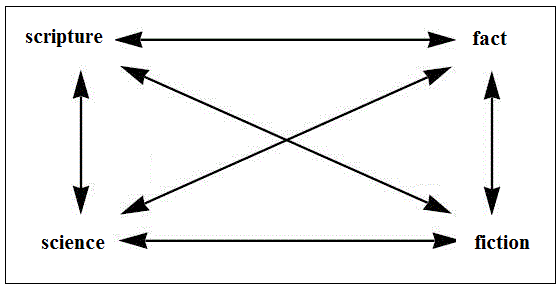
Science fact fiction scripture

Of course, fact and fiction may not be exclusive, opposed categories, and the same is true of scripture and science. Consider, for example, Kathleen Raine’s comment:

myth, when a real event may be the enactment of a myth, is the truth of the fact and not the other way around”

or the similar idea that CS Lewis once wrote to her

What flows into you from the myth is not truth but reality (truth is always about something but reality is about which truth is) and therefore every myth becomes the father of innumerable truths…

*

To return to Sterling… The game of connect the dots that Sterling plays here could be made into a simple systems diagram of the sort that Peter Senge used to illustrate his book, The Fifth Discipline, or the more elaborate form of systems dynamic model that Jay Forrester pioneered at MIT and Donella Meadows so eloquently preached in her essay, Places to Intervene in a System — complete with feedback loops in which shifts in global weather patterns and the exquisitely-patterned trails of SUVs dance the dance of complexity and emergence…

Sterling’s version of the game is verbal, minimalist, and suggestive: two phrases, not often found next to each other, quietly juxtaposed, in such a way that the mind can supply the connection that makes the leap between them. In short: the man can write.

The point I am laboring to make here has to do with communication: with getting an insight across to other people.

Writers do this by dropping verbal markers (“SUVs” and “polar bears”) into sentences. Mostly, they write many such sentences in sequence (a blog post, an article, a book), so the reader skims or skips lightly from one marker to the next, like a stone skipping across a pond in the childhood game. Individual leaps and single connections between pairs of dots are not important here, the reader’s mind half-notes them as it passes to the next dots and the next, and such things as “conclusions” and “actionable items” or in some cases “character” and “plot” far outweigh the largely subliminal links and connections triggered along the way.

From an analytic point of view, however, it is the connections that make the difference — whether those connections are causal, as in the steps of an argument; dynamic, as in the workings of a homeostatic system with feedback loops; emergent, as in the discernment of pattern at the edge of chaos; or associative, as with creative insight, metaphor and analogy.

And in each of these cases, some form of language, diagram or model can spell out the connection, some form of software can embody that language, diagram or model, and some form of human insight can assimilate its meaning and apply it to further tasks of observation, orientation, decision and action…

*

We may connect the dots for pleasure, as in one of those games that chains of restaurants print up to keep children busy while their parents talk over pancakes and bacon, or for benefit: and here the issue is not only to connect “past” dots correctly so as to understand what has already happened and can be viewed with twenty-twenty hindsight, but to make the great conceptual leap from past and present and propose connections with dots that will arise in the “future” (that zone of uncertainty): we write scenarios, we plan, we attempt to intuit an enemy’s next move, to make our own OODA loop tighter and meaner than his.

And while in the short term we may succeed, in the mid and long term we may fail.

At which point, as a depth psychologist might say, our projections tell us more about ourselves than about the reality we are attempting to grasp.

I’d include here those moments when we “see” connections that don’t exist, as well as those in which we miss connections that do: hallucinatory links, and blind spots, both.

*

Bruce Sterling, in the same forward-looking piece that contains that quick verbal aside about polar bears and SUVs, asks himself how anyone can give “a coherent picture of where your future is heading”. Without some such picture, indeed, we are at the mercy of vicious feedback loops and unintended consequences.

Here’s how he thinks about what we might call medium term scenarios:

Let’s imagine you’re three years old again. You want to give your Dad, back in 1974, a coherent picture of what 2010 looks like. You know, something very actionable, lucid and practical, where he can just slap the cash on the counter and everything works out great for the family. Okay: given what you know now about the present, tell me what you oughta tell him about 2010, back in 1974.

Forrester-style modeling won’t carry us forward thirty five years: there are simply too many shades of grey and black swans between “now” and “soon”.

And so task number one is an “ornithological” task — to peer into our own blind-spots, to see the invisible, to have what is called “vision”.

And I don’t mean a gosh-darn brand-new marketing strategy. I mean a sense of the great tides that underlie epochal changes — the kind of vision that William Blake had, which allowed him to rail on about the “satanic mills” long before the word “ecology” was a dim spark in the mind of the fellow who coined the word. The sort that Leonardo da Vinci had.

The sort, in fact, that contemplatives (all those Zen and Tibetan and Benedictine monks) and shamans (Lakota and Huichol and !Kung and all the rest) and artists (in words, in images, in sound, in film, in concept) all know about.

*

Which is to say, the sort Einstein knew about — so that when the mathematician Jacques Hadamard asked him about his thought process, he answered:

The words or the language, as they are written or spoken, do not seem to play any role in my mechanism of thought. The psychical entities which seem to serve as elements in thought are certain signs and more or less clear images which can be “voluntarily” reproduced and combined.
 
There is, of course, a certain connection between those elements and relevant logical concepts. It is also clear that the desire to arrive finally at logically connected concepts is the emotional basis of this rather vague play with the above mentioned elements. But taken from a psychological viewpoint, this combinatory play seems to be the essential feature in productive thought – before there is any connection with logical construction in words or other kinds of sign, which can be communicated to others.
 
The above mentioned elements are, in my case, of visual and some of muscular type. Conventional words or other signs have to be sought for laboriously only in a secondary stage, when the mentioned associative play is sufficiently established and can be reproduced at will.

That’s quite a mouthful, so I’d like to pick out a few points that maybe of relevance here.

Let’s clear the word “muscular” out of the way first. Some of the ideational germs of Einstein’s most brilliant work, he tells us, are “muscular”. Many of us know that visual thinking is an important component of understanding: Einstein adds thinking “of muscular type” into the mix. His body is part of his mind, and he knows it. That’s important: Einstein is, in fact, connecting dots for us here linking mind and body. But he doesn’t just link dots in his response to Hadamard — he actually talks quite a bit about making connections.

*
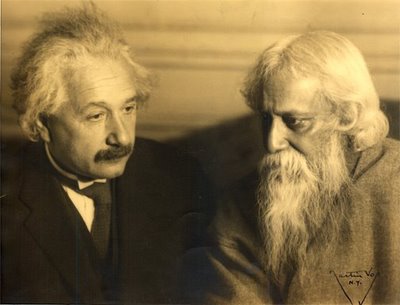
Einstein Tagore

Einstein links to Tagore

Let me rephrase his response to Hadamard the way I see the process he describes unfolding.

He has a strong emotional desire to understand, in the way that “physics” understands — which is to say, “to arrive finally at logically connected concepts” of the nature of nature. He then turns away from logic and concepts, and — still under the sway of that desire — attends to the sensations of his body and to his internal field of vision. In response to that desire and from regions of the body and mind unspecified, certain “psychic elements” of a visual and some of muscular sort arise. These he says can be “combined” — he says also that he can “play” with them — but the play is, at least at first “vague”. Indeed it is precisely this “combinatory play” which appears to Einstein to be “the essential feature in productive thought”. It is only when these elements have been voluntarily played with and satisfactorily combined that Einstein begins, internally, to verbalize and “translate” the combinations he has perceived into some form of “logical construction in words or other kinds of sign, which can be communicated to others”.

So we have three sorts of connection going on here: (i) an associative connectivity between imagistic and muscular “psychic elements” in the mode of play (ii) their “connection with logical construction in words or other kinds of sign” and (iii) the connections he can then present to others in the language of “logically connected concepts” — ie mathematical physics.

*

In all of this, I would like to highlight (i) the (perhaps unexpected) importance of the body’s connection with the mind in human thinking, (ii) the significance of a deep desire for understanding as the attractor for the largely unconscious motions of body and mind, (iii) the role of play as the mode of thinking in which creative linking occurs, (iv) the ubiquity of connectivity as the ruling imperative in all phases from the initiation of play to the communication of theoretical physics.

All four — body-mind, desire, play and connection — are key components in anything worthy of the name of vision.

A Superb Exposition on the Power of Metaphor

Saturday, November 6th, 2010

A work colleague, of great height and formidible baldness, pointed me to a new, dynamic slideware app called Prezi.

While Prezi is interesting in itself for those of you condemned to give briefings and presentations, I was intrigued by one of their showcase demos on metaphors. A first rate, concise, presentation on metaphorical thinking  by Adam Somlai-Fischer; a strong cognitive bent, but very reachable for a general audience.

By the way, you should watch this presentation on “Autoplay” while listening to this:


Switch to our mobile site

