zenpundit.com » national security

Archive for the ‘national security’ Category

Book Review: Engaging the Muslim World by Juan Cole

Wednesday, July 8th, 2009
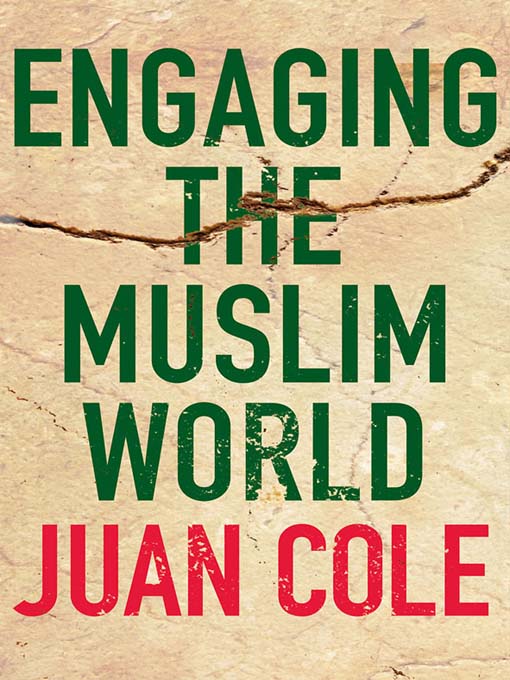
Engaging the Muslim World by Juan Cole

I recently finished reading Engaging the Muslim World by Juan Cole, the influential academic, well known liberal-left blogger of Informed Comment, past president of the Middle East Studies Association and occasional media talking head. Cole has written an intriguing book on contemporary foreign policy that is of special interest to those readers concerned with public diplomacy, the Muslim world, terrorism and the domestic politics of American foreign policy, particularly the war in Iraq. I will state straight off that there are arguments in this book presented by Cole that I profoundly disagree with, or, national security related assertions that I consider questionable; but in other instances, when Cole is concentrating on the nuances of the Arab-Muslim world’s political-cultural lens, he is an illuminating and insightful analyst from whom I have learned new things. 

Engaging the Muslim World is…well….engaging. I found Cole’s prose flowed smoothly, as if the author was talking to the reader across a table, and I had a hard time putting the book down, albeit I was frequently scribbling furiously in the margins. This is a polemical -policy book written by an academic for a lay audience and the reader’s reaction to Engaging the Muslim World will depend in part on their own worldview. Liberals will cheer more than they disagree with Cole, while conservatives and supporters of Israel are likely to reject many of the book’s normative assumptions long before they read the conclusions – but Cole also offers some prescriptive advice that center-right COIN and public diplomacy advocates will warmly embrace.

The book  is divided into six chapters. The first, “The Struggle for Islamic Oil:The Truth About Energy Independence” which deals with energy markets, the Cold War history of the Mideast, global warming, environmental policy, alternative fuel technologies and globalization, is a necessary effort to concisely account for the geoeconomic importance of Muslim oil producing states and the future of fossil fuel economies.  Cole argues – correctly, I suspect – that there will be no short or medium term substitutes for oil and gas until solar power technology is cost-efficient enough (and efficient in a physics sense) to compete with fossil fuels in the marketplace. Not being a scientist or an expert in energy market issues, I am poorly placed by professional background to evaluate Cole’s claims in these areas and will leave those to others.

That said, chapter one remains the odd man out. It smacks of having been  compacted by an editor out of two or more chapters and consequently has disparate issues jumbled together with insufficient explanation; as a whole, chapter one fits uncomfortably with the subsequent chapters which flow together naturally and thematically. On the other hand, the topic of oil can hardly be dispensed with either in a geopolitical discussion of the Mideast, so Cole was right to tackle it and the primary problem is really one of sequence, not subject matter.

Chapters two through six are the heart of Engaging the Muslim World, where Juan Cole articulates a theme of “Islam anxiety” permeating Western, particularly American, media and public opinion. Poorly informed about even the most basic information regarding the Muslim world, such as the differences between Shia and Sunnis, secular Baathist nationalists and Islamist radicals, quietists and the politically militant, Arabs and non-Arabs, Cole asserts that Westerners tend to lump Muslims of all shades of political belief, religiousity and nationality into a homogenous, vaguely mysterious but ever dangerous entity. Cole cites as one example, Egypt’s Sunni Muslim Brotherhood, which has foresworn violence and has members who sit in Egypt’s legislature, being lumped uncritically by American commentators with al Qaida and Hezbollah (which is a radical Shiite group).

A better way to understand violent Islamist extremists in relation to normal Muslims, in Cole’s view, would be to see them as analogous to our homegrown, violent, far-Right, white racist underground that produced Timothy McVeigh, who carried out the Oklahoma City bombing or as cult-like movements. While smaller in size than Islamist radicalism, the racist Right shares with violent Islamists the trappings of a fringe, ostracized, quasi-religious, political cult with a conspiratorial worldview that diverges sharply from the nation’s mainstream religious life. Violent Islamists often make themeslves as unpopular with their co-religioinists as do neo-Nazi extremists here, through actions that horrify society, such as the bloody massacre of Western tourists and Egyptian workers at  Luxor, Egypt.

Cole’s analogy with cults and racial extremists I think is a useful one. Radical Islamists are difficult to classify on a traditional political spectrum as their political behavior has definite similarities with those of the fascist and communist totalitarians of the 20th century, but will not fit smoothly with either, given Islamist religious extremism and the fanatical atheism or at least radically secular nature of the Bolsheviks and Nazis. The psychological overlap however is certain, something akin to the 19th century Anarchist-terrorists or what Eric Hoffer captured in his classic work, The True Believer.

On Israel and Iran, Cole bends over backwards, like a circus sideshow contortionist, to try and explain the lunacy (and Cole admits it is, at best, a crackpot worldview) of Ahmadinejad’s violently antisemitic statements about the Holocaust and Iran’s generally defiant behavior toward the international community while giving Israel no similar benefit of the doubt.  Cole argues that Ahmadinejad’s oft-stated “wipe Israel off of the map” is a deliberate mistranslation by the Western media. Ok, possibly so. I do not speak Farsi, so I’ll take Cole’s word here. If it is the case though, Ahmadinejad is well aware of how his repeated statement is being mistranslated by Reuters and AP, yet he keeps using it. Again and again. That is an ominous statement in itself.

This uneveness regarding Iran and Israel will no doubt enrage conservatives and delight progressives, but in fairness to Juan, I must say that despite his partiality toward Iran in his book, as a blogger he was very quick to denounce the obvious stealing of the recent election by Khameini-Ahmadinejad-IRGC and my perception is that Cole views the apocalyptic Mahdist tendency in Twelver Shiism that Ahmadinejad embraces as a kooky deviation from mainstream Shiism. That not just Ahmadinejad holds this belief dear, but also many influential figures in the Iranian security apparatus as well, is in my view, a cause for alarm.

Despite his politics, Cole concludes Engaging the Muslim World with a very pragmatic prescription for American public diplomacy for engaging Arabs and Muslims in a more effective manner than in the past eight or eighteen or eighty years. If I do not agree with every aspect, it is a good deal better than what the State Department and the rest of the USG is doing now:

Once I saw an Iraqi tribal leader interviewed on al-Jazeera. He said. “There is good and bad in America”. I was struck by how pragmatic and realistic his response was, and how different it was from so much of the fundamentalist vigilantee propaganda about the United States posted on radical internet bulletin boards. If Washington could reach out to all Muslims and bring them around to a more nuanced -and clear-view, in which America was not simply demonized, it would be a major accomplishment. The point is not that they should see the West through rose colored glasses, but that they should be willing to see the good and bad.

That would represent a step up by an order of magnitude.

“Political Commissars in Camouflage”

Thursday, July 2nd, 2009

Dr. Tony Corn opens fire at the SWJ with a 33 page broadside against ….well….many targets… of the Defense Department/ military academia/civilian political status quo. I can’t say that I agree with every point in this brutal, turbocharged jeremiad, but some of Corn’s targets deserve the abuse he heaps on them, and he nails a few of my pet peeves, including the chronic neglect of strategy and grand strategy by the American elite (civilian appointees even more than flag officers, in my view).

You will agree and disagree with Corn as he has a high density of concepts and references here, often expressed in polemical terms. He also throws in a gratuitous dose of anti-Clausewitzianism to add salt to the wounds of some readers, if the political angle is not providing sufficient friction 🙂 :

From War Managers to Soldier Diplomats: The Coming Revolution in Civil Military Relations

….There was of course a price to be paid for the failure to distinguish between political partisanship and political literacy. The risk was to end up with an officer corps focused exclusively on tactical and operational matters, and so lacking in political literacy as to be unable to relate military means to political ends, i.e. to think strategically. It did not seem to matter much at the time for two reasons. In the nuclear age, strategic thinking was seen as being too important to be left to the military, and was therefore quickly taken over by civilians. In addition, those same civilians (including Huntington) tacitly shared the conviction famously expressed by Bernard Brodie in 1946: “Thus far the chief purpose of our military establishment has been to win wars. From now on its chief purpose must be to avert them. It can have no other useful purpose.” And indeed, if the main raison d’etre of the military is not to win, but to avert, war, why take the risk of having officers develop an “unhealthy” interest in politics by emphasizing the strategic level of war?

Read the whole thing here.

ADDENDUM:

My take, four years ago, on the emerging class of “soldier-statesmen” (I try to be so far ahead of each curve that it brings me no recognition whatsoever. LOL!)

Following Up

Friday, June 26th, 2009

Busy today with some personal matters, but I wanted to draw attention to some blogfriends who are extending the discussion of recent posts:

Josephfouche of The Committee of Public Safety, analyzing the the 1913 debate and providing an excellent, explanatory, graphic to boot:

Strategy and the Race to the Sea

….The logic of disarmament runs counter to the logic of strategy. Strategy seeks to pit strength against  weakness. If that isn’t available, it seeks to pit strength against strength. The least palatable option is to pit weakness against strength. A tie between two opposing wavelengths of equal strength on two opposing spectra of power is better than nothing. In the case of the most extreme end of the spectrum of power, annihilation, there is currently a tie between the nuclear armed Great Powers. That section of the spectrum has been taken off the table. To reopen the annihilation wavelengths will merely tempt others to seek advantage where the bravely virtuous have renounced their warheads and beat them into flower pots.

An “evolved sensibility” will not save you where sensibility is not backed by effective counter force. Evolved sensibility is merely the glove hiding the iron fist. Conflict, as Clausewitz explained, is a trial of moral power through the medium of physical power. Morality can only constrain where the correlation of forces is favorable. If the correlation of forces shift, every thing becomes a repeat of the Race to the Sea.

Adam Elkus at Red Team Journal, continuing the robust argument over Grand Strategy started by Smitten Eagle ( I have been working on a post, on and off, to respond to SE’s original post. As many other voices have joined this debate in the past week, I’m still tweaking mine) and added to recently by FLG of Fear and Loathing in Georgetown.

Do We Need a Grand Strategy?

….Of course, FLG is correct that we haven’t suffered as much from our poverty of grand strategy as, say, Philip II of Hapsburg Spain. But I would argue that in this case America’s compelling enemy is not so much a looming adversary as the entirely human tendency states have to make poor decisions regarding the use of force, the expenditure of resources, and our strategic elites’ perception of political, economic, and cultural trends. This doesn’t necessarily mean that we need a hegemonic concept like containment-I felt that Joseph Fouche did a good job of arguing that a nation is better served by multiple grand strategies. But states do need larger guidance as to how they use resources-both human and material-to achieve strategic ends.

Check’em out.

ADDENDUM:

Fabius Maximus has a large number of posts related to grand strategy at the Military and strategic theory section of the FM site. One example:

The Myth of Grand Strategy 

Primal Strategies

We often see something like a grand strategy in the early years of some societies, when the people have a single-minded commitment to a goal, often just a drive to grow. A primal strategy is an expression of this people’s core beliefs. It is non-intellectual, with no need for theories and plans.

  • Rome conquered the Mediterranean world, driven by self-confident belief in their fitness to rule others.
  • Men like Pizzaro and Cortes conquered much of the world for Spain and Christ.
  • The British Empire was built by men like Robert Clive and Warren Hastings, whose acquisitive drive and energy brought India into the British Empire – often without instructions or even against their government’s wishes.
  • Nineteenth century Americans felt it was their manifest destiny to extend America from ocean to ocean.

We can describe these as “grand strategies”, but to do so has an element of falsity. Such intellectual analysis, based on theory, had no place in the hearts of these peoples. History also suggests than leaders cannot manufacture a primal strategy. You either have it, or you do not.

“This is For the Mara Salvatrucha”

Wednesday, June 24th, 2009

Samuel Logan, security specialist, author and sometime ZP commenter has a new book that will be released in early July, This Is for the Mara Salvatrucha: Inside the MS-13, America’s Most Violent Gang.

Sam sent me an advance copy and I have read the first few chapters, which begins at the most granular level of an outlier cell or street crew of MS-13 and a crime committed that ultimately allows law enforcement to penetrate what had been a highly secretive, as well as extremely violent, transnational street gang rooted in Central American immigrant communities.


The book is tightly written with an edge for gritty reality and will be of great interest to readers interested in criminal networks and insurgency; I will be looking to see how, from Logan’s depiction, MS-13 meshes with John Sullivan and Robert J. Bunker’s concept of 3rd Generation gangs.

1913 Redux

Wednesday, June 24th, 2009


My friend Cheryl Rofer of Whirledview, who has a professional background in nuclear weapons issues, is an advocate of strong diplomatic efforts for nuclear disarmament and, someday, of a world free of nuclear arms ( note to readers: Cheryl is NOT advocating immediate or unilateral nuclear disarmament). While I see room for responsble reductions in nuclear weapons systems, I disagree that this objective – very low or no “legal” nuclear weapons- is a good idea; in fact, I expect that doing so will make great power war possible again, a nightmare we have not seen since 1945.

Cheryl had a very interesting post recently, where she makes an argument that the old world, the one that launched the 20th century’s descent into epic carnage and ideological fury in August 1914, is long gone and that the subsequent changes in political order mitigate the dangers of a revival of great power rivalry and warfare. I am using a sizable excerpt here in order to show the core of Rofer’s argument:

Not 1913

My customary response to this (after batting away their ideas that we are talking about unilateral disarmament or that we might have zero nuclear weapons in the next month or so) has been that the negotiations and concessions necessary to move toward zero nuclear weapons will restructure the world in such a way that it will resemble no world we know or have known.

But Nicholas and Alexandra has given me a new argument: Europe is no longer ruled by a single dysfunctional family.

That’s an exaggeration of the Europe of 1913, which was the problem back then. But no such important grouping of countries is any longer ruled by a single family. And there’s more to it than that: the form of rule is important, and the world has pretty much given up on absolute monarchies. There are still autocracies of various kinds around the world, but they are few.

Many of the rulers of Europe before World War I were related to Queen Victoria. She provided the fateful hemophilia gene that the Tsarevich suffered from. Both Nicholas and Alexandra were related to the British royal family, Alexandra a granddaughter of Victoria. Kaiser Wilhelm was a cousin. King Alfonso of Spain was a cousin by marriage, and there were ties to Greece, Prussia, and Denmark. The members of the family were fabulously wealthy, and, as we have recently seen, the values and interests of the fabulously wealthy are not the same as those of the rest of us.

Nicholas regretted having to go to war against Cousin Willy, but his other duties required it. Russia’s national interest was part of it, but a big part of how he thought of national interest was a pride-duty-upholding-our-sacred-values kind of thing that is more like a family’s sense of who they are than today’s national interests of economic growth or security for citizens.

….Monarchy exacerbated the problems
Most of the countries of Europe were monarchies; now most are democracies. In a monarchy, the monarch is in charge of everything. There may be ministers, but they are advisors who have only as much power as the monarch grants. Britain had been moving away from this model for some time, but Nicholas and Alexandra were hardly alone in believing that only one person can rule. When World War I broke out, Nicholas commanded the troops directly. This left a bit of a vacuum in other spheres, which Alexandra tried to fill, with Rasputin’s help.

Power is that centralized in very few countries today. Heads of government have access to advice from experts in many fields: military, scientific, economic, societal, political. The ballot box and the media remind those heads that accepting advice can be a good idea. None of this implies that decisions will be perfect, but it does mean that big decisions, like going to war, will be thought out and justified in ways that a monarch does not need to.

As I said in the comment section at Whirledview, there are two distinct questions here with Cheryl’s argument:

a) The influence of monarchy in historical period of 1913 in precipitating the civilizational calamity of WWI ( or, if you like a broader view, the 1914-1991 “Long War” between liberal democracy and authoritarian-totalitarian regimes).

b) Emerging strategic parallels with 1913 that could be exacerbated by a nuclear free world.

I will deal with each question in turn.

Europe of 1913 was, I would agree, certainly a much more hierarchical and authoritarian place than it is today. Cheryl is implicitly invoking “Democratic Peace theory” here to explain the warlike tendencies of late imperial Europe that contrast so sharply with the conflict averse, liberal democratic, welfare states that make up the EU. However the historical picture I think is more complicated in that none of the monarchs, not even the nominal autocrat Tsar Nicolas II of Russia, were absolute monarchs in practice.

Nicholas II, on paper, was the most powerful ruler but even so, he was forced to accept the Duma and limits on his previously (theoretically) infinite powers in the Revolution of 1905. Kaiser Wilhelm II was technically the “German Emperor”, sort of a commander-in-chief and presiding officer of a federation of Lander that made up Imperial Germany, and not “Emperor of Germany”. The Kaiser had to deal with an unruly Reichstag filled with socialists, other German monarchs like the King of Bavaria, a Prussian and imperial civil service, a junkers class and a Grossgeneralstab, all of which had various institutional prerogatives that checked the authority of “the All-Highest”. The King of Great Britain retained enough real power to force a pre-war reform of the House of Lords against the will of a majority of parliament, but this was regarded as an extraordinary political event ( George III had regularly exercised powers not far removed from those of President Barack Obama). The government of Austria-Hungary is beyond my expertise, except to say that it’s government was riven by byzantine rules and duplicative bodies. The Young Turks had seized power from Abdul-Hamid II and the new Sultan was a figurehead. France was a republic.

While the monarchs exercised varying degrees of executive power before the Great War, they were a declining legacy component of a modern, evolving, state system, one increasingly animated by an aggressive spirit of brutal nationalism and militarism. The state, not the monarch, is what ran Europe in 1913 and in 1918 nearly all of these crowned rulers were swept away without a trace, like a predatory insect discarding an old shell as it grew larger and stronger. Those monarchs that remained became living flags and tourist attractions. Nationalism is far from dead in 2009 and while the state as a global institution has taken an impressive beating since the end of the Cold War, it retains in most countries impressive powers of coercion and an ability to inflict great harm, even where it cannot make itself be obeyed. Zimbabwe, Iran, Sudan, Burma, to name just a few, have governments that continue to rule barbarically and thumb their noses as the civilized world, despite being loathed by substantial parts of their population or even the vast majority of citizens

The strategic calculus regarding the value of nuclear weapons to a state does not remain unchanged with reductions in nuclear arsenals, the value actually increases in the sense that each nuclear weapon becomes more significant as there are fewer of them. Nuclear weapons become more prestigious and, once the US and Russia move to very low numbers of warheads, have greater military significance to the ayatollahs, military dictators, presidents for life, nationalist demagogues and terrorists who might like to have some. Nuclear weapons are useful as status symbols or as shields to deter intervention while pursuing regional ambitions against non-nuclear neighbors, or even nuclear ones in the case of India and Pakistan.  This strategic value does not disappear with paper agreements to the contrary, and even miserably poor nations like North Korea and Pakistan can build nuclear weapons, if they have the political will to endure the modest inconvenience of becoming a diplomatic outcast.

A world that formally abolishes nuclear weapons, or reduces them to the point where major war appears to be a “survivable” risk even if they are used, creates incentives for states to wage war where previously  the fear of nuclear escalation made statesmen pull back from the brink. Moreover, I do not think we will return to exactly the world of 1913 or 1944. History never repeats itself quite so neatly. No, I think we will see the dystopian worst of both worlds – increasing “bottom-up” chaos of 4GW insurgency ( which is driven by more factors than just the nuclear age) coexisting with a renewed interest of states in pursuing interstate warfare at the top.

Human nature does not change. I agree that democracies are far less inclined, on average to fight one another than are authoritarian states but this average could easily be a product of modern democracy being a rarefied commodity until the last twenty years. We still have many brutal tyrannies on planet Earth and democracies are not incapable of aggression, error or hubris. Athens embarked upon the expedition to Syracuse, Republican Rome was more ferociously expansionistic than its later Emperors and the U.S. went through a Manifest Destiny phase.

These things should give us pause before we become too eager to take nuclear weapons off of the table.


Switch to our mobile site