zenpundit.com » society

Archive for the ‘society’ Category

Recommended…Reads.

Sunday, December 21st, 2008

              boydbook.jpg       

 Need a last minute gift idea for….yourself?  Some highly recommended books that I’ve perused in the past year or so:
Great Powers: America and the World After Bush by Thomas P.M. Barnett 

Having read an advanced copy, this is easily Tom’s best work, surpassing his bestselling The Pentagon’s New Map in sweep and historical depth. A book with a provocative analysis that is definitely going to challenge the comfortable assumptions of the defense and foreign policy establishments and enrage not a few partisans. I will have a full review in mid-January after I see the “final edit” version.

Caesar: Life of a Colossus by Adrian Goldsworthy

Goldsworthy, a British military historian, gives Julius Caesar the same comprehensive and magisterial treatment that Alan Schom rendered with his landmark biography of Napoleon (Napoleon Bonaparte, incidentally, was an admirer of Hannibal, not Caesar) A biography and work of military history that is a page turner.

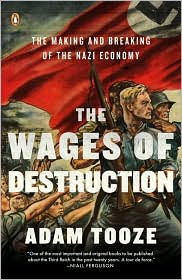
The Wages of Destruction: The Making and Breaking of the Nazi Economy by Adam Tooze

Dan from Madison at Chicago Boyz has reviewed Wages of Destruction, which led me to pick up a copy recently and start reading. Like Niall Ferguson, Tooze puts economic history into a dramatic explanatory context. If you have doubts, pick up a copy and flip to the chapter entitled “The Grand Strategy of Racial War” and read. You’ll walk out of the store with it.

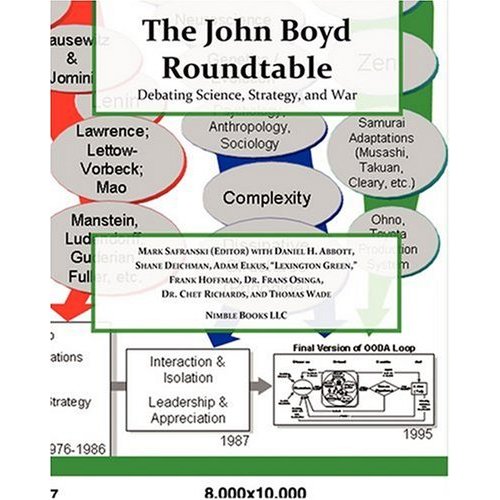
The John Boyd Roundtable: Debating Science, Strategy, and War by Mark Safranski, Daniel Abbott, Chet Richards, Shane Deichman, Thomas Wade, Frans Osinga, Adam Elkus and Frank Hoffman. Foreword by Thomas P.M. Barnett

A refinement and extension of the online roundtable at Chicago Boyz dedicated to reviewing Science, Strategy and War by Col. Frans Osinga (see below) and debating the ideas of the late strategic theorist Colonel John Boyd. Great for both the “Boyd expert” and those wanting a quick primer before tackling Osinga’s monumental work of strategic studies and intellectual history [ Full Disclosure: for newer readers who may not be aware, I was the editor and I’m shamelessly self-promoting here  🙂 ] 

Science, Strategy and War: The Strategic Theory of John Boyd (Strategy and History)  by Frans Osinga

Dr.Osinga has delivered a meticulously researched tome that William Lind called “the book Boyd would have written” that explains Colonel John Boyd as “the first postmodern strategist”. Osinga walks the reader through Boyd’s intellectual journey into fields as far removed from classical military studies as cybernetics, knowledge theory and the work of mathematician Kurt Godel and explains how Boyd distilled a strategic worldview on the nature of conflict and competition.


The Culture of War by Martin van Creveld

Eminent and controversial Dutch-Israeli military historian Martin van Creveld expands upon his body of work that is often described as “prophetic” these days in order to argue the intrinsic cultural value of war.

The Black Swan: The Impact of the Highly Improbable by Nassim Nicholas Taleb

This was the “must read” book of the blogosphere in 2007- 2008, widely cited (though perhaps first by John Robb) for the Black Swan concept itself. Taleb is an idiosyncratic, wide-ranging, writer interested in counterintuitive perspectives and is deeply skeptical of the validity of existing epistemological methodologies. Parts of the book will be of interest only to those with advanced backgrounds in probabalistic analysis and mathematics but there is much else that is intriguing and entertaining along the way while Taleb explains the characteristics of Extremistan and Mediocristan. A friend who moves among quite a few “thought leaders” described Taleb to me as “arrogant” but with something of value to say. Agreed.

On War (Oxford World’s Classics) by Carl von Clausewitz

Pick up a copy and join us during the Clausewitz Roundtable in January!!

Annihilation from Within: The Ultimate Threat to Nations by Fred C. Ikle

Ikle, a senior Defense Department official in the Reagan administration tackles apocalyptic threat scenarios including the one coming from our own best efforts to avoid them. A gloomy but thought-provoking read.

The Cold War: A New History by John Lewis Gaddis

Gaddis intended to write a book for the college undergraduate or layman that concisely explains the Cold War and the “why ?” of the victory of the West and generally does a superb job of it.  The undercurrent or background that may not be obvious to the layman is that Gaddis is sticking a thumb in the collective eye of the revisionist diplomatic historians of the New Left – notably Walter LaFeber, Lloyd Gardner, Gabriel Kolko and Robert Buzzanco and others descending at least vaguely from the school of thought founded by William Appleman Williams.

Stalin: The Court of the Red Tsar by Simon Sebag Montefiore

A brilliant example of Soviet studies scholarship. I’ve read innumerable books on Stalin and the USSR and I still learned things from  Montefiore. Highly recommended.

The Third Reich in Power, 1933-1939 by Richard J. Evans

The second book in his trilogy on the history of Nazism, Evans looks at the Nazi state and party apparatus and German society during the years of peace. Evans, along with Michael Burleigh, Ian Kershaw and Adam Tooze are revising our understanding of the Third Reich and illuminating that as evil as Hitler’s regime was in fact, it ultimately was intended to be several orders of magnitude worse had Germany won the Second World War.

Nixon and Kissinger: Partners in Power by Robert Dallek

A deeply partisan work of history, Dallek makes little effort to be fair (especially in the first half of the text) to either Richard Nixon or Henry Kissinger, both whom he characterizes as mentally and emotionally unstable, if highly intelligent, personalities and makes an argument that Nixon’s mental state during the Watergate crisis required his removal from office under the 25th amendment. It’s difficult to imagine Dallek treating Bill Clinton or LBJ in similar fashion, regardless of their personal behavior or abuses of power because seldom does Nixon ever get the benefit of the doubt ( in comparison Richard Reeves’ devastating profile, Nixon: Alone in the White House is a work of hagiography).

Why read Nixon and Kissinger then ? Because Dallek, despite his biases, has done an outstanding job in presenting new sources and evidence and his delving into the China Opening and Nixon and Kissinger’s very complicated personal relationship, remains a first-rate work of scholarship. Therefore, I say “Read it” ( just do not let it be the only book you read on Richard Nixon).

That’s it!


Depth, Breadth and Velocity

Wednesday, August 27th, 2008

I thoroughly enjoyed John Hagel’s post Stupidity and the Internet where he analyzed the implications of the book vs. snippet debate initiated by Nick Carr’s  Atlantic article “Is Google Making Us Stupid?”. Hagel properly broadened the debate away from content format to encompass the social sphere:

But if the concern is about intelligence, thinking and the mind, then isn’t content just one small piece of the puzzle?  Nick and many of the digerati who line up against Nick have one thing in common – they are content junkies.  They consume content voraciously and care deeply about the form that content takes. 

In the heat of debate, they seemed to often lose sight of the fact that most people are not content junkies.  Most people use the Internet as a platform to connect with each other.  Sure, they are exchanging information with each other, but they are doing a lot more than that.  They are learning about each other. They are finding ways to build relationships that expand their understanding of the world and enhance their ability to succeed in their professions and personal lives.

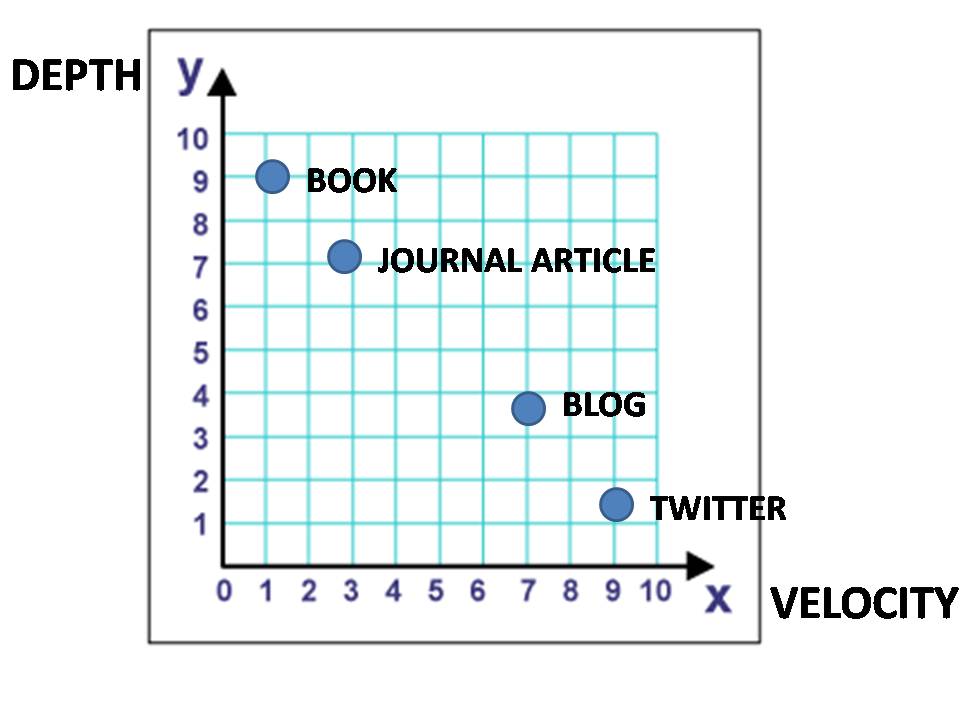
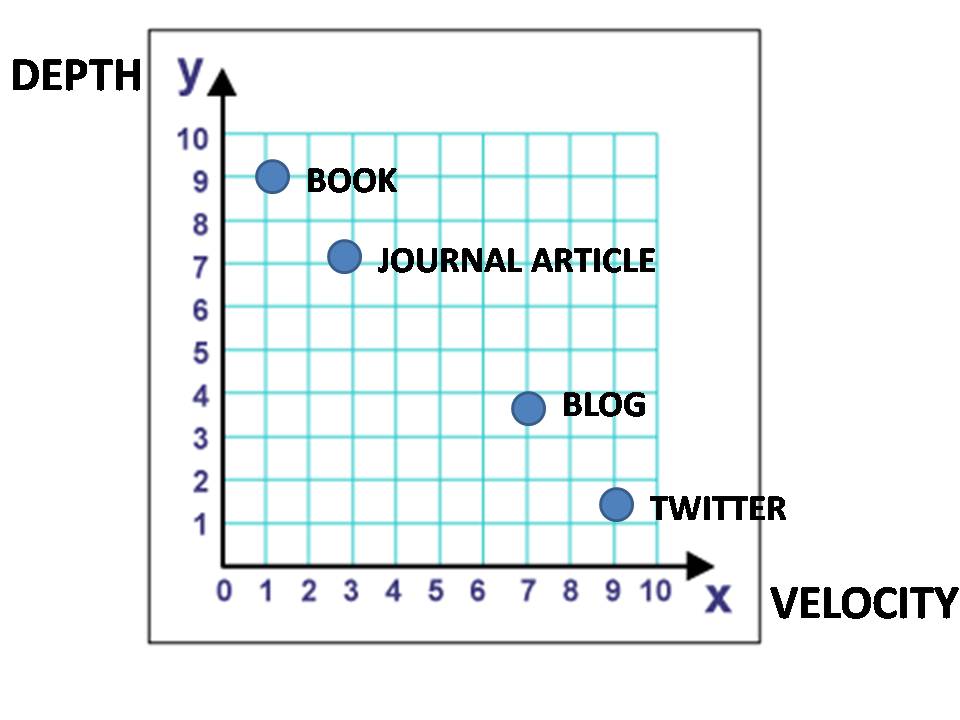
I’m going to back the discussion up a half-step by pointing out that these online relationships are often, initially of a transactional nature. Information is being exchanged and the kind of information used as a “hook” to capture attention may be determinative to the trajectory the social relationship may take and the rate of information exchanged may determine if the social connection can be sustained. To simplify, we are discussing Depth, Breadth and Velocity of information:

graph1.jpg

Books, journal articles, blog posts and Twitter “tweets” ( 140 character microblogging) could have their relative informational and transactional qualities be represented on a simple graph. Books have the greatest potential depth but the least level of timely, qualitatively reciprocal, informational transaction for the author ( primarily gained from the relationship with the editor or a “sounding board” colleague). Peer review journals are next, with a narrow community of experts sanctioning the merit of the article or rejecting it for deficiencies that put the work below or outside the field’s recognized professional standards. Blog posts can potentially generate an enormous volume of feedback, though at the cost of a dramatically inferior “signal to noise ratio“. Microblogging services like Twitter have hyperkinetic transaction rates but unless used strategically ( for example, by Robert Scoble) or within an existing social network, they generate little other than useless noise.

Attention can be attracted by a clever “snippet” – particularly if the concept itself has ambiguity or nuance that would intrigue more people than if it were precisely defined – but the attention will not be held unless the author can sustain the flow of interesting material, something that requires depth of knowledge about a subject.  Even better is to have depth in a subject along with breadth, the ability to think horizontally across many domains to spot emergent patterns, construct powerful analogies and distill a meaningful synthesis. In turn, pulling a willing audience of useful collaborators into a relationship around such intellectual pursuits hinges on first gaining their attention with a comprehensible simplification of complex abstractions and exhibiting a willingness to interact on a reciprocal basis.

It’s not a case here of “Books vs. Google”. Depth, breadth and velocity of information are interdependent and mutually reinforcing.

Information Operations Uber-Post

Wednesday, August 6th, 2008

Matt Armstrong has a must-read analytical, IO piece up at CTLab Review:

New Media and Persuasion, Mobilization, and Facilitation

…New Media is more than 24/7 news cycles. It is the ability to create trusted peer relationships, or the appearance of, to create legitimacy of information as well as depth and breadth of acceptance. This can be done as traditional media or other new media outlets pick up on a bit of “news” for redistribution, giving the impression of validity as the sources go up from one to many, often in excess of the three needed to create a “fact.” It is easier to see you’re not alone in the New Media environment, something that was not possible with radios and film (unless you risked gathering as a group).

There are several defining characteristics of the new media environment. The obvious are hyperconnectivity, persistence of information, inexpensive reach, and dislocation with speaker and listener virtually close but geographically distant. New Media also democraticizes information in the sense that hierarchies are bypassed, permitting both direct access to policy and decision makers and the possibility of “15-minutes of fame” (if even only one minute or less) to everyone. Information can be created and consumed by everyone regardless of “eliteness,” CV, and at minimal cost to any party.

All true and well said. Matt however points to a seldom recognized but critical variable here:

To the insurgent and terrorist, New Media’s capacity to amplify and increase the velocity of an issue that is critical. They increasingly rely on the Internet’s ability to share multiple kinds of media quickly and persistently to permit retrieval across time zones around the world from computers or cell phones. The value is the ability to not just persuade an audience to support their action, but to mobilize their support and to facilitate their will to act on behalf of the group (or not to act on behalf of another group, such as the counterinsurgent).

Velocity is very important in many senses. An accelerating message tempo heightens the sense of crisis in the mind of the audience so long as it does not move so quickly as to slide into unfiltered “noise”. Control of velocity also permits the exploitation of “information lag” in slower moving hierarchies or audiences. Finally, this velocity is really “alinear”; the ability of new media tools to “mash-up” entirely unrelated events separated by time, distance and circumstance and synthesize them out of context permits the scoring of tactical propaganda victories.

Read all of Matt’s post here.

Building upon the “Renaissance Networks” Meme

Wednesday, July 30th, 2008

This is what I like best about the blogosphere and Web 2.0. The evolution of ideas.

Recently, Galrahn at Information Dissemination had an excellent post where he coined the term “Renaissance Networks” (he should trademark that one) where he argued, in part:

We think the concept of “Renaissance men” is evolving into “Renaissance networks”, they range from the generalists (like Matt and David), the interested citizens (you, being a politically active, informed citizen, in the case of this blog interested in military and specifically maritime strategy), and the larger network that extends to the specialists whom takes various forms like media and research, and who ultimately disseminate through various mediums including periodicals like Proceedings or even a Research organization like CSBA.

The point is, when one observes the evolution of social media networks, not only do we see a Think Tank 2.0 replacing the Think Tank in the future, we also see the development of a hierarchy of information dissemination from the generalists to the specialists for discussion, and back up to the generalists for broader information redistribution. This hierarchy is already well developed in politics, information technology, and entertainment, but the emergence of professional and topic centric blogs for the national security debate and foreign policymaking are slow in coming, but those blogs are emerging. It will take time for consensus to build among the “punditsphere” regarding who the professionals are, but we are already seeing movement on that as well.

That inspired my CTLab colleague Drew Conway to post up with “Points of Failure in the “Renaisance Network” :

Knol fits in ID’s hierarchical model somewhere at the top; however, we must be cautious of the inherent faults of this system. For example, Knol uses a ranking system of five stars to give the audience an idea of a piece’s quality. Like other social media outlets (del.icio.us and digg.com), the rankings can be skewed by intentional manipulation (paid services to increased the number of bookmarks or ratings), or online mob behavior to push flavor-of-the-week pieces to the front page. More troubling, though, is the digital tunnel vision that social media construct. Cass Sunstein has been the loudest voice on this issue for several years, and in his Republic.com 2.0 he points out

…people should be exposed to materials that they would not have chosen in advance. Unplanned, unanticipated encounters are central to democracy itself. Such encounters often involve topics and points of view that people have not sought out and perhaps find quite irritating.

It is one thing to allow social media to find the “hottest” site at any given moment, but it is a different thing entirely to allow that same system to determine authoritative works.

In turn, fellow SWC member Dr. Marc Tyrell picked up the meme and ran with it with “Renaissance networks”: social media and reciprocity systems. This is a heavily linked post but here is one part:

In most of my work, I’ve argued in one way or another, that this “shift” to a network society is not “new” by any stretch of the imagination. It is, in fact, a shifting to a form of social relations that was dominant throughout our species history, probably as early as Australopithicines (if not earlier), and not replaced by another form until circa 10-12,000 years ago with the Agricultural Revoltion (aka the Neolithic Revolution). I find it exceedingly unlikely that any species would evolve for several millions of years without developing specialized neural circuitry to handle the problems and opportunities inherent in their social environment (along with mechanisms to detect cheaters). As Cosmides and Tooby have noted, “Our modern skulls house a stone age mind”.

Inherent in much of the discussion over this “shift” is a concept of linear time that I find exceedingly frustrating. The implication is that this shift is either an evolution (or revolution… take your pick) that is following along some pre-determined teleological vector. What is lost in the discussion, mainly because the linearity of time is assumed, is the recognition that this is not a “radical” change but, rather, a “phase change” – a shift between different forms of social relations, all of which are inherent in the human species (see Alan Fiske’s Structures of Social Life).

“Phase transition” is a nice analogy from physics, which my longtime friend Dr. Von has applied to discussions of “emergence” and network theory in the past. I agree that it is a useful way of shorthanding complex but apparently seamless changes in human social network behavior, where “tipping points” mark significant alterations, that we cannot explain as a sequential process.

In any event, cyclical conceptions of society and time have a long pedigree. Polybius argued for cyclicality in governance as did Confucianist assumptions regarding virtue and the mandate of Heaven or salvation concepts inherent in Hinduism and Buddhism. What social network phase transitions may be creating may be less cyclical in nature though than asynchronous; permitting divergence, co-evolutionary development and fusion of behavioral trend lines.


Nice Post on Social Networking Connectivity

Tuesday, July 29th, 2008

Picked this up on Socialmedian:

Broadcasting BrainHyperconnectivity shakes up six degrees of separation

Type 0 and 1 plus:

  • Social media and Web 2.0 (social news, social bookmarking, and social networking)
  • Microblogging, aggregators, lifestreaming, blog commenting
  • Audio and video blogging
  • Open IM clients (e.g. GTalk)
  • Wireless connectivity

Communication advances have generally created faster and easier to use methods. In the pre-Internet era, nothing was faster than a phone call except for a face-to-face meeting (although travel time to arrange a face-to-face meeting was often prohibitive). Today we have a number of methods that allow virtually real-time interaction and more variations on them seem to appear on a regular basis.

Lots of visuals in this post. The author seems to be alluding to attention economy variables in Part II.


Switch to our mobile site