zenpundit.com » iraq

Archive for the ‘iraq’ Category

Of dualities, contradictions and the nonduality II

Tuesday, July 30th, 2013

[ by Charles Cameron — notes towards a pattern language of conflict and conflict resolution: bridging divides in Baghdad 2013, Netherlands 1888 and the Germanies 1961 ]
.

I’ll be collecting examples of “dualities and the non-dual” here, because they give us a chance to consider the pattern that underlies “conflict and conflict resolution” and much else besides. This post picks up on an earlier post on the same topic: I’ll begin with three tweets that came across my bows this last week…

First, a vivid glimpse of sectarianism in today’s Iraq:

Second: sectarianism in the Netherlands, 1888:

And last, unexpected but charming, the divided Berlin of 1961:

It’s obvious once you think about it — thought we don’t always remember, such is the mind’s propensity to distinguish, divide, and argue from just one half of the whole — that human nature embraces both conflict and conflict resolution.

Those black banners / AQ flags, revisited

Tuesday, July 9th, 2013

[ by Charles Cameron — don’t let’s go overboard, eh? ]
.

I’d like to note up front that Liz Sly was talking about a pro-Morsi rally, and Leah very possibly about an anti-Morsi event…

In any case, these two tweets between them remind me that my own interpretation of “black banners” in terms of the army from Khorasan may well be due for retirement except when specifically indicated.

**

I’ve been writing here for a while about the black banners of Khorasan and their apocalyptic resonance, especially for those in Afghanistan and recruiting for AQ: today I’d like to suggest two qualifications.

The first is that there are a variety of black flags flown in various parts of the world for various purposes, and have been since the Prophet first flew his black flag, the Raya. It seems plausible that the Khorasan ahadith originated with the ‘Abbasids, in support of their own miltary activities, and certainly black banners taken together with those ahadith have been a powerful recruiting tool for AQ, as illuuminated in their respective books by Ali Soufan and Syed Saleem Shahzad.

But there are black flags and black flags, some plain black, some bearing the shahada, some with what looks to be a replica of the Prophet’s seal — and the one that is most commonly called “the Al-Qaida flag” is the one that originated with the Islamic State of Iraq — see Aaron Zelin‘s post on the matterr at al-Wasat. That post, btw, is likely the one that seeded my thoughts here.

My second point, then? A problem arises when we begin to think that any black flag seen, photographed, or reported in any Islamist context is “the AQ flag” — or indeed that any of the varieties of black flag reported hither and yon would qualify for that appellation.

In Iraq, the flag with seal, okay. A black flag with shahada in a Khorasan / Mahdist context — yes, and with Mahdist overtones. Otherwise — maybe, or maybe not so much.

So could we be a little more cautious, and more specific?

As for Cairo — I wasn’t there, and haven’t see a Liz Sly photo, so I don’t know which black flag or flags she saw. And yes, she was at a pro-Morsi rally. But as Leah notes, in recent days black flags have been less prominent, and Egyptian flags more in evidence — as indeed, this photo from an anti-Morsi rally on July 3 this year suggests:

If my guess is any good, then, black flags showing up in Egypt now presumably indicate MB or Islamist but not necessarily by any means AQ sympathies, while Egyptian flags would appear to indicate dissatisfaction with Morsi and his Islamist cohorts, combined with strong nationalist sentiment and pride.

**

Corrections, amplifications etc are welcome… This is a test post, really: a big question mark. I’ve an inquisitive mind to be sure — but as you’ll have seen in my previous post, I also admit to ignorance.

Oh —

And now I’m totally confused, too — El Cid just pointed me to Arch Enemy‘s Under Black Flags We March video. Eh?

Every day is Ashura, every place is Kerbala

Wednesday, May 29th, 2013

[ by Charles Cameron — an Ayatollah’s video take-down of the Grand Mufti ]
.

Today’s latest news from the Long War Journal is titled Egyptian jihadists call for attacks in Shiite countries and opens with the paragraph:

Twenty Egyptian jihadists have issued a statement calling upon Sunnis to launch attacks in Shiite-led countries in response to the Assad regime’s offensive in Qusayr, a city in western Syria near Homs. The chief signatory on the statement is Mohammed al Zawahiri, the younger brother of al Qaeda emir Ayman al Zawahiri.

**

**

I’ve been having some conversations on Twitter recently in which I’d been verifying my own sense that Hezbollah‘s ethos and imagery of martyrdom would presumably extend beyond the poppies and doves depicted here to include also the martyrdom of Husayn at Kerbala, and I’m grateful to Phillip Smyth for his confirmation and elaboration on that theme.

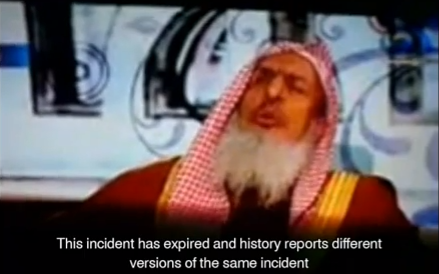
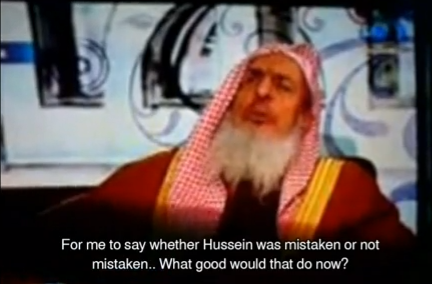
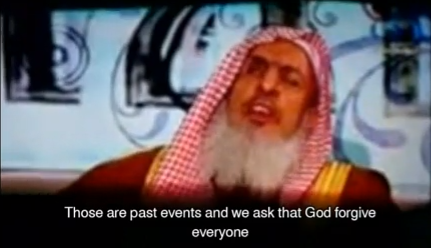
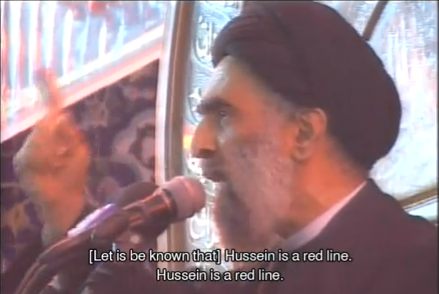
Somehow in my wanderings, I came across this video, in which Ayatollah Sayed Hadi al Modarresi, a senior Shia cleric, bookends his even more senior Sunni counterpart the Grand Mufti of Saudi Arabia, Sheikh Abdul Aziz al-Sheikh, with his own commentary, speaking from the very heart of Shia passion — the shrine of Imam Husayn in Kerbala.

The Ayatollah challenges the Grand Mufti’s assertion that Husayn erred in refusing his oath of obedience to Yazid, thus bringing his own death upon himself at the ensuing battle of Kerbala:

**

Things that impressed me:

The simple but rhetorically effective use of one video quoted within another.

The incredible passion of the crowd in Kerbala, which the poster called to our attention with a note saying:

Keep watching to see the fury of the audience..

The half-accusatory, half-conciliatory way in which the Grand Mufti expressed himself, with phrases that suggested Husayn — may God be pleased with him — was in error, while asking God to forgive him…

and:

and in response, the Ayatollah’s use of the imagery of the “red line”:

**

If the Long War Journal piece shows us an aspect of the current situation, this stunning video offers us a window into the passions such events are poised to arouse.

Furnish on Pew findings re: Islam

Thursday, May 2nd, 2013

[ Charles Cameron presenting guest-blogger Timothy Furnish ]
.
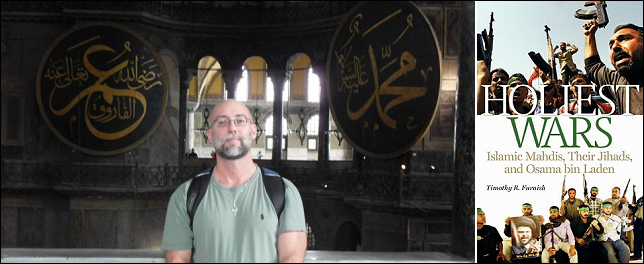

.

I’m delighted to welcome Dr Timothy Furnish as a guest-blogger here on Zenpundit. Dr Furnish has served as an Arabic linguist with the 101st Airborne and as an Army chaplain, holds a PhD in Islamic history from Ohio State, is the author of Holiest Wars: Islamic Mahdis, Their Jihads, and Osama bin Laden (2005), and blogs at MahdiWatch. His extended piece for the History News Network, The Ideology Behind the Boston Marathon Bombing, recently received “top billing” in Zen’s Recommended Reading of April 24th.

**

Does This Paint It Black, or Am I A Fool to Cry? Breaking Down the New Pew Study of Muslims
by Timothy R. Furnish, PhD
.

Pew has released another massive installment of data from its research, 2008-2012, into Muslim attitudes, entitled “The World’s Muslims: Religion, Politics and Society.” Over 38,000 Muslims in almost 40 countries were surveyed, thus constituting a survey both statistically sound and geographically expansive. Herewith is an analysis of that information and what seem to be its major ramifications.

The first section deals with shari`a, usually rendered simply as “Islamic law” but more accurately defined as “the rules of correct practice” which “cover every possible human contingency, social and individual, from birth to death” and based upon the Qur’an and hadiths (sayings and practices attributed to Muhammad) as interpreted by Islamic religious scholars (Marshal G.S. Hodgson, The Venture of Islam, Vol 1: The Classical Age of Islam, p. 74). Asked “should sharia [as Pew anglicizes it] be the law of the land,” 57% of Muslims across 38 countries answered “yes” — including, most problematically for the US: 99% of Afghans, 91% of Iraqis, 89% of Palestinians, 84% of Pakistanis and even 74% of Egyptians. Should sharia apply to non-Muslims as well as Muslims? Across 21 countries surveyed on this question, 40% answered affirmatively — with the highest positive response coming from Egypt (its 74% exceeding even Afghanistan’s 61%). And on the question whether sharia punishments — such as whippings and cutting off of thieves’ hands — should be enacted, the 20-country average was 52%, led by Pakistan (88%), Afghanistan (81%), the Palestinian Territories [PT] (76%) and Egypt (70-%). On the specific penalty of stoning for adultery, the 20-country average was 51% — with, again, Pakistan (89%), Afghanistan (85%), the PT (84%) and Egypt (71%) highest in approval. Finally, 38% of Muslims, across those same 20 nations, support the death penalty for those leaving Islam for another religion.

Huge majorities of Muslims across most of these surveyed nations say that “it’s good others can practice their faith” — but Pew’s imprecise terminology on this topic makes possible that this simply mean many Muslims are willing to grant non-Muslims the tolerated, but second-class, ancient status of the dhimmi. Majorities, too, in most countries say that “democracy is better than a powerful leader;” however, the latter was actually preferred by most surveyed in Russia, Bosnia-Hercegovina, Kyrgyzstan, Afghanistan and Pakistan, as well as by 42% of Iraqis, 40% of Palestinians and 36% of Egyptians. Most Afghans, Egyptians and Tunisians (and even 1/3 of Turks) believe that “Islamic political parties” are better than other ones, although 53% of Indonesians and 45% of Iraqis are also worried about “Muslim extremists.” (Curiously, 31% of Malaysians are, on the other hand, worried about “Christian extremists” — although evidence of such existing in that country is practically non-existent.) There is good news on the question of suicide bombing, however: across 20 countries, only 13.5% think it is ever justified — although the support is much higher in the PT (40%), Afghanistan (39%) and Egypt (29%).

In terms of morality, large majorities in most Muslim countries (especially outside Sub-Saharan Africa) think drinking alcohol is morally repugnant, notably in Malaysia (93%), Pakistan and Indonesia (both 91%). Most Muslims in most countries surveyed consider abortion wrong, as well as pre- and extra-marital sex and, almost needless to say, homosexuality. (Although one wishes Pew had asked about mu`tah, or “temporary marriage” — a practice originally Twelver Shi`i which has increasingly become used by Sunnis.) Yet, simultaneously — following Qur’anic rubrics — some 30% of Muslims in 21 countries support polygamy, including almost half of Palestinians, 46% of Iraqis and 41% of Egyptians. There is also significant support for honor killings in not just Afghanistan and Iraq but also Egypt and the PT. Over ¾ of Muslims across 23 countries says that “wives must always obey their husbands:” an average of 77%. And Pew notes that there is a statistically very significant correlation between sharia-support and believing women have few(er) rights.

Asked whether they believed they were “following Muhammad’s example,” 75% of Afghans and 55% of Iraqis answered affirmatively — although most Muslims were not nearly so confident. On the question “are Sunni-Shi`i tensions a problem,” 38% of Lebanese, 34% of Pakistanis, 23% of Iraqis and 20% of Afghans said “yes.”

It is no surprise that huge majorities of Muslims in most surveyed countries believe that Islam is the only path to salvation, nor that most also say “it’s a duty to convert others” to Islam. It is somewhat counterintuitive, however, that many Muslims say they “know little about Christianity” — even in places with large Christian minorities, such as Egypt. Muslims in Sub-Saharan Africa are the most likely to agree that “Islam and Christianity have a lot in common,” and so are 42% of Palestianians, as well as some 1/3 of Lebanese and Egyptians. But only 10% of Pakistanis agree. Asked whether they ever engaged in “interfaith meetings,” many Muslims in Sub-Saharan Africa said that they did (with Christians), and a majority of Thais said likewise (albeit with Buddhists). But only 8% of Palestinians, 5% of Iraqis, and 4% of Egyptians said they ever do so—despite substantial Christian populations in each of those areas.

Regarding the question “are religion and science in conflict,” most Muslims said “no” — with the exceptions of Lebanon, Bangladesh, Tunisia and Turkey where over 40% in each country (and, actually, a majority in Lebanon) said that they were at loggerheads. Most Muslims also say they have no problems with believing in Allah and evolution — the exceptions being the majority of Afghans and Indonesians. Regarding popular culture, clear majorities of Muslims in many countries say they like Western music, TV and movies—but, at the same time, similar majorities say that such things undermine morality (although Bollywood less so than Hollywood).

Observations:

1) The high degree of support for sharia is the red flag here. Contra media and adminstration (both Obama and Bush) assurances that most Muslims are “moderate,” empirical data now exists that clearly shows most Muslims, in point of fact, support not just sharia in general but its brutal punishments. Perhaps just as disturbing, almost four in ten Muslims are in favor of killing those who choose to follow another religion. And countries in which the US is heavily involved either diplomatically or militarily (or both) are the very ones where such sentiments run most high: Pakistan, Afghanistan, Egypt, the Palestinian Territories. So are the “extremists” these very Muslims who want to follow, literally, the Qur’an and hadiths? Messers Brennan, Holder and Obama have some explaining to do.

2) Afghanistan would appear to be a lost cause. Afghans are at the top of almost every list in support for not just sharia, suicide bombing, honor killing and — ironically (or perhaps not) — confidence that they are emulating Islam’s founder, as well as dislike for democracy. In light of this clear data, two points about Afghanistan become clear: tactically, ostensible American befuddlement as to the causes of “green on blue” attacks and the continuing popularity of the Taliban in Afghanistan appears as willful ignorance; strategically, the US decision to stay there after taking out the al-Qa`ida [AQ] staging, post-9/11, and attempt to modernize Afghanistan was a huge, neo-Wilsonian mistake. 2014 cannot come soon enough.

3) In some ways Islam in Southeastern Europe, and to a lesser extent in Central Asia, seems to be a more tolerant brand of the faith than the Middle Eastern variety. For example, the SE European and Central Asian Muslims are the least likely to support the death penalty for “apostasy,” and the most supportive of letting women decide for themselves whether to veil. And Muslims in Sub-Saharan Africa are the most likely to know about Christianity, and to interact with Christians. On the other hand, African Muslims are among the most enamored of sharia, and Central Asian ones fond of letting qadis (Islamic judges) decide family and property disputes. So there does not seem to be a direct link between Westernization and moderation; in fact, the influence of Sufism — Islamic mysticism — in the regard needs to be correlated and studied (beyond what Pew did on the topic in last year’s analysis).

4) One bit of prognostication based on this data: Malaysia may be the next breeding ground of Islamic terrorism. It’s home to some 17 million Muslims (61% of its 28 million people), who hold a congeries of unsettling views: 86% want sharia the law of the land; 67% favor the death penalty for apostasy; 66% like sharia-compliant corporal punishments; 60% support stoning for adultery; and 18% think suicide bombing is justified. PACOM, SOCOM and the intelligence agencies need to ramp up hiring of Malay linguists and analysts.

5) Finally, some words for those — like FNC’s Megyn Kelly and Julie Roginsky (on the former’s show “American Live,” 4/30/13) — who pose a sociopolitical and moral equivalence between Muslim support for sharia and Evangelical Protestant Christian support for wives’ obedience to husbands: that’s a bit too much sympathy for the devil. Yes, Evangelical Christian pastors hold some pretty conservative views of the family, as per a 2011 Pew study of them; for example, 55% of them do agree that “a wife must always obey her husband” (compared to 77% of Muslims). And, ironically, many such Evangelicals agree in large measure with Muslims on issues such as the immorality of alcohol, abortion and homosexuality. However, one searches in vain for any Evangelical (or other) Christian support for whippings, stonings, amputation of thieves’ limbs, polygamy or suicide bombing.

Islam is the world’s second-largest religion, numbering some 1.6 billion humans (behind only Christianity’s 2.2 billion). There is, thus, enormous diversity of opinion on many issues of doctrine and practice, and essentializing Islam as either “peaceful” or “violent” is fraught with peril. Nonetheless, this latest Pew study provides empirical evidence that many — far too many — Muslims cling to a literalist, supremacist and indeed brutal view of their religion. Insha’allah, this will change eventually — but time is not necessarily on our side.

Octavian Manea interviews MIT’s Roger D. Peterson

Friday, April 19th, 2013

Another installment of Octavian Manea’s excellent COIN interview series at SWJ. This one focuses on social science and varieties of insurgency:

Breaking Down “Hearts and Minds”: The Power of Individual Causal Mechanisms in an Insurgency 

….OM: In your research you pointed out to a spectrum of conceivable individual roles in an insurgency. What is the methodology behind this typology?

RDP: This methodology comes from my 2001 book (Resistance and Rebellion: Lessons from Eastern Europe) which focused on Lithuanian resistance to Soviets in the 1940’s. Insurgency is a complex phenomenon, especially in how violent organization and networks are created and sustained, and the methodology of that book involved breaking down this complexity into component parts and then building back up into a coherent whole. At the base of this process is the way individuals position themselves relative to the dramatic and violent events of insurgency. Most people may wish to remain neutral and just take care of their families but events push significant numbers of individuals into roles of unarmed support of insurgents, or local armed position of a militia, membership in a mobile non-local organization, or equivalent positions in support of the government.  Furthermore, individuals may move back and forth along this spectrum of roles. If one is skeptical of broad and vague theories at a high level of aggregation, as I am, then you need to get down and observe dynamics at a basic level. Observing movement along this spectrum of roles is one way to do that. 

…..Is it FM 3-24 and the whole contemporary Western COIN discourse too narrow, too much focused on rational, cost/benefit models of decision-making? Is it too restrictive when making this inventory of driving motivations or causal mechanisms?

RDP: I think there is a tendency in the Western academic analysis to focus on rational theories. Those theories are straightforward.  But they also might be too straightforward, too simple.  In Iraq, the coalition did not plan on the emotion of resentment stemming from a status reversal affecting Sunni calculations in the beginning stages of the conflict. We did not understand the revenge norms that exist in some of the places. We did not fully understand the social norms that helped to produce the tribal militias in Anbar province.  We did not understand the psychological mechanisms underlying the Sunni view of the new world they were living in. 

The last part is a curious lacuna.

The incompetence of the planning for the occupation of Iraq has been amply recorded – the high level disdain of General Tommy Franks and Secretary Rumsfeld for what befell the day after victory, the keeping of professional Arabists at arms length in preference for Beltway contractors and college kids with AEI connections, the haplessness of Jay Garner and the political obtuseness of Paul Bremer ad so on. This is not what I mean about lacuna.

I mean something more fundamental, in terms of understanding human nature as the root of political behavior and therefore political violence. We are all familiar with the Clausewitzian trinity (or should be) but less attention is paid to the motivational factors that make men decide to stand, fight and die or stand aside. Thucydides also had a trinity that did not attempt to capture the nature of war but rather explain why wars happened and it seems to me to be of particular use for evaluating the decision in small wars to pick up a gun or not, to side with the government or join the rebellion:

“Surely, Lacedaemonians, neither by the patriotism that we displayed at that crisis, nor by the wisdom of our counsels, do we merit our extreme unpopularity with the Hellenes, not at least unpopularity for our empire. That empire we acquired by no violent means, but because you were unwilling to prosecute to its conclusion the war against the barbarian, and because the allies attached themselves to us and spontaneously asked us to assume the command. And the nature of the case first compelled us to advance our empire to its present height; fear being our principal motive, though honour and interest afterwards came in. And at last, when almost all hated us, when some had already revolted and had been subdued, when you had ceased to be the friends that you once were, and had become objects of suspicion and dislike, it appeared no longer safe to give up our empire; especially as all who left us would fall to you. And no one can quarrel with a people for making, in matters of tremendous risk, the best provision that it can for its interest. 

Fear, honor and interest are ever present in “calculation” both by men and by the political communities they compose and the factions that threaten to tear them apart. All the more so in a defeated and broken country divided by ethnicity and sect where all parties were uneasily eyeing the conqueror. No special knowledge of Arab culture should have been required to anticipate that Iraqi men, if made desperate by uncertainty and circumstance, might have at least seen it in their interest to achieve some measure of security with the gun and to enact policies of carrots and sticks a priori to discourage that, before the insurgency gained critical mass.

Awareness of the universality of the Thucydidean trinity would not have in itself guaranteed success in Iraq but knowing it is a rudimentary minimum of political competence upon which you can at least build.


Switch to our mobile site