zenpundit.com » cultural intelligence

Archive for the ‘cultural intelligence’ Category

Bin Laden’s death and a White House or Palace

Tuesday, May 3rd, 2011

[ by Charles Cameron ]
.

Okay, you may groan and skip quickly to the next post or perhaps read with bemused interest every time I post here about Islamic eschatology — but in either case you might have hoped that the death of bin Laden would have no apocalyptic resonance whatsoever.

Sadly enough, Anjem Choudary — co-founder with Omar Bakri Muhammad of the UK’s Islamist group al-Muhajiroun – has a press release posted on his website today titled May Allah grant Sheikh Usama Martyrdom. It begins:

The announcement this morning of the death of Sheikh Usama Bin laden has been met with joy in the United States and by other enemies of Islam and Muslims. I would like remind everyone that someone much better and much more significant then Sheikh Usama Bin laden passed away in the past, namely the Messenger Muhammad (saw) and that this never stopped the Jihad nor the spread of Islam to the East and West. Indeed the Messenger Muhammad (saw) said that the day of judgement will not come until a group of Muslims conquer the White House.

The hadith in question comes from Sahih Muslim, Book 19, On Government (Kitab Al- Imara) 4483, and reads as follows:

Narrated Jabir ibn Samurah:
.
It has been narrated on the authority of Amir ibn Sa’d ibn AbuWaqqas who said: I wrote (a letter) to Jabir ibn Samurah and sent it to him through my servant, Nafi’, asking him to inform me of something he had heard from the Messenger of Allah (peace_be_upon_him). He wrote to me (in reply): I heard the Messenger of Allah (peace_be_upon_him) say on Friday, the day on which al- Aslami was stoned to death (for committing adultery): The Islamic religion will continue until the Hour has been established, or you have been ruled by twelve Caliphs, all of them being from the Quraysh. I also heard him say: A small force of the Muslims will capture the white palace, the palace of the Persian Emperor or his descendants. I also heard him say: Before the Day of Judgment there will appear (a number of) imposters. You are to guard against them. I also heard him say: When God grants wealth to any one of you, he should first spend it on himself and his family (and then give it in charity to the poor). I heard him (also) say: I shall be your forerunner at the Cistern (expecting your arrival).

I suppose I should apologize, but “until the Hour has been established” and “Before the Day of Judgment” are both clear “end times” references.

A poster on SunniForum quotes this hadith from Muslim, one of the two hadith collections regarded as most reliable and given the epithet “sahih” (authentic), and follows it with another, citing Al-Tabarani, Al-Mu’jam al-Kabeer 2.198:

Jabir b. Samura said: I heard the Messenger of Allah (may peace be upon him) say on Friday evening, the day on which Ma’ez al-Aslami was stoned to death (for committing adultery): A small force of the Muslims will capture the white house. I said: Kisra? he replied Kisra.

Be it noted that while “white palace” or “white house” would both be appropriate translations of the term used, Kisra clearly refers not to the house of the US President in Washington DC, but to the palace of Khosrau (Chosroes) I of Persia in Ctesiphon (now an impressive ruin in Iraq).

*

I expect I found the Anjem Choudary press piece following a lead from Aaron Zelin, and if so I owe him double thanks – because he also pointed me to this quote from a member of the Ansar Forum:

al-Qaeda are the people of the Victorious Sect, which recognizes the last of the banner to the Mahdi

The victorious sect is the one sect of Islam out of very many that holds fast to the Prophet’s teaching, see the hadith collected here. As UCLA historian Jean Rosenfeld noted in a comment on the al-Sahwa blog:

Al-Qaida took the Salafi myth of the Saved Sect and the Victorious Group and applied it to themselves. This is in line with the need for converts to see themselves as heroes carrying out a transcendent purpose.The Saved Sect was turned into an eschatological myth by bin Ladin and his compatriots. It is a group of warriors who sacrifice themselves for the Din, the Land, and the people. The members of the Sect are a vanguard and they are few. Not only are they attacked by their opponents, but fellow Muslims may persecute them. Thus, if the group remains small and is regarded as practicing fitnah and is denounced, that only validates the group’s certitude that it is the Saved Sect. Only this sect — out of “72 sects” (note: this is probably a symbolic number meaning “many”) — will attain paradise at the end time.

*

A couple more clear instances of end-times associations in the (Sunni) jihadist current…
The DARPA arts

Friday, April 29th, 2011

[ by Charles Cameron ]

.

Blog-friend Cameron Schaefer has a piece up at Small Wars Journal today in which he quotes Boyd (writing that his approach “incorporated science, but more closely approximated the often chaotic, creative impulses of art”) and Mahan (“art, out of materials which it finds about, creates new forms in endless variety”), and concludes:

Approaching strategy in an indirect fashion, as more of an art than science may make some uneasy, specifically those who find safe haven in the concreteness of checklists and formulas. Yet, the nature of strategy reflects the nature of the world. It is infinitely complex, it is always changing and it is filled with humans that often do irrational things. Literature (see Charles Hill) and psychology have as much of a place at the strategy table as military history… as do mathematics, physics, political science and technology. So, when asking, “what must one study to be a great strategist?” the answer seems to be, “everything else.”

Okay, so that (and Hill‘s work, which Zen reviewed recently) gives us the significance of the arts in strategic thinking which, one hopes, is practiced before going in to battle, and may indeed give one second thoughts about it…

*

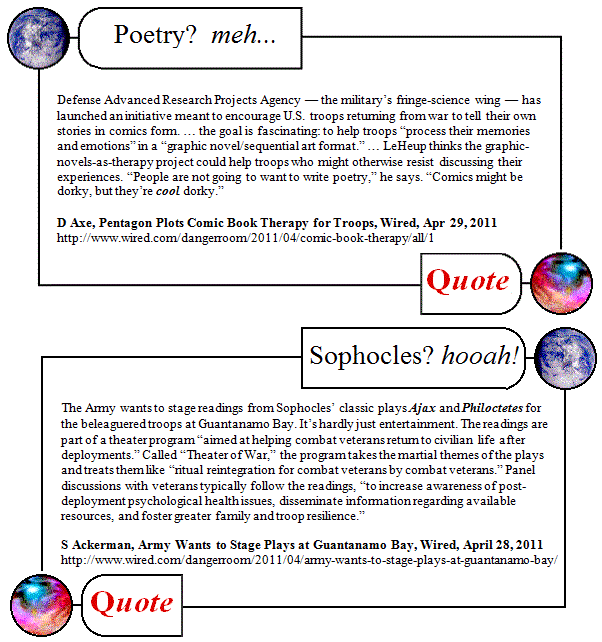
Literature and the arts are also important after battle, though – and the US Military and DARPA have clearly been thinking about that side of things:

quodarpa-arts1.gif

Sources: ComicsPlays

Poetry? meh… Sophocles? Chlanna nan con thigibh a so’s gheibh sibh feoil!

*

Lionel Tiger and Robin Fox in The Imperial Animal characterize modern health care as the “bureaucratization of mercy” and propose that for comparison, we set it beside:

the Greek ideal of the hospital as the place with the best food, the finest furnishings and paintings, and the most skilled musicians and comedians.

The greatest healing center in ancient Greece was the Asclepion at Epidavros / Epidaurus, which housed an amphitheater that could seat more than ten thousand people for dramatic and musical performances without amplification.

At Epidavros, patients would be healed by watching those same dramas of Sophocles to which the US Army is now turning for therapeutic relief in Guantanamo — for as Tiger and Fox (what a pair of names) go on to argue:

It is not the healthy, but the sick who most vitally needed such agreeable and re-creative stimuli; and the resources the community had were most beneficially and sanely used in helping them ease their personal disarray and feel encouraged by this display of their community’s careful concern.

*

It’s also interesting to note that the graphic novel Silver Shields mentioned in Axe‘s piece as a precursor to DARPA’s “Online Graphic Novel/Sequential Art Authoring Tools for Therapeutic Storytelling” project is “set during the ancient Greek invasion of Afghanistan more than two millenniums ago” as a metaphor for America’s current situation…

The Glenn Beck, Mahdism & Antichrist series

Wednesday, April 27th, 2011

[ by Charles Cameron ]

.

Glenn Beck has a new documentary coming out tonight on Mahdism and the Antichrist.

He calls it “the documentary that you will not see on mainstream television” and to get to see it, you have to be a subscriber to Beck’s Insider Extreme channel on the web. But then that fits with Beck’s emphasis right now — he doesn’t mind crying shame on the media for not carrying the documentary, but he doesn’t want unbelievers to see it either — he told his radio audience today:

Make sure you see it tonight at nine o’clock. And if I may recommend that you watch it with some friends. Invite some friends over, some like-minded people, don’t try to get any converts in. Pull up the nets, man, pull up the nets.

So okay — it won’t be on “mainstream television” but it will be seen in a million “like-minded” homes, and it will influence them, it will influence their perspective on Islam, and on the Middle East.

Here’s a description of what they can expect, drawn from Joel Rosenberg‘s blog today. Joel is the author of the apocalyptic thriller The Twelfth Imam, has seen the rough cut and will be appearing on the video, along with those he lists here:

Tonight on his website, Glenn Beck will premiere his new documentary film, “Rumors of War — Part Two.” As with Part One, I was interviewed for the film…

The documentary examines current events and trends in the Middle East and the Islamic world from various vantage points — Biblical End Times theology, Jewish End Times theology, and Islamic End Times theology. It discusses the latest threats from the Radical Islamic world to Israel, the West and our allies. It features a wide range of Jewish, Muslim and evangelical Christian authors and commentators in a balanced yet provocative and fascinating way. Among them:

  • Dore Gold, former Israeli ambassador to the U.N.
  • Reza Kahlili, former CIA agent inside Iran and author of A Time To Betray
  • Tim LaHaye, author of the Left Behind novel series
  • Brigitte Gabriel, author of They Must Be Stopped: Why We Must Defeat Radical Islam and How We Can Do It
  • Joel Richardson, author of The Islamic Antichrist
  • Dr. Zudi Jasser, president of American Islamic Forum for Democracy

*

The thing is, Beck doesn’t know a whole lot about these things, and his advisers get things wrong — sometimes flat out wrong, sometimes just out of proportion — too.

I aim to review Beck’s documentary along with its predecessor, and the books of Joel Richardson and Joel Rosenberg, and also take a look at some other books and articles that cover the same materials with greater scholarship and less religious special interest — notably the works of David Cook, J-P Filiu and Timothy Furnish — clear up some of this issues in which definitive corrections are in order, suggest areas where the preponderance of evidence and informed commentary leans away from Beck’s position, and raise again those urgent questions which remain.

Because from where I sit, Glenn Beck has hit on one of our blind spots — and is giving us a dangerously distorted mirror in which to view it.

*

Here’s Beck talking about the upcoming documentary this morning on his radio show:

Tonight, you don’t want to miss, on Insider Extreme, something that we have been trying to tell the story for quite some time, and I have told it to you many times before, the story of the Twelfth Imam, well this is not the full story of the Twelfth Imam, this is what people Middle East believe about the Twelfth Imam, or the Mahdi as the… Sunnis? Sunnis are in Egypt, Shias are in, ah, is it Shias in Iran or is it the other way around? I think it’s S.. Shias are in Iran. One believes in the Twelfth Imam, the others believe in the Mahdi, same guy, it is the… the… you would know it as the Antichrist. It is the, it has every earmarking of the Antichrist, every single one, I mean, he makes a peace for seven years with Egypt, he viol… — I mean with Israel, he violates it, he marks people with a number, he beheads people if they don’t submit, I mean it’s all there. It’s all there. And Ahmadinejad says that he is alive and well and orchestrating the things in the Middle East.

Did you get that? He’s not sure: “is it Shias in Iran or is it the other way around?”

If Beck has been working on this documentary for a year now, let’s hope he does in fact know the difference between Sunni and Shi’a, and that he’s using the popular gag technique of pretending not to know, so his audience — who haven’t all been working on a documentary and may well not know — can feel all the more strongly “he’s one of us”. And besides, Sunni, Shia, it’s all the same, Mahdi, Twelfth Imam, no difference at all, right?

So that’s the level of required accuracy that’s tolerated here. Which side was it wanted to keep slavery? I forget now, I think it may have been the South. Belfast — now is that Catholic, or Protestant?

*

And one last quick note from the same post on Joel Rosenberg’s blog:

As far as I can tell, Glenn Beck is leaving the Fox News Channel in part because Fox is opposed to him devoting so much time on his program to End Times issues, Bible prophecy, Iran’s eschatology, and the linkage of these things to left wing efforts to sow seeds of revolution and chaos. It’s too bad, really.

That’s an interesting data point.

*

There will be plenty to talk about, anyway:

the new documentary, Joel Rosenberg’s thriller, which I enjoyed, Joel Richardson, with whom I correspond and whom I like, the new Mahdist video in Iran which is causing quite a stir, and may or may not be an “official” Iranian production, the vexed question — vexed in all three Abrahamic faiths — of whether you can hasten the coming of the Awaited One and if so, how, and the implications of all this both in the United States and in the Middle East, the Iranian nuclear program…

The Glenn Beck, Mahdism & Antichrist blog series, coming up.

More on Where Good Ideas Come From

Tuesday, April 19th, 2011

Dr. Von weighed in on Steven Johnson’s Where Good Ideas Come From with an extensive book review last December( I posted on Johnson here. On a related note, read Charles Cameron’s comment about the limitations of linear thinking here):

Where do New Ideas come from?

….But what exactly are innovation and creativity? The dictionary definition of innovation is ‘the introduction of new things or methods,’ while creativity is ‘the ability to create meaningful new ideas, forms or methods’ that are original and imaginative. So the key notion is the development of new ideas in whatever field one is working. A question naturally develops, which is where do new ideas come from? How do we begin preparing children now to be creative and innovative in the future? In the past, many would have first thought about the arts as being the training ground for creativity. Now, we realize that the development of the abilities and mindsets and skills necessary to be creative in every field of study is necessary.Steven Johnson’s new book, Where Good Ideas Come From: The Natural History of Innovation, provides the argument that there are seven common themes that have led to the vast majority of great ideas throughout history. He gives numerous examples of such ideas, ranging from Darwin’s development of the theory of evolution to the of the GPS system, from Google to the creation of the first mechanical computing devices centuries ago, and so on. It is an interesting read.Here is a summary of the seven themes that lead to good ideas. Keep in mind there is certainly some degree of overlap and relationships between the themes, but overall they can be thought of as distinct concepts.1. The Adjacent Possible: Even if you have an interest in some topic or problem, if there is not a good environment conducive to presenting the necessary pieces to solve the problem, good ideas will almost certainly not develop. You may be brilliant with some of the information (i.e. pieces of a puzzle) in your mind that is necessary to solve a problem, but if your surroundings are not able to provide the remaining pieces of information or experiences, you will endlessly search for them to no avail. If you are isolated from others who know something about your problem or issue, or if there is no means of gathering further information (which is becoming less of a problem with the advent of the Internet), or if your environment does not provide the physical infrastructure or supplies to finish building a new physical device, you will be unable to develop the Idea or solution to your problem.

2. Liquid Networks: Great ideas can develop when information is allowed to flow through a larger network. One possible network is a social network, or often and more specifically, a professional network. The focus of this is the ability to collaborate to solve problems. It turns out that there are almost no great ideas throughout history that have been developed in isolation or by an individual who did not need any help in the development of that great idea. One may think Newton or Einstein did their work in isolation, but this is not entirely true. Those two individuals come about as close as you can get to not needing a network to develop the laws of motion or relativity, but they relied on some level of feedback, reading others’ work, and ultimately talking and discussing issues with close colleagues and friends.
An interesting study was done that looked at how research groups reach the coveted ‘Eureka!’ moment, where a new discovery is made. It turns out that these rare moments of discovery or problem solving almost never happen in the lab! Instead, the ‘Aha!’ are yelled out at the conference table, where members of the group are throwing ideas around and sharing results of their latest work over the past week. The person who figures it out needs to have input they have not thought about from the larger group or network, before the grand idea is formed….

Read the rest here.

Head to Head: Colin Gray and Joseph Nye on Soft and Hard Power

Friday, April 15th, 2011

Colin Gray is one of the four or five go-to strategic thinkers around today. Joseph Nye, the father of the soft power concept, is a seminal figure in Political Science and International Relations.

Colin S. Gray  Hard Power and Soft Power: The Utility of Military Force as an Instrument of Policy in the 21st Century

….Unfortunately, although the concept of American soft power is true gold in theory, in practice it is not so valuable. Ironically, the empirical truth behind the attractive concept is just sufficient to mislead policymakers and grand strategists. Not only do Americans want to believe that the soft power of their civilization and culture is truly potent, we are all but programmed by our enculturation to assume that the American story and its values do and should have what amounts to missionary merit that ought to be universal. American culture is so powerful a programmer that it can be difficult for Americans to empathize with, or even understand, the somewhat different values and their implications held deeply abroad. The idea is popular, even possibly authoritative, among Americans that ours is not just an “ordinary country,” but instead is a country both exceptionally blessed (by divine intent) and, as a consequence, exceptionally obliged to lead Mankind. When national exceptionalism is not merely a proposition, but is more akin to an iconic item of faith, it is difficult for usually balanced American minds to consider the potential of their soft power without rose-tinted spectacles. And the problem is that they are somewhat correct. American values, broadly speaking “the American way,” to hazard a large project in reductionism, are indeed attractive beyond America’s frontiers and have some utility for U.S. policy. But there are serious limitations to the worth of the concept of soft power, especially as it might be thought of as an instrument of policy. To date, the idea of soft power has not been subjected to a sufficiently critical forensic examination. In particular, the relation of the soft power of attraction and persuasion to the hard power of coercion urgently requires more rigorous examination than it has received thus far.

Joseph Nye –The War on Soft Power

….In 2007, Richard Armitage and I co-chaired a bipartisan Smart Power Commission of members of Congress, former ambassadors, retired military officers, and heads of non-profit organizations at the Center for Strategic and International Studies in Washington. We concluded that America’s image and influence had declined in recent years and that the United States had to move from exporting fear to inspiring optimism and hope.

The Smart Power Commission was not alone in this conclusion. Even when he was in the George W. Bush administration, Defense Secretary Robert Gates called on Congress to commit more money and effort to soft-power tools including diplomacy, economic assistance, and communications because the military alone cannot defend America’s interests around the world. He pointed out that military spending then totaled nearly half a trillion dollars annually, compared with a State Department budget of just $36 billion. In his words, “I am here to make the case for strengthening our capacity to use soft power and for better integrating it with hard power.” He acknowledged that for the secretary of defense to plead for more resources for the State Department was as odd as a man biting a dog, but these are not normal times. Since then, the ratio of the budgets has become even more unbalanced.

One of the ironies here, is that the United States, through the private sector production of goods, services and intellectual property, has since WWII been overwhelming successful in exporting our “soft power” into foreign cultures to an extent seldom matched in history. However, the ability of the USG to capitalize on this latent-passive global acculturation through public diplomacy has ranged from minimal to excruciatingly counterproductive when our words, deeds and image are in serious disharmony.


Switch to our mobile site
