zenpundit.com » strategist

Archive for the ‘strategist’ Category

Who among us can comprehend religion? — Mahdi & Second Coming

Wednesday, August 8th, 2012

[ by Charles Cameron — the Second Coming in Mahdist eschatology, Abu Musab al-Suri: a first addendum to my post responding to Scott Atran ]
.

I quietly asked “who among us can comprehend religion?” in the header to my most recent post responding to Atran on FP, and here and in the post that follows this one, I want to stir some thoughts on the topic.

**

First, here’s a snippet of today’s twitterfeed that caught my attention:

Bright folks, each one of them — and Vatyma is right, Lebovich nails it tecommending Filiu‘s book.

**

Okay, larger than life with my in-house advantage, here’s my response:

**

And here’s Jean-Pierre Filiu, talking specifically about Abu Musab al-Suri‘s attention to the Second Coming — understood as an accompaniment to the coming of the Mahdi and defeat of the Antichrist / Dajjal — in his Apocalypse in Islam, p. 191:

Abu Musab al-Suri endorses all the accepted traditions concerning Jesus and the Antichrist, notably among them the homicidal hadith about the stones and trees that denounce the Jews hiding behind them. But he innovates in supplementing it with a related saying, according to which the concealed presence of “impure Christians” will also be betrayed in the same fashion.

BTW, that’s the gharqad tree hadith, on which see (a) the Charter of Hamas, article 7, and (b) Anne Marie Oliver & Paul Steinberg, The Road to Martyr’s Square, pp 19-24.

Here’s Filiu again, a little later on the same page, still expounding Abu Musab:

The Antichrist, harassed by two angels who denounce his lies, will attempt to follow [the Muslims into Jerusalem], but at this juncture Jesus will return from heaven and strike him down.

**

Abu Musab dedicates the last hundred pages of his 1,600-page Call for Global Islamic Resistance to his eschatological views — and as Filiu notes, and as I have quoted before:

There is nothing in the least theoretical about this exercise in apocalyptic exegesis. It is meant instead as a guide for action. …

So there you have it: in the view of the man Brynjar Lia calls the Architect of Global Jihad, popular Sunni eschatology — including the return of Jesus — has detailed implications for prophetically informed strategic jihadist planning.

Religion: why it is indeed imperative, as Scott Atran suggests, for us to understand it.

Numbers by the numbers: four

Wednesday, July 18th, 2012

[ by Charles Cameron — importance of the ratio form (“this is to that as thus is to so”) as a bridge between domains and silos, creative leaps, the glass bead game, and finally, Chittick’s joke about camels, sex and translations from the Arabic ]
.
.

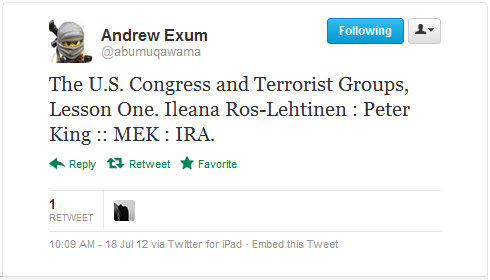
I retweeted this tweet of Andrew Exum‘s to my friend Paul Pilkington because I know he’s working on a project to find out what “this is to that” is to some other “this is to that” — across a wide swathe of human culture.

Note particularly that Exum is using this formal device to illuminate, to give insight, in an area of importance to analysts, strategic thinkers and decision makers.

I’m also retweeting Exum to Paul because I believe Paul’s simple experiment, based as it is on his reading of Hermann Hesse‘s Glass Bead Game, has the capacity to build an architecture of thought (a) crossing all disciplines and (b) spanning the trivial with the profound.

I’m doing something similar with Cath Styles in our Sembl games project — but this time I want to concentrate on Paul’s approach, and since there are four moving parts in an a is to be as c is to d configuration, I’m calling this post Numbers by the numbers: four — number three will just have to wait a while.

**

To get a sense of what Paul is up to, we can go to his Twitter Project page, which describes the fourth in a series of books he’s writing — and also follow him on Twitter, where he posts as Just Knecht.

Two of Paul’s recent tweets express his sense of the task pretty incisively:

The whole of language is the holding up of one unlike thing to compare, contrast and connect with another

Curating is a matter juxtaposition of work against work, artist against artist, place against place – A.Searle on Documenta 13, The Guardian

On his Twitter Project Page, he tells us:

Each tweet is an individual Glass Bead Game move, which is a comparison (metaphor, simile or analogy) across different areas, and may be either a statement or a question.

In question form, these are not unlike analogy questions from SAT tests with an additional dimension of general knowledge, cultural invention and intellectual playfulness. The basic challenge is to work out the relationship between two terms in one context, and apply it in another. Sometimes a tweet will extend an analogy further, which would be the beginning of forming a larger game from an individual move.

Some of the most interesting moves do not have right or wrong answers. Some have canonical or original answers, but they’re not necessarily right. In fact, very often I will post something I’ve picked up from elsewhere which I would love to see improved on, challenged, or at least better explained by others.

He then poses some of the sorts of questions that intrigue him:

Who is the J.H.Prynne of contemporary dance? Like Prynne in contemporary poetry they need to have been ‘out there’ right at the edge of theory and practice for some time, and also deeply steeped in tradition at the same time. Merce Cunningham? Suggestions welcome … And Heston Blumethal or Ferran Adrià might be the Prynne of cookery. But what about the Prynne of contemporary warfare?

What is the equivalent of sonata form in architecture? Goethe and Hegel both said ‘architecture is frozen music’ but neither really explained what they meant. If it is, then is there an architectural equivalent in Western architecture of the key structural form in Western art music? Suggestions welcome …

So, Zenpundit readers — who is the JH Prynne of contemporary warfare?

**

Not so long ago, in Numbers by the numbers: one, I posted a series of self-referential tweets that I’d collected over the last month or two — here I’d like to present some of Paul’s recent tweets:

Let’s start with one that’s a foreign policy insight, arguably as significant to day as it was when Vance first said it:

16 Jul @justknecht
“The Strait of Hormuz is the jugular vein of the West” (Cyrus Vance)

If these tweets can be timeless, they can also be timely:

4 Jul @justknecht
The Higgs boson is the quantum of the Higgs field, just as the photon is the quantum of the electromagnetic field

As they accumulate over time, they can build a conceptual “mesh” that engages an entire field — in this case, recent classical music — while linking it to a variety of other areas:

16 Jul @justknecht
“Boulez’ Derive 2 sounds like birthday cakes ought to” – Philip Clark, Gramophone

22 Jun @justknecht
Wagner was a beautiful sunset that was mistaken for a dawn – Claude Debussy, quoted by Geoffrey Norris in Gramophone

30 May @justknecht
Fauré’s Theme and Variations (no. 9) is like an evening star falling slowly from the sky – Bryce Morrison cites Alfred Cortot in Gramophone

11 May @justknecht
Kraftwerk is the Warhol of pop music – The New Yorker

There’s profundity here:

9 Jun @justknecht
“Space is to place as eternity is to time.” – Joseph Joubert

This could be, as Paul says, “the beginning of forming a larger game from an individual move” — that quote in itself could plausibly be the keystone of an architecture bridging science with religion…

There are historical parallels to consider:

31 May @justknecht
Robert Burton : Oxford :: Jeremy Prynne :: Cambridge

Catty remarks by Nobel laureates:

21 May @justknecht
“Thinking is to humans as swimming is to cats” (Nobel laureate Daniel Kahneman)

Near-tautologies:

21 May @justknecht
Macon Telegraph: Recipes are to food as blueprints are to buildings.

And, ooh, exotic forms of slander!

18 May @justknecht
“[Your daughter] has lovers as numerous as the striking of tablas on Palm Sunday” – Arabic satire by Abu Nawas, 756 – 813 AD

Once again, it’s form that generates insight, not content. Get used to form, play around with it, and content will leap out at you from the page, from the screen.

**

I’m no Arabist myself, but ah! that last quote reminds me irresistibly of the difficulties faced by translators from the Arabic, as recounted by William Chittick in The Self-disclosure of God: Principles of Ibn Al-‘Arabi’s Cosmology (SUNY Press, 1998, pp. xxxv-xxvi.)

An old joke among orientalists tells us that every Arabic word has four meanings: It means what it means, then it means the opposite of what it means, then it has something to do with sex, and finally it designates something to do with a camel …. The rational mind tends to push the meaning of a word away from experience to ‘what it means’ but the imaginal mind finds the self-disclosure of the Real in the sex and the camel … it is in the world’s concrete realities that God is found, not in its abstractions.

I’d been looking for an excuse to post that quote on Zenpundit — now I’ve found it!

Infinity Journal: The Foundation of Strategic Thinking

Tuesday, July 3rd, 2012

I first heard Lieutenant General Paul Van Riper speak at the Boyd ’07 Conference at Quantico and came away impressed. General Van Riper has a new article posted at Infinity Journal (registration required but always free….):

The Foundation of Strategic Thinking 

….While Clausewitz alludes to this nonlinearity through much of his opus On War, he speaks to it directly in Book One, Chapter 1, Section 28. This section, which hardly takes up half a page, summarizes many of the essentials of Clausewitz’s theory of war. He begins the section noting: “War is more than a true chameleon that slightly adapts its characteristics to the given case.”[vii] His use of a biological metaphor indicates war is not mechanistic and therefore not a controllable or predictable phenomenon. He then lays out the dominant tendencies of that phenomenon, which strategists often sum up as passion, probability, and reason. He mentions that most often the three tendencies are the concern of the people, army, and government.[viii] Continuing, Clausewitz makes a strong claim: “A theory that ignores anyone of them or seeks to fix an arbitrary relationship between them would conflict with reality to such an extent that for this reason alone it would be totally useless.”[ix]

In other words, to be valid any theory of war must incorporate war’s intrinsic dynamism. He goes on to say: “Our task therefore is to develop a theory that maintains a balance between these three tendencies like an object suspended between three magnets.” This analogy points to a cutting-edge scientific experiment of his era, that demonstrates the nonlinearity of any system where there is freedom of movement among three or more elements.[x] The virtual impossibility of duplicating the path of a pendulum as it moves among three equally spaced magnets tells us that despite our desire to balance passion, probability, and reason—the three central tendencies of war—it is simply not possible.[xi] War is a nonlinear phenomenon.

As with all nonlinear phenomena, we can only study war as a complete system, not as individual parts. Clausewitz is clear in this regard claiming that, “. . . in war more than in any other subject we must begin by looking at the nature of the whole; for here more than elsewhere the part and the whole must always be thought of together.”[xii] This advice runs counter to Americans’ preference for using an engineering approach to solve all problems. Reductionism tends to be part of the national character. We persist in using linear methods even when the evidence shows their limitations.

John Lewis Gaddis described the difficulties this approach has caused the U.S. national security community in a ground-breaking article questioning why political scientists failed to forecast the end of the Cold War.[xiii] His convincing conclusion is that while members of the physical and natural sciences were incorporating the tools of nonlinear science into their various disciplines those in political science were adopting classical linear practices, which blinded them to the dynamics that led to the Soviet Union’s demise. In the end, we confront the reality that as with war, international relations is nonlinear. Indeed, so also are most things that flow from it, including strategies and strategic thinking. […]

Read the rest here.

I particularly liked Van Riper’s later comment as going to some of what ails us:

….Good strategists know how nonlinear systems such as nation-states, non-state actors, international relations, politics, economics, wars, campaigns, and a host of others work in the real world. More importantly, they use this knowledge of a nonlinear world when they ponder strategic questions or recommend strategies. Good strategists don’t depend on analytical tools to uncover the future security environment or potential enemies. Rather, they look to history and economic and demographic trends to inform their judgments of what might happen in a nonlinear world.

If you look at the biographies of the men who were “present at the creation” or made the transition from World War to Cold War – Stimson, Acheson, Harriman, Marshall, Bohlen, Kennan, McCloy, Forrestal, Nitze, Eisenhower, Dulles, Lovett – they had overlaps of background in international business, diplomacy, banking, law and war. While this did not mean policy harmony – for example Acheson, Kennan, Bohlen, Harriman and Nitze had disagreements among themselves in regards to the Soviets  – they possessed a shared understanding of strategy and the historical context in which they operated.

Today, high level discussions of strategy between the military, policy and political worlds are too often exactly that – communications between different planets rather than a dialogue within one small world.

Gray on Strategic Theory and COIN

Wednesday, June 27th, 2012

I linked to this only in passing previously:  here is eminent Clausewitzian scholar Colin S. Gray at NDU PRISM:

Concept Failure? COIN, Counterinsurgency, and Strategic Theory 

….Argument

If this debate about COIN is to be reset along more productive lines than those typically pursued in the often heated and bad-tempered exchanges of recent times, it is necessary to place some reliance on the conceptual tools that strategic theory provides. Unsurprisingly, in its several forms that theory yields what Clausewitz specified: it sorts out what needs sorting. There is much that should be debated about COIN, but the controversy is not helpful for national security if the structure and functioning of the subject matter, suitably defined, are not grasped and gripped with intellectual discipline. To that end, what follows is a nine-part argument intended to make more sense of the not-so-great COIN debate triggered by the unmistakable evidence of confusion, frustration, and either failure or unsatisfactorily fragile success in Iraq and Afghanistan. This is neither policy nor strategy advocacy, but generically it is advocacy of policy (and its politics) and strategy, properly employed.

Formal education in strategy is not an adequate substitute for experience or talent and aptitude, but it should help.COIN debate would benefit if the debaters took a refresher course in the basics of strategy. Many fallacies and inadequate arguments about COIN in Afghanistan, for instance, are avoidable if their proponents were willing to seek and were able to receive help from theory. Harold Winton offers useful guidance when he identifies five functions for competent theory: such theory “defines, categorizes, explains, connects, and anticipates.”10 About what does theory perform those functions? The answer, which for strategy is the equivalent of E = mc2, is ends, ways, means, and (with caveats) assumptions. If a strategist’s narrative performs well on this formula, he has indeed cracked the code that enables—though it cannot guarantee—strategic success. The strategist needs to understand his subject, which is not COIN or counterterrorism; it is strategy for his particular challenge in COIN or counterterrorism. It is hard to find compensation for a lack of case-specific local knowledge, but it is even harder, and can be impossible, to compensate for weakness in understanding of strategy.

There is a classical canon of authors worth reading for their contributions, both intended and not, to the general theory of strategy. This theorist has reshaped and assembled the theory in the form of dicta (formal statements that are not quite principles and definitely not laws).11 Rather than test readers’ patience with a recital of my dicta, here I capture much of their meanings and implications by offering a list of “strategists’ questions,” some of which, with some amendments, I have borrowed with gratitude from the late Philip Crowl, followed by my own redrafting of the now long-traditional “Principles of War” as a set of Principles of War that I believe more suitably serves the declared purpose. First, the following are the strategists’ questions:

  • What is it all about? What are the political stakes, and how much do they matter to us?
  • So what? What will be the strategic effect of the sundry characters of behavior that we choose to conduct?
  • Is the strategy selected tailored well enough to meet our political objectives?
  • What are the probable limits of our (military) power as a basket of complementary agencies to influence and endeavor to control the enemy’s will?
  • How could the enemy strive to thwart us?
  • What are our alternative courses of action/inaction? What are their prospective costs 
    and benefits?
  • How robust is our home front?
  • Does the strategy we prefer today draw prudently and honestly upon the strategic education that history can provide?
  • What have we overlooked? 

Ok, so far but take a look at this claim:

….It is not sensible to categorize wars according to the believed predominant combat style of one of the belligerents.Guerrilla-style warfare is potentially universal and, on the historical evidence, for excellent reasons has been a favored military method of the weaker combatant eternally. There are no such historical phenomena as guerrilla wars. Rather, therehave been countless wars wherein guerrilla tactics have been employed, sometimes by both sides. To define a war according to a tactical style is about as foolish as definition according to weaponry. For example, it is not conducive of understanding to conceive of tank warfare when the subject of interest is warfare with tanks and so forth, typically, if not quite always, in the context of combined arms. It is important conceptually not to allow the muscle to dominate the brain. 

So there is no qualitative difference between a nuclear war (WWIII) and a war in which some nuclear weapons were used (WWII)? What?

No. Gray is correct that many  wars partake of a blend of tactical fighting styles or that most wars are better defined (or at least should be in terms of causation) by their political character. That said, a specific fighting style sometimes is a definitive descriptive characteristic of a war, particularly if a dominant tactical style explains one side’s consistent comparative advantage (ex. the Macedonian phalanx vs. the Persians) in battle and some of the resultant choices which were forced upon the adversary.

The Russians are Not Coming….Nor are they Going Away

Monday, June 25th, 2012

Now that Vladimir Putin has resumed the Presidency of Russia, it merits looking at the defense discussion that appeared under his name in Rossiiskaya Gazeta. Virtually everyone agrees that the condition of the Russian Army is parlous and that Putin’s program of difficult military reform to transform the Russian military from a conscripted army to a modernized professional force has not borne fruit. Therefore it is interesting to look at how Putin’s regime articulates it’s defense challenges with a mixture of bravado and brutal strategic realism we would never hear from an American politician.

Excerpts of the article are in bold while my commentary is in normal text.

 Being Strong 

…..The world is changing, and the transformations underway could hide various risks, often unpredictable risks. In a world of economic and other upheaval, there is always the temptation to resolve one’s problems at another’s expense, through pressure and force. It is no surprise that some are calling for resources of global significance to be freed from the exclusive sovereignty of a single nation, and that this issue will soon be raised as a “matter-of-course.”

There will be no possibility of this, even a hypothetical one, with respect to Russia. In other words, we should not tempt anyone by allowing ourselves to be weak. 

While some of this is boilerplate, it does demonstrate Putin’s astute view of Western elite noises about “global governance” as an effort to erode historic Westphalian legal norms of sovereignty for a self-aggrandizing reasons.

I am including paragraphs here from different parts of the paper where President Putin deals with nuclear weapons, though the first one continues from where the last excerpt left off.:

It is for this reason that we will under no circumstances surrender our strategic deterrent capability, and indeed, will in fact strengthen it. It was this strength that enabled us to maintain our national sovereignty during the extremely difficult 1990s, when, lets’ be frank, we did not have anything else to argue with.

….I remember in 2002 when the Chief of the General Staff proposed liquidating a base for strategic ballistic missile submarines on the Kamchatka Peninsula. Understandably, this proposal was motivated by dire circumstances. This would have deprived Russia of its naval presence in the Pacific Ocean. I decided against this. Due to the lack of the required budgetary funding, we had to ask private companies for help. I would like to thank them for that. Both Surgutneftegaz and TNK stepped up to provide the required funding for the base’s initial reconstruction. Budgetary allocations were later disbursed. Today, we have a modern base in Vilyuchinsk where next-generation Borei class submarines will soon be deployed.

….We have greatly increased the capabilities of our early missile warning system. Tracking stations have been launched in the Leningrad and Kaliningrad Regions and in Armavir, and a similar facility is undergoing tests in Irkutsk. All aerospace defence brigades have been equipped with the Universal-1S automation systems, and the Glonass satellite group has been deployed.

The land, sea and air components of our Strategic Nuclear Forces are reliable and sufficient. The proportion of modern land-based missile systems has grown from 13% to 25% over the past four years. The rearmament of 10 missile regiments with the Topol-M and Yars strategic missile systems will be continued.  Long-range aviation will maintain the fleet of strategic Tu-160 and Tu-95MS bombers; work is underway to modernise them. They will be equipped with a new long-range cruise missile system. Russia’s strategic aviation resumed combat patrols in their zone of responsibility in 2007. A new aircraft is being designed for strategic long-range aviation.

New-generation Borei class strategic submarines are being put on combat duty. These include the Yury Dolgoruky and Alexander Nevsky which are undergoing state trials.

….In the coming decade, Russian armed forces will be provided with over 400 modern land and sea-based inter-continental ballistic missiles, 8 strategic ballistic missile submarines…. 

This does not sound  like Putin puts much stock in his predecessor’s endorsement of Global Zero or President Obama’s goal of eliminating nuclear weapons. Or that a drastic unilateral American cut in nuclear weapons proposed by Global Zero to “break the triad” contemplated by the Obama administration would be reciprocated by Russia. Or any other nuclear power state.

Given that Pakistan, India, North Korea, Israel and China are reportedly increasing and improving their nuclear arsenals, it begs the question of whether the Obama or the Putin administrations have the most realistic view about nuclear weapons and their currency in international relations. Or what the Obama administration would use as bargaining chips to negotiate reductions in foreign nuclear arsenals after making gratuitously slashing unilateral cuts. And if the paper was not clear enough, Putin was more blunt about the strategic situation two days ago:

“With regard to further steps in the sphere of nuclear weapons, these further steps should be of a complex character, and this time all the nuclear powers should be involved in this process. We cannot disarm indefinitely while some other nuclear powers are building up their arsenal. It is out of the question!” 

On the subject of Russia’s land forces:

….There are no undermanned units in the Russian armed forces any more. The Army has over 100 combined and special brigades. These are full-scale military units with the requisite personnel and equipment. Their alert reaction time is one hour and they can be deployed to a potential theatre of war within 24 hours.

In the past, it took up to five days to prepare for combat readiness. The deployment and equipment of all the armed forces to wartime conditions could take nearly a year, even though most armed conflicts now last from a few hours to several days.

Why have we chosen the brigade as the main tactical unit? First of all, we have relied on our own experience in the Afghan and other wars, where mobile combat and assault groups reinforced with air and other support units have proved  more efficient than regiments and divisions.

The new brigades are smaller than divisions in the number of personnel but have a bigger strike capability, better firepower and support, including artillery, air defence, reconnaissance, communications, and so on. Brigades can operate both autonomously and jointly with other units. I admit that the quality is not perfect in all instances. We need to achieve the required standards in the near future. 

A Russian Army brigade numbers slightly over 4000 soldiers (vs. 3000-5000 in American and NATO militaries) and moving to a brigade structure is intended to make the Russian Army more versatile, flexible, deployable and mobile. The US essentially did the same thing with the “modularity” reforms for a brigade team force structure. However, I find it dubious that the Russian version is anything other than an aspirational work in progress or that Russia today could muster a force remotely approaching 100 combat brigades on short notice or keep them in the field for more than thirty days.

The old Soviet Red Army in the 80’s at the peak of it’s power was a military long on officers and critically deficient in NCOs  and the 90’s cratered the main force quality of what remained of the Soviet armies. Russia will not have a deployable fighting army for anything other than brief Georgia type raids and SPETSNAZ operations until it builds a proportionate NCO corps and modernized logistical support system.

On future war and it’s strategic context:

….The probability of a global war between nuclear powers is not high, because that would mean the end of civilisation. As long as the “powder” of our strategic nuclear forces created by the tremendous efforts of our fathers and grandfathers remains dry, nobody will dare launch a large-scale aggression against us.

However, it should be borne in mind that technological progress in many varied areas, from new models of weaponry and military hardware to information and communications technology, has dramatically changed the nature of armed conflicts. Thus, as high-precision long-range conventional weapons become increasingly common, they will tend to become the means of achieving a decisive victory over an opponent, including in a global conflict.

The military capability of a country in space or information countermeasures, especially in cyberspace, will play a great, if not decisive, role in determining the nature of an armed conflict. In the more distant future, weapons systems based on new principles (beam, geophysical, wave, genetic, psychophysical and other technology) will be developed. All this will, in addition to nuclear weapons, provide entirely new instruments for achieving political and strategic goals. Such hi-tech weapons systems will be comparable in effect to nuclear weapons but will be more “acceptable” in terms of political and military ideology. In this sense, the strategic balance of nuclear forces will play a gradually diminishing role in deterring aggression and chaos.

We see ever new regional and local wars breaking out in the world. We continue to see new areas of instability and deliberately managed chaos. There also are purposeful attempts to provoke such conflicts even within the direct proximity of Russia’s and its allies’ borders.

The basic principles of international law are being degraded and eroded, especially in terms of international security. 

Here we see much of the same keen interest Western military experts have had in RMA/”transformation” but more as new domains in which to fight or weapons to fight with, but Putin’s assumptions about the roots of international conflict remain exceedingly traditional in Clausewitzian and Machiavellian realpolitik senses. There’s no idea here that war’s political nature is being transformed by technological advances or even that breakdowns in order in other nations flow primarily from indigenous social forces  than from strategic conspiracies and manipulations of foreign powers hell-bent on humiliating Russia.

This is a worldview of cynical realism salted with nationalism and a paranoia induced by the lessons of centuries of Russian history. International relations, it follows, hinge primarily on power in all it’s manifestations, a few rules that separate the law of nations from the law of the jungle and that states exert power to accomplish rational strategic objectives. Furthermore, in an echo of Tsarist Russia’s last modernizer, Petr Stolypin, what Putin has put forth as a political program for his domestic audience (sincere or not) is “a great Russia”.

The good news is that President Putin is, unlike his Soviet predecessors, is uninterested in grand ideological crusades that would destabilize the world order and that Russia currently would be incapable of carrying any out. The bad news is that Putin is a shrewd strategic thinker, one who views the US as a long-term adversary of Russia and one who is likely to be highly antagonized and partially misread (and thus miscalculate)  the tactical geopolitics of intervention pursued by America’s R2P moralizers.

From Putin’s perspective, we are currently crusaders rather than deal-cutters grounded in reality. America does not need to appease other power,s but we’d further our own interests faster if we spent a little time looking at the world through the eyes of others

Hat tip to Lexington Green


Switch to our mobile site

