zenpundit.com » islamic world

Archive for the ‘islamic world’ Category

“Whoever took religion seriously?”

Saturday, January 8th, 2011

[ by Charles Cameron — cross-posted from the DIME/PMESII boards at LinkedIn ]

I’ve been hammering away at the importance of a nuanced understanding of religious drivers in successful modeling of our world, and today I ran across some paragraphs from a book by Gary Sick that explain, forcefully and briefly, just why this seems like a big deal to me.

1

Sick, who was the National Security Council’s point man on Iran at the time of the Ayatollah Khomeini‘s Iranian Revolution, recounts how totally unprepared we were for the sudden emergence of a theocracy in his book, All Fall Down:

Vision is influenced by expectations, and perceptions — especially in politics — are colored by the models and analogies all of us carry in our heads. Unfortunately, there were no relevant models in Western political tradition to explain what we were seeing in Iran during the revolution. This contradiction between expectation and reality was so profound and so persistent that it interfered fundamentally with the normal processes of observation and analysis on which all of us instinctively rely.

On one level, it helps to explain why the early-warning functions of all existing intelligence systems — from SAVAK to Mossad to the CIA — failed so utterly in the Iranian case. Certainly, US intelligence capability to track the shah’s domestic opposition had been allowed to deteriorate almost to the vanishing point. But even if it had not, it would probably have looked in the wrong place. Only in retrospect is it obvious that a good intelligence organization should have focused its attention on the religious schools, the mosques and the recorded sermons of an aged religious leader who had been living in exile for fourteen years. As one State Department official remarked in some exasperation after the revolution, “Whoever took religion seriously?”

Even after it became clear that the revolution was gaining momentum and that the movement was being organized through the mosques in the name of Khomeini, observers of all stripes assumed that the purely religious forces were merely a means to the end of ousting the shah and that their political role would be severely limited in the political environment following the shah’s departure, The mosque, it was believed, would serve as the transmission belt of the revolution, but its political importance would quickly wane once its initial objectives had been achieved.

2

The blissful ignorance didn’t end back there in 1979. Right at the end of 2006, reporter Jeff Stein asked Rep. Silvestre Reyes (Dem, TX), the incoming head of the House Intelligence Committee (which has oversight of the entire US Intelligence Community) whether Al-Qaida was Sunni or Shiite – noting in two asides, “Members of the Intelligence Committee, mind you, are paid $165,200 a year to know more than basic facts about our foes in the Middle East” and “To me, it’s like asking about Catholics and Protestants in Northern Ireland: Who’s on what side?”

Reyes guessed wrong – not good – and so did a lot of other senior people in the FBI, Congress and so forth. Understandable perhaps, but still, not good.

The popular media keep many of the rest of us confused, too. Glenn Beck has been misinformed by the Christian thriller writer Joel Rosenberg, and refers to the “Twelvers” when he means the “Anjoman-e Hojjatieh” -which, to extend Stein’s point, is the equivalent of saying “Catholic Church” when you mean “Legionnaires of Christ”.

3

Okay, we know that religion has something to do with all this Iran – and Afghanistan and Pakistan and Iraq, and Yemen, and Somalia, and Nigeria — and maybe even homegrown — mess. And I agree, other people’s religions really aren’t our business normally, and it’s not surprising if we don’t know much about them.

Except, I’d say, when religions take up the sword, or have significant power to influence decisions about the use of nuclear weapons — at which point it’s appropriate to get up to speed…

Warriors of the Spirit

Friday, December 31st, 2010

[ by Charles Cameron ]

It’s a very different approach…

I’ve been preparing to write up some of the episodes that represent how warm and close relations between Muslims and Christians can at times be – the meeting of St Francis with the Sultan Malik al-Kamil, the period of considerable tolerance and artistic flourishing under Umayyad rule in Cordoba – and I have to say I’m getting very impatient to see this film:

film poster for

.
If you would like to understand why the Qur’an (5:82) says:

The nearest to the faithful are those who say “We are Christians. That is because there are priests and monks among them and because they are free of pride.”

May I recommend you either read John Kiser’s The Monks of Tibhirine: Faith. Love and Terror in Algeria — or, when it opens in your part of the world, go see Of Gods and Men. Or both.

Wishing us all peace in the new year, decade, century…

King Abdullah’s health and the Signs of the Times

Sunday, December 19th, 2010

[ by Charles Cameron ]

King Abdullah of Saudi Arabia is currently recovering from two recent surgeries in hospital in the US, may he, may we all be blessed with good health.

1.

Dr. Kamal El-Helbawy of the Centre for the Study of Terrorism in London was quoted yesterday by [Iranian] Press TV as saying that a coup might take place in Saudi Arabia:

“It is possible that a coup could happen, and I see nothing to prevent that from happening,” Dr. Kamal Helbawy of the Center for the Study of Terrorism said in an interview with Press TV aired on Saturday. “Both in Qatar and Oman in the past, the sons of the kings stole the leadership from their fathers, and I think there is a rift in the house of Saud,” he added. [ … ] “With his old age and sickness, there is suspicion about succession. There has been tension in the family for several decades. I believe there is a political and religious crisis,” Helbawy said.

[ h/t Habiba Hamid ]

2.

I have no special insight into the affairs of the Kingdom. I only mention this press report because just today I ran across a reference to the Kuwaiti Shi’ite author Jaber Bolushi and his book [downloadable here in Arabic], Appearance of Imam Mahdi in 2015 — which brings us back to King Abdullah.

We need (IMO) to get used to the idea that every newsworthy event has the potential to spark some kind of reaction in the apocalyptic mind.

I do not wish to suggest that any given event will necessarily spark a Mahdist response — just that it may — and that we should therefore keep tabs on Mahdist and messianic sentiment in general, and note carefully what “signs of the times” might prove persuasive to those who seek such things.

3.

The Sunni site where I found Bolushi’s book mentioned, contained the following among a list of “signs” of the soon-coming of the Mahdi:

Death of King Abdullah of Saudi Arabia (we wish him long life) in 2015: The Shia believe that King Abdullah will be the last king of the House of Saud before the appearance of the Mahdi. Jaber Bolushi cites a Hadith attributed to Prophet Mohammad [saw] (the Shia claim this Hadith used to be reported in Musnad Ahmad, but was later removed) in which the Prophet mentions that the last man who will govern Al-Hijaz (the region that includes Mecca & Medina) before the Mahdi will be called Abdullah and he will be the successor of his brother who is named by the name of an animal. The previous king of Saudi Arabia was King Fahd (Fahd means leopard). It is worth noting that King Abdullah is currently 84 years old. After he dies, a dispute will occur among the royal family as to who should succeed him. There will be a strife and blood shed. Then, people will search for the Mahdi and offer him allegiance between Rukun and Maqam in the Haram Masjid in Mecca.

4.

My point is not to discuss the health of King Abdullah – I wish him well – nor the specifics of this particular prophecy – date-setting seems to me to be a fool’s errand, even according to the scriptures of the various religions where it is practiced.

My point, again, is that today’s news – whatever it is — will be “read” and understood within dozens of conflicting apocalyptic contexts, most of which we are in general unaware of, with possible repercussions on the world stage that may therefore take us by surprise.

5.

Jean-Pierre Filiu in his recently published book, Apocalypse in Islam, writes that:

ambitious militia leaders, such as Muqtada al-Sadr in Iraq and Hasan Nasrallah in Lebanon, consciously exploit popular messianic feeling in order to assert their authority at the expense of the Shi’i clerical establishment, without allowing themselves to fall captive to apocalyptic rhetoric. [ … ] For the moment, only the Iraqi militia known as the Supporters of the Imam Mahdi has actively sought to translate the rise of eschatological anxiety into political action. Yet one day a larger and more resourceful group, eager (like Abu Musab al-Suri) to tap the energy of the “masses” as a way of achieving superiority over rival formations, may be strongly tempted to resort to the messianic gambit. An appeal to the imminence of apocalypse would provide it with an instrument of recruitment, a framework for interpreting future developments, and a way of refashioning and consolidating its own identity. In combination, these things could have far-reaching and deadly consequences.

That’s the point.

Book Mini-Reviews to Clear a Boundless Bibliographic Backlog!

Friday, December 10th, 2010

I have too many books that I have read that I would like to review that, realistically, I will never get to post on in conventional fashion. A fair number belong with Summer Series which seems ridiculous as it is two weeks to Christmas! Therefore, brace yourselves, as I commence the first, and hopefully only, Mini-Reviews post:

Play: How It Shapes the Brain, Opens the Imagination, and Invigorates the Soul by Stuart Brown, MD

Dr. Stuart Brown, scientist and psychiatrist, has written a short tome on the nature and cognitive value of play. While there is plenty of child social development information and “pop”self-helpish type chapters, ZP readers wil gravitate to the chapters on play’s vital role in creaivity and innovation ( which are not the same thing), scientific discovery and work. Also of interest are the spectrum of “play personalities” and the “dark side of play”. Not an academic book but a reasonable read on a deceptively complex subject.

The Collapse of Complex Societies by Joseph Tainter

A superb academic book, previously featured and reviewed in the blogosphere by John Robb and Joseph Fouche, The Collapse of Complex Societies embarks upon a critical examination and partial de-bunking of theories that purport to explain the “sudden” fall of great empires, such as Rome or the vanishing of the Mayans. With caveats, Tainter settles on declining marginal returns from increasing societal investment in complexity as a rough proximate cause capable of subsuming a ” significant range of human behavior, and a number of social theories” under it’s rubric. Highly recommended.


The Bin Ladens: An Arabian Family in the American Century by Steve Coll

A biography of the Bin Laden family, this book does not come close to matching the impact or importance of Coll’s previous instant classic, Ghost Wars. There are many interesting trivialities about the divergences between the “religious and the hard Rock Cafe wings” of the Bin Laden families, and intriguing nuggets about political matters such as the 1979 takeover of the Grand Mosque and the connections between the Bin Ladens and elite figures inside the beltway but anyone looking for insight into Osama bin Laden will be disappointed. The most infamous member of Saudi Arabia’s dominant non-royal business clan is a subdued figure in this biography. Coll’s superior skills as a wordsmith and reporter manage to make the book a pleasant page turner.

The Death and Life of the Great American School System: How Testing and Choice Are Undermining Education by Diane Ravitch

Conservative education scholar and historian Diane Ravitch lays out the demise of the movement for high curricular standards in public education that she once championed and it’s transmogrification under NCLB into a punitive system that is slowly imposing an unprecedentedly narrow and dumbed down national curriculum focusing on basic math and reading skills, featuring gamed  test results, highly paid lawyer-consultant insiders and perverse incentives for public and charter schools alike. A depressing but important read.

A DoubleQuote for Anders

Friday, December 3rd, 2010

[ by Charles Cameron ]

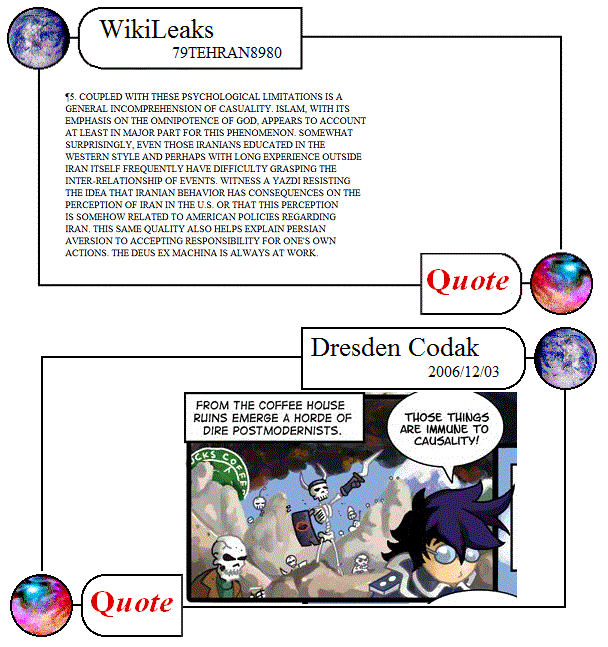
One of my hobbies is finding apposite quotes to juxtapose — I call them DoubleQuotes and think of them as twin pebbles dropped into the mind-pool for the pleasure of watching the ripples…

And I particulartly enjoy it when one of my DoubleQuotes manages to span different sensory streams — aural, visual, verbal, numerical, cinematic — as here, with text and image.

This one’s for Anders Sandberg.

QUOAcausal

I’d been carrying around the quote from WikiLeaks for a few days, but it was running across the Dresden Codak via Anders’ Andart blog today that gave me the second “dot” to connect with the first.


Switch to our mobile site