zenpundit.com » chicago boyz

Archive for the ‘chicago boyz’ Category

Announcement: The Ronald Reagan Roundtable at Chicago Boyz

Monday, January 17th, 2011

February 6th 2011 marks the centennial of the birth of America’s 40th president, Ronald Wilson Reagan and it is an appropriate time to reflect on the legacy of a man whose presidency altered the course of his party, his nation and the world. It is no exaggeration to say that events set in motion by the Reagan administration are still unfolding today and the ideas and values championed by Ronald Reagan continue to shape our public policies and frame our political discourse.

Therefore, to commemorate and debate this important legacy, The Ronald Reagan Roundtable, hosted at Chicago Boyz blog will begin February 6th and end on the 16th.

Past Chicago Boyz Roundtables have featured discussions about specific books – On War by Carl von Clausewitz, Science, Strategy and War by Col. Frans Osinga and The Anabasis of Cyrus by Xenophon. They were well-regarded and thought-provoking enterprises. This roundtable will be a little more like the last one on Afghanistan 2050, in that there is no set book to evaluate but a wide-open and free-wheeling discussion of Ronald Reagan, his administration and the historical record.

Contributors will be free to address the topic narrowly or broadly, from Left, Center or Right, in scholarly or polemical tone, with a focus on the present or the past, at whatever length or number of posts they feel is required. Book reviews of the burgeoning number of titles related to Ronald Reagan and his times are also very welcome.

Participants will be encouraged to comment upon one another’s posts and interact with the readers who leave comments but that is not obligatory, contributions can also stand on their own.

Those interested in in joining the Ronald Reagan Roundtable should contact me or Lexington Green and we will make the arrangements with a final “head count” to be announced on or about February 1st

Hope to see you there!

“Do they mean peace, or do they mean we just want to be left in peace? There can be no real peace while one American is dying some place in the world for the rest of us. We’re at war with the most dangerous enemy that has ever faced mankind in his long climb from the swamp to the stars, and it’s been said if we lose that war, and in so doing lose this way of freedom of ours, history will record with the greatest astonishment that those who had the most to lose did the least to prevent its happening. Well I think it’s time we ask ourselves if we still know the freedoms that were intended for us by the Founding Fathers.”
  – Ronald Reagan

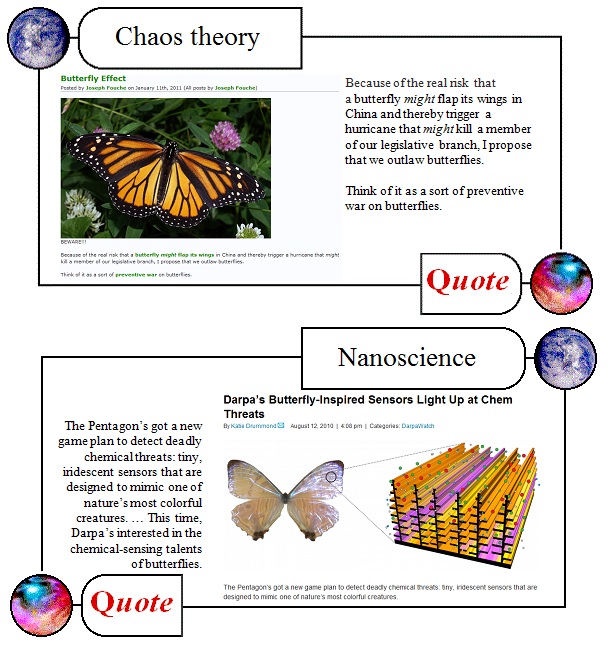
Ah yes, the entomology of war

Tuesday, January 11th, 2011

[ by Charles Cameron — in playful response to M. Fouche’s recent post on ChicagoBoyz, Butterfly Effect ]

Links: Chaos theoryNanoscience

Follow-up: Martyrdom, messianism and Julian Assange

Friday, December 24th, 2010

[ by Charles Cameron ]

This is a follow-up to my earlier post on Zenpundit and ChicagoBoyz, picking up on some comments made on both sites, explaining my own interests, and taking the inquiry a little further.

On Zenpundit, Larry said, “Your need to destroy Assange is getting embarrassing. Why not make lemonaid?” and JN Kish, “The real story here should be about the data – and who is helping Assange – not Assange himself.” Meanwhile on ChicagoBoyz, a certain Gerald Attrick commented, “Ah, but as we say in in art crit: Deal with the Art and not the Man…”

To Larry I would say, I think that my post WikiLeaks: Counterpoint at the State Department? — in which I point up the irony inherent in the same State Department spokesman celebrating World Press Freedom Day and chiding Assange for “providing a targeting list to a group like al-Qaida” on the same day — could as easily be read as pro-Assange as today’s post, Martyrdom, messianism and Julian Assange can be read as calling for his destruction.

More generally, it seems to me that there are a whole lot of stories to be told here: the ones I wish to tell are those where I have a reasonably informed “nose” for relevant detail, and which tend to be overlooked by others — and thus have the potential to blindside us.

*

My own main interest is in tracking religious, mythic and apocalyptic themes in contemporary affairs, where they are all too easily overlooked, misunderstood or dismissed. Thus I have posted on Tracking the Mahdi on WikiLeaks, and added related material in section 1 of my post today.

I am also interested in concept mapping, games and creative thinking — interests which led me to post WikiLeaks: Critical Foreign Dependencies and The WikiLeaks paradox, and more lightheartedly to take an amused sideways glance at WikiLeaks in The power of network visualization.

And I certainly find Assange himself an interesting figure, and have done what I can to illuminate his background in mythology, religion and games in Wikileaks and the Search for a Cryptographic Mythology, again in Update: Wikileaks and Cryptographic Mythology and (again light-heartedly) in A DoubleQuote for Anders.

*

Let me be more explicit: I have no wish to lionize Assange, nor to feed him to the lions — I would like to understand him a little better.

I come from a scholarly tradition that doesn’t favor the demonization of new religious movements, and believes (for instance) that it is entirely plausible that the Waco inferno could have been avoided if the religious beliefs of David Koresh and the Branch Davidians had been taken seriously as such, and not dismissed out of hand as “bible babble”.

James Tabor and Eugene Gallagher in Why Waco for instance, write:

The Waco situation could have been handled differently and possibly resolved peacefully. This is not unfounded speculation or wishful thinking. It is the considered opinion of the lawyers who spent the most time with the Davidians during the siege and of various scholars of religion who understand biblical apocalyptic belief systems such as that of the Branch Davidians. There was a way to communicate with these biblically oriented people, but it had nothing to do with hostage rescue or counterterrorist tactics. Indeed, such a strategy was being pursued, with FBI cooperation, by Phillip Arnold of the Reunion Institute in Houston and James Tabor of the University of North Carolina at Charlotte, one of the authors of this book. Arnold and Tabor worked in concert with the lawyers Dick DeGuerin and Jack Zimmerman, who spent a total of twenty hours inside the Mount Carmel center between March 29 and April 4, communicating directly with Koresh and his main spokesperson, Steve Schneider. Unfortunately, these attempts came too late. By the time they began to bear positive results, decisions had already been made in Washington to convince Attorney General Janet Reno to end the siege by force.

Jane Seminaire Docherty’s Learning Lessons from Waco, similarly, “offers a fresh perspective on the activities of law enforcement agents. She shows how the Waco conflict resulted from a collision of two distinct worldviews-the FBI’s and the Davidians’—and their divergent notions of reality. By exploring the failures of the negotiations, she also urges a better understanding of encounters between rising religious movements and dominant social institutions.” [Syracuse UP]

I’d therefore be hesitant to drag Assange into a somewhat murky association with the “cult milieu” – but Assange himself was quite open in talking with Raffi Khatchadourian of the New Yorker about the man his mother lived with and had a child by, then ran away from, after her marriage to Assange’s father broke up. Khatchadourian writes:

When I asked him about the experience, he told me that there was evidence that the man belonged to a powerful cult called the Family—its motto was “Unseen, Unknown, and Unheard.” Some members were doctors who persuaded mothers to give up their newborn children to the cult’s leader, Anne Hamilton-Byrne. The cult had moles in government, Assange suspected, who provided the musician with leads on Claire’s whereabouts.

Wikipedia’ has an account of that group, also known as the Santiniketan Park Association.

And as you might expect, there’s a bizarre and frankly conspiracist take on this connection already out and about on the web.

*

For a more detailed and indeed harrowing view of the Santiniketan Park Association from a member who left, see this excerpt from Sarah Moore’s book, Unseen, Unheard, Unknown.

A couple of odd remarks here strike me:

Some of us had multiple birth certificates and passports, and citizenship of more than one country. Only she knows why thus was and why we were also all dressed alike, why most of us even had our hair dyed identically blond.

The motto of the sect is ‘Unseen, Unheard and Unknown’, and even now the thought of the consequences of betraying that motto still worries me sometimes.

We weren’t often allowed to see newspapers, in fact that happened only after we were quite a bit older and even then they’d been censored .

and:

Looking back, I can see that any game or hobby that we started we would get hooked on, playing it over and over again in our limited spare time. If we got into a game or fantasy we tended to want to keep on with it and it assumed the utmost importance in our lives.

It might have appeared that we were obsessive kids but it was understandable considering the malevolent reality we faced outside our games. Usually Anne and the Aunties saw to it that as soon as we started enjoying ourselves, it was stopped, and a new rule would be made, forbidding us from playing that particular game. We would thus be forced to try and make up a new one within the boundaries of the rules that governed our lives, still knowing that eventually this new one would be banned also.

*

Speaking of “cults” – there are several WL cables that make reference to a cult or cults, generally in the context of a “cult of personality” (Mao, eg), and in one case with reference to Scientology. There’s also – and this where things get interesting from my POV — one intriguing reference to a cult in Iran:

Though stressing that he is not an opponent of the Islamic system, he warned that the Revolutionary Guard-based faction which “stole the election,” and is now seeking total control is “extremely dangerous to both us and you.” He repeatedly characterized this group as “a criminal cult,” motivated by its fanaticism, ignorance, and the monetary self-interest of its members. He added that the group is intent on exporting revolution. According to source, both Ahmedinejad and Ayatollah Mesbah-Yazdi are affiliates rather than “leaders” of this group, and neither will likely end up with significant power if the group successfully consolidates control over the state and its economy (see reftel).

A religious group of which “both Ahmedinejad and Ayatollah Mesbah-Yazdi are affiliates” sounds suspiciously like the Hojjatiyeh.

But that’s the topic for another upcoming post, I promise.

WikiLeaks in conspiracy space

Sunday, December 12th, 2010

I thought my response to a comment Lex posted at ChicagoBoyz might be of equal interest here.

Lex wrote:

This is starting to remind me a little bit of Robert Anton Wilson. Even the squirrels in the trees are in on the conspiracy. What conspiracy? You know, the conspiracy

My comment follows…

Indeed, it seems there’s plenty of room in conspiracy space for WikiLeaks:

Wikileaks – A Big, Dangerous US Government Con Job
By F. William Engdahl
12-10-10

The story on the surface makes for a script for a new Oliver Stone Hollywood thriller. A 39-year old Australian hacker holds the President of the United States and his State Department hostage to a gigantic cyber “leak,” unless the President leaves Julian Assange and his Wikileaks free to release hundreds of thousands of pages of sensitive US Government memos. A closer look at the details, so far carefully leaked by the most ultra-establishment of international media such as the New York Times, reveals a clear agenda. That agenda coincidentally serves to buttress the agenda of US geopolitics around the world from Iran to Russia to North Korea. The Wikileaks is a big and dangerous US intelligence Con Job which will likely be used to police the Internet.

*

WikiLeaks – More Israeli Game Theory Warfare?
By Jeff Gates
12-1-10

“The United States is the real victim of WikiLeaks. It’s an action aimed at discrediting them.” Franco Frattini, Foreign Minister of Italy

The impact of the WikiLeaks release of diplomatic cables fits the behavior profile of those well versed in game theory warfare. When Israeli mathematician Robert J. Aumann received the 2005 Nobel Prize in economic science for his work on game theory, he conceded, “the entire school of thought that we have developed here in Israel” has turned “Israel into the leading authority in this field.” The candor of this Israeli-American offered a rare insight into an enclave long known for waging war from the shadows. Israel’s most notable success to date was “fixing” the intelligence that induced the U.S. to invade Iraq in pursuit of a geopolitical agenda long sought by Tel Aviv. When waging intelligence wars, timing is often the critical factor for game-theory war planners. The outcome of the WikiLeaks release suggests a psy-ops directed at the U.S.

BTW, both theories come via the same publisher, rense.com.

A draft of what’s on my mind lately

Sunday, December 5th, 2010

by Charles Cameron
[ cross-posted from ChicagoBoyz ]

I’ve been thinking…

*

Reports, overstatements and underestimates

There are factual reports of violence and threats of violence, which are within the proper province of journalism and intelligence gathering.

There are also overstatements of such reports, generally resulting from paranoia, hatred, recruitment, or the desire to increase sales of advertising or munitions.

And there are understatements of such reports, generally resulting from sheer ignorance or a desire to be diplomatic.

*

Religious sanctions for violence

Similarly, there are factual reports of sanctions for violence in the scriptures, hagiographies and histories of various religions.

There are also overstatements of such reports, attributing to entire religions the beliefs and or activities of a significant subsection or outlier group of that religion

And there are understatements of such reports, avoiding the attribution of violence to religious beliefs regardless of whether the religious correlation is a “cover” for other motives or a sanction powerfully affecting the actions of those who respond to it.

*

Proportional and disproportionate responses

There are actions which represent a balanced and proportional response to threats or acts of violence, whether they be made at home or abroad, by the military or law enforcement, for reasons of just war or of security.

There are actions which present an unbalanced and disproportionate heightened response to acts of violence, into which category I would place both over-reactive military responses and over-reactive domestic security measures.

And there are inactions which are no less unbalanced as responses to acts or threats of violence, as with political wool-gathering or appeasement, bureaucratic failures to implement realistic information sharing and dot-connection within the IC, or public aversion to factual news or intelligent, nuanced analysis.

*

Ideals, kumbaya and skepticism

There are honest statements of aspiration for peaceable outcomes to current and future conflicts.

There are versions of such aspirations which naively overlook the very real correlations between religious sanctions and violence.

And there are skeptical aversions to such aspirations, which no less naively overlook the very real differences which are present between the most angry, the most terrified, the most politically driven, the most financially interested and the most generous members of any and every religious and irreligious viewpoint.

*

Let’s talk…

It is useful to bear these distinctions of category in mind, and to make accurate appraisals of one’s information inputs in terms of which categories they fall under, and how much trust one should therefore place in them.

There: it was on my mind and I have said it.

This is, as my title indicates, a first draft. I hope it will spark some interesting conversations, and lead to further insight and refinement…


Switch to our mobile site