Archive for the ‘Geography’ Category
Wednesday, January 27th, 2010
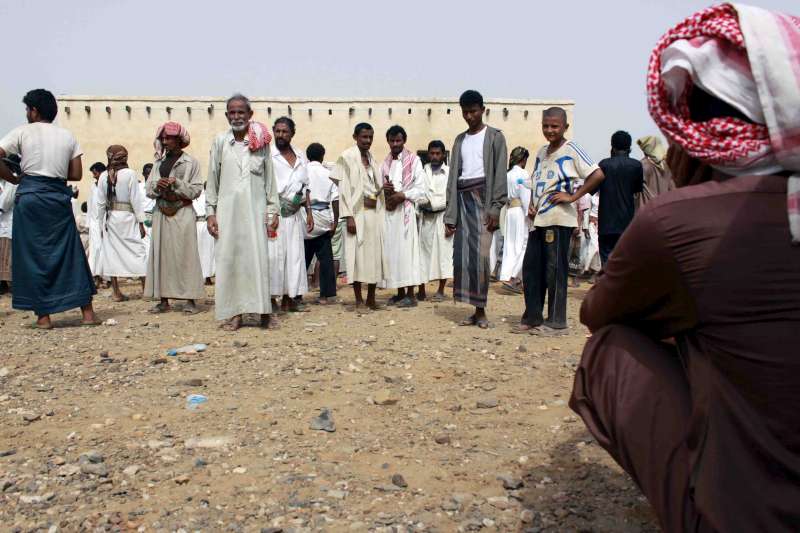
An informative post by Curzon at Coming Anarchy
Yemen: Geography Matters!
….The Saudis are guilty of aggravating and prolonging the conflict. Wary of taking too many losses on the ground and unable to do much by air and sea, they have recruited the Hashed, a local tribe, to fight against the Huthi, the tribe central to the Shia rebels. The Hashed have several incentives to continue fighting for as long as possible-they have a long-standing feud with the Huthi, and make a great deal of money from fighting for the Saudis, and may be coming up with schemes to prolong the conflict. According to a source of Al Jazeera:
If [the Hashed are] given the mission of taking a particular mountain, for example, they’ll call up the Huthi leaders and tell them: ‘We’re getting five million riyals to take the mountain. We’ll split it with you if you withdraw tonight and let us take over’… After the tribesmen take charge, they hand it over to the Saudis… The next day, the Huthi return and defeat the Saudis and retake the mountain… It’s been happening like this for weeks.
Posted in 4GW, al qaida, arab world, COIN, coming anarchy, counterinsurgency, cultural intelligence, extremists, Failed State, foreign policy, Geography, history, insurgency, islamic world, islamist, map, mideast, non-state actors, primary loyalties, shia, state failure, terrorism, tribes, war, warriors | Comments Off on Battleground Yemen
Tuesday, September 22nd, 2009

The Call of Nepal: My Life In the Himalayan Homeland of Britain’s Gurkha Soldiers by Col. J.P. Cross
Nimble Books, a publisher I am proud to be associated with, is rolling out the American edition of the memoirs of the legendary COIN specialist, soldier and linguist, Colonel John Philip Cross, of the Gurkhas. Foreword by Robert D. Kaplan. Disclosure – I had a part, albeit a small one, along with Lexington Green, in connecting Col. Cross with Nimble Books, and I could not be more pleased to see this memoir in print. Not many books these days start by announcing how modern academics will hate it.
Cross was the focus of a story by Kaplan in The Atlantic Monthly magazine in 2006.
Review soon to come….

Posted in 20th century, army, asia, authors, book, COIN, counterinsurgency, cultural intelligence, culture, Geography, history, India, insurgency, linguistics, military, military history, Nimble Books, the atlantic, war, warriors | 7 Comments »
Tuesday, June 23rd, 2009
The author of The World’s Most Dangerous Places: 5th Edition  and Licensed to Kill: Hired Guns in the War on Terror
 was nice enough to drop by in the comment section and discuss his firsthand view of special operators in Afghanistan. During the course of the discussion, in response to a question from Lexington Geen, RYP offered up a couple of links that I think readers will find worthwhile. Here is a quote from one of them: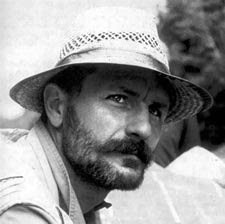
….The next morning, about 60 Afghan cavalry came thundering into the compound. Ten minutes later, another 40 riders galloped up. General Abdul Rashid Dostum had arrived.
“Our mission was simple,” another soldier says. “Support Dostum. They told us, ‘If Dostum wants to go to Kabul, you are going with him. If he wants to take over the whole country, do it. If he goes off the deep end and starts whacking people, advise higher up and maybe pull out.’ This was the most incredibly open mission we have ever done.”
“Dostum” is the mercurial, ex-Communist, Uzbek Afghan warlord, General Abdul Rashid Dostum.
Here are the links:
The Legend of Heavy D and the Boys: In the Field With an Afghan Warlord 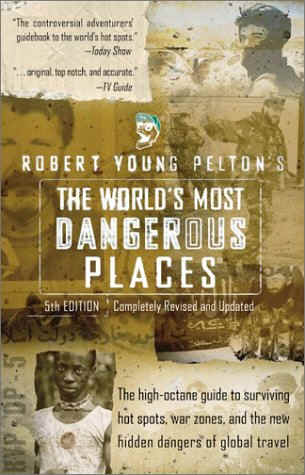
Inside the Afghan War Machine
Incidentally, I read The World’s Most Dangerous Places in an earlier edition, back when Pelton’s uber-violence list was topped by Algeria, Colombia and several, broken down, West African nations. It’s a great book and a fun read that I have lent out to many of my students who had an all too idealistic and parochial view of the world. It cured a few of them.
Posted in 21st century, 3 gen gangs, 4GW, Afghanistan, authors, book, dystopia, Failed State, Geography, insurgency, non-state actors, OSINT, Robert Young Pelton, state failure, tribes, Writing | 1 Comment »
Tuesday, June 24th, 2008
Two great new adds:
In Harmonium : Fellow SWC member, Dr. Marc Tyrell’s blog dedicated to symbolic anthropology, COIN, education, music, knowledge and other subjects.
FANTOM PLANET : A blog about geographic studies, tech, maps, Web 2.0 and other intersectional things.
Posted in anthropology, blogosphere, Blogroll, Geography, small wars council | 3 Comments »
Sunday, April 27th, 2008
A pleasant downstream effect of having blogged for a while is that readers will send you interesting things from time to time. Like the following…
Check out: The Complex Terrain Laboratory
Snippets:
This is muddled and confusing. Human Terrain is “an emerging area of study”? No it’s not. Human “terrain” is a label, a metaphor, for guess what? History, geography, anthropology, sociology, psychology, communications, etc., etc. It’s “major goal is to create operational technologies”? No it’s not. That’s what mathematicians and engineers can deliver on multimillion dollar DoD contracts. Human terrain is, just in case anyone hasn’t read a newspaper or wireclip over the last few years, about people, what they think, their perceptions, their loyalties, the consequences they bear in wartime, the support they may or may not provide to insurgents, the physical, cultural, and informational spaces they create and occupy in times of conflict and crisis.
Freaking mad scientists. They’re everywhere. Technology is a tool, not the answer
and
What is really meant by ‘fragile’ states is ones that have acquired legal sovereignty but that have lost, or more probably never acquired, the effective powers attached to that status. There are more and more such states. How many depends on one’s definition of fragility. The United Kingdom’s government development agency, the Department for International Development (DFID), one of the smartest outfits in the business, estimates that 46 states, over one quarter of the world’s total, fall within its definition of ‘fragile states’. The population of these 46 states is over 870 million. DFID bases its definition of fragility on a state’s record in combating poverty. Others define fragility not by reference to poverty, but to security. Referring to the slightly different concept of ‘failure’, in the United States’ 2002 National Security Strategy, President Bush stated that America ‘is now more threatened by weak and failing states than…by conquering ones’.
“Human Terrain Mapping” is one of those relatively new concepts I’ve been meaning to investigate and CTLab – run by a distinguished trio of scholars and authors Stephen D.K. Ellis, Michael A. Innes and Brian Glyn Williams – fits the bill. Definitely a “blogroll-worthy” site for all of the Intel/COIN/IO/DIME/Foreign Policy bloggers and of interest to the history blogosphere as well since two of the three gentlemen are professional historians.
I look forward to many enjoyable and profitable visits.
UPDATE:
Mike Innes has written in to explain that CTLabs is still expanding their team of SME’s as well as the working on the aesthetic and functionality aspects of the site itself, which will be formally “rolled out” with a higher level of interactivity and collaboration.
Posted in 4GW, academia, analytic, anthropology, blogosphere, COIN, complex systems, consilience, counterinsurgency, CTLab, cultural intelligence, economics, Geography, geopolitics, history, ideas, intellectuals, intelligence, map, meme, politics, primary loyalties, psychology, readers, social networks, society, state failure, synthesis, theory, tribes | Comments Off on Fragile States, Failed States and Spatial Anthropology


