zenpundit.com » Strategy and War

Archive for the ‘Strategy and War’ Category

Bunker and Sullivan’s One-Stop Narco-Insurgency Shop

Thursday, January 13th, 2011

Actually, an article at SWJ with an impressive list of resources on Mexico’s burgeoning cartel war:

Criminal Insurgencies in Mexico: Web and Social Media Resources by Dr. Robert Bunker and John Sullivan

The authors of this piece, individually, collectively, and in cooperation with other scholars and analysts, have written about the criminal insurgencies in Mexico and various themes related to them in Small Wars Journal and in many other publications for some years now. The Small Wars publications alone include “State of Siege: Mexico’s Criminal Insurgency,” “Plazas for Profit: Mexico’s Criminal Insurgency,” “Cartel v. Cartel: Mexico’s Criminal Insurgency,” “The Spiritual Significance of ¿Plata O Plomo?,” “Explosive Escalation?: Reflections on the Car Bombing in Ciudad Juarez,” and “The U.S. Strategic Imperative Must Shift From Iraq/Afghanistan to Mexico/The Americas and the Stabilization of Europe.” Certain truths have become evident from such writings and the raging conflicts that they describe and analyze.

First, the criminal insurgencies in Mexico have been increasing in intensity since the formal declaration of war-penned with the initial deployment of Army units into Michoacán and Ciudad Juárez against the insurgent gangs and cartels-by the Calderón administration in December 2006. Over 30,000 deaths in Mexico, just over ten-times the death toll from the 9-11 attacks, have now resulted from these conflicts with 2010 surpassing the earlier end of year tallies with almost 13,000 total killings. While most of these deaths have been attributed to cartel on cartel violence, an increasing proportion of them include law enforcement officers (albeit many of them on cartel payroll), military and governmental personnel, journalists, and innocent civilians. While some successes have been made against the Mexican cartels, via the capture and targeted killings of some of the capos and ensuing organizational fragmentation, the conflicts between these criminal groups and the Mexican state, and even for neighboring countries such as Guatemala, is overall not currently going well for these besieged sovereign nations. Recent headlines like those stating “Mexico army no match for drug cartels” and “Drug gang suspects threaten ‘war’ in Guatemala” are becoming all too common. Further, it is currently estimated that in Mexico about 98% of all crimes are never solved-providing an air of impunity to cartel and gang hit men and foot soldiers, many of whom take great delight in engaging in the torture and beheading of their victims.

Broke Down and Bought

Wednesday, January 12th, 2011

Grand Strategies: Literature, Statecraft, and World Order by Charles Hill

Heard way too many good things about this book from regular commenters like Scott Shipman (read his review here) to ignore it. The blurbs on the dust jacket are from some genuine heavyweights (and provoked an amusing academic political tantrum masquerading as a review  in FP.com from some minor departmental nemesis of Hill’s at Yale, where Hill is one of the founding lecturers of their Grand Strategy Program).

I will upjump this in my antilibrary queue to be read after I finish with Luttwak.

A Clausewitzian on “Cohesion”

Thursday, December 30th, 2010

Long time ZP readers are probably familiar with seydlitz89, a dedicated Clausewitzian and retired former military officer who comments here occasionally and blogs at Milpub regularly. I first read seydlitz89 at Dr. Chet Richards’ late, great, DNI site and seydlitz89 went on to participate in two extensive events at Chicago Boyz, the Clausewitz Roundtable and the Xenophon Roundtable and also had some of his more extensive writings featured on Clausewitz.com.

I would like to draw attention to one of those articles and seydlitz89’s focus on Clausewtz’s concept of “cohesion” and an implicit “theory of political development”. I am going to excerpt for my own purposes, but suggest that you read seydlitz89’s argument in full:

The Clausewitzian Concept of Cohesion as a Theory of Political Development

….The concept of cohesion comes up in various forms in On War and to lesser extent in Clausewitz’s other writings.   These forms of the overall concept include:

  • Cohesion as the moral (think tribalism, nationalism) and material (think constitution, institutions, shared views of how to define “civilization”) elements that make up the communal/social organizations of political communities, as exemplified in the three ideal types discussed below. Moral cohesion can be seen as the traditional communal values of a political community, what values and motivations guide people in their actions with family, friends and neighbours, whereas material cohesion are the modern cosmopolitan values associated with society or those social actions associated with institutions of various types. The two types exist is a certain state of constant stress and tension with modern values actually being destructive to the retention of traditional values (following Weber). Cohesion here is Clausewitz’s theory of politics which also includes the abstract concept of money. (Book VIII, Chapter 3B & the essay titled “Agitation”)
  • Cohesion provides the process behind which the center of gravities of both participants in a conventional war are formed. Lack of a center of gravity would indicate the inability to win decisively, which would include the target of conventional militaries committed to unconventional/guerrilla warfare. (Book VI, Chapter 27, Book VIII, Chapter 4)
  • Cohesion is the target of strategy in that tactical success is extended by strategic pursuit in order to expand the sphere of victory and bring about the disintegration of the enemy. Cohesion links the whole sequence of decisions (contingency) that allows the political purpose to be achieved through the means of the attained military goal, that is cohesion provides the chain of decisions/outcomes that unite political purpose with strategy and strategy with tactics, or vice versa. (Books II, IV, & Book VI Chapter 8)
  • Cohesion acts within the balance of power among various states – especially in terms of interests – with an aggressor having to contend with all the other states having an interest in maintaining the status quo. This would include the tendency for Clausewitz of a potential hegemon to fail in its attempt to dominate other peer states. (Book VI Chapter 6)
  • Cohesion can also be seen has having an influence in the varying states of balance, tension and movement through which all conflicts proceed. The cohesion (moral and material forces, willingness to take risks, soundness of the military aim in connection with the political purpose, etc) of each side being relatively equal while in balance, but increasing on one side during tension until a release of the tension (attack) and decreasing again during movement until balance is once again achieved or the conflict ends. (Book III, Chapter 18)
  • At the most abstract level the concept of cohesion could be seen as providing the unifying concept which maintains the various elements (the remarkable trinity and the operating principles) of Clausewitz’s general theory as part of a whole, the fields of attraction and tension that provide the general theory with its dynamic quality. (Book I Chapter 1)

Thus cohesion can be seen as a very broad concept, but for my purpose I am using only the first point listed above. 

and later:

….The third type of theory I wish to mention is what I refer to as Clausewitz’s theory of politics, or maybe more accurately, a theory of political development, which I see as inseparable from his concept of cohesion as I described in point one above in discussing the various forms of cohesion. 

For our purposes here we are interested in Clausewitz’s concept of cohesion as it pertains to this first point, the physical and moral cohesive elements of political communities, how cohesion acts in effect as a sliding scale of ever increasing (or deceasing) concentration, integration and organization of a political community. 

This is a very useful elucidation by seydlitz89, regardless if one favors Clausewitz or Sun Tzu or is altogether indifferent to military-strategic concerns and are more interested in broad questions of political philosophy and social policy.

Furthermore, I think Clausewitz’s speculations on cohesion were, like many of his systemic perceptions in On War, remarkably farsighted and intuitively rooted in a scientific reality that was unknown and untestable in his day. The conservative and eponymous scholar, Paul Johnson noted in his book Birth of the Modern that the 1820’s represented a time of great intellectual ferment when the arts, humanities and sciences were not yet compartmentalized, professionalized and estranged from one another. To paraphrase Johnson, it was still an era when a scientist like Faraday and an artist ( probably Harriet Jane Moore) could and did have a productive conversation about the properties of light in complete seriousness. As an intellectual, Clausewitz shared that zeitgeist.

In a military frame of reference,  the concept of “cohesion” brings to mind the Greek-Macedonian Phalanx as a representative example

but the phenomena appears not merely in military tactics or in human social relations but throughout the animal kingdom. Howard Bloom, the popular science writer using a sociobiological perspective, used “Spartanism” and “Phalanx” as metaphors for documented behaviors of creatures as disparate as bacteria, baboons and hard shell Baptists. “Groups under threat, constrict” Bloom wrote in Global Brain and this characteristic of cohesion appears to apply even when the groups are not sentient. Network theorists and scientists can explain collective behavior in terms of “strong” and “weak” ties, nodes and hubs and resilience, including emergent behavior of systems are not even alive.

Cohesion is an aspect of the natural world.

Now Reading Luttwak

Thursday, December 23rd, 2010

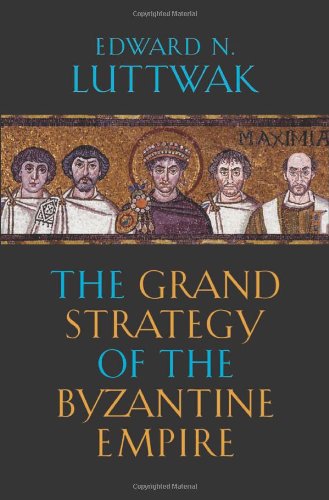
The Grand Strategy of the Byzantine Empire by Edward Luttwak

Just starting reading this magnum opus by eminent strategist Edward Luttwak and I am thoroughly enjoying it; particularly, the context-building historical digressions that enrich the text.  Highly recommended.

Interviews at SWJ Blog

Wednesday, December 15th, 2010

I very much  like the turn toward the publication of short interviews with experts occurring of late at SWJ BLog, for example the COIN series by FP’s Octavian Manea. To toot my own horn for a moment, I did an early one for SWJ when I interviewed Tom Barnett.

There are two new ones up right now that I recommend:

Octavian Manea – Thinking Critically about COIN and Creatively about Strategy and War An Interview with Colonel Gian Gentile

Q: To what extent should Algeria be a warning for present?

A: The warning it should provide is that you should never think that improved tactics, whether it is a conventional or a counterinsurgency war, can rescue a failed strategy or policy. Sun Tzu offers one of the most profound statements on the relationship between tactics and strategy: Strategy without tactics is the slow road to victory, but tactics without strategy is the noise before defeat. Another historical example comes to mind. The German army up to a certain point in WWII was arguably one of the finest tactically fighting armies in history. But it lost. The warning is to be careful how much faith you place in the idea that better tactics can save a failed strategy or policy (or in the case of the Vietnam War – better tactics rescuing a war that was unwinnable in the first place)

Mike Few –A Conversation with Dr. Douglas Porch Relooking French Encounters in Irregular Warfare in the 19th Century

A:  Alas, Arquilla’s representation of these incidents as primitive versions of modern concepts are a stretch, when not total misrepresentations. At worst, his examples are lifted from context, include material factual inaccuracies, and misconstrue reasons for French “success.” (The “successes” themselves are debatable.) Finally, Arquilla perpetuates the fundamental COINdanista heresies that tactics can rescue flawed policy and defective strategy, while “modernizing” Western occupations will be perceived as “liberation” by indigenous societies. I will take each of Arquilla’s examples in turn to explain their context, in the process illustrating why an incomplete history can lead to misleading results.

Under Suchet, Aragon did in fact enjoy the reputation as the most pacified Spanish province in Spain. But Suchet’s achievement was temporary, contingent and a “success” only when contrasted with the overall catastrophic outcome of Napoleon’s Spanish project. Aragon and the sliver of bordering Catalonia over which Suchet had charge only shines in context: The French totally lost the narrative in Spain. Napoleon’s deposition and imprisonment of the Bourbon Ferdinand VII — whom he replaced with his brother Joseph Bonaparte in 1808 — established a government regarded as illegitimate, not only in Spain, but in Europe and Latin America as well. The obligation imposed by the Napoleon that the Spaniards pay the costs of occupation meant high taxes and requisitions of Church lands. “Modern” French secular ideas taken from the French Revolution were an affront to the values of conservative Spaniards, who were horrified that Napoleon had imprisoned two Popes and annexed the Papal States to the Roman Republic. The fact that Napoleon was unable to vanquish Great Britain, and the presence

Kudos to Bill and Dave! Keep’em coming!


Switch to our mobile site