zenpundit.com » Perception

Archive for the ‘Perception’ Category

Query: COIN Manual Conference Feedback

Wednesday, May 16th, 2012


Was the COIN  Manual conference at Fort Leavenworth last week a success or a failure?

I have heard backchannel that the focus of the rewrite of FM 3-24 was going to be on “tactics” and but that a “light footprint option” had to be included to appease policy makers. Some good suggestions were made at SWJ by Colonel Robert C. Jones, but not much has been said yet online that I have seen. USACAC bloseriously could use some updating on a more frequent basis.

I’m curious where they went with this. Opinions and comments solicited.

The Taliban who turned himself in

Wednesday, April 18th, 2012

[ by Charles Cameron — a possible cultural parallel, also an entry for the pattern language of creativity, ourobouros ]

.

.

You’ve read about it in the news already:

U.S. officials couldn’t believe their luck last week when a suspected Taliban commander who heard there was a $100 reward for his whereabouts turned himself into authorities.

Perhaps misunderstanding the meaning of ‘wanted’, Mohammad Ashan sauntered up to police in Sar Howza, Paktika province, with a poster bearing his own face – and demanded the finder’s fee.

There are two things to note here — a parallel, and a pattern.

1.

The parallel is with an incident I mentioned earlier on Zenpundit:

I was also struck by an anecdote Tom Ricks told Fareed Zakariah on the latter’s show recently. He recounted a story first told by John Masters in his book “Bugles and a Tiger”, the memoir of a British officer serving with the Gurkhas in Waziristan in the 1930s. At the end of the war, so the story goes, some Afghans approach the British soldier and ask, “Where are our medals?” “You were the enemy,” he replies. And here’s the punchline, the Afghan respose to that: “No, no. You gave medals to the Pashtuns on your side. We want our medals, too. You couldn’t have had a good war without us.”

Tom Ricks comments, “This is very much the Afghan attitude. This is a kind of sporting event for them in many ways.”

Food for thought.

2.

The pattern is self-reference. Again,it’s something I’ve touched on here before, because it’s always of interest when it crops up:

there’s a special place in my analytic thinking for those representables which are self-referential – the category that gave rise to Douglas Hofstadter’s celebrated book, Gödel, Escher, Bach.

Indeed, I have a special glyph that I use in my games to notate ideas that are self-referential:

We don’t learn anything new about the particular instance of the Taliban walking in to claim his award for identifying himself by noting that it’s self-referential — but it intrigues us because it is, and that’s actually a sign that paradoxes of self-reference are significant at an unconscious level: that they’re a pattern worth watching for, and one that will play a role in the generation of aha! moments — whether they be analytic insights, creative breakthroughs, or (as in this case) just strange and amusing.

Kekulé von Stradonitz‘s basic insight into the structure of the benzene molecule was that it might be a serpent eating its own tail. That’s self-referential paradox at it’s finest — and a key aha! moment in the history of Chemistry.

It is also an archetypal image — the self-devouring serpent (ouroboros) crops up in alchemy (see image above) and in the Norse myth of Jörmungandr, the serpent who encircles Yggdrasil, the world tree.

Such images are important to the care and feeding of the creative mind.

History Will Judge Only if We Ask the Right Questions

Wednesday, April 18th, 2012

Thomas Ricks of CNAS recently had a historically-minded post at his Best Defense blog at Foreign Policy.com:

What Tom would like to read in a history of the American war in Afghanistan 

I think I’ve mentioned that I can’t find a good operational history of the Afghan war so far that covers it from 2001 to the present. (I actually recently sat on the floor of a military library and basically went through everything in its stacks about Afghanistan that I hadn’t yet read.)

Here are some of the questions I would like to see answered:

–What was American force posture each year of the war? How and why did it change?

–Likewise, how did strategy change? What was the goal after al Qaeda was more or less pushed in Pakistan in 2001-02?

–Were some of the top American commanders more effective than others? Why?

–We did we have 10 of those top commanders in 10 years? That doesn’t make sense to me. 

–What was the effect of the war in Iraq on the conduct of the war in Afghanistan?

–What was the significance of the Pech Valley battles? Were they key or just an interesting sidelight?

–More broadly, what is the history of the fight in the east? How has it gone? What the most significant points in the campaign there?

–Likewise, why did we focus on the Helmand Valley so much? Wouldn’t it have been better to focus on Kandahar and then cutting off and isolating Oruzgan and troublesome parts of the Helmand area?

–When did we stop having troops on the ground in Pakistan? (I know we had them back in late 2001.) Speaking of that, why didn’t we use them as a blocking force when hundreds of al Qaeda fighters, including Osama bin Laden, were escaping into Pakistan in December 2001?

–Speaking of Pakistan, did it really turn against the American presence in Afghanistan in 2005? Why then? Did its rulers conclude that we were fatally distracted by Iraq, or was it some other reason? How did the Pakistani switch affect the war? Violence began to spike in late 2005, if I recall correctly — how direct was the connection?

–How does the war in the north fit into this?

–Why has Herat, the biggest city in the west, been so quiet? I am surprised because one would think that tensions between the U.S. and Iran would be reflected at least somewhat in the state of security in western Afghanistan? Is it not because Ismail Khan is such a stud, and has managed to maintain good relations with both the Revolutionary Guard and the CIA? That’s quite a feat. 

Ricks of course, is a prize winning journalist and author of best selling books on the war in Iraq, including Fiasco and he blogs primarily about military affairs, of which Ricks has a long professional interest and much experience.  Ricks today is a think tanker, which means his hat has changed from reporter to part analyst, part advocate of policy. That’s fine, my interest here are in his questions or rather in how Ricks has approached the subject.

First, while there probably ought to be a good “operational history” written about the Afghan War – there’s a boatload of dissertations waiting to be born – I think that in terms of history, this is the wrong level at which to begin asking questions. Too much like starting a story in the middle and recounting the action without the context of the plot, it skews the reader’s perception away from motivation and causation.

I am not knocking Tom Ricks. Some of his queries are important – “What was the effect of the war in Iraq on the conduct of the war in Afghanistan?”  – rises to the strategic level due to it’s impact and the light it sheds on national security decision making during the Bush II administration, which I suspect, will not look noble when it is revealed in detail because it almost never is, unless you are standing beside Abraham Lincoln as he signs the Emancipation Proclamation.  Stress, confusion, anger and human frailty are on display. If you don’t believe me, delve into primary sources for the Cuban Missile crisis sometime.  Or the transcripts of LBJ and NIxon. Exercise of power in the moment is uncertain and raw.

But most of the questions asked by Ricks were “operational” – interesting, somewhat important, but not fundamental. To understand the history of our times, different questions will have to be asked in regard to the Afghan War. Here are mine for the far off day when documents are declassified:

What was the evolution of the threat assessment posed by Islamist fundamentalism to American national security by the IC from the Iranian revolution in 1979 to September 11, 2001?  Who dissented from the consensus? What political objections or pressures shaped threat assessment?

What did American intelligence, military and political officials during the Clinton, Bush II and Obama administrations know of the relationship between the ISI and al Qaida and when did they know it?

What did American intelligence, military and political officials during the Clinton, Bush II and Obama administrations know of the relationship between Saudi intelligence, the House of Saud and al Qaida and when did they know it?

What did American intelligence, military and political officials during the Clinton, Bush II and Obama administrations know of the relationship between the Taliban and al Qaida and when did they know it?

In the aftermath of 9-11, how did Saudi leverage over global oil markets effect American strategic decision making?

In the aftermath of 9-11, how did Pakistani nuclear weapons effect American strategic decision making?

In the aftermath of 9-11, how did the “Iraq problem”  effect American strategic decision making?

In the aftermath of 9-11, how did nuclear terrorism threat assessments effect American strategic decision making?  Did intelligence reports correlate with or justify the policy steps taken?

Who made the call on tolerating Pakistani sanctuaries for al Qaida and the Taliban and why?

Was there a net assessment of the economic effects of a protracted war in Afghanistan or Iraq made and presented to the POTUS? If not, why not?

Why was a ten year war prosecuted with a peacetime military and a formal declaration of war eschewed?

How did the ideological convictions of political appointees in the Clinton, Bush II and Obama impact the collection and analysis of intelligence and execution of war policy?

Who made the call for tolerating – actually financially subsidizing – active Pakistani support for the Taliban’s insurgency against ISAF and the Government of Afghanistan and why?

What counterintelligence and counterterrorism threat assessments were made regarding domestic Muslim populations in the United States and Europe and how did these impact strategic decisions or policy?

What intelligence briefs or other influences caused the incoming Obama administration to radically shift positions on War on Terror policy taken during the 2008 campaign to harmonize with those of the Bush II administration?

What discussions took place at the NSC level regarding the establishment of a surveillance state in the “Homeland”, their effect on our political system and did any predate September 11, 2001 ?

What were the origins of the Bush administration’s  judicial no-man’s land policy regarding “illegal combatants” and “indefinite detention”, the recourse to torture but de facto prohibition on speedy war crimes trials or capital punishment?

The answers may be a bitter harvest.

Going to Try this App

Sunday, April 15th, 2012

Paper for iPad


Simultaneity II: the pictorial eye

Wednesday, April 11th, 2012

[ by Charles Cameron — when sequence becomes simultaneous, the pictorial eye, rethinking thinking, continuing from Simul I ]
.

What better day to begin writing this second post on simultaneity than the day on which Google celebrated the birthday of Eadweard Muybridge with a Google Doodle — not that I’ll get the post finished within those same 24 hours!

The film — sequence of frames? stills? which would you call it? — that Muybridge took of a horse, used in that Google Doodle [view it in motion, here], is celebrated as showing beyond a doubt that when galloping, all four of a horse’s hooves may be in the air at the same time.

But is it — Muybridge’s work product — sequential, ie a film, or simultaneous, ie the presentation of many moments at one time?

That question gets to the heart of an issue that all narrative faces, as we shall see. First, the pictorial side of things.

*

Hans Memling‘s Passion of Christ (above) tells the gospel narrative, from Christ’s entry into Jerusalem and the Last Supper through his crucifixion, entombment and resurrection to his appearances in Emmaus and by the sea of Galilee in one canvas, much as Bach’s Matthew Passion [link is to Harnoncourt video] tells major portions of the same narrative in three hours of unfolding musical drama.

*

David Hockney has recently been working on forms of what I can only call “asynchronous synchrony” — as exemplified here:
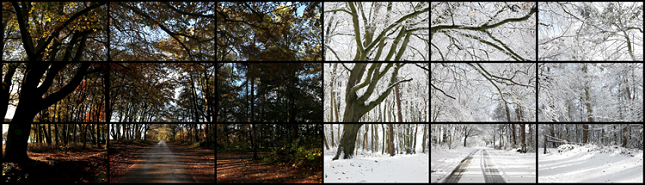

Stills from Woldgate 7 November 2010 11:30 AM (left) and Woldgate 26 November 2010 11 AM (right). Credit: ©David Hockney

This image comes from a fascinating article describing Hockney’s current work by Martin Gayford, titled The Mind’s Eye, which you can find in MIT’s Technology Review, Sept/Oct 2011:

We are watching 18 screens showing high-definition images captured by nine cameras. Each camera was set at a different angle, and many were set at different exposures. In some cases, the images were filmed a few seconds apart, so the viewer is looking, simultaneously, at two different points in time. The result is a moving collage, a sight that has never quite been seen before. But what the cameras are pointing at is so ordinary that most of us would drive past it with scarcely a glance.

As with the Muybridge video above, “the viewer is looking, simultaneously, at different points in time”. Here Hockney does this with video cameras — but he achieves something of the same effect of time-displacement with still photos, too, as you can see in his brilliant portrait of the sculptor Henry Moore, hosted on the British Council’s Venice Biennale site.

Here is Gayford’s concluding paragraph, tying Hockney’s work into the larger context of our need for multiple frames of reference:

“Don’t we need people who can see things from different points of view?” Hockney asks. “Lots of artists, and all kinds of artists. They look at life from another angle.” Certainly, that is precisely what David Hockney is doing, and has always done. And yes, we do need it.

*
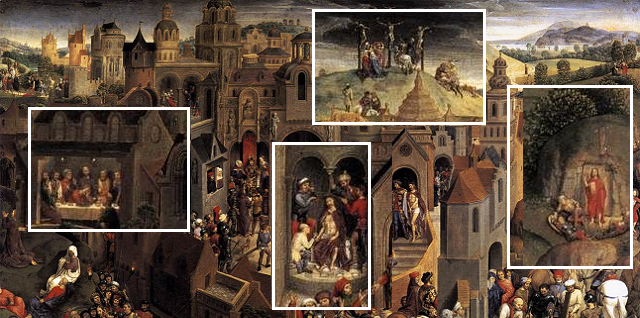
Memling again — and here I have enlarged and “framed” four of the 23 scenes from the passion of Christ which he has incorporated in the one painting: the Last Supper, the Crowning with Thorns, the Crucifixion, the Resurrection — Thursday evening through Sunday, and from life to death and back again.

*

It was Holy Week for Christians just last week, so perhaps you will forgive my having been preoccupied with images of the passion during the season set aside for such meditations — but what I want to point out to you is timeless, and indeed brings the transcendent into the everyday. Let’s take a look at a Hitchcock film next, then, and see how a contemporary videographer Jeff Desom has remixed the already Hockney-like Rear Window [link to IMDb] to create his own time-lapse telling of the tale [link to Vimeo], from which I took this screen-grab:

*

Time-lapse — simultaneity? The philosopher Alfred North Whitehead once wrote:

The communion of saints is a great and inspiring assemblage, but it has only one possible hall of meeting, and that is the present; and the mere lapse of time through which any particular group of saints must travel to reach that meeting-place, makes very little difference.

And so it is with this other Memling painting — and many others like it, by artists old and new:
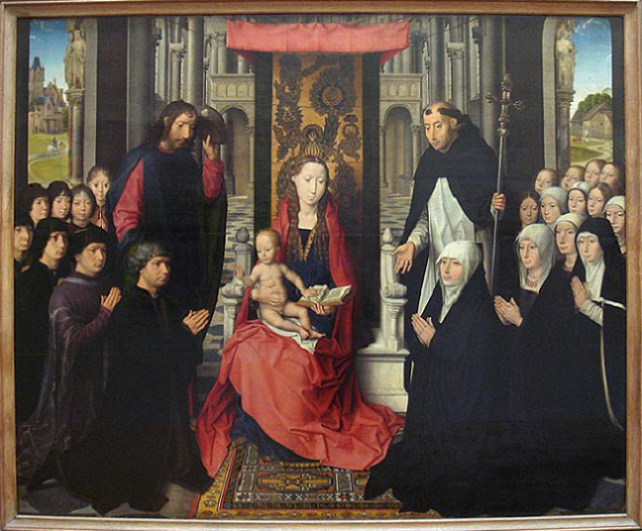
Here we see the Virgin Mary and Christ child with Saints Dominic and James — there’s an eleven centuries gap right there, St Dominic lived from 1170 – 1221, more than a millennium after Christ — and Memling has St Dominic presenting his patron, the spice trader Jacques Floreins with his family to Christ, circa 1490. With everyone dressed in late 15th-century fashions…

Whitehead — co-author with Bertie Russell of Principia Mathematica — see how amazing this is? — could have been thinking of Memling: “the mere lapse of time through which any particular group of saints must travel to reach that meeting-place, makes very little difference”.

*

Coming up next: how this affects our understanding of story.

____________________________________________________________________________

For an understanding of the setup David Hockney uses for his multiple-video takes, see here and specifically this and this. For the setup used by Jeff Desom in his Rear Window remix, see here and specifically this.


Switch to our mobile site