zenpundit.com » Israel

Archive for the ‘Israel’ Category

The Said Symphony: moves 13 – 15

Wednesday, December 21st, 2011

[ by Charles Cameron – extended analytic game on Israeli-Palestinian conflict — continuing ]

.

It has been a while since I last played a move in the Said Symphony: our game has been quiet since July, and it is now December.  Meanwhile, the world has moved on, and many of the knowns of the Middle East have become unknowns – the Egyptian view of Israel among them.

My next move, then, will recognize this lapse of time — but for those who may be unacquainted with the game, and wish to follow it, here is a quick recap.

The Said Symphony Game, played in the spirit of Hermann Hesse‘s fictional Glass Bead Game, is an attempt to “concept-map” the various voices in the Israeli-Palestinian conflict and its wider context, both contemporary and historical/mythological, so that its many voices can be held in counterpoint in the mind, and parallelisms and oppositions discerned between them as in a great fugue of Bach or Beethoven — inspired by the Palestinian public intellectual and music critic’s suggestion:

When you think about it, when you think about Jew and Palestinian not separately, but as part of a symphony, there is something magnificently imposing about it. A very rich, also very tragic, also in many ways desperate history of extremes — opposites in the Hegelian sense — that is yet to receive its due. So what you are faced with is a kind of sublime grandeur of a series of tragedies, of losses, of sacrifices, of pain that would take the brain of a Bach to figure out. It would require the imagination of someone like Edmund Burke to fathom.

The game thus far:

The game is a solo game, and you may wish to read it slowly.

I will now play moves 13 – 15.

____________________________________________________________________________________________

Move 13: Pause

Move Content:
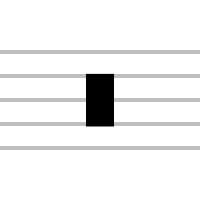
The rest [in this case a “long” rest] is the indication in the score of a musical silence: that is, a silence heard as musical, silence within the music. The rest extends over time, the music continues – so I’m adding a fermata or hold to the rest, which will extend it further, thus:

To my way of thinking, the pause is, above all else, a sabbath, a time of rest:

“Labor is a craft, but perfect rest is an art”, writes Abraham Joshua Heschel in his great, short book, The Sabbath — “He who wants to enter the holiness of the day must first lay down the profanity of clattering commerce … He must go away from the screech of dissonant days” and “How else express glory in the presence of eternity, if not by the silence of abstaining from noisy acts? These restrictions utter songs to those who know how to stay at a place with a queen…”

Links claimed:

There are other pauses, pauses of dissonance, pauses of rending.

To Auschwitz: The pause that Auschwitz enforces on us is a silent scream, atonal, ultra-modern in its sensibility, the attempt of a little, unmoored, desacralized western consciousness to get to moral grips with the factory extermination of one’s fellow beings by the millions, perpetrated by people who wear the same shoes and suits and ties, and carry the same briefcases as ourselves. It lacks all that has previously been called  musicality: it cannot cope.

I do not believe there is any escaping this scream: it is to be heard and held, embraced even. It is ugly, and it is an ugliness increaed by magnitude, by repetition, by number.

To Golgotha: The pause that Golgotha asks of us is of another order.  Christ, “when he had cried again with a loud voice, yielded up the ghost.” The Word is silenced. Only after three days will it begin to speak again.

Comment:

Leading into the next move, I have suggested that the rest is a musical silence – whether it be the deathly silence we may sense in Golgotha, the hideous silence that Auschwitz draws from our exhausted lungs, or the encompasing silence of glory of which Rabbi Heschel speaks.

It is a musical silence, a silence in each case to be listened to – tolerable or intolerable – a John Cage zen silence if you will…

In that silence, sounds can be vaguely sensed, emerging as if a morning mist is lifting, and some bird or twig or trill takes form…

Our board thus far:

[ my appreciation and thanks to Cheryl Rofer, who corrected me with regard to the notation of rests ]

____________________________________________________________________________________________

Move 14: Jerusalem


And so a new movement in our Symphony begins.

I have been aching for this moment: as move 14, I play Jerusalem

Move 14: Jerusalem

Move content:

Jerusalem is at the heart of the Israeli / Palestinian and Israeli / Arab problem, and thus of much of the tension in the  Middle east and the world.

It is also the city of peace, Salem – and you might say the ultimate hope, not of this game, which cannot aspire so high, but of the heart, is expressed in the three words: shalom salem salaam… In fact, ubi shalom, ibi salaam might be the motto of this work: where there is peace, let there be peace.

In making the opening move of this second movement of my game Jerusalem, then, I am taking us into the heart of the conflict, and into the heart of the hope for peace.

Jerusalem is a contested city, and we shall explore that contest in the moves to come.

Links claimed:

First, to the rest in 13: because in the silence, three sounds can be heard.  I quote here the words of Jamal Zahalka, a Palestinian Knesset Member — not for who he is but for their music:

The sound of the Muezzin, the church bells and the blowing of the shofar have always existed.

Those are the sounds “that can be vaguely sensed, emerging as if a morning mist is lifting”, in the silence of the musical rest.

Second, to Golgotha, the place outside Jerusalem where, according to the Christian telling, the body of the man who compared his body to the temple was so cruelly tortured that he “yielded up the ghost” – and at that moment, as if in sympathy, in the spiritual heart of Jerusalem and all Israel “behold, the veil of the temple was rent in twain from the top to the bottom; and the earth did quake, and the rocks rent…”

Third, to the Glass Bead Game: because “the holy city, new Jerusalem, coming down out of heaven from God, made ready as a bride adorned for her husband” of Revelation 21.21 finds its intellectual avatar in “the hundredgated cathedral of the mind” to which Hesse’s Game aspires.

Fourth, to William Blake, prophet, for whom Jerusalem was so urgent a matter that he must have it with him in England – as many Americans must have it with them in America — singing (as I myself have lustily sung):

And did those feet in ancient time.
Walk upon England’s mountains green:
And was the holy Lamb of God,
On England’s pleasant pastures seen!

And did the Countenance Divine,
Shine forth upon our clouded hills?
And was Jerusalem builded here,
Among these dark Satanic Mills?

Bring me my Bow of burning gold;
Bring me my Arrows of desire:
Bring me my Spear: O clouds unfold!
Bring me my Chariot of fire!

I will not cease from Mental Fight,
Nor shall my Sword sleep in my hand:
Till we have built Jerusalem,
In England’s green & pleasant Land

But Blake did better than to write these words – he illuminated them, and I shall place the text as he presented it at the bottom of this post.

Next: to Bob Dylan.  Well, there’s this:

— but it seems to be someone’s personal graphic for a compilation of Dylan songs, so this – Dylan at the Wailing Wall, 20 February 1983, attending his son’s Bar Mitzvah – will have to suffice:

And finally, I find there’s a peruasive link to Moral Equivalence — because Palestinians claim possession of the Noble Sanctuary and parts of the old city, while Israelis claim the same rights over the whole of Jerusalem including the Temple Mount – the Temple Mount and Noble Sanctuary being one and the same physical space — and there are wise and foolish, hardliners and diplomats, scholars and treatises on both sides, and in the interstices between them.

And the question is: are the claims and complaints of one side justified and the other baseless, or is there a moral equivalence between them.?

That is a question of balance on the scale of justice, to be tempered, one always hopes, with mercy.

Comment:

What are the claims and counter-claims, ancient and modern – and what do the peace-makers say?

Addendum:

A page from Blake’s Preface to Milton:
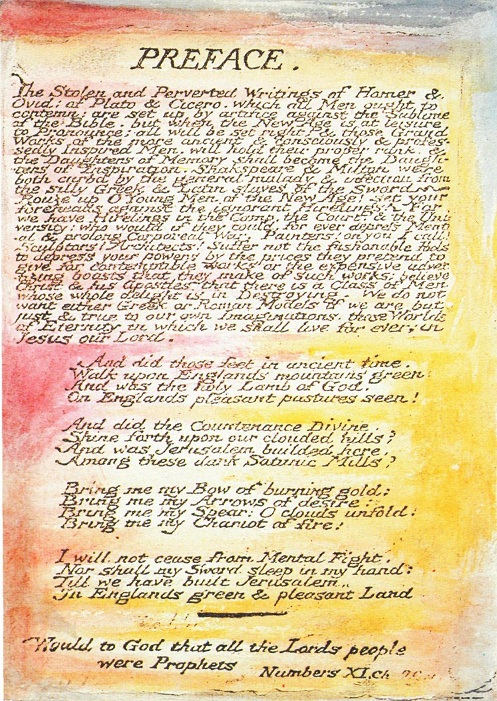
It would be a marvel to have purchased his book at the time, to have held it and read and savored it, each copy uniquely illuminated by his own hand…


____________________________________________________________________________________________

Move 15: Netanyahu’s Leopard

Move 15: Netanyahu’s Leopard

sforzando

Move content:

“A leopard has sunk its teeth in our flesh, in the flesh of our children, wives, our elderly, and we will not be tempted to believe that this leopard has now changed its spots. We will not ignore its voracious growls. We will strike it down.”

From the desk of Israeli Prime Minister Netanyahu, speech at the Memorial Ceremony for Victims of Terror, October 5th, 2011.

Links claimed:

To rest or pause, I suppose, because the lull between intifadas may seem like a sort of temporary truce, but it’s really mostly an opportunity for the enemy to regroup and rearm; and then to Jerusalem, because Jerusalem is Irael and Israel Jerusalem; and finally to — what was it — moral equivalence because there is no moral equivalence, is there?

I’m sorry if that seems a bit abrupt, but the musical signature at the top of the move says sforzando, and we’ve got work to do.

Comment:

Getting into the thick of it, Netanyahu’s speech doesn’t leave much room for compromise.  And sforzando, a musical term, literally means “forcibly” — “with strong emphasis”.

Conflict is not pretty, in the way one might hope that symphonies and other works of art and beauty might be.  There’s death to be distributed and withheld, and wealth and power — and the urgency they bring to the fight.
 

Apocalyptic Updates I: Warren Jeffs and a troubled world

Thursday, December 15th, 2011

[ by Charles Cameron — prophecy, Warren Jeffs, FLDS, Zion in the US, the future, mapped ]

.

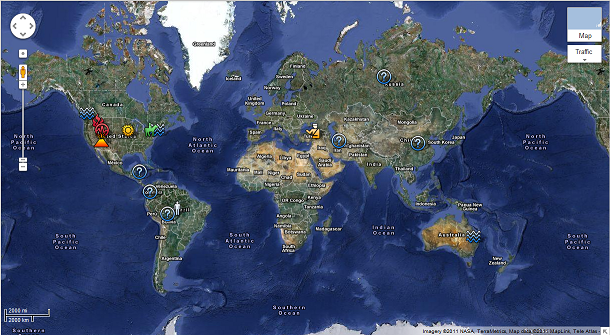
Well, there you have it: a map of where Warren Jeffs, the imprisoned president of the Fundamentalist Church of Jesus Christ of Latter-Day Saints (FLDS), prophesies there will be major problems soon, if his life sentence for child sexual assault isn’t quickly rescinded.

I’ll bet our meteorologists, intel folks and policy-makers wish they had this kind of insight into just where and what will happen next.

*

Let’s take a closer look.

That’s Africa, the Middle East and a good bit of Asia and Australasia, with not a whole lot going on to be honest.  Turkey?

Turkey helps Israel

“Let Turkey aid Israel in day of great attack against my Israel, lest you also fall and become a subject nation. Amen.”

Iran?

Iran warning

“Let the nation of Iran cease all aggressive power against neighboring lands and peoples, lest you become a nation no more; only to be of subjugation to a foreign power, to no longer be of aggression”

And that’s it for the ever-contentious Middle East.

*

And there’s good reason for that.  The Middle East isn’t where Zion is.

Take a look at the US  now, and see how much more dire the prophetic warnings are here…

An earthquake and tidal wave in Seattle, a “melting fire of such powers to cleanse my land of all evil” in Idaho, a tsunami off the East coast (Californians should be relieved) in which “great and noticeable cities on the coast shall be swept off the land ” — and more.

And that’s because the center of gravity shifts to the US when (a) Christ appears here as well as in Israel, according to the Book of Mormon, and (b) Joseph Smith receives his revelations and founds the Mormon church here.

And if that’s not enough, here are two especially significant events to be on the lookout for:

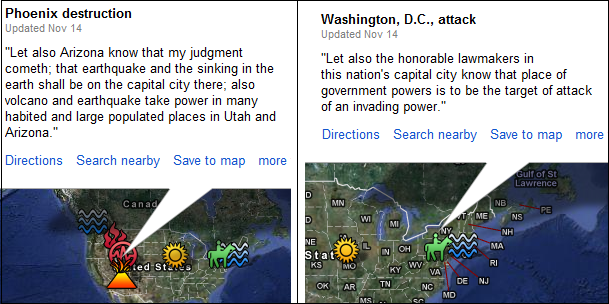
An attack on Washington, the destruction of Phoenix, and volcanoes across Arizona and Utah…

…which points us to the sites especially sacred to the FLDS — and indeed other churches in the tradition of Joseph Smith:

So that’s the hub of this whole thing, what the Temple Mount / Noble Sanctuary is to potent prophetic and apocalyptic influences in the Middle East: New Jerusalem in  Missouri.

*

So that’s your update on our future prospects as Warren Jeffs sees them.

The map was kindly provided by Lindsay Whitehurst on her Salt Lake Tribune blog, and can be found here.  Three of Jeff’s recent prophecies, containing materials used in these maps, have been made public by the Utah Attorney General’s office, and can be downloaded here and here.

Coming up shortly: Apocalyptic Updates II: Iran, the Mahdi and the Vilayat

There’s been some new analysis of the Ahmadinejad / Khamenei split at MEMRI that makes it clear that Ahmadinejad’s Mahdist claims are very much at the root of the issue, so that we have what is essentially a Mahdist vs Velayat standoff on the theological level, and a clerical elite vs populist standoff on the political.  Watch this space…

A question for the readership

Saturday, December 10th, 2011

[ by Charles Cameron — terminology of war ]
.
I have a question:

Do we have or need a term for the kind of situation where one nation, while ostensibly at peace with another, fights them by means that are plausibly deniable –- I’m thinking a campaign of sabotage, computer viruses, assassinations -– whose leaders when asked if they would care to deny them, smile like so many Cheshire Cats?

This certainly seems to be one mode of the continuation of politics by other means — and once war is declared, it would fold itself into war itself as covert and info ops — but I was wondering: is there a name for this, or do we perhaps need a name for it, in “peacetime”, as one of the forms of warfare?

I pinged Mark on this, since he’d know better than I, and he replied:

There is no legal term for such a state.

Individually, these actions either constitute “violations of sovereignty” or “criminal acts” depending on how the state chooses to interpret them, until they consider them “an act of war” (i.e. mining harbors, sabotage, assassination) and act diplomatically. Until then it is a state of “peace” under International Law.

Which leaves me wondering: is it about time we had a name for this kind of war, which the United States and / or Israel may plausibly – and deniably – be waging at against Iran as we speak?

Would it be useful to have a term for, and a legal doctrine about, campaigns of this sort?

Lex Talionis I: the matter of Subramaniam Swamy and Harvard

Friday, December 9th, 2011

[ by Charles Cameron — Harvard controversy, free speech vs hate speech, Hindutva, moral high ground & sanctions for and against violence ]

.

I am grateful to various members of the New Religious Movements list for pointing me to the recent events in Harvard, where a group of scholars led by the formidable Diana Eck (her book on Banaras is a masterpiece and greatly treasured) have persuaded the Faculty of Arts and Sciences to omit two courses in economics usually taught by Subramaniam Swamy from their Summer School offerings next year, on the ground that an op-ed he published in Daily News and Analysis titled “How to Wipe Out Islamic Terror” fell under the category of hate-speech (as opposed to free speech).

The article in question is no longer available on the DNA site, but can be found on Pamela Geller‘s Atlas Shrugged blog.  An account of the controversy can be found on Inside Higher Ed, and Harvard Faculty’s debate was reported in the Harvard Magazine.

Subramaniam Swamy is President of what remains of the once powerful Janata Party and former Union Cabinet Minister.

With that as background, I would like to address the issue of the varying principles and rule-sets invoked as offering a moral high ground – or a necessary safeguard – in various religious and other traditions.

*

I have read Dr Subramaniam Swamy’s article, and while the various quotes in it recommending specific actions — such as “Remove the masjid in Kashi Vishwanath temple complex, and 300 others in other sites as a tit-for-tat” and “Enact a national law prohibiting conversion from Hindu religion to any other religion” – give western readers a sense of Swamy’s overall mindset and intentions, it was another quote that held my attention:

This is Kaliyug, and hence there is no room for sattvic responses to evil people. Hindu religion has a concept of apat dharma and we should invoke it. This is the moment of truth for us.

I suspect the reason this quote has not been featured in the reports I’ve read of the debate have to do with the number of words in it that are unfamiliar to the western reader.

I’m acquainted with Kaliyug (the Age of Darkness) and with the concept of the sattvic (“Sattva is a state of mind in which the mind is steady, calm and peaceful” to quote the sacred Wiki), but had to dig a bit to discover that apat dharma is essentially “righteousness in emergencies”:

There are special Dharmas during critical and dangerous circumstances. They are called Apat-Dharma.

Swami Sivananda

Apat Dharma: They are duties that come to one under extraordinary circumstances, in crisis or in emergencies (apatmulakah). In such circumstances, even that which under normal circumstance is deemed wrong becomes dharma (tatra adharmo’pi dharmah). Here the righteous motives guide our actions (bhava-suddhimattvat). Normally a doctor gives anaesthesia before operating the patient but an emergency operation performed on the battlefield to save the life or limb of a soldier on the battlefield may be done without anaesthesia and with the instruments available, be they sterilized or not. When emergency is declared in the country, the elected parliament can be dismissed, the Constitution suspended and the ruler assumes extra-ordinary powers to deal with the situation. When peace prevails, the youth of a country should get education and work, but during war, the country may call upon its youth to sacrifice their education and fight in defence of the country, sometimes with hardly any training.

Sanjeev Nayyar

So that quote – “This is Kaliyug, and hence there is no room for sattvic responses to evil people. Hindu religion has a concept of apat dharma and we should invoke it. This is the moment of truth for us” – is essentially the abstract principle on which Swamy’s various proposals are based, and thus corresponds to the principles articulated by PM Netanyahu in his recent opening of the Knesset as underlying his government’s policies with regard to national security:

Our policy is guided by two main principles: the first is “if someone comes to kill you, rise up and kill him first,” and the second is “if anyone harms us, his blood is on his own hands.”

If you want a sense of how important that quote about apat dharma is to a Hindu (and a fortiori, a Hindutva) reader, see the way it is singled out and quoted with an illustration of Krishna driving Arjuna‘s chariot into battle by “Sanchithere (I’ve used the same illustration at the head of this post):

*

What am I after here?

It seems to me that we could use a brief yet definitive scholarly account of what the guiding principles of the various religions and secular worldviews allow their adherents, in terms of justice, forgiveness, pre-emption, retribution and retaliation.

This would need to include, compare and contrast such principles as:

  • The Judaic notions of pre-emptive killing (Netanyahu’s first principle, found in the Talmud and commonly quoted as ‘ha’Ba Lehorgecha, Hashkem Lehorgo, If someone tries to kill you, rise up and kill him first) and the injunction, in fighting the Amalekites, “Now go and smite Amalek, and utterly destroy all that they have, and spare them not; but slay both man and woman, infant and suckling, ox and sheep, camel and ass” (1 Samuel 15:3).
  • Christ’s “But I say unto you which hear, Love your enemies, do good to them which hate you.” (Luke 6.27)
  • Christian “just war” theology.
  • The western / UN “norm” that some actions are simply beyond the pale, unacceptable under any circumstances (essentially the basis for war crimes tribunals)
  • Game theory’s “tit for tat” strategy in an iterated Prisoners’ Dilemma as proposed by Anatol Rapaport and articulated by Robert Axelrod in his book, The Evolution of Cooperation.
  • The Islamic tradition’s notion of response in kind (Qur’an: 2.194, “and so for all things prohibited, — there is the Law of Equality. If then anyone transgresses the prohibition against you, transgress ye likewise against him but fear Allah, and know that Allah is with those who restrain themselves”) – which would appear to imply that actions that would not normally be acceptable may be appropriate in response to an enemy that has already “transgressed” in that specific manner
  • Gandhi’s ahimsa, together with his corollaries, “An eye for an eye makes the whole world blind” (attributed) and “It is better to be violent, if there is violence in our hearts, than to put on the cloak of nonviolence to cover impotence.”
  • Swamy’s own “This is Kaliyug, and hence there is no room for sattvic responses to evil people” and “the nation must retaliate — not by measured and ‘sober’ responses but by massive retaliation.”
  • Buddha’s “Victory breeds hatred. The defeated live in pain. Happily the peaceful live giving up victory and defeat” (Dhammapada15,5)…

… and so forth.

*

I am grateful for further pointers and comments you may care to offer.

I hope to follow this post up with another, Lex Talionis II, which will address the use of private rewards for revenge killings in the Israeli / Palestinian matter.

Dead Sea Scrolls & Nag Hammadi Codices online

Wednesday, September 28th, 2011

[ by Charles Cameron — archaeology, Biblical scholarship, eschatology, digital literacy ]

.

Both the Dead Sea scrolls from Qumran and the Gnostic and associated codices from Nag Hammadi are now available for study online:

quo-codices.jpg

The Nag Hammadi Archive can be explored via the Claremont Colleges Digital Library, and the Digital Dead Sea Scrolls via the Israel Museum, Jerusalem.

Here’s a description of the War Scroll from Qumran, which “is dated to the late first century BCE or early first century CE”:

Against the backdrop of a long biblical tradition concerning a final war at the End of Days (Ezekiel 38-39; Daniel 7-12), this scroll describes a seven stage, dualistic confrontation between the “Sons of Light” (the term used by Community members to refer to themselves), under the leadership of the “Prince of Light” (also called Michael, the Archangel) – and the “Sons of Darkness” (a nickname for the enemies of the Community, Jews and non-Jews alike), aided by a nation called the Kittim (Romans?), headed by Belial. The confrontation would last 49 years, terminating in the victory of the “Sons of Light” and the restoration of the Temple service and sacrifices. The War Scroll describes battle arrays, weaponry, the ages of the participants, and military maneuvers, recalling Hellenistic and Roman military manuals.

You can see why I’m interested.

The Nag Hammadi texts are a little less well known but include — along with a variety of other texts, some of them self-described as “apocalypses” — the now celebrated Gospel of Thomas, which Bart Erhman reads as continuing a “de-apocalypticizing” of Jesus’ message which he finds beginning in Luke and continuing in John:

In the Gospel of Thomas, for example, written somewhat later than John, there is a clear attack on anyone who believes in a future Kingdom here on earth. In some sayings, for example, Jesus denies that the Kingdom involves an actual place but “is within you and outside you” (saying 3); he castigates the disciples for being concerned about the end (saying 18); and he spurns their question about when the Kingdom will come, since “the Kingdom of the Father is spread out on the earth and people do not see it” (saying 113).

Again, you can see why I am delighted that these texts are becoming available to a wider scholarly audience…

In both the Nag Hammadi codices and Qumran scrolls, we have texts that were lost for almost two thousand years and discovered, somewhat haphazardly, in 1945 and 1947 respectively, providing us with rich insights into the religious ferment around a time and place that have been pivotal for western civilization.

Now, more than half a century later, the web — as it becomes our global museum and our in-house library — brings us closer to both…


Switch to our mobile site