zenpundit.com » military professionalism

Archive for the ‘military professionalism’ Category

“Optimizing the Potential of Special Forces”

Sunday, July 14th, 2013

[ by Mark Safranski – a.k.a “zen”]

A remarkably blunt article on SF/SOF (“special forces” is being used as an umbrella term for both) in the context of policy and strategy, from the perspective of an emerging great power by LTG Prakosh Katoch of the Indian Army. The American example of SOCOM in Afghanistan/Iraq/GWOT has obviously had an impact here, as has the negative example of Pakistani use of terrorists as proxy forces and ISI covert operatives for direct action in Indian territory and elsewhere. Quite aside from global conflicts and the bilateral rivalry with Pakistan, India also faces more than a dozen long term irregular conflicts with their own dynamics, such as the NaxaliteMaoist insurgency , which Katoch places in the context of Chinese strategic ambitions against India.

A must read.

Optimizing the Potential of Special Forces

….In India, the lack of strategic culture, more on account of keeping the military out from strategic military decision making, has led the hierarchy to believe that conventional forces coupled with nuclear clout can deter us from irregular threats. Nothing can be farther from the truth. Pakistan, though conventionally inferior, has been successfully playing her ‘thousand cuts policy’ knowing full well that India has failed to develop the required deterrent. It is our inability to find a cure to this Achilles’ heel, that has led China, which was hitherto using Pakistan as proxy to wage irregular war on India, now directly aids and supports insurgent and terrorist outfits inside India.

….Why the US has managed to secure its mainland post 9/11 is not only because of an efficient Homeland Security organisation but because the US Special Forces (USSF) are operating in 200 countries including India. Significantly, USSF have undeclared tasks such as conducting proactive, sustained ‘man-hunts’ and disrupt operations globally; building partner capacity in relevant ground, air and maritime capabilities in scores of countries on a steady – state basis; helping generate persistent ground, air and maritime surveillance and strike coverage over ‘under-governed’ areas and littoral zones and employing unconventional warfare against state-sponsored terrorism and trans-national terrorist groups globally. Before 26/11, Al-Qaeda had planned similar operations against New York but could not because the USSF had infiltrated Al-Qaeda. One cannot guard the house by simply barricading it. You must patrol the streets and the area outside.

Growing inter-dependence and interlinking of terrorist groups regionally and internationally should be a matter of serious concern. It is not the US alone that has deployed its Special Forces abroad. This is the case with most advanced countries including UK, Russia, Israel, China and even Pakistan. Pakistan’s SSG was operating with the Taliban in Afghanistan and has been active in Jammu and Kashmir, Nepal and Bangladesh, primarily training anti-India forces. There is a strong possibility of their presence in the Maldives and Sri Lanka as well, aside from presence within India. The Chinese have been smarter. For all the development projects throughout the globe, including in Myanmar, Nepal, Pakistan-POK, Sri Lanka, Bangladesh and Seychelles, contracts underway by PLA-owned/affiliated companies employ serving and veteran PLA soldiers and disguised Special Forces with assigned tasks, including evacuation of Chinese citizens from that country in case of emergencies. 

Read the rest here.

On Time and timeframes

Monday, July 1st, 2013

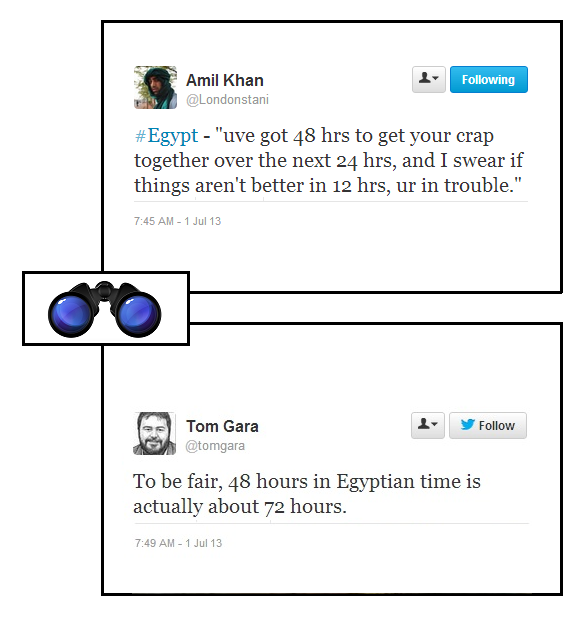
[ by Charles Cameron — 48 hours, Egyptian time, can mean many things, also DoD foresight, next 48 hrs ]
.

We seem to have at least four “times” here, ranking from 12 to 72 hours — or zero to 72 if you take the Army’s announcement itself as a sort of starting pistol — and they’re operating, obviously enough, under different frames. The army likes nicely rounded numbers like “48 hrs”, PERT chart thinking gives you the least time available in which to take the first step towards a desired aim, here “12 hours” — and “24 hours” is the latest target time for serious, visible progress to avert “worst case” response preparations. Or something along those lines.

And “72 hours”? That may be Egyptian elastic time, and thus roughly comparable to Lakota time

The Lakota view of time was simple. “Time was never a specific minute, but rather spaces of time,like early morning, just afternoon or just before midnight. The real meaning of time could be summed up by the phrase “nake nula waunyelo” loosely translated it means:

“I am ready for whatever, any place, any time, always prepared”.

When work needed to be done, people were prepared to work late inthe fields or stay up until 3 am to finish goods to be sold at market.When no work needed to be done, they didn’t work.

The irony is in the next comment:

Policy makers saw an opportunity to improve things by installing awestern time ethic and a respect for the clock.

I don’t know Egypt — but I have spent time “on Lakota time” and don’t wear a watch or carry a phone these days… The piece I drew those quotes from, Lessons from the Lakota: Time lessons for today’s managers, may or may not be useful advice for managers, but its overview-with-graphic of different time systems is worth a quick look. Anthropologists would be able to tell you more about individual cultures, but my point is that differing timeframes are among the major features of different worldviews, and we need to have a decent sense of them when we interface with them.

So “72 hours” may be an instance of relaxed but purposive time, okay? Which wouldn’t necessarily fit well with starched and pressed military time.

**

And here’s the blockbuster:

According to the Congressional Budget Office’s Analysis of DoD’s Future Years Defense Program from 2013, military foresight time runs five years ahead, while USG foresight time runs to 2030 at least:

In most years, the Department of Defense (DoD) provides a five-year plan, called the Future Years Defense Program (FYDP), associated with the budget that it submits to the Congress. Because decisions made in the near term can have consequences for the defense budget well beyond that period, the Congressional Budget Office (CBO) regularly examines DoD’s FYDP and projects its budgetary impact over several decades. For this analysis, CBO used the FYDP provided to the Congress in March 2012, which covers fiscal years 2013 to 2017; CBO’s projections span the years 2013 to 2030.

That’s confidence of a kind… but consider this:

I know, I know — whatever happens in Egypt “momentarily” may turn out to be no more than an eddy briefly interrupting a larger time-flow in the “mid-term” — a phenomenon I’d like to map nicely with some river graphics one of these days.

**

But time? What was it St Augustine said of it?

What, then, is time? If no one asks me, I know what it is. If I wish to explain it to him who asks me, I do not know.

Two Readings, and If You Read It, Why Not Review It?

Thursday, May 23rd, 2013

[by J. Scott Shipman]

One Hundred Days, The Memoirs of the Falklands Battle Group Commander, Admiral Sandy Woodward

For professional reasons, many trusted colleagues have recommended One Hundred Days, and I finally finished it a few weeks ago. They reminded me the Falklands War “was the first modern anti-access/area-denial (A2/AD) war, pitting a joint expeditionary force against a regional power with modern land, air, and sea capabilities.” [sourced from Proceedings magazine, May 2012, by Commander Jim Griffin, U.S. Navy—strongly recommended] In other words, the scrap in the South Atlantic in 1982 was the last time a “modern” expeditionary force faced a credible adversary with modern capabilities. 

Admiral Woodward reminds that no one expected Argentina to invade the Falklands, and even if they did, no one expected the UK to respond with force (even the Royal Navy (RN) was surprised, and many had to find the islands on a map). Woodward departed with the two remaining UK carriers, the Hermes and Invincible which were already on the chopping block due to budget problems (sound familiar?). Fighting was such a distant memory for the RN, having not engaged in significant action since WWII, and Woodward recounts that many of his men had difficulty making the transition from “a sea-going job” to fighting, and possibly dying. I wondered as I read if the U.S. Navy has prepared/is prepared for this transition; and truly both officer and rates proved susceptible. The personal nature of Woodward’s account was bit of a surprise, but provides valued insight into the challenges and frequent frustrations faced by naval leaders.

Commander Griffin’s account in Proceedings referenced above has a very good list of lessons learned, and a few observations and questions are added for consideration:

  1. Naval warfare is war of attrition. Attrition can occur as a result of sinking or disabling an opponent. In the case of the Brits, many of their ships sustained non-fatal hits that, for practical purposes, removed the ship from any offensive or defensive action. Many of our enemies, while not sophisticated, understand and plan accordingly. As a result numbers are important; numbers of ships and weapons.
  2. In the age of the missile, response times were/are measured in seconds, so ships and aircraft will be lost…often, quickly.
  3. Are our systems susceptible to electro-magnetic interference (EMI)? 
  4. Could our ships navigate or fight without GPS or other satellite-dependent technologies?
  5. Can sailors onboard fix systems when they break (and they will break, see #6 below)? One RN ship had a contractor embarked who made the difference, which was blind luck. Over the last 20 years, the USN has tended towards “operators” over technicians.
  6. “Murphy” is alive and well. When things can fail (including technologies), they will, at the worst possible time.
  7. Is the theater commander in command? In the Falklands, Woodward had command of ships, but not submarines—which hampered the effectiveness of his battle group.
  8. Ship preservation (preventive maintenance) is often paid for in battle. At least two RN ships were unable to use weapons because of salt corrosion rendering missile hatches inoperable. This is engineering problem, too, to be sure, but also an example of how preventive maintenance can pay-off when it counts.
  9. Damage control training for all-hands; rigorous and often. RN sailors did a masterful job of saving several of their wounded ships.
  10. Anti-missile capabilities on logistic/support ships.
  11. Homefront politics and posturing provides fog in war as does the enemy. One curse of modern communications; having the White House Situation Room second-guessing/micromanaging the war.
  12. The press is often not your friend. On a couple of occasions, the BBC broadcast orders of battle and goals, and the Argentineans planned and acted accordingly.
  13. The motto of Captain John Coward, RN, of HMS Brilliant, “The essence of war is violence. Moderation in war is imbecility.”

Woodward’s book is the clearest account we have of naval warfare in the missile age. If it is not already, One Hundred Days should be required reading for every naval officer. Strongest recommendation.

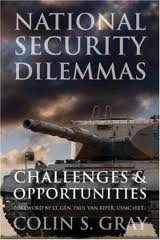
National Security Dilemmas, Challenges & Opportunities, Colin S. Gray

Colin Gray is no stranger to the readers of Zenpundit. I read this title over the Christmas break, and have returned to review with some frequency. In fact, my copy is so littered with underlining and marginalia, these periodic “reviews” can take a couple of hours. As the title suggests, Gray outlines the challenges and opportunities facing policymakers, and in so doing provides an accurate glimpse of our current state of political-military affairs. He encourages policymakers to reacquaint themselves with the importance of the concept of victory, and on how to successfully navigate a transition of our military from our previous focus of regular warfare to the realities introduced by enemies using irregular methods. Gray discusses “revolutions in military affairs (RMA)” and deterrence and the implications of both in our thinking and planning. Gray’s concluding section on preemption and preventative war is exceptionally well-presented.

For example, Gray’s section on Achieving Decisive Victory includes:

  1. Better armies tend to win.
  2. No magic formula for victory.
  3. Technology is not a panacea.
  4. The complexity of strategy and war is the mother of invention.
  5. Know your enemies.

This book is imminently quotable, so I’ll share a few with my highest recommendation.

The idea that strategy has an essence is deeply attractive. Strategy sounds incredibly rare and valuable, like something that could be bottled and sold. Unfortunately, American understanding of and sound practice in strategy is desperately rare. Strategic thinking and behavior are endangered activities in the United States. This is hardly a stunningly original insight. However, familiar though the criticism should be, it loses none of its bite for reason of longevity. Much as the U.S. defense community periodically is prodded by irregularist anxiety to worry about insurgency and terrorism, so from time to time it remembers the value of strategy. Though American defense professionals do not know what strategy is or how it works, they know that it is a matter of grave importance. The pattern has been one wherein a politician or a senior official with a personal interest has lit the fire of genuinely strategic discussion. The fire briefly flare brightly but then dies away for want of fuel. The fire is not fed, because there is not much demand for the heat and light of truly strategic argument in the United States. Although America is not quite a strategy-free environment, such a characterization would err in the right direction. (page 169 of paperback edition)

Since, inter alia, warfare is a competition in learning between imperfect military machines, fortunately one need only be good enough. (page 178; this is a personal favorite of mine)

There needs to be a continuous, albeit “unequal,” dialogue between civilian and soldier. War and warfare are permeated with political meaning, and consequences. A competent supreme command knows this and behaves accordingly. However, this relationship carries implications for civilian participation in military decisions in wartime that run contrary to the traditional American way in civil-military relations. If the strict instrumentality of force is not to be neglected, there has to be a constant dialogue between policymaker and soldier. Policy is a nonsense if the troops cannot perform “in the field,” while the troops may be so effective in action that policy is left gasping far behind unexpected opportunities by events. (page 179, emphasis added)

Gray’s National Security Dilemmas is a must read for policymakers and practitioners. [btw: it has been my custom to provide selected referenced works in book reviews. Gray’s bibliography is so excellent and comprehensive, I could not make a list that would do it justice.]

That said, I’ll close with more questions, and an apology: Does anyone read anymore? I’m rereading Manchester’s classic American Caesar after an absence of 30+ years, and I’d forgotten how much time both MacArthur the Elder and MacArthur the Younger (Douglas) spent reading. That said, how often do we see military leaders review the books they recommend? A reading list is one thing, explaining why the book made the cut another. With blogs, the internet, and social media, there are no barriers to entry. Recommendation to senior officers, including the General Officers and Flag Officers who post required reading lists: let your folks know why, write it down, explain it—the exercise will do you good, and give your subordinates insights into your thinking.

Now for the apology: there are four of us here at Zenpundit, but I’ve been the anchor man. This is my first post in too long, and I apologize to my colleagues and you, the reader. I’ve been on a tear reading naval stuff, mostly associated with my business endeavors. That said, I’ll endeavor to eat my own cooking and review what I read/have read with greater frequency.

Boyd and Beyond Local DC Event

Tuesday, December 18th, 2012

[by J. Scott Shipman]

Jim Hasik’s White Board Outline


At the suggestion of Adam Elkus, we were privileged to host our first “local” Boyd and Beyond event on 15 December. We had 14 attend, and five speakers. Logistically, we turned our family room in to a fairly comfortable briefing area, using a wall with Smart Sheets as a temporary white board. In keeping with our October events, we took up a collection and had pizza delivered for lunch. Coffee, soft drinks light snacks were provided. Each speaker was allotted 50 minutes, but given the participation of the audience, most talks lasted about 90 minutes. I should emphasize to those planning one of these events, to keep a lean speaker’s list, as the Q&A and discussion can easily double the time of a presentation—-and I believe all who attended would agree the comments/discussion made already great presentations even better.

My sincere thanks go out to my wife and partner, Kristen, for making this event look easy! She was the one who made sure everything was moving along and that folks felt at home. I would encourage others around the country to schedule and hold events through the year. We’re looking to do another in March 2013.

Our speakers were:

Jim Hasik, Beyond Hagiography: Problems of Logic and Evidence in the Strategic Theories of John Boyd

Francis Park, The Path to Maneuver Warfare in the U.S. Marine Corps

Robert Cantrell,  Which Card Will You Play?

Terry Barnhart, Designing and Implementing Maneuver Strategy in Transforming Major Organizations

Marshall Wallace, Theories of Change and Models of Prediction

I led off with a few comments on the military professional and intellectual rigor. I recommended the best book I’ve read this year: Inventing Grand Strategy and Teaching Command, by Jon Tetsuro Sumida, and the challenges he suggests in the realm of intellectual rigor. He writes:

“It remains to be seen whether readers exist with the mind and will to accept his guidance on what necessarily is an arduous intellectual and moral voyage into the realm of war and politics.” (emphasis added)

I followed with the example from An Unknown Future and a Doubtful Present: Writing the Victory Plan of 1941, by Charles E. Kirkpatrick. Mr. Kirkpatrick’s little book provides an excellent primer to the formulation of the United States’ WWII strategy and a refreshing insight into the education of an master strategist, then Major Albert C. Wedemeyer, attached to the War Plans Division, the Army chief of staff’s strategic planners, who wrote the Army strategy for WWII in 90 days. (read the review here) I suggested that military professionals should start something akin to a book club, where they can discuss and debate strategic issues and concept.

Following my comments, Jim Hasik offered his critique of John Boyd’s work. Adam tweeted that we were a “tough crowd,” but Jim was able to discuss his misgivings with respect to Boyd’s work and a lively discussion got us started. For those unfamiliar, Jim is the author of a paper called, Beyond Hagiography, which generated controversy in the Boydian community following this year’s October event at Quantico. (reviewed here and at zenpundit.comHere is a link to the paper. (see Hasik’s white board outline above).

According to Hasik, Boyd erred when extrapolating from physical processes/science to social processes. He reviewed Boyd’s use of science in his essay, Destruction and Creation, and suggested no literal correlation between Clausius’ Second Law of Thermodynamics (entropy), Gödel’s Incompleteness Theorem, and Heisenberg’s Uncertainty Principle and human behavior (on this I concur with Hasik, as analogy or metaphor these scientific principles enlighten).  Hasik asked if OODA scales from air-to-air combat to large scale events, and whether OODA was original (compared to PDCA, for example). One point that generated quite a bit of discussion was whether one could “like” Clausewitz or Sun Tzu and Boyd. Hasik questioned whether Boyd’s work should be judged as social science, history, or war studies, and suggested that further work was needed to fill in the gaps in his work. In October, someone suggested Boyd needed a “Plato,” someone to address Boyd’s work with less emphasis on science (as in Osinga’s book), thereby making Boyd’s work more accessible. The Strassler model was suggested; Strassler is an “unaffiliated scholar” who has written exhaustively referenced versions of ThucydidesHerodotus, and Arrian. [personal note: I believe a Strassler-like book on Boyd’s ideas would be a great resource] A great thought-provoking conversation.

Francis Park’s White Board


Francis Park’s talk on on maneuver warfare, the evidence of history began with “I’m a historian and I have a problem.” The irony wasn’t lost on the audience, as Francis is an active duty Army officer, speaking on the history of the USMC’s adoption of maneuver warfare (MW). Park called the Marine Corps “the most Darwinian of the services.” The venue for for the Corps discussion between MW advocates, and the “attritionists” was the Marine Corps Gazette. This venue was “unofficial,” otherwise the debate may have never happened. The Gazette’s forward-thinking editor made space and encouraged the debate, which was a “long, bitter, and complex fight.”

Park listed and discussed the champions of MW Michael D. Wyly, G.I. Wilson, William Woods, William Lind, and Alfred M. Gray. Park recommended Fideleon Damian’s master’s thesis, THE ROAD TO FMFM 1: THE UNITED STATES MARINE CORPS AND MANEUVER WARFARE DOCTRINE, 1979-1989. (Adam Elkus recommended Eric Walters essay in the Small Wars Journal, titled Fraud or Fuzziness? Dissecting William Owen’s Critique of Maneuver Warfare.)

Park called the USMC adoption of MW a “confluence of fortune” that may have never happened without the vigorous efforts of proponents.

Robert Cantrell’s Which Card Will You Play? was an instructive and interactive example of Robert’s strategy cards. Cantrell has two decks of strategy playing cards, one devoted to strategy, the other to sales strategy. The user’s guide is at www.artofwarcards.com.

Robert provided examples of how the cards are used to spark strategic thought and ideas. Volunteers pulled first one, then two cards from the decks, and read aloud and commented on how the statement(s) on the cards could be used in practice. For example, “Muddy The Water To Hide the Nets” was drawn (the 8 of clubs, a bit more on card suits from Robert below). The “strategy” is to “confuse your adversary so he cannot perceive your intentions. The “Basis” is “Confused adversaries make mistakes they would not make if they grasped your intentions.”

Longtime friend of this blog, Fred Leland at Law Enforcement Security Consulting is using the cards with success. Fred’s goal is “to get cops thinking more strategically and tactically in their work. I have been pulling a card from the deck and writing my thoughts and sharing them with cops who have been passing them along to their officers.” He is using Robert’s cards for “in-service” training, and providing a low cost entry into strategic thinking.

I followed up with Robert and asked for an explanation of the card suits. Here is his response:

Hi Scott – although they are gray delineations, the Hearts are oriented on the shaping self, the Clubs on shaping the field of contest…the diamonds are isolation strategies, and the spades are elimination strategies. This is the wolf pattern on the hunt: wolf becomes all the wolf it can be, shapes the hunt, isolates a member from the heard, brings that member down. With aces high – and again also gray – the higher cards tend to be strategies used from a greater abundance of strength and the lower numbers from comparative weakness in strength. Of course from here we can talk about gaining relative advantage if we cannot have absolute advantage to gain strength for a critical moment…and so on

Terry Barnhart spoke on Boydian organizational applications in a talk called Designing and Implementing Maneuver Strategy in Transforming Major Organizations. Terry said any organizational change had to be accomplished on the realms of the moral, mental, and the physical. With that in mind, he advised mapping the social networks of the organization and speaking in “the language of the culture” and “asking for what you need” when attempting to transformation. The end goal is “aligned autonomy,” and Terry’s recommended method of choice is taken from Boyd’s Patterns of Conflict,Slide 80:

Patterns of Conflict, Slide 80


Search out the “surfaces and gaps”, as reference from Slide 86, POC. In Boyd’s language:

•Present many (fast breaking) simultaneous and sequential happenings to generate confusion and disorder—thereby stretch-out time for adversary to respond in a directed fashion.

•Multiply opportunities, to uncover, create, and penetrate gaps, exposed flanks, and vulnerable rears. [emphasis added]

Create and multiply opportunities to splinter organism and envelop disconnected remnants thereby dismember adversary thru the tactical, grand tactical, and strategic levels. [emphasis added]

In Terry’s words, “be everywhere at once” and establish relationships that result in buy-in, avoiding “no,” as Terry advised it can take a couple of years to overcome an objection. As aligned autonomy is reached, word will get around about the successes, and all of sudden what was a single agent of change becomes a movement. So Terry is recommending methods in maneuver warfare as a method in transforming organization culture.

During Terry’s talk, Dave recommended Orbiting the Giant Hairball, by Gordon MacKenzie as a guide in navigating the bureaucracy and obstacles often found in large organizations.

Marshall Wallace’s White Board


Marshall Wallace’s Theories of Change and Models of Prediction was our final presentation. Marshall has emerged as one of the leading thinkers among Boydeans. Wallace said, “people are lazy” as he led off his discussion of change models. [personal note: I’ve come to refer to this laziness as “neurological economy”] His thinking was influence by Daniel Kaneman’s Thinking, Fast and Slow and the Heath brother’s Switch: How to Change Things when Change is Hard. When change is desired, clarity is an absolute must have. Wallace offered the four models above as example of change. He said we must ask: “What is the change we want to see?” and ” What are the pre-conditions?”—instead of this model, most people begin with the idea, which more often than not, fails.

Wallace walked our group through the models and emphasized the importance of tempo and used his wife’s efforts to establish dog parks in their city. Everything in government has a process, and Wallace said in this case “going slower than the politicians” paid off. Also, for programs of change, it is best if there is 100% transparency of goals. Both Marshall and Terry recommended a book called The Progress Principle, by Teresa Amabile and Steven Kramer. The most powerful model for me was the one in the lower right corner—particular the use of “more people” and “key” people in any effort to affect change.

Post meeting, Wallace posted the following to our Facebook group wall, that rounds out and expands his thinking:

I was on the plane back to Boston yesterday morning, deeply engrossed in Terry’s book [Creating a Lean R&D System] when a phrase leapt into my head: “Target the whole organism”.

As the Michaels in our lives (Moore and Polanyi) remind us, “we know more than we can say”. I feel that quite clearly and I constantly struggle with language. I am never satisfied with any presentation I give because I know that, due to failures on my part to use the perfect word at the right moment, I left some understanding on the table.

Somehow the weekend, with spectacular conversation, a good night’s sleep, the enforced idleness of air travel, and Terry’s superb book, shook something loose.

Target the whole organism.

What flashed through my mind at that moment were pieces of the talks.

Jim prompted discussion of what the next set of books about/on/adding to Boyd should look like.

Francis drew a pie wedge with “firepower” on one edge of the pie and “maneuver” on the other. He was describing two schools of thought on conflict as represented by these extremes. Everybody seemed to agree that the balance lay somewhere in the middle and was definitely related to the context.

Robert’s exercises with his strategy decks shook countless examples of strategic action and insight loose in our minds. The combination of cards, taking one from each of the competition and collaboration decks, was especially exciting.

Terry laid out his plan to blitzkrieg his company, and invited us to make it better.

I ended with a 4-cell matrix demonstrating the four basic categories under which all Theories of Change operate (more on this later). Experience has shown that most people operate out of an implicit Theory that traps them in one quadrant, whereas social change only occurs if all four quadrants are affected.

Target the whole organism.

I got home and opened up “The Strategic Game of ? and ?”. Interaction and Isolation.

Firepower and maneuver – at the same time. Competition and collaboration at the same time.

Boyd side-by-side with his sources and several commentators. CEO, discouraged middle-managers, and the line at the same time. More People and Key People at both the individual level and the structural level all at the same time.

Target the whole organism.

A force that uses maneuver to confuse and firepower to destroy will dominate. A force that can swing rapidly between extremes and also find balance is even more slippery than one that acknowledges the “necessary” balance. The two practices can be in separate parts of the battlespace (context matters), but because both are occurring, the confusion generated may well be more intense. It looks as though the force is two distinct armies and communication among the enemy may be unintelligible because the threats being faced are so different.

Bringing collaborative concepts into competitive spaces or vice versa while not abandoning the underlying logic of the space opens up more options, challenges notions, and expands horizons. Can we interact and isolate at the same time? What does that snowmobile look like?

If we want to effect social change, we need to target the whole system. We can sequence our efforts in time, though we can’t forget to move as quickly as the circumstances allow. At the same time, every effort must be connected to the whole organism.

The target is not the target. I do not aim at the eye of the fish. I don’t wan’t to hit the bullseye.

I want to pick up the whole madding crowd of intense archers, cynical kings, and wildly cheering spectators and move them.

This was the first “local” event, and based on the response, we’ll be doing these a few times a year. Many thanks to all who participated, and Merry Christmas and a Happy New Year to  you all!

UPDATE: Dave shared these with our group. Francis said, “We live and die by bumper stickers.” Here is a good example:


Here is Dave’s interpretation of the Sufi elephant:


Cross-posted at To Be or To Do.

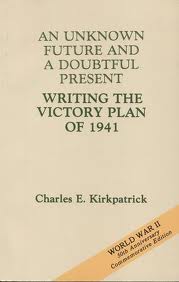
An Unknown Future and a Doubtful Present: Writing the Victory Plan of 1941 — a review-lite and a few questions

Tuesday, November 20th, 2012

[by J. Scott Shipman]

An Unknown Future and a Doubtful Present: Writing the Victory Plan of 1941, by Charles E. Kirkpatrick

Mr. Kirkpatrick’s little book provides an excellent primer to the formulation of the United States’ WWII strategy and a refreshing insight into the education of an master strategist, the focus of this post. At 138 pages (plus bibliography/index), Kirkpatrick provides an overview of the enormous contribution of Major Albert C. Wedemeyer, then attached to the War Plans Division, the Army chief of staff’s strategic planners. In the spring of 1941, General George C. Marshall wanted a “more clear-cut strategic estimate of our situation”. Wedemeyer placed his work in the context of four questions:

1. What is the national objective of the United States?
2. What military strategy will be devised to accommodate the national objective?
3. What military forces must be raised in order to execute that military strategy?
4. How will those forces be constituted, equipped, and trained?

Wedemeyer understood that number 4 was not possible without a clear understanding of 1 through 3. Number 1 did not exist (probably still does not), so Wedemeyer made his best guess. Wedemeyer placed his task in context and produced a plan in the prescribed 90 days (!).

No Ordinary Major

Wedemeyer was no ordinary major. He was a voracious reader and student of history; familiar with Clauzewitz, von der Glotz, Fuller and Sun Tzu. He was fortunate to have a mentor (who happened also to become his father-in-law), MG Stanley Embick. Embick encouraged Wedemeyer to “organize discussion groups of officers during the years on Corregidor. Professional reading served as the context for such social gatherings of Wedemeyer’s peers intelligent and articulate men who met periodically to discuss current events, the books they had been reading, and professional interests.”

Wedemeyer was an honor graduate of the Command and General Staff College, and his performance earned him the opportunity to attended the Kriegsakademie, the German staff college. However, coupled with impressive academic preparations, Kirkpatrick writes that Wedemeyer’s curiosity exposed him to a “kaleidoscope” of ideas and methods. Kirkpatrick summed-up Wedemeyer: “Competence as a planner thus emerged as much from conscientious professional study as from formal military education…” Going on to say:

In common with many of his peers, much of Wedemeyer’s professional and intellectual education was less the product of military schooling than of personal initiative and experience in the interwar Army.

Wedemeyer’s intellectual development was purposeful and paid off. In Wedemeyer’s deep study of his profession he used the prescribed paths, but also explored on his own. How common is that today? What is the real intellectual foundation supporting our professional warriors? Is it the minimum one will glean from the service schools, or we encouraging our people to go a step further.  In an earlier post I wondered aloud, and echoed a remark posed by Jon Sumida with respect to Alfred Thayer Mahan:

“It remains to be seen whether readers exist with the mind and will to accept his guidance on what necessarily is an arduous intellectual and moral voyage into the realm of war and politics.” (emphasis added)

Against this backdrop, Tom Ricks in an interview at the Washington Post said:

The U.S. Army is a great institution. The rebuilding of the U.S. Army after the Vietnam War was an epic struggle and was enormously successful. Today we have great frontline soldiers. They are well equipped, they are well trained and they are in cohesive units.

The problem is at the very top. This magnificent rebuilding of the U.S. military after Vietnam really did recreate the force, but they kept the old head. The one thing they didn’t really change after Vietnam was how they shaped their generals. What we got was a generation of officers who thought tactically and not strategically. It’s the difference between being trained and being educated. You train people for known attacks. You educate people for the unknown, the complex, the ambiguous, the difficult situation. (emphasis added)

No intention of singling out the Army, I would cast the net of this question to include the other services, and ask whether we have Major Wedemeyer Majors/Lieutenant Commanders in the pipeline. If we do, are we nurturing and encouraging them? How many of our professional warriors study independently, and like Wedemeyer host/encourage frequent independent fellowship/discussions around books and ideas independent of the academy? As I mentioned in an earlier post, there is no app for intellectual development. We should at least expose our officers to the Wedemeyer method, if you will, and go deeper than service schools, blogs, and the constant chatter in our information laden world. Colleagues gathering to discuss and debate; educating and enlightening each other.

On strategy, Kirkpatrick quotes Wedemeyer:

…strategy, properly conceived, thus seemed to me to require transcendence of the narrowly military perspectives that the term traditionally implied. Strategy required systematic consideration and use of all the so-called instruments of policy–political, economic, psychological, et cetera, as well as military–in pursuing national objectives. Indeed, the nonmilitary factors deserved unequivocal priority over the military, the latter to be employed only as a last resort.

Wedemeyer’s net was wide and comprehensive and worthy of emulation. While his accomplishment(s) are impressive, so was his preparation.

Wedemeyer went on to a successful Army career, retiring as a 4-star. In 1985, he was presented the Presidential Medal of Freedom by President Reagan. (See the New York Times obituary.)

This is an important and accessible introduction to the nuts-and-bolts of strategic planning and has my strongest recommendation.

A free electronic copy can be found here (pdf).


Switch to our mobile site