zenpundit.com » foreign policy

Archive for the ‘foreign policy’ Category

The US Army War College National Security Seminar 2011

Sunday, June 12th, 2011

warcollege.jpg

As noted previously, I was fortunate to attend the National Security Seminar at the the US Army War College this year and wanted to relay my impressions while they were still fresh.

First, in terms of reception and cordiality, I have rarely experienced such an extensive and personal outreach as was demonstrated by the War College staff, faculty, administration and students. Every new member had a “sponsor” – a student, usually a colonel or Navy captain, who acted as a liason and personal guide from the time their plane touched down until the moment they returned to the airport. My sponsor, the former commander of the WolfhoundsColonel Richard “Flip” Wilson, whom I consider a friend, really extended himself on my behalf, making me feel welcome and a full member of Seminar Group 20. Most of the students have multiple tours of duty in Iraq and Afghanistan under their belt and many can report the same for the first Gulf War, Panama, Bosnia or Kosovo.

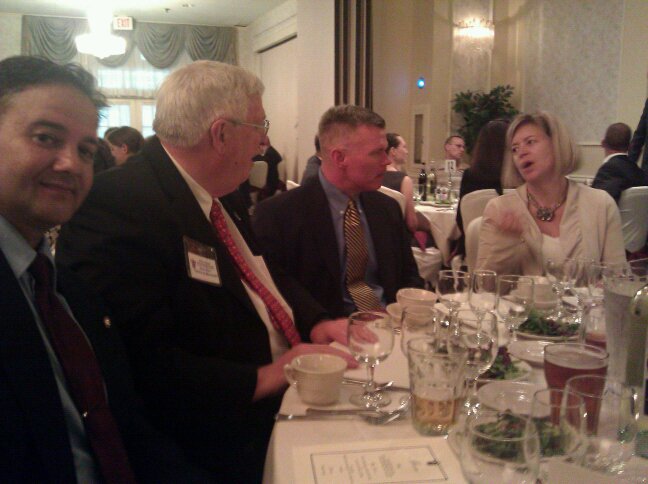
The War College, the Commandant and the Seminar Group all hosted receptions and dinners designed to get students and civilian new members to mix and further discuss issues raised in the seminar sessions or lectures. At these events I had the opportunity to meet and talk to the leadership of the Army War College including the Commandant Major General Gregg Martin, the Deputy Commandant for International Affairs, Ambassador Carol Van Voorst, the Executive Director of the Army Heritage Foundation, Mike Perry, the Director of SSI, Dr. Douglas Lovelace,  the Chief of Staff and numerous faculty and seminar members. The New Members such as myself were exceedingly well fed at these events as I suspect the Army was attempting to prove that it really does march on it’s stomach.
                                                                                                                                                                                                                                                                                                                

warparty.jpg

warparty2.jpg

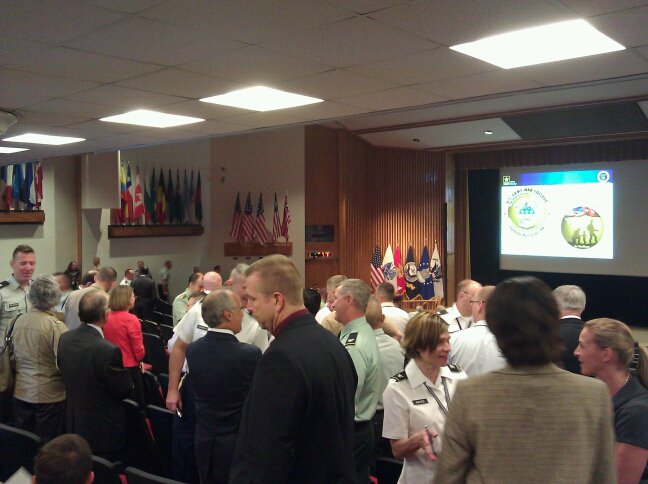
The serious business of the National Security Seminar was divided into two segments, the talks given by distinguished speakers to the entire class of 2011 and the New Members and the Seminar Group sessions of approximately twenty students, New Members, academics and foreign visitors. We received a brief on the war in Afghanistan from the ISAF Chief of Staff, who was standing in last minute for General Petraeus who was called to meet with senior adminstration officials; and a very interesting concluding talk by Foreign Affairs Editor Gideon Rose, author of How Wars End, which covered issues of strategy, grand strategy and the disconnect with policy.
warseminar.jpg

  The National Security Seminar is run strictly on a non-attribution basis, in order to encourage candor and frank exchange of views, which handicaps my ability to discuss specifics here. I can say that my views on Pakistan ( which I compared to “North Vietnam” ) riled more than a few people – Pakistan is the only country in the world given 2 exchange student slots at the Army War College at the request of the most senior leadership of the US Army – and several students and faculty members took the time, outside of seminar sessions, to make certain I heard countervailing POV regarding Pakistan’s value as an ally. Other topics included, but were not limited to:

Defense budget cuts and force structure
Narco-cartels in Mexico: Insurgency or No?
Civil-Military Relations
Repeal of DADT
AfPak War
al Qaida and GWOT/US Strategy
COIN
Critical thinking and Leadership
Logistics
Libya and NATO
AWC Strategy Curriculum/Program
What the US public expects from their military
China as a peer competitor
Effects of ten years of war on officer corps/military
Illegal combatants and international law
PTSD
Battle of Gettysburg and Grand Strategy
Cyberwar
Differences in Armed Services strategy, command climate, discipline, leadership
The Arab Spring
US Global leadership and Economics
Interagency Operational jointness

Most of the discussion took place in the seminar groups, with Q&A periods in the mass sessions with featured speakers. I came away deeply impressed with the seriousness and insights as practitioners that AWC students brought to the table. The AWC strategic studies program seeks to broaden students who are assumed to arrive with tactical expertise and prepare them for higher command that carries operational, strategic and even policy responsibilities (at least in terms of interpreting and executing within policy guidelines). Many students were articulating ideas associated with Thomas P.M. Barnett, the “mission order” and “commander’s intent” style of leadership or Clausewitzian strategic premises during debates and discussion.

The National Security Seminar Week was for me, an enlightening and exceptionally enjoyable experience, one I would highly recommend to readers who may have such opportunities in future years.
Humanity among Monsters: The Descent of Mexico

Thursday, June 2nd, 2011

From Boing Boing:

A kindergarten teacher in Mexico seeks to protect her students and calm their fears as narco-cartel fighters conduct a raging gun battle outside the window of her school. The woman has nerves of iron.

But hey…..Mexico can’t have an “insurgency” because the narcos don’t have “political” goals. Or a unified political goal. Or because there are still good vacation deals there at all-inclusive resorts. Or….Or…Or…. whatever flimsy rationale helps policy makers continue to punt the war next door.


Jung in Tehran, aka “enantiodromia”

Wednesday, June 1st, 2011

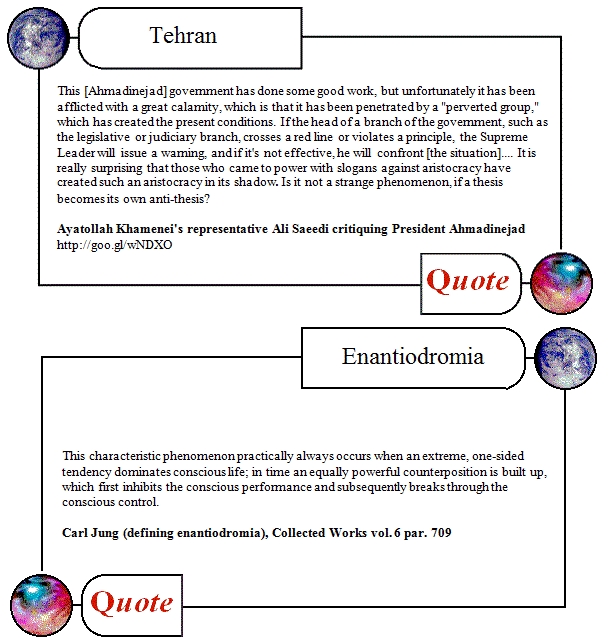
[ by Charles Cameron — Ahmadinejad vs Khamenei, Jungian enantiodromia ]

.

quo-enantiodromia-in-tehran.gif

*

The western press, on the whole, has covered the recent tussle between Iranian President Ahmadinejad and his superior, the Ayatollah Khamenei, in political terms — as a power struggle between a President who wants increased authority for the Presidency and a Supreme Authority who isn’t about to relinquish his Supremacy.

It is also a theological struggle, and the LA Times nicely weaves the two strands together in commenting:

At its heart is a possible future struggle for power between the firebrand president and Khamenei’s conservative clergy, who are wary of Ahmadinejad’s messianic strain of Islam and his incendiary populism. They worry his tendency for explosive talk could threaten their long-term interests, if not render them obsolete.

Putting it bluntly, the arrival of the Mahdi – or a strong populist current holding the opinion that Ahmadinejad is the Mahdi’s trusted lieutenant, chosen to prepare the way for his coming – would disenfranchise the clerics of Qom, who ultimately derive their authority from the Imam Mahdi’s absence.

The fairly recent discovery of a video, apparently prepared by Ahmadinejad’s supporters and proclaiming the Mahdi’s “soon coming”, seems to have heightened the tension…

Having said that, it’s my impression that Ahmadinejad is losing this tug-of-war, that he doesn’t have the popular groundswell of support he would need to go up against the Supreme Authority and win, and that consequently, his Mahdist “messianic strain” is losing power and credibility.

Which in turn should mean that the West has less to fear from Iranian Mahdism…

Glenn Beck, take note.

*

Putting that another way, it seems that the extreme Mahdism of Ahmadinejad is resulting – ironically enough, by enantiodromia – in a backlash from Khamenei that appears likely to depotentiate and dissipate it.

Guest Post: Few’s The Serenity Prayer for Grand Strategy

Thursday, May 26th, 2011

[Cross-posted from SWJ Blog]

Major Mike Few, one of the SWJ Blog’s trusty editors opines on the nuts and bolts of “doing grand strategy”. Pay close attention to points #2 and #7. Hopefully, the first of many guest posts here by Major Few, if I can steal some of his time from Dave Dilegge 🙂 :

The Serenity Prayer for Grand Strategy: Nine-Step Recovery Method for Reframing Problem Solving

by Mike Few

Recently, our authors began to shift from problem definition to reframing problem solving. Over the last year, we published some remarkable works effectively describing Iraq, Afghanistan, Mexico, Libya, and others. Simultaneously, we published several series on design and wicked problems.

The challenge we are posing is can someone produce a concise document applying design to an existing problem? If we cannot find practical application or wisdom, then the process becomes a moot effort. Below is my white board attempt to provide an example and discussion for others to follow. This blog post is similar to many of the discussions our authors and readers have daily in the classroom and nightly at the pub or dinner with colleagues. Simply put, I am merely merging the sum of our published thought and discussions.

Three years ago, I was challenged to determine if my experiences in big wars and counterinsurgency could be applied to the macro level. On the tactical level, I found that I simply relearned the lessons of those that had come before me, the countless art of war and warfare. However, when I consider how my thinking had changed, I feel that perhaps there are some lessons that can be applied for us all.

In combat, I finally learned the limits of my own control. This understanding freed me to concentrate focusing on changing the things that I could control. I look at framing problem solving in international relations in a similar manner. It’s kind of like the Serenity Prayer for Grand Strategy. So, as a practical exercise, below is an example of how I would use Design, Wicked Problems, and Military Decision Making Process using the example of Mexico.

1. Define what we cannot control. We cannot “fix” Mexico. They are a sovereign nation-state, and they must choose to work on their internal issues. Moreover, our “solution” to their problems may not be a proper fit despite our best intentions. Our intervention efforts in Central and South America over the past sixty years (or more) have had mixed results.

2. Define the problem as it is not as we wish to see it. Are we really in a war on poverty, drugs, education, terrorism, and governance? Are we really at war? Labels are often limiting, but there needs to be some common framework to understanding. Typically, that can be driven by good communication and active listening. We must learn to transcend how “I” see the problem and work towards how the collective group sees the problem accounting for all stakeholders.

3. Define our relationship. How does the US and Mexico see each other? This perception requires a degree of self-introspection and humility. Are we a brother attempting to help our sibling overcome addiction or work through difficult financial times? Are we a parent disciplining a spoiled child? Are we a spouse in a broken marriage? How we see ourselves defines our national interest. If we see ourselves as the parent, then we’re self-imposing a conceptual block.

As Martin Luther King wrote while sitting in the Birmingham Jail,

“Moreover, I am cognizant of the interrelatedness of all communities and states. I cannot sit idly by in Atlanta and not be concerned about what happens in Birmingham. Injustice anywhere is a threat to justice everywhere. We are caught in an inescapable network of mutuality, tied in a single garment of destiny. Whatever affects one directly, affects all indirectly. Never again can we afford to live with the narrow, provincial “outside agitator” idea. Anyone who lives inside the United States can never be considered an outsider anywhere within its bounds…In any nonviolent campaign there are four basic steps: collection of the facts to determine whether injustices exist; negotiation; self-purification; and direct action.”

4. Describe what we are currently doing and how we can adjust these things.

– Impact of NAFTA
– Border Security
– FID efforts in Mexico
– Counter-Drug efforts in Mexico
– Counter-Drug efforts in the United States
– Anti-Gang efforts in the United States

5. Discuss the cost benefits of future intervention efforts and internal reforms

– Comprehensive immigration reform
– Dream Act
– Expanded Counter-Drug efforts
– Expanded FID efforts to better strengthen Mexico’s Army and Police internal security forces
– State Department “better” governance efforts (Plan Colombia)- to include judicial and economic issues
– Legalizing drugs in the continental United States (demand side interdiction)
– Comprehensive Prison Reform in the United States
– Treasury Department financial interdiction to narco banking
– Promoting and expanding free press in Mexico through Twitter, Facebook, and new media

6. Describe Area of Influence- Central and South America

– Illegal immigration from Guatemala
– Drug Trafficking from Colombia

7. Ask the hard questions

-What are the key factors driving the problem?
-What is the causality?
-And, if the analysis is from a U.S. perspective, to what degree and in what ways is the problem a problem for the United States?
-what ways do those in power benefit by the status quo?

8. Rethinking the Assumptions

-What are the desired outcomes?
-Is the policy driving the process or is the effort outcome based?
-Are our efforts helping or hurting?

9. Timing of Implementation

– Simultaneous, Sequential, or Cumulative
-Prepare to accept that some items are not decision points; Rather, they are processes that change and morph over time.

Special thanks to those that contributed to the proofreading of this post, and I would like to specifically highlight Dr. Nancy Robert’s methodology for teaching any class on problem solving,

A. Creativity
B. Problem Framing
C. Systems thinking
D. Entrepreneurship and Innovation
E. Collaboration in Networks

Now, let the discussion and writing continue…

Book Review: The Shaping of Grand Strategy

Tuesday, May 24th, 2011

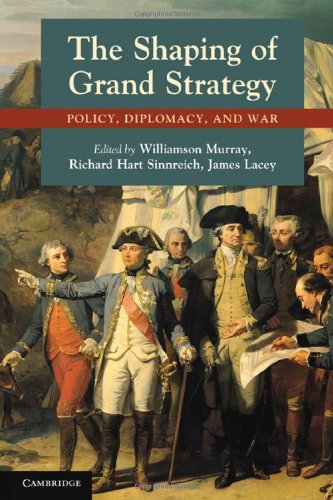
The Shaping of Grand Strategy: Policy, Diplomacy, and War by Williamson Murray, Richard Hart Sinnreich and James Lacey (Ed.)


As readers of this blog know, grand strategy is an important and timely subject that speaks directly to the difficulty American leaders have had in navigating the ship of state in the waters of the international arena. The Shaping of Grand Strategy: Policy, Diplomacy, and War by Williamson Murray, Richard Hart Sinnreich and James Lacey (Ed.) and contributing authors Colin S. Gray, Marcus Jones, Jeremy Black and John A. Lynn III postulates what grand strategy is and explain from historical case studies how statesmen struggled to fashion one in peace and war.

The Shaping of Grand Strategy has a number of strengths to recommend it to the serious student of history or strategic practitioner:

Focus: The case studies are all anchored in the Westphalian state system starting with the early modern period of European absolutism and apex of “national” monarchies and transitions through a Bismarckian 19th century to finish with the West’s cataclysmic 20th century battle with totalitarianism. This gives the chapters by different scholars a sense of cohesion and chronological succession.

Balance: The Shaping of Grand Strategy gives scholarly treatment from both the theoretical, strategic studies perspective as well as the historical case study. I learned some things about Louis XIV’s Europe and the Great Britain of the Pitts and the Hanoverian dynasty of which I was unaware. Theory bookends history in this tome.

Nuance: Each scholar gives his subject an adult treatment. Controversial points are interesting rather than shrill and each author engages an impressive synthesis of historiographic material as they cover a broad ground in investigating grand strategy. Each chapter is sound and engaging.

Limitations, such as they are, to be considered:

Absent: Powerful non-Western case studies. The ancient world.  Revolutionary war (French, Soviet or Islamist insurgent) as a grand strategy. Geoeconomics asnd political economy as a foundation for grand strategy. 

Weak: Insufficient treatment of the impact of nuclear weapons and deterrence on grand strategy, which frankly deserved a chapter of it’s own.

If you are composing a syllabus for a class on grand strategy or strategy, The Shaping of Grand Strategy would serve as an excellent generalist core for the course, supplemented by cognate, specialist or subtopical readings.

Some things that struck me while reading The Shaping of Grand Strategy:

  • Colin Gray’s distillation of the strategic dilemmas faced by Truman and an almost Boydian implicit explanation of what grand strategy is and why it needs a compelling moral power:

High policy does not emerge in a vacuum, though it can be invented in a hurry without much forethought when necessity presses. Policy requires a North Star for guidance that can inspire, yielding to would-be leaders the fuel they require to recruit and satisfy their followers

  • James Lacey’s realistic and granular treatment of the relationship between military strategy and grand strategy in the WWII Anglo-American Alliance and his generally admiring assessment of FDR as a strategist vs. a critical treatment of George Marshall.
  • Marcus Jones’ emphasis of the importance of the strategist himself and the uncertainty of decision making in his chapter on Otto von Bismarck.
  • The drawing of historical parallels with today  by John Lynn and Richard Sinnreich as well as the investigation of the reasons for grand strategic failure of British appeasement by Williamson Murray.

The Shaping of Grand Strategy is a tight, concise and focused academic book that furthers the discussion of grand strategy by providing coherent and detailed examples as well as a readable an interesting analysis from which both the professional or the the student can profit.

Strongly recommended.


Switch to our mobile site