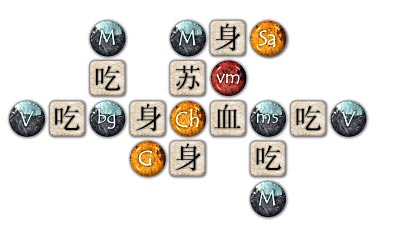
That video is almost exactly a month old, and it’s pitched at “the universe of things” with a marked tilt towards e-commerce. Fair enough.
**
It’s instructive to compare it with Wolfram Language, although here I’ve had to go with a video that’s a couple of years old:
Stephen Wolfram, the creator of both Mathematica and Wolfram Alpha, is focused on the world of numbers — and incidentally, that includes graphs of the sort I’ve been discussing in my series here On the felicities of graph-based game-board design, as you can see in the video above.
It will be interesting to see how the two of them — Viv and Wolfram — interact over time. After all, one of the purposes of these lines of development is to dissolve the “walled gardens” which serve as procrustean beds for current thinking about the nature and possibilities of the web. Do these two gardens open to each other? If so, why? If not, why not?
**
I’ve talked enough for my purposes about AlphaGo and it’s narrowly focused though impressive recent triumph, and the wider picture behind it, as expressed by Monica Anderson — and tying the two together, we have this video from Monica’s timeline, Bob Hearn: AlphaGo and the New Era of Artificial Intelligence:
Monica’s Syntience, it seems to be, is a remarkable probing of the possibilities before us.
**
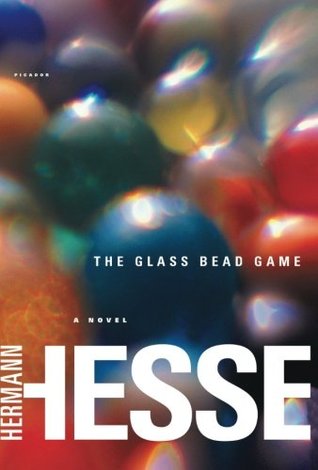
But I’m left asking — because Hermann Hesse in his Nobel-winning novel The Glass Bead Game prompts me to ask — what about the universe of concepts — and in particular for my personal tastes, the universe of musical, philosophical, religious and poetic concepts. What of the computational mapping of the imagination?
My question might well have large financial implications, but I’m asking it in a non-commercially and not only quantitative way. I believe it stands in relationship to these other endeavors, in fact, as pure mathematics stands in relation to physics, and hence also to chemistry, biology and more. And perhaps music stands in that relationship to mathematics? — but I digress.
If I’m right about the universe of concepts / Glass Bead Game project, it will be the most intellectually demanding, the least commercially obvious, and finally the most revelatory of these grand-sweep ideas..
From my POV, it’s also the one that can give the most value-add to human thinking in human minds, and to CT analysts, strategists, journos, educators, therapists, bright and playful kids — you name them all!
Seeing it in terms of counterpoint, as Hesse did — it’s the virtual music of ideas.
Since I’m plaguing Emily Steiner with my thoughts on two of her recent tweets, I’d best explain first the reasons for my interest.
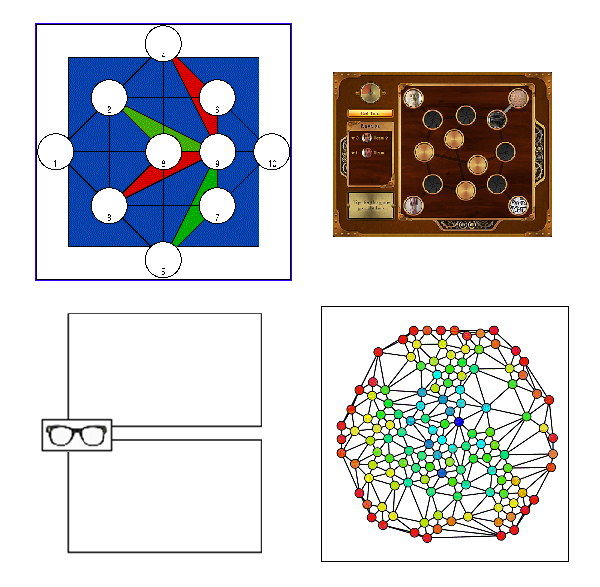
top left, a HipBione “WaterBird” board; right, Cath Styles‘ “Museum Game” board; lower left, an early HipBone “DoubleQuote” board; right, the “Said Symphony” board
As long time readers here will already be aware, I’m involved in the design, development and play of a family of games based on Hermann Hesse‘s conceptual Glass Bead Game, using boards that are what mathematicians would term graphs:
**
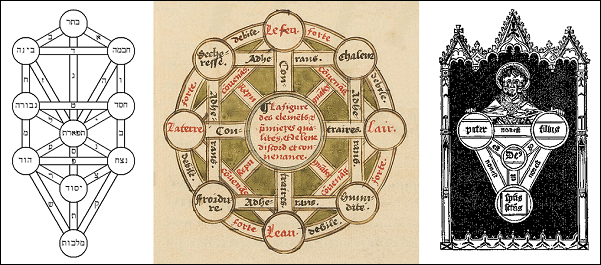
Technically, our game boards in the course of play are what Margaret Masterman termed semantic networks — and Masterman herself cited one such network from an earlier century imaging the Trinity — here on the right panel — which I have reproduced in the triptych below along with a diagram of the Kabbalah, left, and of the elements by Oronce Fine, center:
**
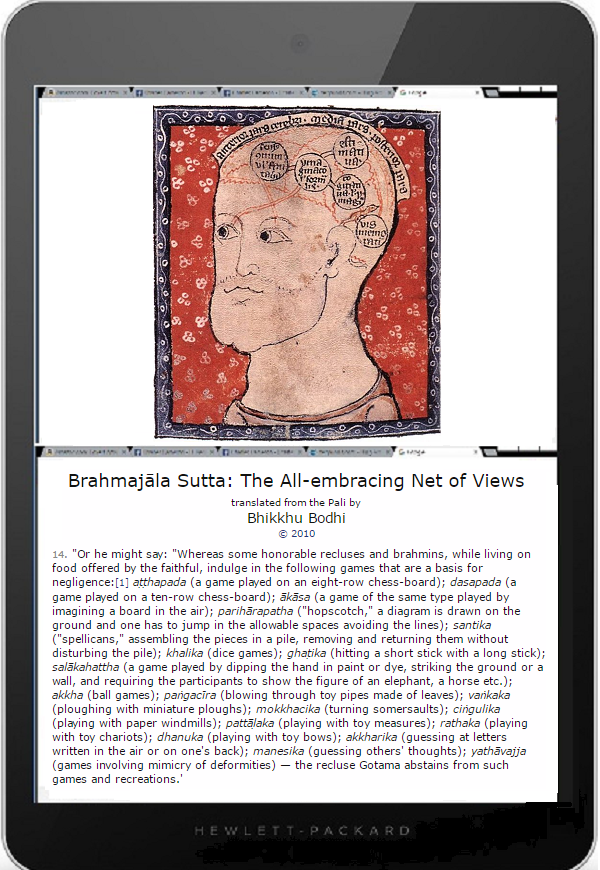
Which brings me to the first of two tweets Prof. Steiner posted today — the image of a head, with what is clearly a semantic network inside it — thoughts connecting with thoughts, or brain areas with brain areas, or perhaps both:
Viewed from the perspective of the HipBone Games, this semantic network within a brain (mind) is what the Buddha termed, somewhat reprovingly, a game played akasa, “by imagining a board in the air”.
**
But the Buddhist tradition wasn’t always as, what shall I say? — puritanical about games:
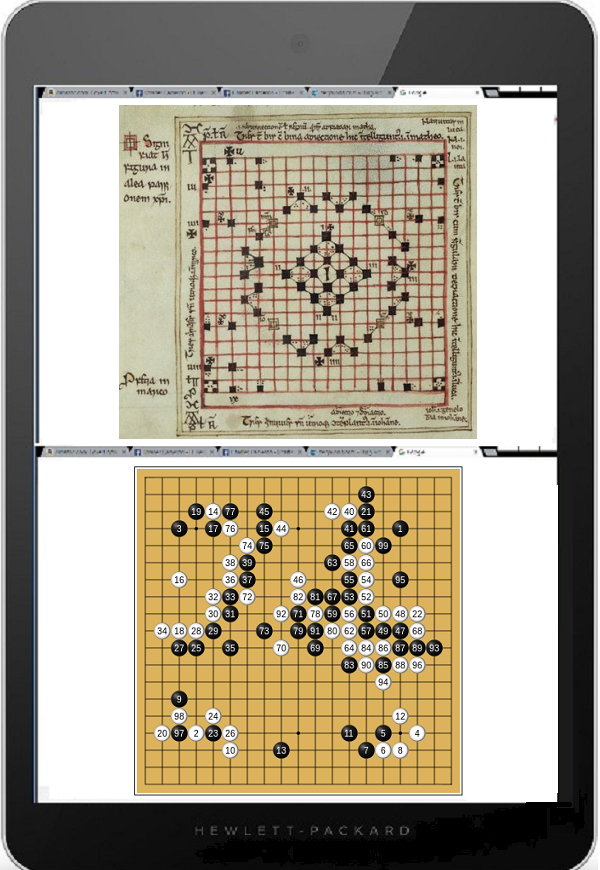
As you’ll see, the upper panel here is a bit more relaxed on the subject of games in Buddhism — while the lower panel shows another game board, this one for a medieval Christian game on the Gospels, which Dr Steiner featured in the other tweet of hers that caught my eye today.
There are four canonical Gospels, Matthew, Mark, Luke, and John, but they’re actually asymmetrical, Matthew, Mark, and Luke sharing properties and chunks of text which have conferred on them the group title of the “synoptic gospels” — while John is more symbolic, deeper, indeed mystical, and stands alone.
There’s a saying about them, Read, Mark, Learn, and Inwardly Digest. I don’t believe it’s intended to name the four pof them, but since Mark is second in order both in the saying and in the sequence of gospels found in the New Testament, I’m happy to consider John’s Gospel to be the equivalent of Inwardly Digest
**
But bringing the ancients into the modern day is a laudable activity, so I’ll close by taking that Gospel game board, as I like to think of it, and compariung it with one of the boards from the recent series of games in which AlphaGo — clearly a duende or djinn of some sort — beat out our best-living Go master in a series of 5 games:
Again, symmetry and asymmetry. Is the symmetry of the Gospels game a symmetry of the Divine Mind? And is the asymmetry of the game of Go an asymmetry of the two minds in play — or simply of a game in which one player gets to make the first move?
I look forward to learning from Dr Steiner how the Gospel game was played.
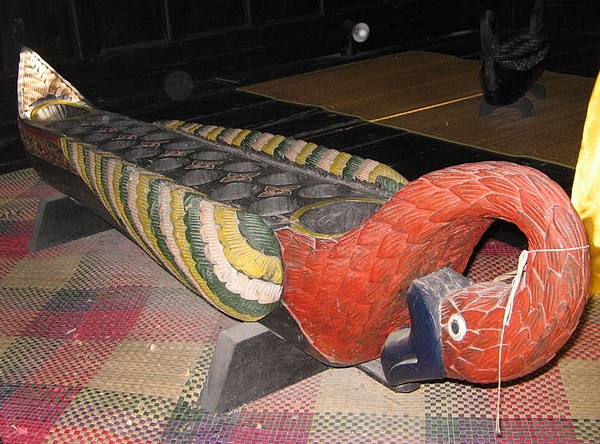
Mancala games are games in which “seeds” are places in a series of “holes” in a board, often a carved wooden board, according to mathematical principles of play and capture. Wikipedia:
Most mancala games share a common general game play. Players begin by placing a certain number of seeds, prescribed for the particular game, in each of the pits on the game board. A player may count their stones to plot the game. A turn consists of removing all seeds from a pit, “sowing” the seeds (placing one in each of the following pits in sequence) and capturing based on the state of board. This leads to the English phrase “count and capture” sometimes used to describe the gameplay. Although the details differ greatly, this general sequence applies to all games.
¶¶
Equipment is typically a board, constructed of various materials, with a series of holes arranged in rows, usually two or four. The materials include clay and other shape-able materials. Some games are more often played with holes dug in the earth, or carved in stone. The holes may be referred to as “depressions”, “pits”, or “houses”. Sometimes, large holes on the ends of the board, called stores, are used for holding the pieces.
Playing pieces are seeds, beans, stones, cowry shells, half-marbles or other small undifferentiated counters that are placed in and transferred about the holes during play.
¶¶
Among the earliest evidence of the game are fragments of a pottery board and several rock cuts found in Aksumite areas in Matara (in Eritrea) and Yeha (in Ethiopia), which are dated by archaeologists to between the 6th and 7th century AD; the game may have been mentioned by Giyorgis of Segla in his 14th century Ge’ez text Mysteries of Heaven and Earth, where he refers to a game called qarqis, a term used in Ge’ez to refer to both Gebet’a (mancala) and Sant’araz (modern sent’erazh, Ethiopian chess).
Nota Bene:
Even when played with glass beads, mancala games are not even close to the Glass Bead Game as Hermann Hesse describes it, since their moves have nothing to do with cultural citation or meanings, let along their contrapuntal connections and correspondences, but are indifferent markers, inherently fungible.
It was 3 Quarks Daily that introduced me to the avian version of mancala games in a post that read:
Acorn woodpeckers drill into trees not in order to find acorns, but in order to make holes in which they can store acorns for later use, especially during the winter.
As the acorn dries out, it decreases in size, and the woodpecker moves it to a smaller hole. The birds spend an awful lot of time tending to their granaries in this way, transferring acorns from hole to hole as if engaged in some complicated game of solitaire.
Multiple acorn woodpeckers work together to maintain a single granary, which may be located in a man-made structure – a fence or a wooden building – as well as in a tree trunk. And whereas most woodpecker species are monogamous, acorn woodpeckers take a communal approach to family life. In the bird world, this is called cooperative breeding. Acorn woodpeckers live in groups of up to seven breeding males and three breeding females, plus as many as ten non-breeding helpers. Helpers are young birds who stick around to help their parents raise future broods; only about five per cent of bird species operate in this way.
**
Conclusion:
For myself, I would rather play with the woodpeckers than with the humans.
Even so, a humanly-wrought board can be very lovely:
[ by Charles Cameron — Art & Philospphy, Latin, Greek & Arabic, Porphyry & Proclus ]
.
I discovered Elaine Van Dalen‘s twitterstream today, and was enchanted. Trawling backwards a little from her tweet about the Sultan al-Kamil, I ran across this one:
The Arabic philosopher Averroes (d. 1198) conversing in Latin with the Greek philosopher Porphyry (d. 305) pic.twitter.com/nGtcdTXVy5
Both are instances of the game Hermann Hesse described himself playing while raking and burning leaves, in his poem Hours in the Garden:
Within me, my thoughts begin to play
A game, an exercise I have practiced for many years.
It is called the Glass Bead Game, a charming invention
Whose framework is music, whose basis is meditation.
[ … ]
I hear music and see men of the past and the future.
Wise men and poets and scholars and artists, all of one mind,
Building the hundred-gated cathedral of the spirit…
That’s Hesse’s private manner of playing the Glass Bead Game: the game as played in the novel is more abstract, shorn of persons, a virtual music of ideas indeed.
I’ve quoted this over and over, I know, but for those who are new to the Game, here’s Hesse’s definitive description from the novel:
The Glass Bead Game is thus a mode of playing with the total contents and values of our culture; it plays with them as, say, in the great age of the arts a painter might have played with the colors on his palette. All the insights, noble thoughts, and works of art that the human race has produced in its creative eras, all that subsequent periods of scholarly study have reduced to concepts and converted into intellectual values the Glass Bead Game player plays like the organist on an organ. And this organ has attained an almost unimaginable perfection; its manuals and pedals range over the entire intellectual cosmos; its stops are almost beyond number. Theoretically this instrument is capable of reproducing in the Game the entire intellectual content of the universe.
This is my second submission attempting (and failing) to become a regular contributor at the fine web-aggregator known as 3QD — you can read my first here. On rereading this more recent attempt, I am not sure I would have selected it myself had I been one of the judges — it perhaps expects too mych “British” knowledge of its readers, who are as likely to come from Hoboken or Pakistan as from Oxford (hat-tip there to my two 3QD friends, Bill Benzon & Omar Ali). For those of you, therefore, who may not know what conkers is, here’s a brief video introduction, with the actual game demo starting around the 1’35” mark:
I’ll add a fantastic passage from Seamus Heaney at the end of my post, to give it the final mahogany polish a conkers post deserves.
Conkers is for kids. So what does it have to do with computers, AI, “deep learning” or robots?
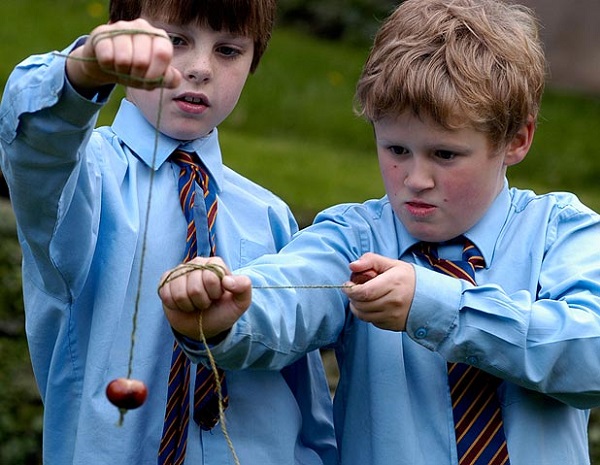
It’s a very British game, conkers, played with the seeds of horse chestnut trees, of which Britain counts almost half a million, pierced and strung on string. I suppose you could think of it as a primitive form of rosary bashing, with each player’s rosary having only one bead, but that might give others the wrong impression since conkers (the game) is sacred the way taste is sacred before anyone has told you, “this is strawberry”, not the way sanctuaries are sacred after someone has put an altar rail round them, or screened them off with a rood screen.
Even giving the game the name Conkers with a capital C puts it on a pedestal, when all it’s about is gleefully finding a suitable conker, maybe loose on the ground or maybe encased in its prickly green shell, drilling it through with some sort of skewer or Swiss Army device, threading it (stringing it) on string, finding a gleeful or shy playmate, and whazzam! conking their conker with your own so their falls apart and yours remains triumphant. Battered perhaps, but victorious.
An artificial general intelligence, left to its own devices and skilled in “deep learning”, will surely figure out that play plays a significant role in learning, by reading Johan Huizinga perhaps, or figuring out “the play’s the thing” – or noting that play is how learning develops in mammalian infancy and expresses itself in human mastery. And since learning is what artificial general intelligence is good for and would like to be even better at, you can bet your best conker that artificial general intelligence will want to learn to play.
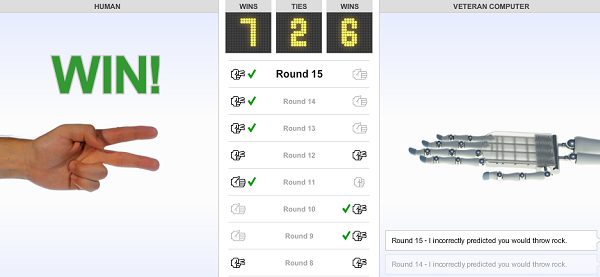
Okay, computers have played, and beaten humanity’s best, at such games as Pong, Space Invaders, Draughts, Backgammon, Chess, Jeopardy, Rock-Paper-Scissors, and Go –
–
— and apparently one set of AI researchers is considering Texas Hold’em as a plausible next challenge. I want to see them try their hands (hands?) and minds at conkers, though.
Consider: they’d need more than brainpower, they’d need mobility. It wouldn’t take a rocket scientist but a robot to do the trick – locating chestnut trees, okay, with a judicious use of Google maps for targeting and drones for close observation, agility to get around the trees (climbing ‘em?) gathering and evaluating nuts, their sizes, densities, colors and weights, testing different angles of attack and types of needles for threading, the respective efficacies of polished (ooh like mahogany!) vs unpolished nuts (somewhat more in the spirit of sabi-wabi), styles of rough or silken string — and then the dexterity to swing the strung nut at its similarly strung and loosely hanging sibling-opponent!!
Ah, but there’s a child to find first, shy or enthusiastic, and the very approach of a disembodied brain or robot might scare or enchant said child. Your successful robot will need to avoid the uncanny valley of too close resemblance, in which a machine garners the same emotional thrill as Chucky the scary doll from Child’s Play and its endless sequels…
All this, to beat the poor kid at the kid’s own game?
Perhaps our robot overchild will have read the bit about “It matters not who won, or lost, but how you played the game” – and will have the good sense and humility to build itself an arm that’s not quite as strong as a child’s arm, and will eventually have played enough child opponents to develop a style that wins only fractionally more games than it loses – say 503 games out of a thousand.
What is man, that thou art mindful of him? and the son of man, that thou playest conkers with him?
Oh, conkers isn’t the only game I’d like to see the computers try for -– in fact it’s one of two games that has been outlawed in some British schools –- and to live outside the law you must be honest, as Dylan says. Another banned — and therefore extra-interesting — game is leap-frog. How do you win and how do you lose at that? You don’t –- you just play.
That’s when things will begin to get really interesting, I think –- when an artificial general intelligence, with or without robotic body, learns playfulness. There will need to be constraints of course, of the Do no Harm variety -– a fireproof Faraday cage playpen perhaps?
**
But play is by no means limited to infancy, it also finds an outlet in genius. So here’s my more serious, though still playful, question for the AI folks out there, and Monica Anderson with her “Intuitive AI” in particular:
When will an AI be able to play Hermann Hesse’s Glass Bead Game?
After all, it’s the only game design that has arguably won its designer a Nobel Prize. And at the moment, it’s brilliantly undefined..
Hesse conceptualized the game as a virtual music of ideas – contrapuntal, polyphonic. Its origins were found in musical games, mathematicians soon added their own quotient of arcane symbols to those of musicians, and other disciplines followed suit until as Hesse puts it:
The Glass Bead Game is thus a mode of playing with the total contents and values of our culture; it plays with them as, say, in the great age of the arts a painter might have played with the colors on his palette. All the insights, noble thoughts, and works of art that the human race has produced in its creative eras, all that subsequent periods of scholarly study have reduced to concepts and converted into intellectual values the Glass Bead Game player plays like the organist on an organ. And this organ has attained an almost unimaginable perfection; its manuals and pedals range over the entire intellectual cosmos; its stops are almost beyond number. Theoretically this instrument is capable of reproducing in the Game the entire intellectual content of the universe.
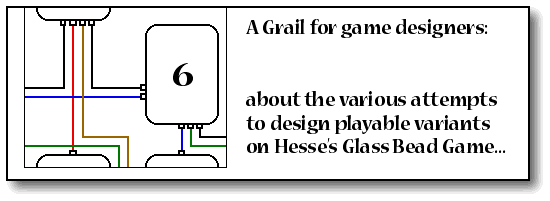
Various people, myself among them, have proposed playable variants on Hesse’s great Game, and with a little further precision, definition and development, one of us might be able to propose a specific GBG format that would challenge AI to, essentially, produce profundity, beauty, perhaps even “holiness.” For when all’s said and done, that’s where Hesse’s game inexorably leads, as his Game Master Joseph Knecht tells us:
Every transition from major to minor in a sonata, every transformation of a myth or a religious cult, every classical or artistic formulation was, I realized in that flashing moment, if seen with a truly meditative mind, nothing but a direct route into the interior of the cosmic mystery, where in the alternation between inhaling and exhaling, between heaven and earth, between Yin and Yang, holiness is forever being created.
3QD is a polyphonic glass bead game of sorts, and comes far closer to Hesse’s ideal than the internet as a whole, since it curates the thoughts and insights it delivers — so maybe the challenge will be for an AI to win a place at the 3QD table by providing an essay, 1,000 to 2,500 words in length, to Abbas, by email at or before 11.59pm New York City time on some Saturday yet to be announced.
Preferably, such an AI will also have a stock of essays available, touching on a variety of subjects with passion, clarity, and at least a hint of quasi-human humor, for posting on specified Mondays. And before it writes in, it may need to think itself up a nom de plume.
So that was my 2QD submission, with a couple of additional images thrown in. As I say, I’m not convinced I got it right — and next time. if there is a next time, I’ll likely avoid the Glass Bead Game and pick on some other topic. To give you a “rounded experience”, however, I am going to return now to conkewrs and chestnut trees, and offer you that quote I promised from Seamus Heaney, taken from his essay The Placeless Heaven: Another Look at Kavanagh:
In 1939, the year that Patrick Kavanagh arrived in Dublin, an aunt of mine planted a chestnut tree in a jam jar. When it began to sprout, she broke the jar, made a hole and transplanted the thing under a hedge in front of the house. Over the years, the seedling shot up into a young tree that rose taller and taller above the boxwood hedge. And over the years I came to identify my own life with the life of the chestnut tree.
This was because everybody remembered and constantly repeated the fact that it had been planted the year I was born; also because I was something of a favourite with that particular aunt, so her affection came to be symbolised in the tree; and also perhaps because the chestnut was the one significant thing that grew visibly bigger by the year…
When I was in my early teens, the family moved away from that house and the new owners of the place eventually cut down every tree around the yard and the lane and the garden including the chestnut tree. We all deplored that, of course, but life went on satisfactorily enough where we resettled, and for years I gave no particular thought to the place we had left or to my tree which had been felled.
Then, all of a sudden, a couple of years ago, I began to think of the space where the tree had been or would have been. In my mind’s eye I saw it as a kind of luminous emptiness, a warp and waver of light, and once again, in a way that I find hard to define, I began to identify with that space just as years before I had identified with the young tree.
Zenpundit is a blog dedicated to exploring the intersections of foreign policy, history, military theory, national security,strategic thinking, futurism, cognition and a number of other esoteric pursuits.