American Public Schools and History
Friday, September 4th, 2009My amigo and blogging colleague Lexington Green had an excellent post this week on the anniversary of the invasion of Poland by Nazi Germany, abetted by Joseph Stalin’s Soviet Union, which set off WWII in Europe. Lex laments the state of historical knowlege in public schools and asks readers for their recommendations for books on the Second world War. As of this writing, there are already 47 comments:
World War II started (in Europe) 70 years ago today.
There are two sorts of people in the USA today. A tiny minority who are very interested in military history and know a lot about World War II, and a vast majority who can barely even tell you who was in it (“was that the one with Hitler?”), when it occurred (“the Seventies?”), or what it was about, or even who won (“Japan?”). American children whom I talk to are apparently taught two things and two things only about our participation in World War II: (1) The Japanese Americans were imprisoned, and that was racist and wrong, and (2) we dropped atomic bombs on Japan, and that was racist and wrong. Some know about the Holocaust. College age youth are taught that the war was an exercise in American imperialism, meant to spread expoitative capitalism across the world, and that it is a myth that the GIs went to Europe to liberate the conquered countries or to bring democracy and freedom. Even depictions that are not entirely negative, such as Saving Private Ryan, depict the war solely as a personal tragedy and pointless death and destruction, and not about anything, and certainly not about anything good or admirable. Fed exclusively on this diet for over a generation, we now have a population that sees the war in this way.
This is precisely what Pres. Reagan warned us about:
We’ve got to do a better job of getting across that America is freedom-freedom of speech, freedom of religion, freedom of enterprise. And freedom is special and rare. It’s fragile; it needs [protection]. So, we’ve got to teach history based not on what’s in fashion but what’s important-why the Pilgrims came here, who Jimmy Doolittle was, and what those 30 seconds over Tokyo meant. You know, 4 years ago on the 40th anniversary of D-Day, I read a letter from a young woman writing to her late father, who’d fought on Omaha Beach. Her name was Lisa Zanatta Henn, and she said, “We will always remember, we will never forget what the boys of Normandy did.” Well, let’s help her keep her word. If we forget what we did, we won’t know who we are. I’m warning of an eradication of the American memory that could result, ultimately, in an erosion of the American spirit.
Reagan was right. I have gone beyond being distressed about all this to being fatalistically resigned. With historical memory either non-existent or actively corrupted, those of us who care about these things will have to preserve the record as best we can.
At The Corner (updated here) they are asking people to list their favorite books on World War II. This is a good idea, and I solicit your suggestions in the comments. The Boyz readership always suggests something I have not heard of already. Please list two or three favorites, in the comments. I could spend all day doing this, but I will abide by my own rule, and limit myself to three.
Read the rest here:
You should read the rest, as well as the comments, many of which are informative and a few of which qualify as entertaining. While I am very tempted to discuss books and historiography, I will instead address the teaching of history in our public schools.
The ideological Marxoid craziness of which Lex writes does indeed exist, though it is far more common in university courses than in secondary school classrooms ( Oak Park, though, is a pretty liberal UMC burg) and more common in urban school districts on the coasts than in the Midwest or South. In particular, I have seen firsthand at national conferences, teacher-zealots from California who appear to have been kicked out of Trotskyite Collectives for excessive radicalism and who are more like the mentally unsound homeless than someone entrusted with the education of children. They are largely scary exceptions though. The main problem with the teaching of history in our public schools is that as far as subjects go, history is a tertiary concern of government officials, administrators and school boards; as a result, most of history instructors are hard working and well-meaning people who are by education, totally unqualified for the positions they hold.
This is not to say that these history teachers do not have college degrees, They do, usually they are education or English lit majors with a scattering of PE and business majors whose main career concern is becoming varsity football or basketball coach. A few were punitively reassigned to history departments out of fields they are highly qualified to teach because they are good teachers and administrators saw them as capable of filling a gap in the master schedule, credentials be damned.
Nor would I say that these teachers do not care about children or shirk their responsibilities. By and large they are professionals who are dedicated to and care about the welfare of their students. The problem is that they don’t know much history – and it is very difficult to teach something well that you yourself do not even know enough about to be aware of the parameters of your own ignorance.
In 1997, education scholar Diane Ravitch wrote:
…Of those teachers who describe themselves as social studies teachers, that is, those who teach social studies in middle school or secondary school, only 18.5% have either a major or a minor in history. That is, 81.5% of social studies teachers did not study history in college either as a major or as a minor. In case you thinkyou didn’t hear me correctly, let me say it again: 81.5% of social studies teachers did not study history in college either as a major or a minor. This figure helps to explain why history is no longer the center of the social studies, since so few social studies teachers have ever studied history
What? “Well that was twelve years ago!” you say? My friend, the vast majority of that 81 % of unqualified teachers are still teaching today. And most of that remainder are still as unqualified now as they were in 1997. Imagine the state of our buildings and bridges if 81% of the professors of engineering had majored in, say Art Criticism or Women’s Studies.
Aggravating matters, even if a prospective teacher did major in history in college, fewer of their professors were full-time history instructors than ever before, meaning that even the quality of the small minority of teachers who are history majors is going into decline! NCLB scorns history as a subject, so school districts across the nation will continue to starve it. Poorer districts will fire all the social studies teachers in coming years and parcel out the history sections to unwilling English teachers in order to save the jobs that will preserve reading scores (assuming those are making AYP in the first place). After that, the science teachers will start to get the axe.
Students know a few bare minimum things about WWII, what can be gleaned from dumbed-down, turgidly written, textbooks that are long on glossy pictures and short on engaging prose, plus what they might catch on the History Channel which is seldom short of Nazi-related documentaries. It is unsurprising that most high school students are ignorant of their own nation’s history – given the state state of the field, it would actually be surprising if they knew anything at all.
We are deliberately cultivating a level of societal ignorance that is a deadly longitudinal threat to the continuance of democratic governance and individual liberties in this country. Maybe that was always part of the plan.
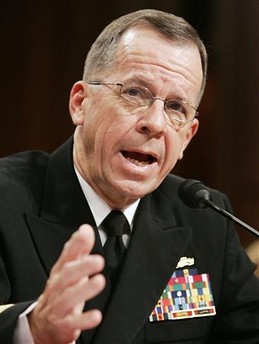 substantive points, with which I essentially agreed. Admiral Mullen also deserves credit for modeling intellectual leadership by putting his own ideas into the arena rather than relying upon public affairs officers to issue bland statements in his name. This is exactly what we should see from our senior military officers – leadership!

