zenpundit.com » 2011 » September

Archive for September, 2011

Al Farrow: an artist who leaves me uneasy, questioning

Wednesday, September 7th, 2011

[ by Charles Cameron — art, religion, and violence ]

.

Al Farrow, the San Francisco-based artist, finds and shows us that violence which is one pole of religion — what I think of myself as the landmines in the garden, where the garden is pardis, pairidaeza, paradise, the opposite pole of religion — perhaps inseparable from the violence, perhaps separable — the pole of peace, eirene, salaam

He show us this uncanny juxtaposition by building. meticulously, a cathedral out of guns and bullets:

al-farrow-cathedral-p-sm.jpg

His work leaves me impressed, but ill at ease, and for that I am grateful: he makes me think.

Take a close look at one of those flying buttresses… and compare it with its cousins at Notre Dame:

buttresses-nd-sculpt.jpg

That detail really brings the power of Farrow’s work home to me.

*

William Blake suggested that it is the artist’s function to “cleanse the doors of perception” — to give us fresh eyes, to see the world anew for us.

Al Farrow does this: it is as though in his cathedral, Catholic and Protestant Ireland meet.  Indeed, in an exhibit of his works — he has built mosques and synagogues of guns and bullets too — Christianity faces off against Islam, Judaism confronts its demons.

But there’s something more here, perhaps – the clash of war and peace, of hate and love — and how hatred can at times work with “love” as a protective shield…

Farrow himself says:

I am perpetually surprised by the historical and continuing partnership of war and religion. The atrocities committed in acts of war absolutely violate every tenet of religion, yet rarely do religious institutions speak against the violations committed in the name of God. Historically, Popes have even offered eternal salvation to those who fought on their behalf (The crusades, etc.).

In my constructed reliquaries, I am playfully employing symbols of war, religion and death in a facade of architectural beauty and harmony. I have allowed my interests in art history, archeology and anthropology to influence the work. The sculptures are an ironic play on the medieval cult of the relic, tomb art, and the seductive nature of objects commissioned and historically employed by those seeking position of power.

There’s considerable further irony, therefore, in the way in which Farrow’s already ironic work can be juxtaposed with it’s utterly non-ironic equivalent – Saddam Hussein‘s concept of the Mother of All Battles Mosque:

quo-for-al-farrow.jpg

*

Farrow’s work does not instruct us to be warriors, nor to be pacifists – it draws our attention to the blend of violence and peace of which our human dreams and lives are made. As Farrow says in this video clip from an exhibit of his work in Washington:

I use real bones, real bullets, real guns, because fake bones wouldn’t shake anybody up, nor would a fake gun. The purpose of my work is actually to get people to think about that complex relationship between war and religion – or any violence and religion. And a lot of violence is committed and has been through history in the name of religion, and that’s an ongoing thing, in any part of the world you look.

And yes, I think it’s fair to say Farrow’s juxtapositions of religion and violence clearly lean us towards peace.  War does the same, no?

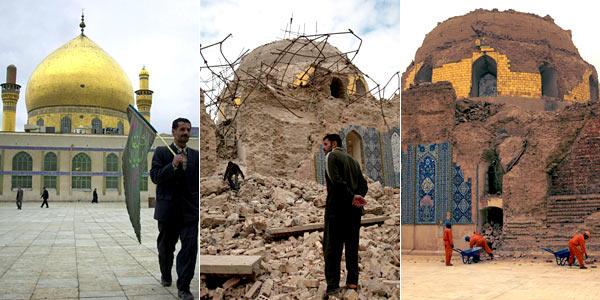
War, after all, destroys places of worship, along with many and varied other places – munitions dumps and churches, mosques and homes:

mosque-5679058138_dfee59923e_z.jpg

But just as religion has its landmines, so too it offers us its gardens – and just as a mosque or church or temple may be a rallying point offering a divine sanction to violence, so too it may be a focus for peace and reconciliation.

samarra-mosque-al-askari-rebuilding-wide-horizontal.jpg

Out of the ashes of destruction: creation, renewal, rebuilding…

For more on Al Farrow’s work, visit the Catharine Clark Gallery page.  And feel uneasy by all means, meditate — the koan I am sitting with this month is “Stop the War” — and ponder…

Recommended Reading to Provoke

Tuesday, September 6th, 2011

Special edition, derived from the always steady stream (at times, geyser) of articles, PDFs and book recs coming through the Warlord Loop:

The Atlantic  Parag Khanna  America’s Non-Grand Strategy

….Grand strategy should be about connecting ends and means on a global scale that transcends administrations and their peculiar obsessions and preoccupations, whether it be Iraq, Afghanistan, or China. It is about more than reacting to immediate events. In the age of globalization, grand strategy must take into account the financial crisis, Middle Eastern instability, Asia’s hunger for commodities, nuclear proliferation, technological disruptions, and trans-regional terrorist networks — all at the same time. Unfortunately, U.S. foreign policy over the last two decades has been characterized more by, to borrow the great historian Arnold Toynbee’s terms, alarmism and reactiveness than the necessary foresight and adaptation. From Afghanistan to Iraq to the Arab Spring, the U.S. has been either over-confident, caught off guard, or behind the curve. In all cases, it still lacks a coherent vision grounded in a realistic grand strategy.

….During the Clinton administration, Henry Kissinger quipped about then-National Security Advisor Sandy Berger, “You can’t expect a trade lawyer to be a grand strategist.” Today again, foreign policy is overseen by lawyers such as Tom Donilon and Hillary Clinton who give advice on specific events and problems but not guidance on the bigger picture. As a result, Obama’s speeches remain mellifluous but no longer really register abroad, other than to frustrate for their lack of clear purpose. As Kissinger wrote, “A statesman’s job is to resolve complexity, not just contemplate it.”

Having been beating the “we don’t  have  a  grand  strategy” drum for some time, I don’t find this to be controversial but opinions vary.

RUSI Anne-Marie Slaughter  The End of Twentieth Century Warfare

….From the vantage point of 2011, however, it is far more likely that historians will see 9/11 as the catalyst for the end of twentieth-century warfare: large-scale, multi-year deployments requiring the conquest, control and long-term stabilisation and reconstruction of foreign territory. The nuclear weapons that ended the Second World War ended great power war. The fall of the Soviet Union ended great power proxy war among current great powers, although Pakistan certainly thinks it is fighting India in the valleys and cities of Afghanistan. The second Iraq war and the war in Afghanistan are ending boots-on-the ground wars of counter-insurgency and regime change. 

The great power wars of the twenty-first century will be fought by special forces: specialised in combat against pirates, terrorists and global criminal networks; in focused search and rescue and search and destroy missions; and in civilian protection units capable of disabling but not destroying an enemy. They will be fought by cyber-warriors, skilled in manipulating unmanned weapons and in deterring and responding to system-wide cyber-attacks. And they will be fought in multilateral coalitions aimed at stopping the wars that criminal governments wage against their own people and bringing individual leaders and their coterie of high-level supporters to justice.

Somewhere…someplace….the head of Colin Gray is exploding. 🙂

The problem here is one of simplifying overstatement, not in getting the trends wrong. Dr. Slaughter is largely correct because currently a) the US lacks a true military peer and is absolutely dominant in a head-on, conventional clash and b) 4GW/irregular warfare is comparatively cheap way to attrit your foe, disrupt their systems and corrupt their OODA Loop.

However, we are very early in the 21st C. to call this trend as lasting for twenty, thirty or fifty years. Deliberately eviscerate America’s conventional warfare assets, as the UK has just done to the Royal Navy and British Army, and the geopolitical calculus will change in a hurry with great power war becoming more probable again and second tier interstate war becoming likely.

AFJ  Bernard Finel  The failed secretary

….Civil-military relations under Gates were more dysfunctional than any time since the early days of the Civil War. Though it may seem hyperbolic to some, the reality is that the accumulated transgressions of civil-military norms by senior military leaders far outstrip the misconduct of Gen. Douglas MacArthur during the Korean War.

During the Gates years, senior military leaders intervened in domestic politics; actively lobbied for policy preferences; waged sophisticated information operations against the American public; blocked the development of alternative options requested by the president and sought to punish those in uniform who were willing to respond to presidential requests; and created command environments in which contempt for civilian leaders was widespread. And Gates was either absent or an accomplice in most of these transgressions.

….The main problem with Gates was his tendency to see his job as that of quartermaster or personnel chief. Instead of providing high-level leadership, he tended to see his job as intervening at lower levels to solve specific problem. Soldiers are killed by improvised explosive devices? He worked to get more MRAPs into theater. Units not having enough time to rest, refit and train between deployments? He signed off on temporary force-size increases. Various programs overbudget or facing technical challenges? Gates was willing to kill them to fund more pressing priorities. But in all of this, where was the strategic leadership we expect from our senior leaders?

The problem is that “winning the wars we’re in” is an appealing mantra. It sounds tough and hands-on. But except in the rare circumstance of total war, the “wars we’re in” must always be balanced against the threats and challenges we may face in the future. This is particularly true when our current conflicts are, essentially, sideshows, wars of choice in strategic backwaters. The notion that American national security strategy ought to be subservient to the short-term demands of Iraq or Afghanistan is obviously flawed. Instead, those conflicts must be waged with an eye to making them consistent with long-term national security requirements. In a fundamental sense, Gates consistently put the tactical/operational cart before the strategic horse. That is an understandable flaw for a theater commander, but it is precisely the sort of mistake we expect a good secretary of defense to avoid.

I am a fan of former SECDEF Robert Gates, Dr. Finel is not and I offer his vigorously argued op-ed in the spirit welcoming contrasting views. Many of the Gates critics seem to be unhappy with his attitude toward the USAF/Navy “Big War” positions and weapons platforms as well as Gates having focused on the wars of today ( the Pentagon is a planning agency for the wars we fight tomorrow).

That’s it.

Elkus on Wikileaks and Sovereignty

Sunday, September 4th, 2011

Adam Elkus has a smart piece up at Rethinking Security that deserves wider readership:

WikiLeaks and Sovereignty

….WikiLeaks represents the idea that states have no inherent authority to hold onto vital national secrets. Because information is fundamentally boundless and unlimited by the “oldthink” of national borders and politics, state control over proprietary information is irrelevant. WikiLeaks and other radical transparency advocates believe that they-an unelected, transnational elite-can pick and choose which states are good and bad and whose secrets deserve exposure. And if information deserves to be free-and the only people who would keep it from being so are those with something to hide-then it is fine for non-state networks to arrogate themselves the right to receive and expose state secrets.

….While WikiLeaks is often positioned as a champion of digital democracy, it is actually wholly anti-democratic. It transfers power and security from national governments and their publics to unelected international activist organizations and bureaucrats. While this may seem like a harsh interpretation, there is no check on the likes of Julian Assange. Governments-even autocratic ones-still must contend on a day-to-day basis with the people. Even China had to face a reckoning after the Wenzhou train crash. WikiLeaks and other radical transparency organizations mean to replace one group of elites-which at least nominally can be called to court-with another who are accountable only to their own consciences.

Read the whole thing here.

Let me add a few comments to Adam’s excellent analysis.

Wikileaks and Julian Assange were not and have never been, lone wolves or information-must-be-free martyrs. They are allied with important institutions and individuals within the Western progressive elite, not least major media heavyweights like The New York Times, The Guardian and Der Spiegel, but also sympathizers within Western governments. Unless you think that Pvt. Bradley Manning was a hacker wunderkind with an intuitive grasp of which files that could be swept up to further a sophisticated political agenda, the man had some inside help from further up the food chain.

Adam is correct to describe these political factions as anti-democratic because they are and while leaking has been going on as long as there have been governments, we now have the emergence of a transnational generational clique that see themselves as entitled to rule and impose policies that comport with their social prejudices, economic self-aggrandizement and ideological fetishes, whether the people support them or not. A vanguard attitude, if not an organizational vanguard.

Wikileaks and other devices operating in shadowy undercurrents are their form of liberum veto against the rest of us in the instances where they are not completely in control, thus migrating political power from responsible state institutions to the social class that currently fills most of the offices and appointments. So far, their actions have been largely cost-free because their peers in government, however irritated they may be at the effects of Wikileaks, are loath to cross the Rubicon and hammer these influential conspirators with whom they went to school, intermarry, do business, live amongst and look out for the careers of each other’s children the way they have hammered Bradley Manning.

The same oligarchical class indulgence is seen in the financial crisis where almost none of the people responsible for massive criminal fraud in the banking and investment  sectors that melted the global economy have faced prosecution, unlike previous financial scandals like the S&L crisis or BCCI where even iconic figures faced grand juries. Instead of indictments, the new class received subsidies, bonuses and sweetheart, secret deals from their alumni chums running central banks and national governments. 

Carl Prinecommenting on a much narrower and wholly American slice of this corrupt camarilla, described this new class very well:

Let me be blunt.  A late Baby Boomer generation of politicians, bankers, reporters and generals has formed into a cancer inside this democracy, and their tumorous leadership won’t be kind to your future.

Unfortunately, this cancer is not limited to our democracy, it is the root of the decline of the West.

R2P is a Doctrine Designed to Strike Down the Hand that Wields It

Saturday, September 3rd, 2011

There has been much ado about Dr. Anne-Marie Slaughter’s ennunciation of “Responsibility to Protect” as a justification for the Obama administration’s unusually executed intervention (or assistance to primarily British and French intervention) in Libya in support of rebels seeking to oust their lunatic dictator, Colonel Moammar Gaddafi. In “R2P” the Obama administration, intentionally or not, has found it’s own Bush Doctrine, and unsurprisingly, the magnitude of such claims – essentially a declaration of jihad against what is left of the Westphalian state system by progressive elite intellectuals – are beginning to draw fire for implications that stretch far beyond Libya.

People in the strategic studies, IR and national security communities have a parlor game of wistfully reminiscing about the moral clarity of Containment and the wisdom of George Kennan. They have been issuing tendentiously self-important “Mr. Z” papers for so long that they failed to notice that if anyone has really written the 21st Century’s answer to Kennan’s X article, it was Anne-Marie Slaughter’s battle cry in the pages of The Atlantic.

George Kennan did not become the “Father of Containment” because he thought strategically about foreign policy in terms of brutal realism. Nor because he was a stern anti-Communist. Or because he had a deep and reflective understanding of Russian history and Leninism, whose nuances were the sources of Soviet conduct. No, Kennan became the Father of Containment because he encapsulated all of those things precisely at the moment when America’s key decision makers, facing the Soviet threat, were willing to embrace a persuasive explanatory narrative, a grand strategy that could harmonize policy with domestic politics.

Slaughter’s idea is not powerful because it is philosophically or legally airtight – it isn’t – but because R2P resonates deeply both with immediate state interests and emotionally with the generational worldview of what Milovan Djilas might have termed a Western “New Class”.

While it is easy to read R2P simply as a useful political cover for Obama administration policy in Libya, as it functioned as such in the short term, that is a mistaken view, and one that I think badly underestimates Anne-Marie Slaughter. Here is Slaughter’s core assertion, where she turns most of modern diplomatic history and international law as it is understood and practiced bilaterally and multilaterally by sovereign states in the real world (vice academics and IGO/NGO bureaucrats) on it’s head:

If we really do look at the world in terms of governments and societies and the relationship between them, and do recognize that both governments and their citizens have rights as subjects of international law and have agency as actors in international politics, then what exactly is the international community “intervening” in?

…For the first time, international law and the great powers of international politics have recognized both the rights of citizens and a specific relationship between the government and its citizens: a relationship of protection. The nature of sovereignty itself is thus changed: legitimate governments are defined not only by their control of a territory and a population but also by how they exercise that control. If they fail in that obligation, the international community has the responsibility to protect those citizens.

Slaughter is a revolutionary who aspires to a world that would functionally resemble the Holy Roman Empire, writ large, with a diffusion of power away from legal process of  state institutions to the networking informalities of the larger social class from whom a majority of state and IGO officials are drawn, as a global community. In terms of policy advocacy, this is a brilliantly adept move to marry state and class interests with stark moral justifications, regardless of how the argument might be nibbled to death in an arcane academic debate.

As with Kennan’s X Article, which faced a sustained critique from Walter Lippmann who realized that Containment implied irrevocable changes in the American system, R2P has attracted criticism. Some examples:

Joshua Foust –Why sovereignty matters

Much as advocates of the “Responsibility to Protect,” or R2P, like to say that sovereignty is irrelevant to the relationship of a society to its government (which Slaughter explicitly argues), it is that very sovereignty which also creates the moral and legal justification to intervene. For example, the societies of the United States and NATO did not vote to intervene in Libya – their governments did.

Foreign Affairs – The Folly of Protection

….RtoP, responding to the sense that these domestic harms warranted international response, solidified the Security Council’s claims to wider discretion. Yet it also restricted its ability to sanction intervention to the four situations listed in the RtoP document — genocide, war crimes, ethnic cleansing, and crimes against humanity — and thus precluded, for example, intervention in cases of civil disorder and coups. Although the resolution authorizing force against Libya will certainly further entrench the principle of RtoP, it will not completely resolve the tension between RtoP — in itself only a General Assembly recommendation — and the UN Charter itself, which, according to the letter of the law, limits action to “international” threats.

Dan Trombly –The upending of sovereignty and Responsibility to Protect Ya Neck

Beauchamp, along with Slaughter, have revealed R2P for what it actually is: a doctrine based on regime change and the destruction of the foundations of international order wherever practically possible. After all, are intervening powers really fulfilling their responsibility if they fail to effect regime change after intervening? This is exactly why I believe R2P is far more insidious than many of its advocates would have us believe or intend in practice. It is essentially mandating a responsibility, wherever possible, to seek the sanction, coercion, or overthrow of regimes which fail to meet a liberal conception of acceptable state behavior. Even if R2P is never applied against a major power, it is hard to see why such behavior would not be met with just as much suspicion as humanitarian intervention and previous Western regime change operations were. Indeed, a full treatment will reveal there is immense pressure for R2P to initiate the more fundamental, and more universal, impulse to revert to the potential ruthlessness inherent in international anarchy.

Understandably, such critiques of R2P are primarily concerned with sovereignty as it relates to interstate relations and the historical predisposition for great powers to meddle in the affairs of weaker countries, usually with far less forthrightness than the Athenians displayed at Melos. It must be said, that small countries often  are their own worst enemies in terms of frequently providing pretexts for foreign intervention due to epic incompetence in self-governance and a maniacal delight in atavistic bloodshed. Slaughter is not offering up a staw man in relation to democide and genocide being critical problems with which the international community is poorly equipped and politically unwilling to counter.

But R2P is a two edged sword – the sovereignty of all states diminished universally, in legal principle, to the authority of international rule-making about the domestic use of force is likewise diminished in it’s ability to legislate it’s own internal affairs, laws being  nothing but sovereign  promises of state enforcement. Once the camel’s nose is legitimated by being formally accepted as having a place in the tent, the rest of the camel is merely a question of degree.

And time.

As Containment required an NSC-68 to put policy flesh on the bones of doctrine, R2P will require the imposition of policy mechanisms that will change the political community of the United States, moving it away from democratic accountability to the electorate toward “legal”, administrative, accountability under international law; a process of harmonizing US policies to an amorphous, transnational, elite consensus, manifested in supranational and international bodies. Or decided privately and quietly, ratifying decisions later as a mere formality in a rubber-stamping process that is opaque to everyone outside of the ruling group.

Who is to say that there is not, somewhere in the intellectual ether, an R2P for the the environment, to protect the life of the unborn, to mandate strict control of small arms, or safeguard the political rights of minorities by strictly regulating speech? Or whatever might be invented to suit the needs of the moment?

When we arrest a bank robber, we do not feel a need to put law enforcement and the judiciary on a different systemic basis in order to try them. Finding legal pretexts for intervention to stop genocide does not require a substantial revision of international law, merely political will. R2P could become an excellent tool for elites to institute their policy preferences without securing democratic consent and that aspect, to oligarchical elites is a feature, not a bug.

R2P will come back to haunt us sooner than we think.

ADDENDUM:

Doug Mataconis at Outside the Beltway links here in a round-up and commentary about R2P posts popping up in the wake of the Slaughter piece:

The “Responsibility To Protect” Doctrine After Libya

….It’s understandable that the advocates of R2P don’t necessarily want to have Libya held up as an example of their doctrine in action. Leaving aside the obvious contrasts with the situation in Syria and other places in the world, it is by no means clear that post-Gaddafi Libya will be that much better than what preceded it. The rebels themselves are hardly united around anything other than wanting to get rid of Gaddafi and, now that they’ve done that, the possibility of the nation sliding into civil and tribal warfare is readily apparent. Moreover, the links between the rebels and elements of al Qaeda that originated in both Afghanistan and post-Saddam Iraq are well-known. If bringing down Gaddafi means the creation of a safe haven for al Qaeda inspired terrorism on the doorstep of Europe, then we will all surely come to regret the events of the past five months. Finally, with the rebels themselves now engaging in atrocities, one wonders what has happened to the United Nations mission to protect civilians, which didn’t distinguish between attacks by Gaddafi forces or attacks by rebels.

….Finally, there’s the danger that the doctrine poses to American domestic institutions. If Libya is any guide, then R2P interventions, of whatever kind, would likely be decided by international bodies of “experts” rather than the democratically elected representatives of the American people. American sailors and soldiers will be sent off into danger without the American people being consulted. That’s not what the Constitution contemplates, and if we allow it to happen it will be yet another nail in the coffin of liberty.

Read the rest here.

Reading Lists and the Wit of Joseph Fouche

Thursday, September 1st, 2011

A gem at Fear, Honor and Interest by Joseph Fouche:

The Really Alternative U.S. Army Reading List

Everyone, even CNASistas, is making fun of new U.S. Army Chief of Staff Gen. Martin Dempsey’s 26 volume attempt at a “professional reading list“. This Committee, ever eager to jump on the newest, hippest trend out of the Pentagon, is as willing to dogpile on Gen. Dempsey’s list as anyone else.

Any list that includes one, let alone two, books by the Mustache of Understanding, is instantly marked “self-parody” in the Committee’s collective INBOX and deleted. After touching any field of human inquiry, the Mustache of Understanding leaves PowerPoint in his wake and calls it wisdom. The Mustache of Understanding’s works may be of interest to future historians looking back on our age. But that sort of interest will be the same sort of forensic interest that epidemiologists summon when examining smallpox under a microscope in a cleanroom.

In the spirit of fairness to the good general, the Committee here offers up its own twenty-six books for the aspiring strategic professional…

And it is a good reading list too.

A line in there qualifies for Dave Schuler’s Imaginative Polemic collection.


Switch to our mobile site