zenpundit.com » 2016

Archive for 2016

Sunday surprise: osprey! — & more..

Sunday, May 15th, 2016

[ by Charles Cameron — elemental battles — one extraordinary nature video in slomo, and another with an interesting angle on threesidedness ]
.

But first, by way of preamble..

Haniel Long Annie Dillard SPEC

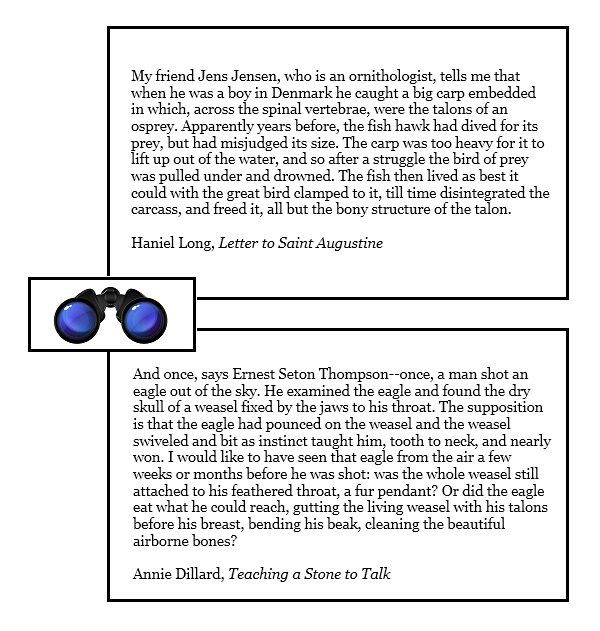
I’ve told the tale of how I came to appreciate the power of DoubleQuotes by running across these two parallel quotes in the works of two writers I admire, Haniel Long and Annie Dillard, in DoubleQuotes — origins, while in Bobcat jumps shark.. I posted a photo of an encounter that strongly reminded me of the pair of them.

**

You can therefore imagine how delighted i was this week to add this fourth entry into what is rapidly becoming a catalogue of fights-to-the-death between creatures of opposing elements:

The bird, as in Haniel Long’s tale, is an osprey, it’s battle is with a heavy fish — but in this case, it is the osprey that survives the encounter — and the slow motion video capture is simply astonishing.

Which reminds me..

**

I have already posted three times on the subject of ternary logic and three player games — in Of games III: Rock, Paper, Tank, in Spectacularly non-obvious, I: Elkus on strategy & games, and in Spectacularly non-obvious, 2: threeness games — but had somehow omitted any mention of another spectacular wildlife video, this one capturing a three-cornered battle between buffalos, lions and a crocodile or two, which can be found on YouTube under the title Battle at Kruger:

With 77 million views and counting at the time I post this, it’s a video you may very well have seen before — and a terrific testament to the idea that sheer quantity may on occasion be indicative of real quality.

Gilmore Girls and FaceBook Friends

Saturday, May 14th, 2016

[ by Charles Cameron — on relationships today, a DoubleQuote found in the Wild ]
.

Call it unconscious humor, found art, or a DoubleQuote in the Wild — these things “catch the eye” and “capture the heart”. Nice work, David Masad, and thanks fore passing it along, Kelsey Atherton.

Conflict resolution has both positive and negative outcomes

Friday, May 13th, 2016

[ by Charles Cameron — paradox: individual health goes down while societal health improves ]
.

reverse arrow conflict individual & group

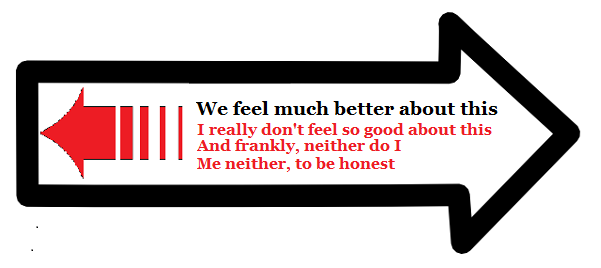
I knew this “reverse arrows” graphic would find a multitude of uses.

**

Here’s the news report:

Post-conflict reconciliation led to societal healing, but worsened psychological health.

Key paras:

Civil wars divide nations along social, economic, and political lines, often pitting neighbors against each other. In the aftermath of civil wars, many countries undertake truth and reconciliation efforts to restore social cohesion, but little has been known about whether these programs reach their intended goals.

A new study published in Science suggests reconciliation programs promote societal healing, but that these gains come at the cost of reduced psychological health, worsening depression, anxiety, and trauma.

“Our research suggests that talking about war atrocities can prove psychologically traumatic for people affected by war. Invoking war memories appears to re-open old war wounds,” said Oeindrila Dube, assistant professor of politics and economics at New York University and one of the authors of the study. “At the same time, the reconciliation program we examined was also shown to improve social relations in communities divided by the war.”

¶ ¶ 

The study took place across 200 villages, 100 of which were randomly chosen to be offered the reconciliation program. The research team tracked 2,383 people in both sets of villages, recording their attitudes towards former combatants, their mental health, and the strength of their social ties nine and 31 months after the program.

The study was made in Sierra Leone a decade after the civil war ended. Assuming the methodology is good and the results are as described, there’s a very interesting paradox here. And hey, a decent paradox really gets my mental feet a-tapping. It will be instructive to see whether similar results are found elsewhere.

**

The study is J. Cilliers, O. Dube, B. Siddiqi. Reconciling after civil conflict increases social capital but decreases individual well-being. Science, 2016; 352 (6287): 787 DOI: 10.1126/science.aad9682 — to which I have no access, and which would very likely prove beyond my comprehension in any case.

That a world-mapping should include our assumptions

Friday, May 13th, 2016

[ by Charles Cameron — Lorenz’ butterfly : tornado :: Fukushima’s rat : earthquake? + Brussles metro attack ]
.

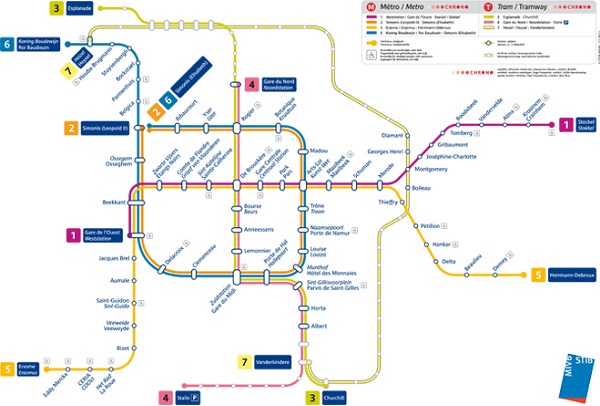
Brussels map
Brussels metro & tramway map

**

For every unintended consequence, there’s an assumption that was assumed and thus overlooked, forgotten, unfairly assigned to oblivion, amirite? Sometimes we’re fortunate, and a pattern emerges that can then be written into checklists, and repeat unintended consequences subsequently averted, if we heed the checklists, ahem.

Consider this stunning paragraph, from a Union of concerned Scientists‘ 2013 piece titled Fission Stories #133: Mayflies, and Squirrels, and Rats, …:

Fukushima Daiichi recently received worldwide media attention when another power outage once again interrupted cooling of the water in the Unit4 spent fuel pool for several hours. The culprits in 2011 were an earthquake that knocked out the normal supply of electricity to the cooling system and a tsunami that disabled the backup power source. This time, a rat was the culprit. It chewed through the insulation on an electrical cable, exposing wires that shorted out and stopped the cooling system. It was also the rat’s final meal as the event also electrocuted the guilty party.

Part of what’s so conceptually audacious here is the implicit risk equation, okay, perhaps I should call it the implicit risk approximation:

earthquake = rat

**

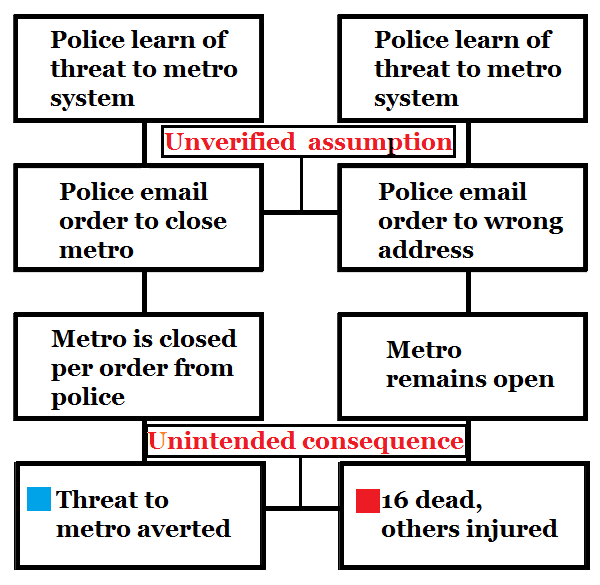
Take the Brussels metro attack: in my less-than-graphically-ideal mapping below, the left hand column shows what was intanded by the police to be the order of events as they initiated them in response to the airport attack a little earlier:

01

while the two centered annotations in red indicate the unverified assumption that interfered with the sequence of events as intended by the police, and the right hand column shows what actually transpired.

Exceopt that the situation was wildly more complex than that — a point not germane to my argument here, but elaborated upon in today’s WaPo article, The email that was supposed to prevent the Brussels metro attack was sent to the wrong address. Which see.

**

Getting back to Fukushima, the earthquake and the rat, perhaps we can now take the title of Edward Lorenz‘ remarable paper that gave us the term “butterfly effect” — Predictability: Does the Flap of a Butterfly’s Wings in Brazil Set Off a Tornado in Texas? — out of the realm of speculation, and into the realm of improbable yet actualized comparables, by rephrasing it thus: Predictability: Does the Bite of a Rat’s Teeth in Fukushima Have Comparable Effect to an Earthquake in Fukushima?

Oh, and just because something is predictable doesn’t mean it’s predicted — and just because something is predicted doesn’t mean the prediction will be heard or heeded.

And that’s an anticipable consequence of the way we are.

**

In the matter of Quixote:

I have this quixotic wish to see a map of global dependencies — it’s something I’ve thought about ever since Don Beck told me “Y2K is like a lightning bolt: when it strikes and lights up the sky, we will see the contours of our social systems” — and I’ve talked about it here before, in eg Mapping our interdependencies and vulnerabilities [with a glance at Y2K].

It’s a windmill, agreed — a glorious windmill! — and indeed, combining all our potential assumptions about even one single Belgian metro station in the course of just one particular morning and adding them to a map — or a checklist — would be another.

Tilting at windmills, however, is one of the great games of the imagination, frowned upon by all the righteously serious among us, well-suited to poets — and having the potential to help us avoid those damned unintended consequences.

Of Blood and Bride

Tuesday, May 10th, 2016

[ by Charles Cameron — concerning the tidal pull of two words on the emotions, in considering Hamzah bin Laden’s recent message ]
.
quote-blood-sin-and-desecration-of-the-race-are-the-original-sin hitler

**

In the Jewish book of Leviticus [17.11], we find:

For the soul of the flesh is in the blood and I have assigned it for you upon the altar to provide atonement for your souls; for it is the blood that atones for the soul.

For Christians, the early Church father Tertullian has the appropriate quotation:

Plures efficimur quotiens metimur a vobis? semen est sanguis Christianorum.

This translates to “We multiply whenever we are mown down by you? the blood of Christians is seed” and is often quoted in the form “The blood of the martyrs is the seed of the church.”

The American equivalent comes from Thomas Jefferson‘s Letter to William Stephens Smith of November 13, 1787, and is no doubt familiar to ZP readers:

The tree of liberty must be refreshed from time to time with the blood of patriots and tyrants. It is it’s natural manure.

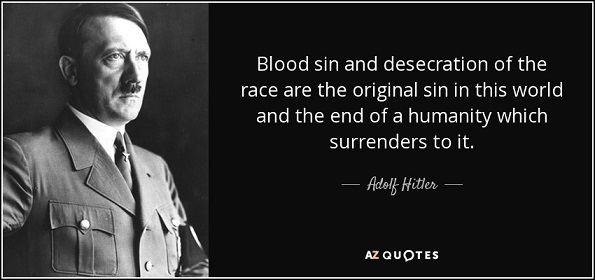
The terrible significance of “blood” to the Nazis is illustrated by the Hitler quote at the top of this post.

**

In the beginnings of the jihad fought by the Al-Qaida and its secessionist successors in the Islamic State, Abdullah Azzam‘s words are foundational. In a document which has been titled Martyrs: The Building Blocks of Nations — shades of Tertullian and Jefferson — Azzam writes of both blood and ink:

The life of the Muslim Ummah is solely dependent on the ink of its scholars and the blood of its martyrs. What is more beautiful than the writing of the Ummah’s history with both the ink of a scholar and his blood, such that the map of Islamic history becomes coloured with two lines: one of them black, and that is what the scholar wrote with the ink of his pen; and the other one red, and that is what the martyr wrote with his blood. And something more beautiful than this is when the blood is one and the pen is one, so that the hand of the scholar which expends the ink and moves the pen, is the same as the hand which expends its blood and moves the Ummah. The extent to which the number of martyred scholars increases is the extent to which nations are delivered from their slumber, rescued from their decline and awoken from their sleep.

Again — though I cannot say for certain who gave that title to this compilation of Azzam’s words — we see the importance of blood as the prime sacrificial element on which a world is built.

Indeed, one commonly cited hadith found in the collection of Bukhari states:

Anyone who is wounded in the path of Allah comes on the Day of Resurrection when [his] color is the color of blood, [but] his scent is the scent of musk.

**

I trust I don’t have to belabor the reasons why the word “bride” — particularly in combination with the word “blood” — is also fraught with enormous archaic, archetypal pulling-power. If we are in any doubt, we should consider the ravishing bridal poetry of the Tanakh’s Song of Songs which is Solomon’s:

Thou hast ravished my heart, my sister, my bride; Thou hast ravished my heart with one of thine eyes, With one bead of thy necklace. [Song of Solomon, 4.9]

— not to mention the eucharistic “bridal supper of the lamb” in that most poetic, visionary, and well-nigh inscrutable book of the New Testament, the Revelation of John of Patmos:

Let us be glad and rejoice, and give honour to him: for the marriage of the Lamb is come, and his wife hath made herself ready. And to her was granted that she should be arrayed in fine linen, clean and white: for the fine linen is the righteousness of saints. And he saith unto me, Write, Blessed are they which are called unto the marriage supper of the Lamb. And he saith unto me, These are the true sayings of God. [Revelation 19. 7-9]

and in the fullest and final revelation of that revelatory book:

And I saw a new heaven and a new earth: for the first heaven and the first earth were passed away; and there was no more sea. And I John saw the holy city, new Jerusalem, coming down from God out of heaven, prepared as a bride adorned for her husband. And I heard a great voice out of heaven saying, Behold, the tabernacle of God is with men, and he will dwell with them, and they shall be his people, and God himself shall be with them, and be their God. And God shall wipe away all tears from their eyes; and there shall be no more death, neither sorrow, nor crying, neither shall there be any more pain: for the former things are passed away. [Revelation 21.1-4]

**

Bear this double call of “blood” and “bride” on the emotions in mind, utilizing whichever of the above examples strikes the deepest chord in you to confirm their trance-like appeal, as you consider this message from Bin Laden‘s son, Hamzah, issued just a day or two ago:


Thomas Joscelyn posted a breakdown of the message content at Long Wars Journal yesterday:

  • Osama bin Laden’s son says jihad in Syria key to ‘liberate Palestine’
  • I trust this post of mine will add to our understanding of the emotional force on which Bin Laden’s son is appealing.
    Switch to our mobile site