zenpundit.com » state failure

Archive for the ‘state failure’ Category

Tom Ricks at Pritzker Military Library

Monday, August 10th, 2009


Out of sheer laziness and a nod to public service, I will re-post this notice from Lexington Green in its entirety:

Early Notice: Thomas E. Ricks at the Pritzker Military Library on September 10, 2009.

Thomas E. Ricks will be in Chicago at the Pritzker Military Library to discuss this most recent book The Gamble: General David Petraeus and the American Military Adventure in Iraq, 2006-2008. The event will be free and open to the public.

Ricks is the author of the widely-acclaimed book Fiasco: The American Military Adventure in Iraq, e.g. this review.

Ricks is a senior fellow at the Center for a New American Security.

Ricks has a blog, The Best Defense.

I hope to read The Gamble before the date, and I plan to attend the event.

I hope the weather is better than the downpour on the night that David Kilcullen spoke at the PML.

Barring any unforseen, work-related, commitments, I will be attending this event and will blog about it. Perhaps some live twittering as well.

On COIN and an Anti-COIN Counterrevolution?

Friday, August 7th, 2009

Had a pleasant and interesting email conversation with the always thoughtful Dr. Bernard Finel of The American Security Project ( that link is the blog, here is the main site for the org). Dr. Finel has been blogging vigorously and very critically of late about COIN becoming conventional Beltway wisdom, a premise he does not accept nor believe to be a useful strategic posture for the United States. It was a good discussion and one that I would like the readers to join.

Due to space limitations, I’m going to give the links and some small excerpts for each of Dr. Finel’s posts, but I strongly recommend reading his arguments in full before going on to my assessment:

Did we Really Ever Have an Afghanistan Debate?

The issue isn’t that people like Exum haven’t considered the issue individually.  I am sure he has.  Many others have also considered the issue, and many have shared their concerns with one another, but it has been, for years, in the context a shared consensus that has actively sought to exclude real disagreement.  It is not about doing due diligence on the policy, it has been about reinforcing the group identity about supporters of expansion of the war in Afghanistan.

The Incoherence of COIN Advocates: Andrew Exum Edition 

But unfortunately, the prerequisites are actually virtually impossible to achieve.  The Afghan government does not have the tax base, infrastructure, expertise, or – significantly – the inclination to build the kind of military and institutional capacity that our strategy requires from the local partner.  Furthermore, the desire to curtail corruption runs counter to the desire to secure the cooperation of provincial leaders.  We are setting the Afghans up to fail.  And unfortunately, setting the Afghans up to fail is a win-win scenario for the COIN theorists.  If, by some miracle, the Afghan government is able to meet our needs, we will claim credit for having given the Afghans a model to achieve.  If the Afghans fail, then any negative consequences will be the fault of the Afghans.

Important Stories from Iraq and Afghanistan

Defeating the current “population security” focused COIN approach is not that hard conceptually.  All the insurgents have to do is reverse the dynamic, by making a U.S. presence synonymous with increased violence.  The logic of population security then forces the counter-insurgent to move the population into more secure locations – minimally with checkpoints and controls over movement, but historically often also into fortified camps or villages (which quickly take on the characteristics of a prison).  Either way, the costs of the American provided “security” begins to look worse than the risks from the insurgents, who – if they are smart – are looking for little other than tolerance from the population.

Tom Ricks and COIN

So, I am confused.  Does Ricks think that the new COIN doctrine works, but is not always well implemented?  Does he believe that it produces short-term security improvements, but no long-term political benefits?  Does he think COIN is a failed doctrine, but nevertheless the best chance we have to rescue bad situations? Is he a closet COIN skeptic, but under pressure to toe the party line at CNAS?

Widening the Debate on COIN

Fourth, it behooves those of us who would like to see the debate transformed to actually include a list of potential alternate experts.  With all due respect to Matt Yglesias (Politico Only Knows Conservative Experts), who often writes about how progressives are often labeled as something other than “serious,” he’s not on the list.  He’s smart, but if I were putting together a list of people I’d like to see advising McChrystal, he wouldn’t be on it.  But here is who I would like to see on it, along with a representative example of their arguments:

  1. Andrew Bacevich (The Petraeus Doctrine);
  2. Chris Preble (The Power Problem: How American Military Dominance Makes Us Less Safe, Less Prosperous and Less Free)
  3. John Mueller (How Dangerous Are the Taliban?)
  4. Mike Mazarr (The Folly of ‘Asymmetric War’)
  5. Col. Gian Gentile (Our COIN doctrine removes the enemy from the essence of war)
  6. And even… if I may… little old me (Afghanistan is Irrelevant)

At the very least… McChrystal would benefit from having some members of this group formally “red team” his evolving strategy… before the Taliban does

In the last post, Dr. Finel cites a blogfriend, Fester at Newshoggers, whose post merits inclusion here- Closing the Overton Window on COIN.  Nothing wrong with red-teaming ( add John Robb to that list).

I shared my initial reaction with Dr. Finel and have continued to think about the subject of COIN and the anti-COIN banner that he and others like Col. Andrew Bacevich and Col. Gian Gentile have raised.  Here is more or less what concerns me in this debate.

First, it is not my impression that Andrew Exum is trying to set up a blame-shifting scenario with the Afghans to vindicate COIN. Exum may not always be correct, I certainly am not, but his written arguments strike me as straightforward and inellectually honest even when I disagree with them ( such as his predator op-ed with Dr. Kilcullen). Some of the questions re: Afghanistan/COIN/Iraq are speculative/experimental in nature and do not come with a hard and fast answer until a policy or tactic is implemented, tried and evaluated.

Has the debate been closed or limited to those in favor of intervention? I don’t think so, though one side was better organized and more effective at addressing concrete problems. I’m certain Dr. Finel is referring here to the broad community of defense intellectuals-military theorists- national security think tankers and the MSM figures covering that ground rather than the public at large, but even there, COIN gained policy ascendancy because:

1) The  “Big Army, the artillery, B-52’s and Search & Destroy=counterinsurgency” approach proved to be tactically and strategically bankrupt in Iraq. It failed in Mesopotamia as it failed in the Mekong Delta under Westmoreland – except worse and faster. Period.

2) The loudest other alternative to COIN at the time, the antiwar demand, mostly from Leftwing extremists, of immediately bugging-out of Iraq, damn the consequences, was not politically palatable even for moderately liberal Democrats, to say nothing of Republicans.

If there was a third alternative being effectively voiced at the time before “the Surge”, please point it out to me, I am not seeing it.

Fast forward to today. The problem with COIN is that it is an operational  “How to”doctrine whose primary advocates are very reluctant to step up and deal with formulating a strategic, global, framework for the use of COIN.  Or if they are contemplating the strategic “Why/When” angle right now at CNAS, they are not yet finished doing so. Possibly, some of the reluctance to deal with the plane of strategy stems from most COINdinistas coming from a professional “Powell Doctrine” military culture that emphasizes -no, indoctrinates – thinking at the tactical level and demands that strategic thinking be studiously left to civilian policy makers. Getting a coherent operational paradigm in order, proselytized and grudgingly accepted by the DoD establishment was no small achievement by the COINdinistas. It’s huge.  Unfortunately,with a few exceptions, our civilian policy makers and even moreso our political class are collectively not up to the task of strategic thinking by education, training and political culture (to say nothing of formulating grand strategy) they do not like making choices, accepting risks, setting realistic goals or even think in these terms. Nor is our media making the sort of intellectual contribution to public policy debate that Walter Lippmann made in critiquing George Kennan’s early advocacy of Containment

The critics of COIN, such as Col. Bacevich are largely arguing for a non-interventionist foreign policy as a strategic posture ( a well argued example of that school of thought would be Dr. Chet Richards’ latest book If We Can Keep It: A National Security Manifesto for the Next Administration) for the United States, largely waving away the messy tactical and operational realities. Such a position has legitimate pros and cons that deserve being debated on their own merits for the future but for our current difficulties their advice amounts to closing the barn door 8 years after the cow wandered away. It may be time to leave Iraq; Afghanistan, by contrast, presents unsolved problems with al Qaida’s continuing as a functional organization in Paktia and in Waziristan-Baluchistan across the border in Pakistan. While circumstances do not require our turning Afghanistan into the Switzerland of the Hindu Kush, al Qaida is not business that we should leave unfinished.

Debate is healthy and helpful and critics of COIN improve the doctrine by their articulate opposition. America’s problems are a seamless garment that need solutions from the tactical level where practitioners and shooters live, up to the world of strategy and grand strategy inhabited by statesmen and national leaders – who have yet to provide the clear and coherent policy objectives that our military requires to be most effective.

Comments, criticism, complaints welcomed.

ADDENDUM:

Exum responds to Bacevich on the need for an Afghanistan debate. Good post. (Hat tip to Arabic Media Shack)

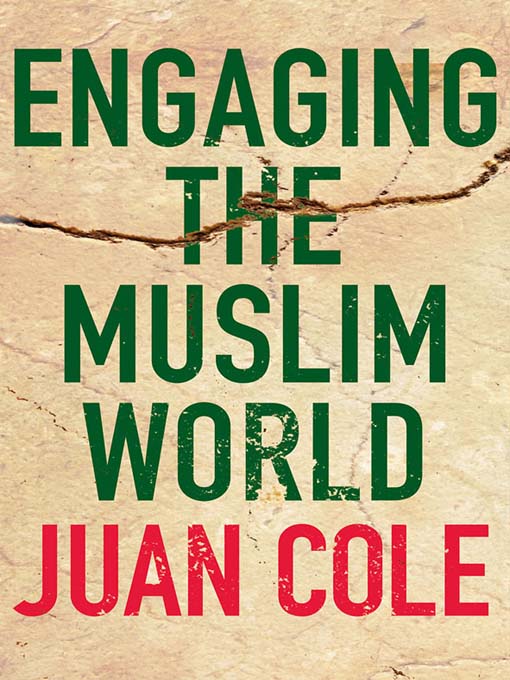
Book Review: Engaging the Muslim World by Juan Cole

Wednesday, July 8th, 2009

Engaging the Muslim World by Juan Cole

I recently finished reading Engaging the Muslim World by Juan Cole, the influential academic, well known liberal-left blogger of Informed Comment, past president of the Middle East Studies Association and occasional media talking head. Cole has written an intriguing book on contemporary foreign policy that is of special interest to those readers concerned with public diplomacy, the Muslim world, terrorism and the domestic politics of American foreign policy, particularly the war in Iraq. I will state straight off that there are arguments in this book presented by Cole that I profoundly disagree with, or, national security related assertions that I consider questionable; but in other instances, when Cole is concentrating on the nuances of the Arab-Muslim world’s political-cultural lens, he is an illuminating and insightful analyst from whom I have learned new things. 

Engaging the Muslim World is…well….engaging. I found Cole’s prose flowed smoothly, as if the author was talking to the reader across a table, and I had a hard time putting the book down, albeit I was frequently scribbling furiously in the margins. This is a polemical -policy book written by an academic for a lay audience and the reader’s reaction to Engaging the Muslim World will depend in part on their own worldview. Liberals will cheer more than they disagree with Cole, while conservatives and supporters of Israel are likely to reject many of the book’s normative assumptions long before they read the conclusions – but Cole also offers some prescriptive advice that center-right COIN and public diplomacy advocates will warmly embrace.

The book  is divided into six chapters. The first, “The Struggle for Islamic Oil:The Truth About Energy Independence” which deals with energy markets, the Cold War history of the Mideast, global warming, environmental policy, alternative fuel technologies and globalization, is a necessary effort to concisely account for the geoeconomic importance of Muslim oil producing states and the future of fossil fuel economies.  Cole argues – correctly, I suspect – that there will be no short or medium term substitutes for oil and gas until solar power technology is cost-efficient enough (and efficient in a physics sense) to compete with fossil fuels in the marketplace. Not being a scientist or an expert in energy market issues, I am poorly placed by professional background to evaluate Cole’s claims in these areas and will leave those to others.

That said, chapter one remains the odd man out. It smacks of having been  compacted by an editor out of two or more chapters and consequently has disparate issues jumbled together with insufficient explanation; as a whole, chapter one fits uncomfortably with the subsequent chapters which flow together naturally and thematically. On the other hand, the topic of oil can hardly be dispensed with either in a geopolitical discussion of the Mideast, so Cole was right to tackle it and the primary problem is really one of sequence, not subject matter.

Chapters two through six are the heart of Engaging the Muslim World, where Juan Cole articulates a theme of “Islam anxiety” permeating Western, particularly American, media and public opinion. Poorly informed about even the most basic information regarding the Muslim world, such as the differences between Shia and Sunnis, secular Baathist nationalists and Islamist radicals, quietists and the politically militant, Arabs and non-Arabs, Cole asserts that Westerners tend to lump Muslims of all shades of political belief, religiousity and nationality into a homogenous, vaguely mysterious but ever dangerous entity. Cole cites as one example, Egypt’s Sunni Muslim Brotherhood, which has foresworn violence and has members who sit in Egypt’s legislature, being lumped uncritically by American commentators with al Qaida and Hezbollah (which is a radical Shiite group).

A better way to understand violent Islamist extremists in relation to normal Muslims, in Cole’s view, would be to see them as analogous to our homegrown, violent, far-Right, white racist underground that produced Timothy McVeigh, who carried out the Oklahoma City bombing or as cult-like movements. While smaller in size than Islamist radicalism, the racist Right shares with violent Islamists the trappings of a fringe, ostracized, quasi-religious, political cult with a conspiratorial worldview that diverges sharply from the nation’s mainstream religious life. Violent Islamists often make themeslves as unpopular with their co-religioinists as do neo-Nazi extremists here, through actions that horrify society, such as the bloody massacre of Western tourists and Egyptian workers at  Luxor, Egypt.

Cole’s analogy with cults and racial extremists I think is a useful one. Radical Islamists are difficult to classify on a traditional political spectrum as their political behavior has definite similarities with those of the fascist and communist totalitarians of the 20th century, but will not fit smoothly with either, given Islamist religious extremism and the fanatical atheism or at least radically secular nature of the Bolsheviks and Nazis. The psychological overlap however is certain, something akin to the 19th century Anarchist-terrorists or what Eric Hoffer captured in his classic work, The True Believer.

On Israel and Iran, Cole bends over backwards, like a circus sideshow contortionist, to try and explain the lunacy (and Cole admits it is, at best, a crackpot worldview) of Ahmadinejad’s violently antisemitic statements about the Holocaust and Iran’s generally defiant behavior toward the international community while giving Israel no similar benefit of the doubt.  Cole argues that Ahmadinejad’s oft-stated “wipe Israel off of the map” is a deliberate mistranslation by the Western media. Ok, possibly so. I do not speak Farsi, so I’ll take Cole’s word here. If it is the case though, Ahmadinejad is well aware of how his repeated statement is being mistranslated by Reuters and AP, yet he keeps using it. Again and again. That is an ominous statement in itself.

This uneveness regarding Iran and Israel will no doubt enrage conservatives and delight progressives, but in fairness to Juan, I must say that despite his partiality toward Iran in his book, as a blogger he was very quick to denounce the obvious stealing of the recent election by Khameini-Ahmadinejad-IRGC and my perception is that Cole views the apocalyptic Mahdist tendency in Twelver Shiism that Ahmadinejad embraces as a kooky deviation from mainstream Shiism. That not just Ahmadinejad holds this belief dear, but also many influential figures in the Iranian security apparatus as well, is in my view, a cause for alarm.

Despite his politics, Cole concludes Engaging the Muslim World with a very pragmatic prescription for American public diplomacy for engaging Arabs and Muslims in a more effective manner than in the past eight or eighteen or eighty years. If I do not agree with every aspect, it is a good deal better than what the State Department and the rest of the USG is doing now:

Once I saw an Iraqi tribal leader interviewed on al-Jazeera. He said. “There is good and bad in America”. I was struck by how pragmatic and realistic his response was, and how different it was from so much of the fundamentalist vigilantee propaganda about the United States posted on radical internet bulletin boards. If Washington could reach out to all Muslims and bring them around to a more nuanced -and clear-view, in which America was not simply demonized, it would be a major accomplishment. The point is not that they should see the West through rose colored glasses, but that they should be willing to see the good and bad.

That would represent a step up by an order of magnitude.

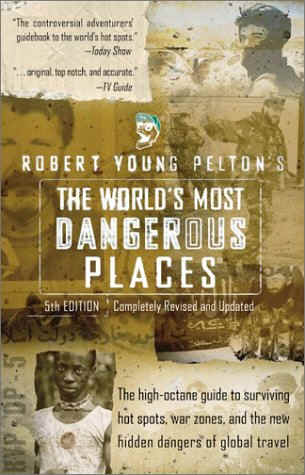
Robert Young Pelton

Tuesday, June 23rd, 2009

The author of  The World’s Most Dangerous Places: 5th Edition  and Licensed to Kill: Hired Guns in the War on Terror was nice enough to drop by in the comment section and discuss his firsthand view of special operators in Afghanistan. During the course of the discussion, in response to a question from Lexington Geen, RYP offered up a couple of links that I think readers will find worthwhile. Here is a quote from one of them:

….The next morning, about 60 Afghan cavalry came thundering into the compound. Ten minutes later, another 40 riders galloped up. General Abdul Rashid Dostum had arrived.

“Our mission was simple,” another soldier says. “Support Dostum. They told us, ‘If Dostum wants to go to Kabul, you are going with him. If he wants to take over the whole country, do it. If he goes off the deep end and starts whacking people, advise higher up and maybe pull out.’ This was the most incredibly open mission we have ever done.”

“Dostum” is the mercurial, ex-Communist, Uzbek Afghan warlord,  General Abdul Rashid Dostum.

Here are the links:

The Legend of Heavy D and the Boys: In the Field With an Afghan Warlord

Inside the Afghan War Machine

Incidentally, I read The World’s Most Dangerous Places in an earlier edition, back when Pelton’s uber-violence list was topped by Algeria, Colombia and several, broken down, West African nations. It’s a great book and a fun read that I have lent out to many of my students who had an all too idealistic and  parochial view of the world. It cured a few of them.

COIN and Counter-COIN

Tuesday, June 2nd, 2009

First, John Robb is en fuego today at Global Guerillas in a series of provocative “standing order”  tactical-strategic posts challenging COIN theory. I strongly advise you to check these out. I may comment on some of these later tonight.

John has been taking time away to work on unrelated business projects and this diversion seems to have sparked a burst of creative and innovative thinking in his field of expertise.  This is an excellent technique for improving productivity as the mental shifting of gears from tackling new subjects is neuropsychologically stimulating.

Secondly, there have been a couple of new responses to my earlier “Kilkullen Doctrine” post to which I want to draw your attention:

Rethinking Security –  COIN and Grand Strategy

Committee of Public SafetyHamilton Rolls Forward, Firing His Laser Eyes and Grand Strategy Through the Lens of Schizophrenia

I had linked to CoPS previously but I think my blog meltdown on Sunday obliterated that particular update.

UPDATE!

Stephen Pampinella – Critical Strategic Theory as Compliment to the Kilcullen Doctrine

The identity question may be the key to grand strategy and the meta-vision behind it – a la John Boyd’s “Theme of Vitality and Growth” as well as the reason why the USG, the bipartisan elite, the COINdinistas all shrink from it. Grand strategy is not merely about externalities, but shaping one’s own. Here America is deeply and bitterly divided.


Switch to our mobile site