zenpundit.com » diplomacy

Archive for the ‘diplomacy’ Category

Hermit Kingdom of Darkness

Sunday, April 7th, 2013

North Korea’s shopworn game of bluster, threaten, bully, violate international norms and eventually be rewarded with concessions and bribes has stopped working, which is why there now is a crisis. With the suckers (ROK, USA and Japan) refusing to play three card monty and with even  Pyongyang’s confederate China wearying of the scam when they have their own fish to fry, Kim Jong Eunhas few options to save face except to double down on painting himself into a smaller and tighter corner. There are some who would like to play the game of appeasement for a temporary respite but both Seoul and Washington are taking a harder line on North Korean antics.

One gets the impression that -unofficially, mind you – Beijing would not mind “Fatty the Third” getting a comeuppance that could push him from power and lead to the ascension of a more mature, more reasonable, more seasoned and more Sinicized leader of the Kim dynasty.

Here is a round up of more intelligently thought out (or at least interesting) articles and posts about the Nut of the North and possible war with North Korea:

Colonel Dave Maxwell– north Korean Leadership Assessment and The Realist Prism: North Korea Gambles on Strategic Assumptions and U.S. would seek regime change in North Korea if attack occurs

Colonel Maxwell is an area specialist on the DPRK, these are the “must read” pieces

Robert Baer –Viewpoint: North Korea’s Gaddafi Nightmare 

Gordon Chang –Is Kim Jong Un’s Bluster Really a Prelude to Reform?

Thomas PM Barnett –The Tricky Thing about Kim Jon Eun 

Patrick Cronin – Tell me How this Starts

IHT –Detecting Shift, U.S. Makes Case to China on North Korea 

Let me try my hand at reading the tea leaves. I don’t know that much, relatively speaking, about the “sovietology” of analyzing North Korean nuances which I will leave for experts like Colonel Maxwell to concentrate on other angles. Some points i no particular order:

  • First, any hope of an internal coup against Eun is probably nonexistent. Not only for the the consistent ruthlessness and lavish bribery which the Kim Family regime has treated it’s military, but the fact that coups of this nature have a poor track record in Communist states, even weird ones like the DPRK. From the inception of Communist power in the USSR, Soviet leaders fretted about “Bonapartism” by counterrevolutionary generals on white horses from Kornilov to Tukhachevskii to Zhukov. That these plots were mostly imaginary did not matter and Communist rulers neutralized this threat by binding the military leadership into the Party leadership at a level subordinate to the Politburo and periodically shooting likely upstarts. The political space for successful military coups do not exist in Communist regimes even for the key insiders, just ask Lin Bao. The North Korean military does not have the will to do this except in conjunction with massive Chinese intervention. Perhaps not even then.
  • For all the talk of irrationality, North Korea has been been playing this game as a survival strategy for sixty years and only miscalculated once, with the original invasion of South Korea in 1950 – which only happened, after Kim Il-Sung received the blessing of Stalin and promise of massive support from Mao ZeDong – and it was an unmitigated disaster for North Korea and China. Pointedly, the North has not initiated a war since and their subsequent violent provocations, while infuriating, have been quixotic and weird rather than existential threats that would guarantee a crushing military response.
  • The “win” for the US and ROK here is in frustrating the regime’s grasp for status, however self-deluded, in extorting more material concessions by acting like the international community’s equivalent of a crazy, menacing, homeless person ranting on a street corner. We need to make this charade appear to be a diplomatic sure-fire loser this time in the eyes of Pyongyang’s elite with an endgame where the North emerges empty handed and Eun feels that pressing further risks a greater loss of face. We do this by making moves where the spillover costs of North Korean intransigence and public lunacy drift in China’s direction; a tightly constrained North Korea out of diplomatic and economic options is really Beijing’s problem.
  • The strategic equation for “victory” from the North’s perspective depends heavily upon the reaction of the US and ROK governments to get drawn into tiresome negotiations before the North ceases it’s behavior, something they ultimately cannot control. Washington and Seoul cold hold firm or even (conceivably) take a harder line. If frustrated in their quest for concessions, the regime could exercise several options a) shift gears to a different propaganda campaign to distract internal audience b) engage in an act of terrorism elsewhere in the world, such as against a ROK embassy c) engage in a military demonstration that while provocative, like ballistic missile test, is not a casus belli d) all of the above e) undertake a military strike under the mistaken impression the ROK will not retaliate.

Comments welcomed.

US Foreign Policy, Egypt and the Muslim Brotherhood

Wednesday, January 30th, 2013

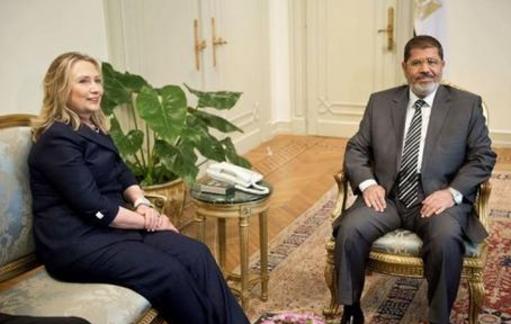
The Obama administration, though they would not characterize it as such nor have much desire to acknowledge it at all, have attempted  a strategic detente with the “moderate” elements of political Islam.

This policy has not been entirely consistent; Syria, for example, is a quagmire the administration has wisely refrained from wading directly into despite the best efforts of R2P advocates to drag us there.  But more importantly, under President Obama the US supported the broad-based Arab Spring popular revolt against US ally, dictator Hosni Mubarak, and pushed the subsequent ascendancy of the Muslim Brotherhood in Egypt and the Libyan revolution against the entirely mad Colonel Gaddafi. These appear to be geopolitical “moves” upon which the Obama administration hopes to build.

I would like to emphasize that there is one legitimate and valid strategic pro to this sub rosa policy; namely, if everything went well, it would provide the United States with powerful triangulation against revolutionary, apocalyptic, radical Islamism as expressed by al Qaida and various Salafi extremist movements. There are reasons, rooted in takfirism, strategy and the politics of lunacy that our terrorist enemies frequently hate and revile the Brotherhood as traitors, apostates or whatever. Isolating the most actively dangerous and violent revolutionary enemies from a large mass of potential allies is, at least, a good strategic goal.

It is also my view, that this “outreach” is as politically sensitive  to the Obama administration as was the China Opening was to Nixon and about which they have been equally opaque and misleading for fear of a domestic backlash. The weird, foot-dragging, dissembling, embittered, kabuki drama inside the Beltway about public statements and intelligence on whether Benghazi was caused by obscure crackpot Islamophobic film makers or a well-orchestrated terrorist attack  is in my view due to a major foreign policy strategy never having been framed in public for what it is. I’m sure people will differ strongly with me on this (which is fine), but I would characterize detente with Islamists as a strategic shift on par with the “Pivot to Asia”.

The downside here is that first, things are not likely to come out well at all, as unfinished revolutions tend to give birth to monsters; and secondly, any detente with “moderate” political Islam is an uncertain gamble based on certain exceptionally optimistic conceptions of not only what the Brotherhood might do, but about it’s very nature.

While the removal of Arab dictators resonated with American values , it was questionable realpolitik while the administration’s de facto support of  Egypt’s Muslim Brotherhood faction over poorly organized secular liberal modernists was an act of realpolitik that required a compromise of the democratic values so recently invoked to justify abandoning Mubarak. This was cynical diplomatic flexibility worthy of Talleyrand.

Unfortunately, the most democratic thing – perhaps the only thing – about Mr. Morsi and his Brotherhood supporters was his election.

The Egyptian people who are subjected now to thuggery from both Morsi’s Islamist stormtroopers and from the security forces of the Egyptian military are less sanguine than are the Brotherhood’s cheerleaders inside the administration. The Egyptian people, in fact, seem to be in revolt against domination by the Muslim Brotherhood’s shadow government.

The first question to ask in assessing if the Obama administration policy here is wise would be “What is the nature of the Muslim Brotherhood?” Americans love to personalize foreign policy, but if  Morsi were to be toppled or die, the Brotherhood will remain what it currently is, the best organized political force in Egypt and one widely influential throughout the Arab world and the West itself.

I am not an expert on the Muslim Brotherhood, nor am I an Arabist by education. Most of us aren’t – a group that I fear includes most of the Obama administration officials involved in shaping this policy. Almost fifty years after King Faisal determined to export Wahhabism, more than thirty years since Khomeini’s Revolution and more than ten years since 9/11 the USG still has less in-house expertise related to Islam than it did about the Soviet Union and Communism a decade after the Berlin Blockade.

Perhaps we all should begin learning more?

Here is an analysis from FPRI; it is extremely critical but it touches on organizational aspects of the Muslim Brotherhood that I have not seen elsewhere (hat tip to David Ronfeldt). Feel free to suggest others, both for and against. The Brotherhood is a very large group with a long history that includes violence , terrorism and subversion on one hand and peacefully representing expressions of pious, middle-class, social conservatism in other places and times:

Lecture Transcript: What Every American Should Know about Egypt’s Muslim Brotherhood, Delivered by Eric Trager 

….Two years ago when I was doing my dissertation fieldwork in Cairo, I sought out interviews with leaders from the Muslim Brotherhood, and I was referred to a man named Muhammad Morsi, now the President of Egypt. At the time, President Mubarak was ill and had gone off to Europe for operations amid a lot of mystery surrounding his health. I asked Muhammad Morsi whether the Muslim Brotherhood would run a presidential candidate if Mubarak died tomorrow. Here is what he said:

[From an audio file played by Trager]

Eric Trager: You don’t see the Muslim Brotherhood nominating a presidential candidate [if Mubarak dies tomorrow]?

Muhammad Morsi: No… because society is not ready… Our society is not ready yet to really defend its worth. We want a society to carry on its responsibilities, and we are part of this society. Another thing, if we are rushing things, then I don’t think that leads to a real stable position.

When he made that statement, I don’t think he was lying, and I don’t think he was being coy. I think that he didn’t expect that he would be faced with this reality in a mere six months. He did not expect that Mubarak would step down six months later and, to be completely honest with you, neither did I. My dissertation was entitled “Egypt: Durable Authoritarianism”—until the revolution.

What did Morsi mean when he said that the Brotherhood was trying to build a society? Let me give you some background on the Muslim Brotherhood. It was founded in 1928 by Hassan al-Banna, who was a schoolteacher in Ismailia. The Muslim Brotherhood’s goal was then—and remains now—to establish an Islamic state in Egypt. The way it pursues this goal is by trying to Islamize Egyptian society. Through social services, education, and the mosque, it sought to make Egyptians more religious and more Islamic as a grassroots strategy for building an Islamic state. That’s very, very different from a strategy that says, “We’re going to run for president, run for the Parliament, and use that power to transform society.” Rather, the Brotherhood says, in effect, “We’re going to Islamize society to build towards power.” It was a long-term strategy; it took them 84 years before they ran for and won the presidency. So Morsi told me in 2010 that the Muslim Brotherhood was not going to run for the presidency because it was not done Islamizing Egyptian society….

Read the rest here.

Gaza negotiations: sincerity and symmetry

Thursday, November 22nd, 2012

[ by Charles Cameron — sincerity and symmetry as the basis for dialog and negotiation ]
.


.

If you read me regularly, you know I’m passionate about form as well as content.

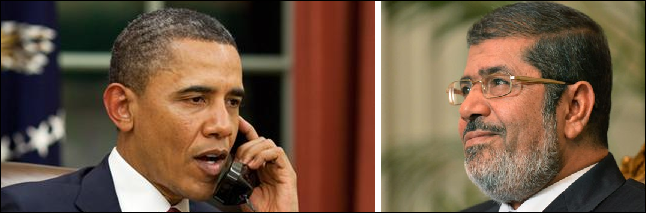
Here’s the New York Times report on the interactions between Presidents Obama and Morsi in the runup to the Gaza ceasefire negotiations:

Mr. Obama told aides he was impressed with the Egyptian leader’s pragmatic confidence. He sensed an engineer’s precision with surprisingly little ideology. Most important, Mr. Obama told aides that he considered Mr. Morsi a straight shooter who delivered on what he promised and did not promise what he could not deliver.

“The thing that appealed to the president was how practical the conversations were — here’s the state of play, here are the issues we’re concerned about,” said a senior administration official who spoke on the condition of anonymity to discuss private conversations. “This was somebody focused on solving problems.”

The Egyptian side was also positive about the collaboration. Essam el-Haddad, the foreign policy adviser to the Egyptian president, described a singular partnership developing between Mr. Morsi, who is the most important international ally for Hamas, and Mr. Obama, who plays essentially the same role for Israel.

“Yes, they were carrying the point of view of the Israeli side but they were understanding also the other side, the Palestinian side,” Mr. Haddad said in Cairo as the cease-fire was being finalized on Wednesday. “We felt there was a high level of sincerity in trying to find a solution. The sincerity and understanding was very helpful.”

**

And here, by way of context, is David Bohm on dialogue:

One way of helping to free these serious blocks in communication would be to carry out discussions in a spirit of free dialogue. Key features of such a dialogue is for each person to be able to hold several points of view, in a sort of active suspension, while treating the ideas of others with something of the care and attention that are given to his or her own. Each participant is not called on to accept or reject particular points of view; rather he or she should attempt to come to understanding of what they mean.

Bohm, Science, Order and Creativity, p 86

**

What interests me here in the Obama-Morsi interaction as described is the dual emphasis on sincerity and symmetry. Sincerity is needed so that each of the two sides — Israel’s POV, as presented by Obama, and that of Hamas, as presented by Morsi — is in fact presented, and not hinted at, watered down or reneged on. And when both sides are in fact sincerely represented, they are mutually present — heard — and there is symmetry.

That symmetry, it seems to me — symmetry of form in the presentations of contents — is the facilitator of successful negotiations.

A Tale of Two Victories and Two Falls

Sunday, November 11th, 2012

My co-blogger Charles Cameron is fond of his “DoubleQuotes” postings that feature frequently uncomfortable juxtapositions designed to prod thinking. Here’s a wordier one from me:

….Planning for a second term has been under way for months, with Lew and Pete Rouse, the counselor to the president and Obama’s internal management guru, preparing lists of possible promotions and nominations. The staff process has been gossiped about by the staff, but details have been kept secret, even from insiders.

“They haven’t even made calls. People haven’t been asked,” said a Democrat familiar with the situation. “They’re more targets than they are potential nominees.”

Now, officials will start to cement their departure dates, and aides will sound out colleagues about possible new roles. Among the top current officials expected to go: Treasury Secretary Timothy Geithner, Secretary of State Hillary Clinton, Defense Secretary Leon Panetta, Energy Secretary Steven Chu, Interior Secretary Ken Salazar and Lisa Jackson, administrator of the Environmental Protection Agency.

Attorney General Eric Holder and Transportation Secretary Ray LaHood might not be far behind — or may even beat them out the door.

There’s also a growing list of people the administration is looking to find spots for: Massachusetts Gov. Deval Patrick most of all, as well as former Michigan Gov. Jennifer Granholm and outgoing North Dakota Sen. Kent Conrad.

Obama has overseen one of the most stable cabinets in history — the only departures have been Defense Secretary Robert Gates, and Gary Locke and John Bryson from Commerce. But what’s about to happen amounts to an almost full-scale second transition: 


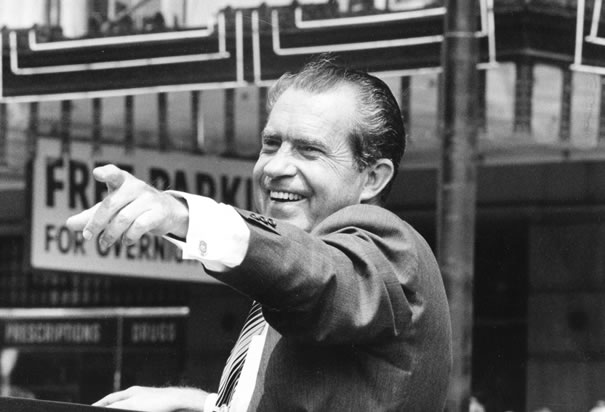
….At eleven o’clock in the morning, Nixon met with his staff in the Roosevelt Room. To many in the room he seemed oddly cool and quietly angry as he thanked them all for their loyalty and said something few of them understood. He said that he had been reading Robert Blake’s Disraeli and was struck by his description a century ago of William Gladstone’s ministers as “exhausted volcanoes” – and then mumbled something about embers that once shot sparks into the sky.

“I believe men exhaust themselves in government without realizing it” the president said “You are my first team, but today we start fresh for the next four years. We need new blood, fresh ideas. Change is important…..Bob, you take over.”

Nixon left then, turning the meeting over to Haldeman. The men and women of the White House stood to applaud his exit, then sat down. The chief explained what Nixon’s words meant: a reorganization of the administration. He told them that they were expected to deliver letters of resignation before the end of the day, then passed out photocopied forms requiring them to list all official documents in their possession. “These must be in by November 10,” he said. “This should accompany your pro forma letter of resignation to be effective at the pleasure of the President”. They were stunned. Speechless. Were they being fired? Haldeman said they would know within a month whether or not they could remain. At noon, the same drama was played out with the entire Cabinet, with Haldeman again passing out the forms.

Ironically, one of the many Cabinet secretaries Nixon ignominiously fired in his bid to centralize power in his White House staff was his former 1968 primary rival, HUD Secretary George Romney, father of 2012 Republican nominee, Governor Mitt Romney.  A blow from which George Romney’s political career never recovered. Nixon’s relationship with Romney had been an acrimonious one, formally polite on the surface with public shows of confidence by Nixon and machiavellian intrigues behind the scenes to undermine Romney and reverse the policies he had been advancing in Nixon’s name.

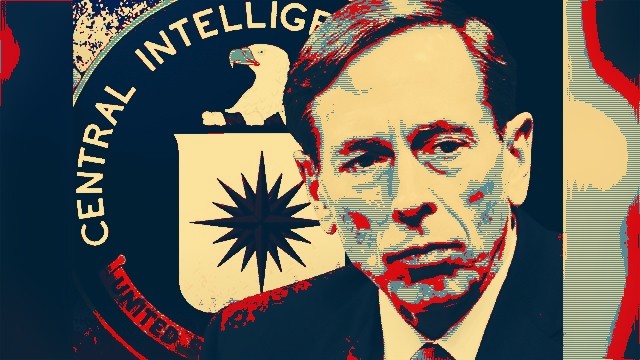
This latest Cabinet reshuffle to build a “Team without Rivals”, comes in the context of an explosive story, the abrupt resignation Friday of CIA Director General David Petraeus, citing an extramarital affair and accepting responsibility for “extremely poor judgment” and “unacceptable conduct”. The affair, allegedly conducted with his official biographer, came to light during a still not fully explained FBI investigation into unauthorized accessing of Petraeus’ private email account. The resignation of the highly regarded General Petraeus comes just before he was expected to testify before Congress regarding discrepancies and questions in the administrations handling of the terrorist attack in Benghazi that killed Ambassador Chris Stevens and other Americans. It also coincides with the Secretary of State Hillary Clinton, declining to testify.

It is difficult to say if General Petraeus public career will survive this scandal that he has brought upon himself, an action which stands in jarring contrast to his sterling, some might say superhuman, record of service to America, or if he will, like George Romney, fade away. Certainly, the CIA badly needed to stop the revolving door on the Director’s office and have a strong, visionary, hands-on leader who could reform and invigorate the Agency not merely in terms of covert action but in terms of rebuilding of capacity in deep cover clandestinity and the acquisition of strategic intel. I do not often find myself in agreement with Senator Feinstein but she is correct, this resignation hurts because it is also a significant institutional opportunity cost for the IC. I too wish it had not been accepted  – at one time it wouldn’t have been – but that is the President’s prerogative.

What however are the real issues? What should we be looking for?

Two things: As with Richard Nixon’s second term machinations, with such sweeping changes personnel changes in the offing for the Obama administration, ask yourself as events unfold: “Where is power flowing? And Why?”

If you do you will be in a better position to game out the direction of the next four years, especially in foreign policy and national security.

The White House has attempted to sell a story that the FBI doing a low-level harassment investigation  stumbled upon a security breach and – on their own authority, mind you – tapped the email account of the Director of the CIA and kept him under surveillance and investigated his mistress and, oh, yeah, the President was only informed of this business after the election on Thursday. Wait! And the DNI ( a three star general whose career was primarily intel administration) on his own initiative called the CIA Director ( a four star general and former theater and combatant commander) in on the carpet and fired him told him to resign. Right.

No, what most likely happened was that the minute the special agents realized who was involved in their investigation and the magnitude of the implications, they stopped and informed their superiors and the matter went up the chain to the FBI Director’s desk. The FBI Director, a former prosecutor with a political antennae circumspect enough to be appointed by George W. Bush and have his term be extended by Barack Obama, would have duly informed the Attorney-General of the United States before proceeding further and – I expect – the National Security Adviser, White House Chief of Staff and the DNI. Worst case scenario thinking in terms of national security would have been one driver. Another would be the fear of an all too juicy story leaking and the media catching an unbriefed POTUS unaware on the campaign trail with a blockbuster scandal before the election. How would that have gone over?

I would further expect that we will in the next few days and weeks hear the most salacious contents of the emails between Petraeus and his biographer, leaked by anonymous officials, timed to coincide with difficult days of testimony regarding Benghazi or new appointments to the administration that could, on a slow media day, prove controversial.

Instead of being distracted by prurient nonsense unrelated to the stewardship of the Republic, time would be better spent scrutinizing the host of nominations to come, not as individuals but as “teams” for particular areas of national security and foreign affairs cutting across bureaucracies – ex. arms control, Russian relations, Mideast etc. What commonalities or congruencies emerge?

I suggest this because back when the Obama administration decided on their “pivot” to Asia, the people they selected for second to third tier workday management related to the Asia-Pacific region were all accomplished, decent, honorable public servants, but their greatest common characteristic was a lack of any professional expertise with China. We saw the same personnel gambit with the Bush administration in the run-up to the war with Iraq where the greatest disqualifier for a job with the CPA was familiarity with the Arab world, Islam or Iraq. When you want careful stratagems, you solicit the advice of experts; when you want grand and revolutionary gestures, the wheels of policy are better greased with bold ignorance. There’s a reason Nixon appointed William Rogers Secretary of State – he knew the State Department bureaucracy would largely oppose his foreign policy initiatives and he wanted someone ill-suited and uninformed in charge there who he could more easily manipulate and keep in the dark.

The sixties radicals used to assert “the personal is the political”; in the eighties, Ronald Reagan in staffing his first administration understood that “the personnel are the political” and picked people culled from Heritage and Cato. My intuition is that in the second decade of the 21st century, the inside circle of the Obama administration have discovered that ” the political are the patterns”.

The story unfolding is no longer the “smoking gun” or the compromising jigsaw piece but the entirety of the puzzle.

The Last Lion, Winston Spenser Churchill, Defender of the Realm, 1940-1965 — finally released!

Saturday, November 3rd, 2012

[by J. Scott Shipman]

The Last Lion, Winston Spenser Churchill, Defender of the Realm, 1940-1965, by William Manchester and Paul Reid

In the 1980’s, William Manchester wrote two of three planned volumes on the life of Winston Churchill. He had notes for the final volume but illness prevented him from completing. Instead, he brought in Paul Reid to finish his masterpiece. While it took 25 years, the wait was well worth it; Reid thus far (I’m halfway through) has channelled Manchester’s style and presenting a seamless connection to the first two volumes.

Strongest recommendation.

Cross posted at To Be or To Do.


Switch to our mobile site