zenpundit.com » state building

Archive for the ‘state building’ Category

Building the Antilibrary

Sunday, May 9th, 2010

New acquisitions….


Street Without Joy: The French Debacle In Indochina by Dr. Bernard Fall

The Human Factor: Inside the CIA’s Dysfunctional Intelligence Culture by “Ishmael Jones

Sadly, my effort to “stay on the wagon” and refrain from the purchase of books until I wade through some of my unread shelves is failing miserably. I also think this will be a COIN heavy year for the 2010 reading list.

ADDENDUM:

My colleague, Lexington Green, points to this fine review of The Human Factor by fellow Chicago Boyz blogger, James McCormick:

Mini-Book Review – Jones – The Human Factor

….Other reviews of this book have proclaimed Human Factor a rather boring recollection of examples of institutional ineptitude and better as a guidebook for potential employees than a useful description of the CIA but I feel this is in fact the most useful book on the CIA’s clandestine service since:

Orrin Deforest and David Chanoff, Slow Burn: The Rise and Bitter Fall of American Intelligence in Vietnam, Simon & Schuster, 1990, 294 pp.

David Atlee Phillips, The Night Watch: 25 Years of Peculiar Service, Atheneum, 1977, 309 pp.

which covered clandestine case officer activities, first person, in Vietnam and Latin America.

Like these two aforementioned titles, Human Factor focuses on the day-to-day challenges of being a covert case officer … the “teeth” in any intelligence organization. It is noteworthy that the Director of Central Intelligence has rarely, if ever, been one of those covert (non-State Department) officers. It’s as if your dentist was being overseen by experts in small-engine mechanics.

Ishmael recounts the minutiae of what reports he needed to write, the porous e-mail systems he had to manipulate, and the permissions he needed to gain. The timing and delays of decisions from Langley … the phrasing and terminology that was necessary to get anyone back in the US to allow any activity whatsoever. As a former stock broker, Jones was entirely comfortable with the challenges of “cold-calling” and dealing with “No” over and over again. But this wasn’t the case for his fellow trainees or for any of his superiors. At every turn, he was able to contrast his experience in the Marines (and military culture), and with Wall Street’s “make the call” ethos, with what he was experiencing as one of the most at-risk members of the Agency

Read the rest here.
The Surge, Rigor, Yardsticks and Mediums

Wednesday, April 7th, 2010

Andrew Exum said the Surge succeeded. Dr. Bernard Finel says “prove it“.

From Abu Muquwama:

Just Admit It: The Surge Worked

….We can argue about how many other factors aside from U.S. diplomatic and military operations led to the stunning drop in violence in 2007. There was a civil war in 2005 and 2006, tribes from al-Anbar “flipped” in 2006, and Muqtada al-Sadr decided to keep his troops out of the fight for reasons that are still not entirely clear. Those are just three factors which might not have had anything to do with U.S. operations. But there can be no denying that a space has indeed been created for a more or less peaceful political process to take place. Acts of heinous violence still take place in Baghdad, but so too does a relatively peaceful political process.

From BernardFinel.com:

Did the Surge Succeed?

….Violence was a problem for Iraqi civilians and for the U.S. military.  Reducing violence has unquestionably served humanitarian purposes in Iraq and has also saved American lives.  But that has nothing to do with “conceptual space” or the broader “success” of the surge.

I mean, come on, if you’re going to write a post that essential expects to settle a debate like this one, snark and assertions much be balanced with rigorous analysis.  But Exum doesn’t demonstrate any real understanding of the dynamics of violence in civil conflicts.

My suggestion is that you first read each gentleman’s posts in their entirety.

The first part of the dispute would be what is the standard of “success” that we are going to use to evaluate “the Surge”. I’m not certain that Exum and Finel, both of whom are experts in areas of national security and defense, would easily arrive at a consensus as to what that standard of measurement would be. Perhaps if they sat across from one another at a table and went back and forth for an hour or so. Or perhaps not. I have even less confidence that folks whose interests are primarily “gotcha” type partisan political point-scoring on the internet, rather than defense or foreign policy, could agree on a standard. Actually, I think people of that type would go to great lengths to avoid doing so but without agreement on a standard or standards the discussion degenerates into people shouting past one another.

In my view, “the Surge” was as much about domestic political requirements of the Bush administration after November 2006 as it was about the situation on the ground in Iraq. In my humble opinion, COIN was a better operational paradigm that what we had been doing previously in Iraq under Rumsfeld and Bremer, but the Bush administration accepted that change in military policy only out of desperation, as a life preserver. That isn’t either good or bad, it simply means that measuring the Surge is probably multidimensional and the importance of particular aspects depends on who you are. An Iraqi shopkeeper or insurgent has a different view from a USMC colonel or a blogger-political operative like Markos Moulitsas Zúñiga. Ultimately, the standard selected involves a level of arbitrary judgment. I can say the Surge was a success because the US was not forced to execute a fighting withdrawal from Iraq as some, like William Lind, was likely to happen but that’s probably not a narrow enough standard to measure the Surge fairly.

The second part of the dispute involves methodological validity, or “rigor” in making the evaluation, which was raised by Dr. Finel. I agree with Finel that in intellectual debate, rigor is a good thing. Generally in academia, where social scientists frequently suffer from a bad case of “physics envy”, this means unleashing the quants to build a mathematical model to isolate the hypothetical effects of a particular variable. I freely admit that I am not certain how this could be done in a situation as complex as the Iraqi insurgency-counterinsurgency in 2007 and still retain enough reliability to relate to reality. The act of isolating one variable is itself a gross distortion of the reality of war. There would have to be some kind of reasonable combination of quantitative and qualitative methods here to construct an argument that is comprehensive, rigorous and valid. I think Bernard should propose what that combination might be in approximate terms.

The third part of the dispute involves the medium for the rigorous argument over the Surge. I’d suggest that, generally, a blog post is not going to cut it for reasons intrinsic to the medium. First, blog posts have an unspoken requirement of brevity due the fact that audience reads them on a computer screen. While you can say something profound in just a few words, assembling satisfactory evidentiary proofs in a scholarly sense requires more space – such as that provided by a journal article or book. Blogging is good for a fast-paced exchange of ideas, brainstorming, speculation and, on occasion, investigative journalism. It’s a viral, dynamic medium. While there are examples of bloggers rising to levels of greater intellectual depth, these are exceptions rather than the rule in the blogosphere.

This is not a dispute that is going to be resolved because the parties are unlikely to find a common ground on which they can agree to stand.

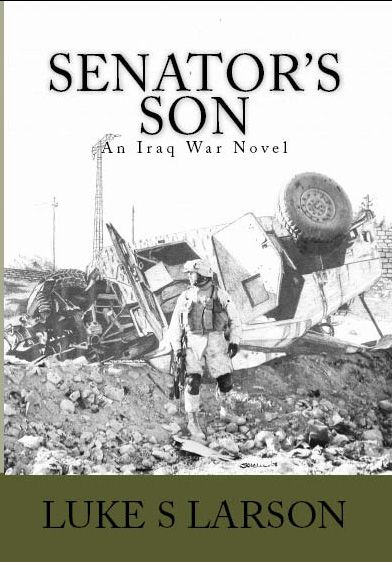
Review: Senator’s Son by Larson

Monday, March 15th, 2010

larson.jpg

Senator’s Son: An Iraq War Novel by Luke S. Larson

Fiction is not a genre that I usually review here, or get an opportunity to read often, but I received a courtesy review copy of a book Senator’s Son, by Iraq war vet, Marine officer and new novelist Luke Larson and was curious. The Iraq War and the War on Terror have produced a fine array of thoughtful books by veterans, war reporters and military thinkers like FiascoOne Bullet Away  and The Strongest Tribe, all of which were non-fiction memoirs, journalistic histories and quasi-policy books. By virtue of writing Senator’s Son as a novel, Larson was taking a different path in explaining his war.

There are two books at once in Senator’s Son. The first, is of course, a story, with characters and a plot and rising action, action, tragedy and theme – all the usual aspects of literature which I am not especially practiced at evaluating here. The second part is a contextual explanation of COIN by an author who lived the Iraq War. To his credit, Larson contacted me personally to request a “No bulls**t review”, so I will give the man what he asked for.

As an explanation of COIN, I think the book is a must read for anyone unfamiliar with the subject and the nuanced complexities that COIN entails. The gritty, unforgiving, human suffering and moments of triumph of soldiers waging “pop-centric” COIN that gets lost in powerpoint slides, in the dry abstractions of journal articles and blogospheric arguments far removed from the ground is present in ample measure in Senator’s Son. Many times, I paused in a passage and thought, “hmmm….I did not consider that”. Or “This is what the soldiers bear up under without complaint”. More people need to read that and digest what we ask of our men and women in Iraq and Afghanistan.

Senator’s Son also lays out, fairly methodically, how COIN theory may have been interpreted and debated by soldiers outside the wire, including cameo appearances or mention of real life COIN leaders woven into the story. The characters Bama, Cash, Rogue, Isaac, Gonzo the Iraqi and more, resist and adapt, struggling with their environment, unseen enemies and the political pressures of higher authorities, registering both frustration and progress in executing the mission of Golf Company. There’s even diagrams. If Senator’s Son is not on official COIN reading lists, it should be.

As a pure novel, judged on literary standards, Senator’s Son reflects its’ status as a “first novel” of a talented author whose vision of the craft is emerging. Larson excels at creating scenarios, staccato vignettes for the characters to act ( Larson may also have a future as a screenwriter – his book naturally flows in the mind like a movie). There’s always a believable, environmental, “texture” present that exceeds that of short story and science fiction writers, yet as a novelist, Larson leaves enough to the reader’s imagination so that the story moves at a dramatic pace.

Characterization in Senator’s Son is uneven. It takes a while for the individual personalities of the characters to shine beyond their common “Marine-ness” and we get only the briefest glimpse of the malign nature of the enemy, and that secondhand through the eyes of an Iraqi character. That probably is an accurate representative of the experience of most US soldiers and Marines in Iraq who are not interrogators; furthermore, having the antagonist that the characters struggle against be the total environment is perfectly legitimate. It would have been interesting for me to have seen how Larson would develop and utilize a figure who was the focus of evil; however that task would be fairly incompatible with getting an effective message across regarding COIN, success of which does not hinge on the defeat of super-villains or the resolution of black-white moral absolutes but is complexity written in shades of gray.

Finally, as an avid reader, I found Senator’s Son to be a page-turner. Several times, I looked at the clock while reading for what seemed to me a short time, noted it was 1:30 am and was regretful that I had to put it on my bedstand ( I always finished the chapter first though 🙂 ) only to repeat the process the following night.  Strongly recommended.

ADDENDUM – OTHER REVIEWS of SENATOR’S SON by:

Thomas P.M. Barnett 

Shrinkwrapped 

Shane Deichman

Mackinlay’s Insurgent Archipelago & Other Books

Tuesday, March 9th, 2010

The Insurgent Archipelago by John Mackinlay

At the strong recommendation of Colonel Gian Gentile, I ordered The Insurgent Archipelago: From Mao to Bin Laden by Dr. John Mackinlay of King’s College, London and a hardcover copy just arrived this afternoon. Judging from the table of contents and the sources in Mackinlay’s endnotes, The Insurgent Archipelago will present a tightly written argument on the nature of COIN. For a well regarded  and informative review, see David Betz of Kings of War blog, brief excerpt below:

Review: The Insurgent Archipelago

….The book is sweeping, as the subtitle ‘From Mao to Bin Laden’ suggests; yet it is also admirably succinct at 292 pages including notes and index.[2] In design it is exceedingly clear, consisting of three parts-‘Maoism’, ‘Post-Maoism’, and ‘Responding to Post-Maoism’, which reflect the basic components of his argument. Insurgency’s classical form is the brainchild of the carnivorously ambitious strategic and political genius Mao Zedong who gave meaning to the now familiar bumper sticker that insurgency is ’80 per cent political and 20 per cent military’. Mao’s innovation was to figure out what to fill that 80 per cent with: industrial scale political subversion by which he was able to harness the latent power of an aggrieved population to the wagon of political change, to whit the victory of the Chinese Communist Party in the Chinese Civil War which ended with the proclamation of the People’s Republic of China in 1949

….The problem is that what we now face in the form of ‘global insurgency’ is not Maoism but Post-Maoism-a form of insurgency which differs significantly from that which preceded it.[6] We have, in essence, been searching for the right tool to defeat today’s most virulent insurgency in the wrong conceptual tool box. This is perhaps the most uncomfortable truth to be laid out in this book; another worrying one is that the security interests of Western Europe differ markedly from those of the United States-because the threat in the former emerges from their own undigested Muslim minorities which are alienated further by their involvement in expeditionary campaigns which, arguably at least, serve the needs of the latter well enough

Oddly, this will be the second book by a former British Gurkha officer that I’ve read in the last six months; the first being The Call of Nepal: My Life In the Himalayan Homeland of Britain’s Gurkha Soldiers by Colonel J.P. Cross, which I played a minor role in getting reissued here by Nimble Books, along with Lexington Green. After just thumbing through a few pages, Dr. Mackinlay already strikes me as a far less mystically inclined military author than does the esteemed but eccentric Colonel Cross.

I am way behind in my book reviews. Fortunately, Charles Cameron is stepping up with a new series of posts this week, which will give me some time to write reviews at least for Inside Cyber Warfare: Mapping the Cyber Underworld and Senator’s Son: An Iraq War Novel and then read Mackinlay. Ah, this designated guest blogger business is proving to be most convenient! 🙂

Tools vs. Strategies: Or, Why “An” Alternative to COIN is Not “THE” Alternative

Friday, February 12th, 2010

Dr. Bernard I. Finel has an important and provocative article in AFJ challenging the current operational primacy of COIN in Afghanistan and Iraq that has stirred a great deal of backchannel and listserv discussion, but not nearly enough open commentary in the blogosphere. I checked an unscientific sampling of COIN blogs and did not find much discussion of Dr. Finel’s article, except one comment at SWJ Blog by respected SWC member Ken White, who called it  a “well stated and logical essay” with a “valid premise”. Finel’s article merits greater attention and debate:

An alternative to COIN

The U.S. military is a dominant fighting force, capable of rapid global power projection and able to defeat state adversaries quickly and at relatively low cost in American lives and treasure. Unfortunately, American leaders are increasingly trying to transform this force into one optimized for counterinsurgency missions and long-term military occupations. A fundamental problem with the adoption of population-centric counterinsurgency (COIN) doctrine as an organizing principle for American military operations is that it systematically fails to take advantage of the real strengths of the U.S. military.

It is true that not all political goals are achievable through the use of conventional military capabilities. However, “victory” in war is not dichotomous, and the cases of Iraq and Afghanistan – often seen as proving the necessity for COIN-capable forces as well as a commitment to nation-building – demonstrate in reality that the vast majority of goals can be accomplished through quick, decisive military operations. Not all political goals are achievable this way, but most are and those that cannot be achieved through conventional operations likely cannot be achieved by the application of even the most sophisticated counterinsurgency doctrine either.

As a consequence, I believe the U.S. should adopt a national military strategy that heavily leverages the core capability to break states and target and destroy fixed assets, iteratively if necessary. Such a strategy – which might loosely be termed “repetitive raiding” – could defeat and disrupt most potential threats the U.S. faces. While America’s adversaries may prefer to engage the U.S. using asymmetric strategies, there is no reason that the U.S. should agree to fight on these terms.

This essay argues the U.S. can largely defeat threats using conventional capabilities, and that what encourages a desire to engage in long-drawn-out asymmetric conflicts is not the elimination of threats, but rather the unattainable goal of trying to prevent threats from emerging in the future.

Read the rest here.

First, I have some sympathy with Finel’s position that COIN operations generally do not maximize the utility of America’s military comparative advantages and extended nation-building via COIN is a costly investment. Dr. Finel is correct here. I’m certain even David Kilcullen would agree with Finel that America trying to do heavy footprint, pop-centric COIN everywhere and anywhere is unwise and too expensive. We need to sync our military might with our political will as well as our wallet.

Secondly, I have no problem with punitive expeditions, or what Finel euphemistically calls “repetitive raiding”. Such “Perdicaris Alive or Raisuli Dead!” tinged operations are as old as warfare itself and a state’s demonstrated willingness to carry them out serves a useful deterrent purpose. William Lind has been advocating a combination of punitive expeditions and containment/isolation for years in his writings on 4GW. This is an option we should definitely consider first in a cost-benefit fashion prior to committing sizable deployments of troops to a long-term nation building adventure.

That said, exchanging one operatiuonal emphasis (COIN) for another (punitive expeditions) does not change our strategic situation much, it just represents a different kind of hammer, a mallet instead of a ball peen. Under Finel’s prospective doctrine, the US military will be greenlighted to fight only the wars it likes best because some foes are more targetable than others, resembling a drunkard looking for his car keys under a street lamp because that is where the light is good. If we can just convince all of our enemies to oblige us by becoming states with flags, armies and capitols, then I’d say junk COIN.

Unfortunately, they won’t and the days when only states can cause damage are long past. A well-trained, paramilitary, insurgency can wreck one hell of a lot of damage, especially when it is striking first with the element of surprise. This is why, even in the state-centric days of the Cold War, that the Soviet Union invested heavily in SPETSNAZ, OSNAZ and various GRU sleeper units to wreck havoc behind NATO lines with terrorism, assassination and sabotage in the run up to WWIII. The Soviets expected at least major tactical, if not strategic, results from such units.

Operational tools are not strategies. This was my prior complaint about COIN being oversold in Afghanistan and punitive expeditions likewise do not fit every geopolitical situation and work best with particular circumstances. The fact is, where we have a real national interest in friendly states with legitimate governments beating back insurgents, COIN is a better choice. Many problems will require a response that is altogether different from either. The enemy, when there is an enemy, has to be dealt with as they are and not as we’d really like them to be in our ten year procurement schedule. We have to select the tools that best fit operational conditions, our policy objectives and our resources.

Strategy must conform to reality and not the reverse.


Switch to our mobile site
