zenpundit.com » islam.insurgency

Archive for the ‘islam.insurgency’ Category

Khan on Taliban Warfare

Friday, April 2nd, 2010

I take a very skeptical position toward America’s alliance with Pakistan, whose elite, to put it as charitably as I can, have a myopic policy toward the Taliban and Islamist extremist groups. That said, the DoD has in previous decades, had standing mil-mil exchanges with Pakistan’s Army that were usually better and far more productive than our diplomatic relationship with Islamabad  ( a situation that is mirrored in Latin American relations). This tradition generally involves talented Pakistani officers partaking in training and educational programs with their American counterparts or studying in our war colleges.

Going back through recent articles at SWJ leads me to recommend the following judicious analysis of the Taliban by LTC. Ehsan Mehmood Khan, currently a student at National Defense University. It’s an excellent survey of the Taliban’s strengths at formulating and implementing their political-military strategy within the context of different strategic schools of thought and it should have attracted more attention than it received when it was first published at SWJ Blog.

 A Strategic Perspective on Taliban Warfare

Taliban Warfare has occupied news headlines in the global information expanse for over a decade. It is also a topic of choice for academics and scholars. However, the subject is often viewed and analyzed in a subjective rather than objective manner. It is mostly looked at across the prism of terrorism – atrocities and crimes against humanity committed by a group of non-state, though not stateless, bandits. Seldom has a theorist or practitioner picked up the pen to draw on the military aspects of the war so as to reach correct conclusions as to how could this war come to an acceptable-by-all end. This line of thought and reasoning might hold good for a given category of politicians but the students of military strategy and those involved in kinetic operations in a counterinsurgency campaign remain bewildered on the nature of the war. There is a need to understand Taliban as people, not monster, and as warriors not gangsters. Likewise, Taliban Warfare is required to be understood in correct military perspective rather than a mere act of crime, terrorism or banditry.

Cameron on Conflicts of Commands, Part III. – A Guest Post Series

Tuesday, March 16th, 2010

Charles Cameron, my regular guest blogger, is the former Senior Analyst with The Arlington Institute and Principal Researcher with the Center for Millennial Studies at Boston University. He specializes in forensic theology, with a deep interest in millennial, eschatological and apocalyptic religious sects of all stripes.  Here is part III. of a three part series by Charles, entitled “CONFLICT OF COMMANDS”.

Conflict of Commands III: Two pre-Hasan documents

by Charles Cameron

In my research on the topic of “conflict of commands” I ran across two documents from October and November of 2001 which make for interesting reading in the wake of Major Hasan’s slide presentation and the Fort Hood shooting.

The first is a MEMRI post, and hence both copyrighted and readily available on the web. It s titled Terror in America (23) Muslim Soldiers in the U.S. Armed Forces in Afghanistan: To Fight or Not to Fight? and dated November 7, 2001, and the intro paragraph reads as follows:

As soon as the U.S. geared up for the war against the Taliban regime in Afghanistan, Muslim military personnel in the American armed forces began to deal with the question of the religious permissibility of their participation in battle. Army Chaplain Capt. Abd Al-Rasheed Muhammad, the Imam of Walter Reed Army Medical Center in Washington, D.C. sent an inquiry on the matter to the North American Fiqh (Islamic Jurisprudence) Council, which in turn referred the matter to clerics in the Arab world. The clerics issued a Fatwa permitting Muslim soldiers to take part in the fighting if there was no alternative, and the council delivered the ruling to Capt. Muhammad. But on October 30, the editor of the Arabic London daily Al-Sharq Al-Awsat reported that the clerics who signed this Fatwa had changed their minds and abrogated their previous Fatwa with a new one prohibiting participation of Muslim soldiers in the war in Afghanistan.

The rest you can read on the MEMRI site.

The second document was actually posted a little earlier on the State Department site, although it is no longer available there. Dated 16 October 2001 and titled U.S. Islamic Leaders Issue Fatwa on U.S. Muslim Soldiers Fighting Terrorists, as far as I can determine, it is currently only present (outside of archive.org) on the Department’s Jakarta site.

Interestingly enough, this document also includes a quote from another person whose name has been much in the news in connection with Islamism: Chaplain Yee — the Chinese-American US Army Chaplain who ministered to the Muslim inmates at Guantanamo Bay, was charged in 2003 with sedition, espionage and other crimes, and held in a Navy brig until all charges against him were dropped. Yee is quoted as saying back in 2001 that “Muslims on his base have come to him with worries about being ordered to fight Muslims overseas”.

I think this document is worth reposting in full, and would simply note my surprise that neither this official State Department statement nor the MEMRI document appears to have formed part of any discussion of the Fort Hood incident in open source materials that I have seen. I hope the IC is doing better in this regard — but if these materials have been overlooked by the relevant classified inquiries too, I wonder whether this might not be yet another result of the sort of thing Gregory Treverton comments on in his 2009 paper “Bridging the Divide between Scientific and Intelligence Analysis” from the Center for Asymmetric Threat Studies, Swedish National Defense College:

Analysts do not have the freedom to explore issues by pursuing them down the rabbit hole, so to speak. There is a hard andfast process in place that determines what they look at, when, and in some cases, to what end.

*U.S. Islamic Leaders Issue Fatwa on U.S. Muslim Soldiers Fighting Terrorists:

*

U.S. Muslim soldiers need to defend their country and combat terrorism
By Phillip Kurata
Washington File Staff Writer
16 October 2001

Washington — Two prominent Islamic scholars in the United States have issued a fatwa, or legal opinion, on the importance of American Muslims serving in the U.S. military to defend their country and combat terrorism.

“All Muslims ought to be united against all those who terrorize the innocents, and those who permit the killing of non-combatants without a justifiable reason. The Muslim soldier must perform his duty in this fight despite the feeling of uneasiness of ‘fighting without discriminating.’ His intention must be to fight for enjoining of the truth and defeating falsehood. It’s to prevent aggression on the innocents, or to apprehend the perpetrators and bring them to justice,” the fatwa reads.

It was written by Taha Jabir Al-Alawani, President of the Fiqh Council of North America and President of the Graduate School of Islamic and Social Sciences, and Sheikh Muhammad Al-Hanooti, a member of the fiqh council. The two Islamic scholars issued their legal opinion in response to a query submitted by Chaplain Abdul-Rashid Muhammad, the most senior Muslim chaplain in the U.S. military, who sought guidance on the permissibility of U.S. Muslim servicemen to participate in the war effort in Afghanistan and other Muslim countries.

“Muslims are part of the American society. Anyone who feels he’s fighting in a just war must fight,” Al-Alawani said.

“We abide by every law of this country except those laws that are contradictory to Islamic law,” said Sheikh Al-Hanooti. The sheikh added that U.S. Muslim military personnel may refuse to fight on the grounds of conscientious objection.

“If any Muslim serving in the U.S. Armed Forces has a conscientious objection to combat and believes that it is against Islamic principles to fight in any war, then that individual has the right to stand by his or her concience,” Al-Hanooti said. “They realize, of course, that they may be administratively separated from the military as a result of their choice.”

Muhammad, who is stationed at the Walter Reed military hospital in Washington, says there is no conflict between being a loyal soldier and a loyal Muslim. He is helping some Muslim American servicemen deal with their qualms about fighting terrorists who claim to represent Islam.

“It is time now for us to not only wake up, but speak up,” Muhammad said in a recent interview. “The prophet said when we see evil action we are compelled to change it with our hand, challenge it with our tongue or at least hate it in our heart.”

Muhammad, an African American who was raised as a Baptist, became the first Muslim chaplain in the U.S. military in 1993. Until then, all the 3,150 U.S. military chaplains were either Jews or Christians. In 1996, a second Muslim chaplain was commissioned by the Navy. Since then the number of Muslim chaplains in the U.S. military has grown to 14.

Qaseem Uqdah, a Marine Corps veteran who is executive director of the American Muslim Armed Forces and Veteran Affairs Council, said the Muslim military chaplains include Muslims who were born into the faith in Asia, Africa and the Middle East and Muslim converts, who include several African Americans, an Anglo-American and a Chinese American. Uqdah’s group has been selected by the U.S. military to recommend people as Muslim chaplain candidates.

U.S. military officials say a shortage of candidates with the required education limits the number of Muslim military chaplains. Three Muslim chaplains are currently being trained at the Hartford Seminary in Connecticut.

The newest Muslim chaplain is James Yee, a Chinese American and a graduate of the West Point military academy, who was born into a Lutheran family. He became interested in Islam while a student and later spent four years studying Arabic and Islam in Damascus, Syria. Currently he serves with the 29th Signal Battalion at Fort Lewis, Washington.

Chaplain Yee said that Muslims on his base have come to him with worries about being ordered to fight Muslims overseas.

“An act of terrorism, the taking of innocent civilian lives is prohibited by Islam, and whoever has done this needs to be brought to justice, whether he is Muslim or not,” Chaplain Yee said.

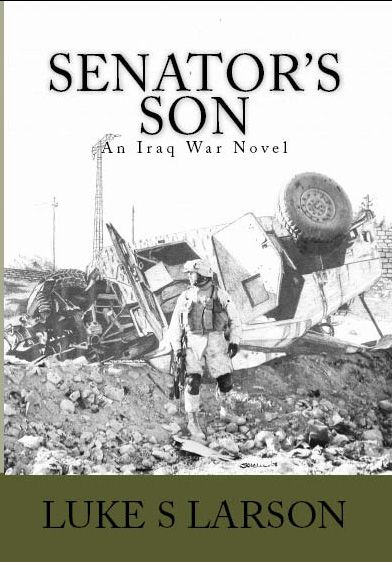
Review: Senator’s Son by Larson

Monday, March 15th, 2010

larson.jpg

Senator’s Son: An Iraq War Novel by Luke S. Larson

Fiction is not a genre that I usually review here, or get an opportunity to read often, but I received a courtesy review copy of a book Senator’s Son, by Iraq war vet, Marine officer and new novelist Luke Larson and was curious. The Iraq War and the War on Terror have produced a fine array of thoughtful books by veterans, war reporters and military thinkers like FiascoOne Bullet Away  and The Strongest Tribe, all of which were non-fiction memoirs, journalistic histories and quasi-policy books. By virtue of writing Senator’s Son as a novel, Larson was taking a different path in explaining his war.

There are two books at once in Senator’s Son. The first, is of course, a story, with characters and a plot and rising action, action, tragedy and theme – all the usual aspects of literature which I am not especially practiced at evaluating here. The second part is a contextual explanation of COIN by an author who lived the Iraq War. To his credit, Larson contacted me personally to request a “No bulls**t review”, so I will give the man what he asked for.

As an explanation of COIN, I think the book is a must read for anyone unfamiliar with the subject and the nuanced complexities that COIN entails. The gritty, unforgiving, human suffering and moments of triumph of soldiers waging “pop-centric” COIN that gets lost in powerpoint slides, in the dry abstractions of journal articles and blogospheric arguments far removed from the ground is present in ample measure in Senator’s Son. Many times, I paused in a passage and thought, “hmmm….I did not consider that”. Or “This is what the soldiers bear up under without complaint”. More people need to read that and digest what we ask of our men and women in Iraq and Afghanistan.

Senator’s Son also lays out, fairly methodically, how COIN theory may have been interpreted and debated by soldiers outside the wire, including cameo appearances or mention of real life COIN leaders woven into the story. The characters Bama, Cash, Rogue, Isaac, Gonzo the Iraqi and more, resist and adapt, struggling with their environment, unseen enemies and the political pressures of higher authorities, registering both frustration and progress in executing the mission of Golf Company. There’s even diagrams. If Senator’s Son is not on official COIN reading lists, it should be.

As a pure novel, judged on literary standards, Senator’s Son reflects its’ status as a “first novel” of a talented author whose vision of the craft is emerging. Larson excels at creating scenarios, staccato vignettes for the characters to act ( Larson may also have a future as a screenwriter – his book naturally flows in the mind like a movie). There’s always a believable, environmental, “texture” present that exceeds that of short story and science fiction writers, yet as a novelist, Larson leaves enough to the reader’s imagination so that the story moves at a dramatic pace.

Characterization in Senator’s Son is uneven. It takes a while for the individual personalities of the characters to shine beyond their common “Marine-ness” and we get only the briefest glimpse of the malign nature of the enemy, and that secondhand through the eyes of an Iraqi character. That probably is an accurate representative of the experience of most US soldiers and Marines in Iraq who are not interrogators; furthermore, having the antagonist that the characters struggle against be the total environment is perfectly legitimate. It would have been interesting for me to have seen how Larson would develop and utilize a figure who was the focus of evil; however that task would be fairly incompatible with getting an effective message across regarding COIN, success of which does not hinge on the defeat of super-villains or the resolution of black-white moral absolutes but is complexity written in shades of gray.

Finally, as an avid reader, I found Senator’s Son to be a page-turner. Several times, I looked at the clock while reading for what seemed to me a short time, noted it was 1:30 am and was regretful that I had to put it on my bedstand ( I always finished the chapter first though 🙂 ) only to repeat the process the following night.  Strongly recommended.

ADDENDUM – OTHER REVIEWS of SENATOR’S SON by:

Thomas P.M. Barnett 

Shrinkwrapped 

Shane Deichman

Reflecting on Neo-COIN and the Global Insurgency, Part II.

Thursday, March 11th, 2010

Previously, I took a look at an academic paper by David Martin Jones and M.L.R. Smith that engaged in a critical analysis of COIN theory and found fault with its underlying premises. Now, I would like to examine the rebuttal offered by John Nagl and Brian Burton of CNAS.

David Martin Jones* and M.L.R. Smith**. “Whose Hearts and Whose Minds? The Curious Case of Global Counter-Insurgency”. The Journal of Strategic Studies. Vol. 33, No. 1, 81-121, February 2010.

*University of Queensland, Australia. ** King’s College London, UK.

John A. Nagl and Brian M. Burton. “Thinking Globally and Acting Locally: Counterinsurgency Lessons from Modern Wars – A Reply to Jones and Smith.  The Journal of Strategic Studies. Vol. 33, No. 1, 123-138, February 2010.

Center for New American Security (CNAS), Washington, DC, USA.

The rebuttal of Nagl and Burton, at a mere 15 pages including bibliography, was a more persuasive and focused argument than the COIN opus offered by Jones and Smith. Their tone was less academic and more practitioner-oriented, both in terms of policy shapers and soldiers in the field. Strategist Dr. Thomas P.M. Barnett, thought the entire debate was “too inside baseball” but nonetheless, that Nagl and Burton had the better of the exchange:

It is a sadly ghettoized argument–very inside baseball. And I am dismayed to see it happening in a sub-field that should be more inclusive than the usual war-discussed-within-the-context-of-war with the added dimension of the fight for political control in developing/failed economies (the whole national liberation bit, references to Maoism, etc.). So we’re still basically treated to two legs of the stool: security with the addition of politics/culture, but the economics remains a no-go-land that elicits the mention of jobs on occasion (the assumption usually being, public-sector financed with aid), but that’s it.

….I thought Nagl’s closing comment in response was fine: difference in degree but not kind. The first article reminded me of nuclear targeting theory, it was so esoterically wrapped around itself.

The intellectual insularity to which Tom complains arguably stems from COIN, an operational doctrine, being required to “pinch-hit” as a long-term strategy due to the abdication of responsibility by the civilian political elite to come to a strategic consensus among themselves on the war that would frame our global conflict with radicalized Islamist terror groups and insurgencies and enunciate the objectives we hope to achieve.

This unwillingness or inability of deeply divided USG civilian leaders to effectively, coherently and consistently articulate the nature of the war itself and our adversaries deprives our senior military leaders of appropriate policy guidance in designing campaigns and carrying out military operations. It is also a partial explanation for the determined resistance of COIN policy advocates like John Nagl and David Kilcullen to address the religious ideology dimension raised by Jones and Smith.

In “Thinking Globally and Acting Locally: Counterinsurgency Lessons from Modern Wars – A Reply to Jones and Smith”, Burton and Nagl firmly showcase “Neo-COIN’s” formidibile strengths as policy but cannot escape its’ enduring weakness. Here most concisely:

“Insurgencies, like other forms of armed conflict are better defined by methodologies than by ideologies. While causes change regularly, the fundamentals of insurgent strategy remain relatively constant”

A powerful throwing down of the theoretical gauntlet. It’s an appealing argument rooted in pragmatism, and to some degree, empiricism, becoming more true as one moves down to the level of small unit counterinsurgency and outward from jihadism’s core leadership toward insurgency’s marginal adherents of convenience, the “$10 a day Taliban” and Kilcullen’s “accidental guerrillas”. While it is the case that occasionally in COIN we have actions of “strategic corporals”, most of the warfighting concerns of NCO’s and junior officers will be tactical and eminently practical a majority of the time.

Earlier, Burton and Nagl expounded at greater length and specificity:

But this argument [by Jones and Smith] overemphasizes the superficial features of conflict. While specific characteristics of individual insurgencies have changed with local conditions and the technology of the day, the fundamental dynamics of insurgency remain largely the same. The essential competition remains between the existing power and the insurgents for influence and ultimately control over populations. The insurgent ’cause’, of which extremist religion can be a component, is generalized and malleable in order to mobilize the broadest possible base of followers.

….the fundamental dynamic of any insurgency is that, as David Kilcullen aptly describes, it needs the people to act in certain ways.[It] needs their sympathy, acquiescence and silence, or simply their reactions to provocation, in order to further [its] strategy

[Emphasis in original.]

There are pros and cons to this theoretical position. It is always a good idea to consider who an intended doctrine is written for; instrumentally, COIN doctrine is foremost for the soldiers who are expected to wage that kind of battle on the behalf of the rest of us. Only secondarily, is COIN doctrine intended as a kind of policy talisman for the government officials, politicians, journalists, academics and bloggers whom it has entranced or repelled. It is important to remember, it critiquing the evolving panoply that is USG COIN policy that the fundamental criterion of measurement is not theoretical niceties but real world results, which have been produced. Not perfection, not instantly, not everything we want plus a pony too, but progress in operational and tactical success. Even some strategic success if stabilization of an Iraqi government holds That weighs heavily on the pro side of the ledger.

The cons are of a different nature.

First, in terms of the Maoist paradigm, classical COIN theory is problematic because it extrapolates only from a very short period of Mao’s career as a guerrilla leader, mostly 1946 -1949 when the political dynamic in China’s civil war was a bilateral conflict between Chiang Kai-shek’s Nationalist government and Mao ZeDong Communist Party and Red Army. This was a period when Mao, courtesy of the Soviets, had suddenly inherited a great quantity of Japanese arms and could field divisions of semi-regulars to fight conventional battles in addition to insurgent units. Most of China’s long civil war was actually heterogeneously anarchic and Mao’s Communist armies were usually much inferior not only to those of the Kuomintang, but to those armies fielded by many provincial warlords and certainly inferior to the invading Imperial Japanese Army, which Mao strove to avoid fighting whenever possible. Much of Mao’s legend as a military genius is political myth constructed after the fact, and his ultimate success in China owed at least as much to Chiang, Hirohito, Stalin and Truman as it did to Mao’s real but frequently exaggerated political and military talent for insurgency.

Vietnam, another historical touchstone of COIN, acheived the bilateral conflict dynamic described in COIN theory only because initially the Vietcong, on the orders of Hanoi, tacitly supported Ngo Dinh Diem’s regime by eschewing military activities while Diem and Nhu systematically destroyed or weakened other potential military/political rivals to the Communists in South Vietnam. Namely, General Ba’s Hoa-Hao, the Binh Xuyen gangs and the Buddhist political clergy ( the Vietnamese Nationalist Party had previously been decimated by the French in 1930). Russia after WWI, Lebanon in the 1980’s, Somalia, Afghanistan and the Congo in the 1990’s are others examples of societies devolving into anarchic, social darwinian, violence before some became conflicts that are somewhat recognizable in COIN theory.

The heterodox Iraqi insurgency of the “surge”, where Neo-COIN found its proving ground, is really the recent historical rule and not the exception that classical Maoist COIN theory might lead you to believe. The theory in other words, is based upon flawed premises of a bilateral conflict. John Robb’sopensource insurgency” concept gets closer to the probable reality of future COIN wars.

Secondly, the strong dismissal of religious drivers by Nagl under his “Kilcullen Doctrine” is tailor made for “disaggregating” the accidental guerrillas at the tactical level, but it seriously misleads us in understanding or effectively countering the “professional guerrillas” at the strategic or the moral levels of war. Instead, it blinds us by projecting our own elite culture’s secular assumption of religion as merely a cynical and antiquated facet of politics on to adversaries for whom such thought is both fundamentally alien and entirely blasphemous. Such a position is what ideologists of  jihad  argue that they are taking up arms against in the first place.

Erasing the religious or ideological motivation makes incisive analysis of the adversaries strategic decision-making impossible because it removes the driver for which he left home, comfort, family for the danger and privation of war. How can we walk in our enemies shoes, get inside his head, if we deny what is in his head has any relevance?

This position makes no sense on the strategic level. Ignoring the influence of Islamism is a prescription for errors and missed opportunities. It is a politically comfortable position for COIN theorists because our political elite are deeply enamored of a PC ideology that provides an excuse to punish and destroy the careers of officials who challenge the orthodoxy of multiculturalism with frank discussion of facts. Avoiding the question of Islamism in front of politicians greases the skids for COIN. Have you heard many members of Congress make a robust defense of liberal, democratic, capitalist, open societies as a morally superior alternative to autocratic Islamism lately? No? Well now you understand why the COIN gurus are not doing it either. Powerful people in Washington and the media do not want to hear thart message.

Yet without confronting Islamism and the attraction of its call to a dissatisfied “pious middle class” in the Islamic world, we can hardly hope to bring the war to a satisfactory close, much less victory.
Mackinlay’s Insurgent Archipelago & Other Books

Tuesday, March 9th, 2010

The Insurgent Archipelago by John Mackinlay

At the strong recommendation of Colonel Gian Gentile, I ordered The Insurgent Archipelago: From Mao to Bin Laden by Dr. John Mackinlay of King’s College, London and a hardcover copy just arrived this afternoon. Judging from the table of contents and the sources in Mackinlay’s endnotes, The Insurgent Archipelago will present a tightly written argument on the nature of COIN. For a well regarded  and informative review, see David Betz of Kings of War blog, brief excerpt below:

Review: The Insurgent Archipelago

….The book is sweeping, as the subtitle ‘From Mao to Bin Laden’ suggests; yet it is also admirably succinct at 292 pages including notes and index.[2] In design it is exceedingly clear, consisting of three parts-‘Maoism’, ‘Post-Maoism’, and ‘Responding to Post-Maoism’, which reflect the basic components of his argument. Insurgency’s classical form is the brainchild of the carnivorously ambitious strategic and political genius Mao Zedong who gave meaning to the now familiar bumper sticker that insurgency is ’80 per cent political and 20 per cent military’. Mao’s innovation was to figure out what to fill that 80 per cent with: industrial scale political subversion by which he was able to harness the latent power of an aggrieved population to the wagon of political change, to whit the victory of the Chinese Communist Party in the Chinese Civil War which ended with the proclamation of the People’s Republic of China in 1949

….The problem is that what we now face in the form of ‘global insurgency’ is not Maoism but Post-Maoism-a form of insurgency which differs significantly from that which preceded it.[6] We have, in essence, been searching for the right tool to defeat today’s most virulent insurgency in the wrong conceptual tool box. This is perhaps the most uncomfortable truth to be laid out in this book; another worrying one is that the security interests of Western Europe differ markedly from those of the United States-because the threat in the former emerges from their own undigested Muslim minorities which are alienated further by their involvement in expeditionary campaigns which, arguably at least, serve the needs of the latter well enough

Oddly, this will be the second book by a former British Gurkha officer that I’ve read in the last six months; the first being The Call of Nepal: My Life In the Himalayan Homeland of Britain’s Gurkha Soldiers by Colonel J.P. Cross, which I played a minor role in getting reissued here by Nimble Books, along with Lexington Green. After just thumbing through a few pages, Dr. Mackinlay already strikes me as a far less mystically inclined military author than does the esteemed but eccentric Colonel Cross.

I am way behind in my book reviews. Fortunately, Charles Cameron is stepping up with a new series of posts this week, which will give me some time to write reviews at least for Inside Cyber Warfare: Mapping the Cyber Underworld and Senator’s Son: An Iraq War Novel and then read Mackinlay. Ah, this designated guest blogger business is proving to be most convenient! 🙂


Switch to our mobile site

