zenpundit.com » islam.insurgency

Archive for the ‘islam.insurgency’ Category

Book Review: A Terrorist’s Call to Global Jihad

Thursday, December 29th, 2011
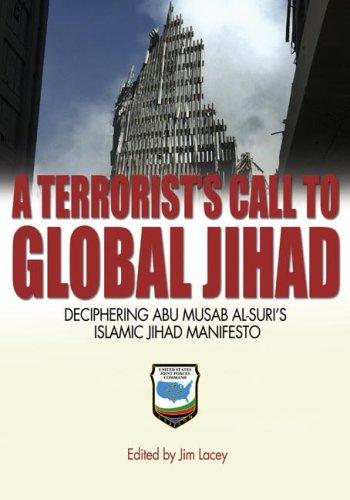
A Terrorist’s Call to Global Jihad: Deciphering Abu Musab al-Suri’s Islamic Jihad Manifesto by Jim Lacey (Ed.)

Previously, I read and reviewed Brynjar Lia’s Architect of Global Jihad, about Islamist terrorist and strategist Abu Musab al-Suri. A sometime collaborator with Osama bin Laden and the AQ inner circle, a trainer of terrorists in military tactics in Afghanistan and an advocate of jihadi IO, al-Suri was one of the few minds produced by the radical Islamist movement who thought and wrote about conflict with the West on a strategic level. Before falling into the hands of Pakistani security and eventually, Syria, where al-Suri was wanted by the Assad regime, al-Suri produced a massive 1600 page tome on conducting a terror insurgency,  The Global Islamic Resistance Call, which al-Suri released on to the jihadi darknet.

Jim Lacey has produced an English digest version of al-Suri’s influential magnum opus comprising approximately 10 % of the original  Arabic version, by focusing on the tactical and strategic subjects and excising the rhetorical/ritualistic redundancies common to Islamist discourse and the interminable theological disputation. There are advantages and disadvantages to this approach.

First, Lacey has produced a concise and readable book from a large mass of sometimes convoluted and repetitive theorizing that al-Suri strung together piecemeal, sometimes on the run or in hiding. For those interested in getting to the heart of al-Suri’s nizam la tanzim strategic philosophy, A Terrorist’s Call to Global Jihad is an invaluable resource for strategists, counter-terrorism specialists, tactical operators,  law enforcement and laymen. Secondly, it is also a useful reference for policy people to see through al-Suri’s eyes the internal political and philosophical divisions within the radical jihadi community. al-Suri himself writes very ambivalently about 9/11 as a great blow against America and yet a complete calamity in it’s effects for the “jihadi current” that destroyed everything the Islamist revolutionaries had so painstakingly built, including the Taliban Emirate. Thus a climate was created by the American counter-attack where old methods of struggle were no longer useful and jihadis must adopt radically decentralized operations ( what John Robb terms Open-Source Warfare; indeed it is clear to an informed reader that al-Suri, a wide-ranging intellectual rather than a narrow religious ideologue, was influenced by Western literature on asymmetric warfare, 4GW, Three Block War  and COIN).

The drawback to this approach is more for scholars looking at the deeper psychological and ideological drivers of jihadi policies, strategy and movement politics. The religious questions and obscure Quranic justifications cited by Islamist extremists that are so tedious and repetitive to the Western mind are to the jihadis themselves, of paramount importance in establishing both the credentials of the person making an argument but also the moral certainty of the course of action proposed. al-Suri himself had some exasperation with the degree to which primarily armchair ideologues, by virtue of clever religious rhetoric, could have more influence over the operational decisions of fighting jihadis than men with field experience like himself. By removing these citations, an important piece of the puzzle is missing.

The Musab al-Suri whose voice appears in A Terrorist’s Call to Global Jihad is consistent with the one seen in Lia’s book, dry, sardonic, coldly hateful toward the West and highly critical of the jihadis own mistakes, laden with overtones of pessimism and gloom. al-Suri did not envision a quick victory over the West and wrote his manifesto as a legacy for future generations of Islamist radicals because the current one was nearly spent after the American onslaught and poorly educated in comparison with predecessors like the generation of Sayid Qutb.

Strongly recommended.

Jihad for all Seasons: Review of Storming the World Stage (in PRAGATI)

Thursday, November 10th, 2011

Storming the World Stage: The Story of Lashkar-e-Taiba by Stephen Tankel

PRAGATI, India’s National Interest Review magazine has published my review of Dr. Stephen Tankel’s book on Lashkar-e-Taiba, titled Storming the World Stage. The article is not yet online (I will add the link when it is released) but the issue digest PDF version is below:

pragati-issue56-nov2011-communityed.pdf

“Jihad for all seasons”

….Carnegie and RAND scholar Stephen Tankel has endeavored to demystify and deconstruct LeT in his meticulously researched book, Storming The World Stage: The Story of Lashkar-e-Taiba and bring into the light the complex relationships that entwine LeT with the Pakistani state and the subterranean universe of radical jihadi politics.  Conducting extensive interviews with Islamist militants, Western and Indian intelligence officials, Pakistani politicians and ISI officers and buttressing his narrative with sixty-three pages of end-notes, Tankel has produced a portrait of Lashkar-e-Taiba that is accessible to the layman while remaining a methodical work of scholarship.

…. An organisation that, like Hezbollah, is state-sponsored but not controlled, Lashkar-e-Taiba is suited for waging what military analyst Frank Hoffman terms “Hybrid War”, but how LeT would play that role in an Indo-Pakistani War is left to the reader’s inference. LeT also demonstrated in Mumbai a fluid tactical excellence in its use of off-the-shelf technology, small arms and mobility to reap an enormous return-on-investment by attacking soft targets, much along the asymmetric lines advocated by warfare theorist John Robb. Tactics that are a critical threat to any open society by forcing it to take preventive measures which are ruinously expensive and contraindicated to keeping society free and democratic….

Will update post as matters develop.

A Multi-Disciplinary Approach?: Coerr’s The Eagle and the Bear Outline

Thursday, October 20th, 2011

Here is something for the learned readership to chew on.

As you are probably all aware, in the hard sciences it is common for research papers to be the product of large, multidiciplinary, teams with, for example, biochemists working with physicists, geneticists, bioinformatics experts, mathematicians and so on. In the social sciences and humanities, not so much. Traditional disciplinary boundaries and methodological conservatism often prevail or are even frequently the subject of heated disputes when someone begins to test the limits of academic culture

I’m not sure why this has to be so for any of us not punching the clock in an ivory tower.

The organizer of the Boyd & Beyond II Conference, Stan Coerr, a GS-15 Marine Corps, Colonel Marine Corps Reserve and Iraq combat veteran, several years ago, developed a very intriguing analytical outline of thirty years of Afghan War, which I recommend that you take a look at:

The Eagle and the Bear: First World Armies in Fourth World Insurgencies by Stan Coerr

the-eagle-and-the-bear-11.pdf

There are many potential verges for collaboration in this outline – by my count, useful insights can be drawn by from the following fields:

Military History
Strategic Studies
Security Studies
COIN Theory
Operational Design
Diplomatic History
Soviet Studies
Intelligence History
International Relations
Anthropology
Ethnography
Area Studies
Islamic Studies
Economics
Geopolitics
Military Geography
Network Theory

I’m sure that I have missed a few.

It would be interesting to crowdsource this doc a little and get a discussion started. Before I go off on a riff about our unlamented Soviet friends, take a look and opine on any section or the whole in the comments section.

Book Review: Architect of Global Jihad by Brynjar Lia

Thursday, August 18th, 2011

Architect of Global Jihad by Brynjar Lia

Architect of Global Jihad: The Life of al Qaida Strategist Abu Mus’ab al-Suri is Brynjar Lia’s definitive biography of the shadowy terror theorist, Islamist intellectual and sometime jihadi, Mustafa bin Abd al Qadir Sitt Maryam.

Sitt Maryam, who went by al-Suri in jihadi circles, was a red haired, fair-skinned Syrian renegade from the Muslim Brotherhood who was trained in military tactics and explosives in Saddam Hussein’s terrorist camps, passing on his skills to fellow “Arab Afghans” during and after the Soviet War. Attracted to secular military theory, guerrilla warfare tactics and strategy rather than theological disputes, hating the West but despising Salafist radicals, Lia’s Abu al-Suri is an isolated and anomalous figure in “the jihadi current” of the 1990’s and post-9/11 era.


“A born critic” with a grim and unsmiling demeanor who entangled himself in acrimonious personal feuds with leading jihadis, including Osama bin Laden, al-Suri failed to win many adherents to his insightful “system not organization” (nizam la tanzim) theory of jihad until his arrest caused his writings, especially his magnum opus The Global Islamic Resistance Call to go viral in the Islamist darknet.

A true intellectual, widely read in western literature and military writings, al-Suri crafted a stategy of jhad that adapted arguments of 4GW, “leaderless resistance” and classical Maoist insurgency to suit Islamist purposes and conditions while rejecting secret, hierarchical, organizations and al-Qaida’s “Tora Bora mentality” as historical failures. Self-radicalization and “sudden jihad syndrome” among alienated Western Muslims was the stuff from which al-Suri hoped to build a massively decentralized, open source, self-sustaining campaign of terrorism.

A hundred and forty some pages of text in Architect of Global Jihad are devoted exclusively to excerpts from al-Suri’s 1,600 page treatise on terrorism operations and strategy. He was a serious and determined opponent of Western civilization’s core values, despite having enjoyed long stretches of reasonably comfortable Western exile in Spain and “Londonistan” to such a degree that al-Suri was in no particular hurry to rejoin the jihad and even acquired the unenviable (and inaccurate) reputation of only being a “pen jihadi”.

Musab al-Suri, who is likely dead at the hands of Baathist jailers, is best described as an Islamist parallel to Vladimir Lenin before the Bolshevik Revolution. The similarities are striking, the irascible temperment, formidible intelligence, the frustrating politics of exiled revolutionary communities, the ideological marginalization both men endured as radicals in a community of already extreme activists and the embrace of terrorism (tactically in Lenin’s case, strategically in al-Suri’s). al-Suri and Lenin, despite wide ideological differences, as revolutionaries represent the psychological type Eric Hoffer termed “true believers” – pitiless, absolutely committed, intellectually rigid on matters of principle but tactically flexible and creative in terms of method.

Such men are dangerous, to themselves as well as to society.

Strong recommendation:

ADDENDUM:

Related posts on or including Abu Musab al-Suri

Lexington GreenAbu Musab al-Suri: Theorist of Modern Jihad and The Networked Jihad: Parasitic on Developed World Technology, Information, Ideas

Charles CameronA Terrorist’s Call to Global Jihad: Deciphering Abu Musab al-Suri’s Islamic Jihad Manifesto

John RobbSURI: nizam, la Tanzim (system, not organization) – Global Guerrillas

The Jamestown FoundationThe Jamestown Foundation: Al-Suri’s Adaptation of Fourth  , The Jamestown Foundation: Al-Suri’s Doctrines for Decentralized  and The Jamestown Foundation: Abu Mus’ab al-Suri and the Third

Jihadica Abu Mus`ab Suri: Architect of Global Jihad Neglected? and Training for the Lone Jihadi

The Hoover InstitutionThe Terror Fringe

New Book: Storming the World Stage by Stephen Tankel

Monday, August 15th, 2011

Storming the World Stage: The Story of Lashkar-e-Taiba by Stephen Tankel

I returned from Texas yesterday to find on my doorstep, a review copy of Storming the World Stage: The Story of Lashkar-e-Taiba by Carnegie scholar Stephen Tankel.  Mirv Irvine of CNAS describes it thusly:

…one of the definitive accounts of Lashkar’s rise as well as the 2008 Mumbai attacks, and his book should be the go-to-guide for those looking to understand Pakistan’s reliance on proxies against India and its attached baggage

Moreover, my co-blogger and expert on esoteric religious militancy, Charles Cameron has already expressed book envy of this review copy and covets it. Heh. With such strong endorsements, I am moving it to the top of the pile for immediate reading.


Switch to our mobile site