zenpundit.com » strategy

Archive for the ‘strategy’ Category

Thoughts on CNAS “Preparing for War in the Robotic Age”

Friday, January 24th, 2014

[by Mark Safranski, a.k.a. “zen“]

My reading at CNAS, which had once been frequent, declined with the waning of the Abu Muqawama blog. While formerly I usually scanned through CNAS reports on a regular basis after reading what Exum and his commenters had to say, toward the end I only visited when Adam and Dan had new posts up.

At the gentle nudging of Frank Hoffman, I decided to read the latest CNAS product;  I’m pleased to say with the release of ” 20YY:Preparing for War in the Robotic Age by Robert Work ( CNAS CEO and former Undersecretary of the Navy) and Shawn Brimley (CNAS Executive V.P. and former NSC Strategic Planning Director) CNAS has rolled out an intellectually provocative analysis on an important emerging aspect of modern warfare.

Work and Brimley have done a number of things well and did them concisely (only 36 pages) in “20YY”:

  • A readable summary of the technological evolution of modern warfare in the past half century while distinguishing between military revolutions,  military-technical revolution and the the 80’s-90’s  American “revolution in military affairs“.
  • .
  • A more specific drill-down on the history of guided munitions and their game-changing importance on the relationship between offense and defense that flourished after the Gulf War. 
  • .
  • An argument that the proliferation of technology and information power into the hands unfriendly states and non-state actors is altering the strategic environment for the United States, writing:
  • .
  • “Meanwhile in the 13 years since the last 20XX game, foreign nation-state C41, surveillance and reconaissance systems, and guided munitions-battle network capabilities have become increasingly capable.  Indeed, these systems now form the very robust and advanced “anti-access and area denial”  (A2/AD) capabilities envisioned in the 20XX game series. The effect has been that the dominance enjoyed by the United States in the late 1990’s/2000’s in the area of high end sensors, guided weaponry, space and cyberspace systems and stealth technology has started to erode. Moreover the erosion is now occurring at an accelerated rate.”
  • .
  • Positing the near-future global proliferation of unmanned, autonomous, networked and swarmed robotic systems replacing( and leveraged by diminishing numbers of) expensive manpower and piloted platforms on the battlefield and altering the age-old relationship between a nation’s population base and the traditional calculation of its potential military power.
  • .
  • An argument that “warfare in the robotic age” will mean substantial to fundamental shifts in strategic calculation of deterrence, coercion, the use of force, operational doctrines and the evolution of military technology and that the United States must prepare for this eventuality.

This report is well worth reading.  In my view there are some areas that require further exploration and debate than can be found in “20YY”. For example:

  • While the power of economics as a driver of unmanned, autonomous weapons is present, the implications are vastly understated. Every nation will face strategic investment choices between opting for simple and cheaper robotic platforms in mass and “pricing out” potential rivals by opting for “class” – fewer but more powerful, sophisticated and versatile robotic systems.
  • .
  • The scale of robot swarms are limited primarily by computing power and cost of manufactureand could be composed of robots from the size of a fly to that of a zeppelin. As John Robb has noted, this could mean billions of drones.
  • .
  • The US defense acquisition system and the armed services are ill-suited for fast and inexpensive introduction of robotic warfare technology – particularly if they threaten to displace profitable legacy platforms – as was demonstrated by the CIA rather than the USAF taking the lead on building a drone fleet.  Once foreign states reach parity, they may soon exceed us technologically in this area. A future presidential candidate may someday warn of  a growing ” robot gap” with China.
  • .
  • Reliance on robotic systems as the center of gravity of your military power carries a terrific risk if effective countermeasures suddenly render them useless at the worst possible time (“Our…our drone swarm….they’ve turned around…they are attacking our own troops….Aaaaahhhh!”)
  • .
  • The use of robotic systems to indiscriminately and autonomously kill is virtually inevitable much like terrorism is inevitable. As with WMD, the weaker the enemy, the less moral scruple they are likely to have in employing lethal robotic technology.
  • .
  • For that matter, the use of robotic systems by an authoritarian state against its own citizens to suppress insurgency, peaceful protest or engage in genocide against minority groups is also highly probable. Is there much doubt how the Kim Family regime in north Korea or Assad in Syria would make use of an army of “killer robots” if they feel their hold on power was threatened?
  • .
  • International Law is not currently configured for genuinely autonomous weapons with Ai operating systems. Most of the theorists and certainly the activists on the subject of  “killer robots” are more interested in waging lawfare exclusively against American possession and use of such weapons than in stopping their proliferation to authoritarian regimes or contracting realistic covenants as to their use.

All in all “20YY:Preparing for War in the Robotic Age provides much food for thought.
Competitive Strategies Interview by Manea

Wednesday, January 22nd, 2014

Just a quick link, but check out the SWJ interview that Octavian Manea has done with former DoD policy planning deputy Dr. Thomas G. Mahnken:

Lessons From Previous Competitive Strategies

SWJ: A key concept that Andrew Marshall and ONA developed and shaped is that of competitive strategies. To what extent did the concept of competitive strategies provide an intellectual construct for winning the Cold War and managing the great power competition during peacetime?

Thomas Mahnken: At one level, the term “competitive strategies” is a redundancy – one certainly wouldn’t want to implement uncompetitive strategies. Indeed, the very notion of competition lies at the heart of strategy.  That having been said, the logical notion that one should pay attention to one’s enduring comparative advantages and exploit a competitor’s enduring comparative weaknesses can at times be an alien way of thinking in a large bureaucracy like the Pentagon and the national security community.

One of the things that the Office of Net Assessment did from its founding in the mid 1970s was to tap into thinking in the business and management literature about how to formulate and implement a long-term strategy for competition. A competitive strategy is focused on peacetime interaction and is about the peacetime use of military power to shape a competitor’s choices in ways that favor our objectives. That is, it is concerned with the development, acquisition, deployment, and exercising of forces, as opposed to their use in combat. A competitive strategy assumes that the choices that the competitors have to make are constrained. A competitive strategy seeks to identify and exploit these constraints.

This overall concept did play a role in U.S. strategy in the 1970s and 1980s by pushing the senior Defense Department leadership to think more in these terms. That meant thinking more about areas of comparative advantage and disadvantage, about areas where we needed to be ahead and areas where we could afford not to be ahead. Over time, that approach played an important role in the U.S. strategic effectiveness, particularly in the late Cold War. First unconsciously and later consciously, the Defense Department carried out a series of competitive strategies against the Soviet Union and in the end that approach played a role in convincing the Soviet leadership that they couldn’t compete with the U.S. in a whole series of areas. 

Making Historical Analogies about 1914

Friday, January 10th, 2014

[by Mark Safranski, a.k.a. “zen“]

The Independent has a short, quasi-sensationalist, article featuring historian Margaret MacMillan discussing what is likely to become the first pop academic cottage industry of 2014….making historical analogies about 1914 and World War I! MacMillan is a senior scholar of international relations and administrator at Oxford ( where she is Warden of St Antony’s College)  with a wide range of research interests, including the First World War on which she has published two books.  I am just going to excerpt and comment on the historical analogies MacMillan made – or at least the ones filtered by the reporter and editor – she’s more eloquent in her own writing where each of these points are treated at greater length:

Is it 1914 all over again? We are in danger of repeating the mistakes that started WWI, says a leading historian 

Professor Margaret MacMillan, of the University of Cambridge, argues that the Middle East could be viewed as the modern-day equivalent of this turbulent region. A nuclear arms race that would be likely to start if Iran developed a bomb “would make for a very dangerous world indeed, which could lead to a recreation of the kind of tinderbox that exploded in the Balkans 100 years ago – only this time with mushroom clouds,”

…..While history does not repeat itself precisely, the Middle East today bears a worrying resemblance to the Balkans then,” she says. “A similar mix of toxic nationalisms threatens to draw in outside powers as the US, Turkey, Russia, and Iran look to protect their interests and clients. 

Several comments here. There is a similarity in that like the unstable Balkan states of the early 20th century, many of the Mideastern countries are young, autocratic, states with ancient cultures that are relatively weak  and measure their full independence from imperial rule only in decades.  The Mideast is also like the Balkans, divided internally along ethnic, tribal, religious, sectarian and linguistic lines.

The differences though, are substantial. The world may be more polycentric now than in 1954 or 1994 but the relative and absolute preponderance of American power versus all possible rivals, even while war-weary and economically dolorous, is not comparable to Great Britain’s position in 1914.  The outside great powers MacMillan points to are far from co-equal and there is no alliance system today that would guarantee escalation of a local conflict to a general war. Unlike Russia facing Austria-Hungary over Serbia there is no chance that Iran or Russia would court a full-scale war with the United States over Syria.

On the negative side of the ledger, the real problem  is not possible imperial conquest but the danger of regional collapse. “Toxic nationalism” is less the problem than the fact that the scale of a Mideastern Sunni-Shia sectarian conflict is so enormous, as are the implications . Nothing in the Balkans after the turn of the century compares to Syria, then Iraq and then other states sliding into a Muslim version of the Thirty Year’s War. An arc of failed states from Beirut to Islamabad is likelier than, say, a new Persian empire run by Tehran’s mullahs.

Modern-day Islamist terrorists mirror the revolutionary communists and anarchists who carried out a string of assassinations in the name of a philosophy that sanctioned murder to achieve their vision of a better world

Agree here. The analogy between 21st revolutionary Islamists and the 19th century revolutionary anarchists is sound.

And in 1914, Germany was a rising force that sought to challenge the pre-eminent power of the time, the UK. Today, the growing power of China is perceived as a threat by some in the US.

Transitions from one world power to another are always seen as dangerous times. In the late 1920s, the US drew up plans for a war with the British Empire that would have seen the invasion of Canada, partly because it was assumed conflict would break out as America took over as the world’s main superpower.

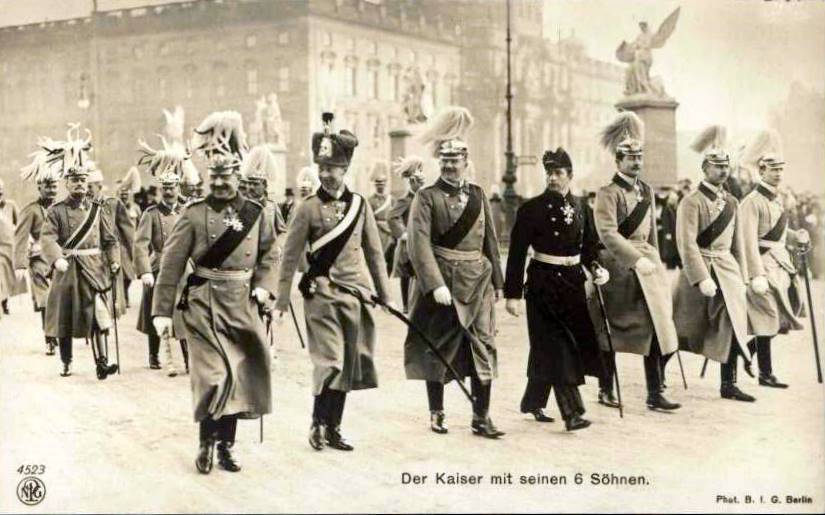
Imperial Germany’s growing power was less troublesome to Edwardian British statesmen than the strategic error of the Kaiser and von Tirpitz to pursue a naval arms race with Great Britain that did not give Germany’even the ability to break a naval blockade but needlessly antagonized the British with an existential threat that pushed London into the French camp.

As to military plans for invading Canada (or anywhere else), the job of military planning staffs are to create war plans to cover hypothetical contingencies so that if a crisis breaks out, there is at least a feasible starting point on the drawing board from which to begin organizing a campaign. This is what staff officers do be they American, French, Russian, German, Chinese and even British. This is not to be taken as serious evidence that the Coolidge or Hoover administrations were hatching schemes to occupy Quebec.

More importantly, nuclear weapons create an impediment to Sino-American rivalry ending in an “August 1914” moment ( though not, arguably, an accidental or peripheral clash at sea or a nasty proxy conflict). Even bullying Japan ultimately carries a risk that at a certain point, the Japanese will get fed-up with Beijing, decide they need parity with China, and become a nuclear weapons state.

Professor MacMillan, whose book The War That Ended Peace was published last year, said right-wing and nationalist sentiments were rising across the world and had also been a factor before the First World War

In China and Japan, patriotic passions have been inflamed by the dispute over a string of islands in the East China Sea, known as the Senkakus in Japan and Diaoyus in China. “Increased Chinese military spending and the build-up of its naval capacity suggest to many American strategists that China intends to challenge the US as a Pacific power, and we are now seeing an arms race between the two countries in that region,” she writes in her essay. “The Wall Street Journal has authoritative reports that the Pentagon is preparing war plans against China – just in case.” 

“It is tempting – and sobering –to compare today’s relationship between China and the US with that between Germany and England a century ago,” Professor MacMillan writes. She points to the growing disquiet in the US over Chinese investment in America while “the Chinese complain that the US treats them as a second-rate power”.

The “dispute” of the Senkakus has been intentionally and wholly created by Beijing in much the same way Chinese leaders had PLA troops provocatively infringe on Indian territory, claim the South China Sea as sovereign territory and bully ships of all nearby nations other than Russia in international or foreign national waters. This is, as Edward Luttwak recently pointed out, not an especially smart execution of strategy. China’s recent burst of nationalistic bluffing, intimidation and paranoia about encirclement are working along the path of self-fulfilling prophecy.

Another similarity highlighted by the historian is the belief that a full-scale war between the major powers is unthinkable after such a prolonged period of peace. “Now, as then, the march of globalisation has lulled us into a false sense of safety,” she says. “The 100th anniversary of 1914 should make us reflect anew on our vulnerability to human error, sudden catastrophes, and sheer accident.

Agree that globalization is no guarantee against human folly, ambition or the caprice of chance.

What are your thoughts?

Narco-cartels as MBAs Doing 4GW

Tuesday, January 7th, 2014

[by Mark Safranski, a.k.a. “zen“]


Yale organizational behaviorist Rodrigo Canales has an interesting talk on the Narco-insurgency in Mexico ( which he correctly sees as having been as lethal as Syria’s civil war). While this won’t be news to close students of Mexico’s cartel wars, Canales explains how Los Zeta, La Familia, Knights Templar and Sinaloa cartel violence is neither random nor strictly criminal on criminal  violence but is used as part of organizational strategies to create distinctive “franchise brands”, amplify political messaging,  reinforce effects of social service investment in the communities they control and maximize market efficiency of narcotics sales and other contraband. COIN, 4GW and irregular warfare folks will all see familiar elements in Canales management theory driven perspective.

A useful short tutorial considering the cartels are operating inside the United States and their hyper-violent tactics are eventually going to follow.

“For the Soldiers of the Future”

Thursday, December 26th, 2013

(by Adam Elkus)

One of my favorite television shows when I was younger was the Japanese sci-fi anime Gundam Wing. The characterization was awful, the giant robots were kind of lame, and the fights often were not all that suspenseful. However, it had a very interesting social and political universe that was far more sophisticated than your average Toonami fare. I remember one episode in particular, now that discussion has turned to the ever-topical future of war and technology.

In a Earth Sphere Alliance military base on Corsica, an special operations officer named Walker greets Gundam‘s antagonist Zechs. Zechs has come to inspect an old prototype mobile suit that Zechs and Walker both believe holds the key to understanding the terrifying new and poorly understood Gundam mobile suits that have been annihilating Alliance bases left and right. The base’s foolish commander, having been forced to cease production of mobile suits due to a terrorist attack on the facility, stages a large display of force with base units to demonstrate that he is in control. The implied purpose is to grandstand to the special operations group that Zechs and Walker belong to, demonstrating that the regular army can do hold the base without the help of the “specials.”

At one point, Walker asks Zech to take the prototype suit from the base with him. Zechs, knowing that the Gundam will likely attack, asks Walker if he is going to die for him. Walker responds that he is following Zechs’ example and fighting for the soldiers of the future. Sure enough, a Gundam does arrive and Walker and his special operations unit suicidally fight to allow the base commander and Zechs to escape. Walker, in commanding his men to fight on despite the certainty of destruction, quite literally casts it as a struggle for the soldiers of the future. The combat data that the fight will produce will help the military fight the Gundams later. And Walker also wants Zechs and the prototype to escape for similar reasons. Zechs himself sorrowfully departs, knowing that he has effectively doomed Walker.

When thinking about World War I, I often see a lot of Walkers. Many of the military theorists, soldiers, and technologists could see nearly all of the challenges of future warfare stemming from C3I, logistics, campaign design, and tactics. Walker most reminds me of Ardant Du Picq, both in his interest in the future of war and untimely end. The problem all of the prewar era’s military theorists faced was that they were caught between something very old and familiar and something new and terrifying — much like the juxtaposition of the proto-Gundam Zechs inspects and the actual Gundam that kills Walker and his team (thus generating combat data). The familiar is tangible, the future is patchy and a black box. Still, that isn’t exactly why WWI was such a slaughterhouse.

An interesting contrast to Gundam is seen in another anime I watched recently, Night Raid 1931.  Set in the 1930s, the anime’s antagonist is a supernaturally empowered Imperial Japanese Army military officer who forsees World War II and the use of the atomic bomb. Prophecy is a very big theme throughout Night Raid — a oracle-like woman is used by the closest echelons of the Japanese government and military to make decisions about war and peace. There is something fitting about the idea that the prime source of information for decision is an esoteric and religiously based strategic forecaster.

The antagonist, afraid of the consequences of world warfare, attempts to enlist the peoples of Southeast Asia in revolt against both Japan and the colonial powers to produce a new order. He takes drastic measures to create his own prototype atomic weapon — which he plans to utilize on Shanghai in order to force the world powers (all of whom have settlements there) to take actions that will demonstrate the deterrent power of his new weapon. He is foiled, but the protagonists all understand that they have only postponed the inevitable.

The perspective in Night Raid is one in which the future is deterministic — even if it cannot be predicted completely. The initial conditions are clear — some sequence of events is on the horizon, ending in the usage of the atomic bomb. The antagonist only can glimpse a very hazy outline of this vision, and he tries and fails to prevent it. Undoubtedly the fact that he tried and failed influenced the outcome somewhat — but the anime implies WWII happens anyway (and the bomb presumably does as well).

The deterministic perspective in Night Raid is contrasted with Gundam 00, in which a Hari Seldon-like figure creates an organization for carrying out a 200-year plan designed to result in a desired future and a massively powerful biological artificial intelligence agent to help plan and direct the process through the centuries. However, after he puts himself in suspended freeze to wait out the future, the components of his organization begin to develop different ideas about it. Factions develop and feud and 200 years later the desired future is very much in doubt.

Though the good guys win in the end (it’s TV), it is by no means implied that the initial conditions are sufficient to produce a deterministic outcome. The end outcome is an emergent product of contingent decisions by all of the anime’s political, military, and economic entities as well as the specific decisions and personalities of the main characters. In fact, there are many points in the anime in which complete derailment of the desired future are very plausible. The fact that the end leads to the heroes triumphant doesn’t necessarily say much about the probability of it occurring. The story tries to present it as such, but this can be dismissed as a narrative contrivance designed to impose a comfortable sense of signal to noise.

The question of what the future holds for war depends in part on how you view the nature of social systems. The key idea of Night Raid is a teleological climb to some higher mountain. Exactly how high no one really knows, but by the end of the anime they are sure that there is some peak much higher that they will ascend to. In contrast, Gundam 00 seems to imply that there are micro interactions that produce fleeting intermediate structures. Furthermore, the interaction between micro and intermediate levels produces a macroscopic outcome that then affects the micro level again.

The challenge is always to avoid the Black Swan problem. It is easy to impose a spurious coherence on past events that you believe gives them teleological order. Much of what Lynn Rees talks about is the problem of imposing such coherence with fuzzy and value-laden ideas about strategy. But as some commenters have noted in the legibility thread, legibility is at heart any process that we use to try to force the world to fit our own mental models. Every time we write history, we inherently distort reality into a soda straw view because no history can capture the complexity of the world as it once was. It is often ironic to see humanities thinkers make this very criticism about mathematical modeling and statistics, when if anything the process of imposing conceptual order on the past is far more fraught with peril than building a clearly specified computer model.

With this in mind, we can see another interesting distinction in the various anime series surveyed in this post. In Night Raid 1931, the antagonist attempts to force the future to fit his own mental model, and fails miserably. The deterministic nature of events is implied by his failure to get the anti-colonial groups to trust him and cooperate — something that could only happen after World War II. However, in Gundam 00 the very act of changing the future also imperils that future — the creation of a large organization to carry out the Foundation-esque dream inevitably splits into factions and personalities that try to twist the plan to fit their own ends.

To return to the Walker-WWI parallel in the beginning — what I’m coming to believe about WWI is not that the greatest risk is failing to see the future clearly or of not collecting the right data. It is that we do not give enough reflective thought to how our anticipations of the future also change it. The preparations of the various powers for war they knew would require large armies, mobilization networks, and speed famously complicated prewar diplomacy. And preparations for Cold War turning “hot” and the scientific and technical spawn they generated in turn also created the roots of American dominance and profitable technological industries today.

Much discussion about future war involves banning or regulating technologies, taking steps to insure that X or Y capability is preserved or scrapped, etc. But that focus renders invisible the problems involved in trying to force the future to be legible, as well as the interesting lack of reflexivity about the combination of predicting the future and seeking to alter it.


Switch to our mobile site

