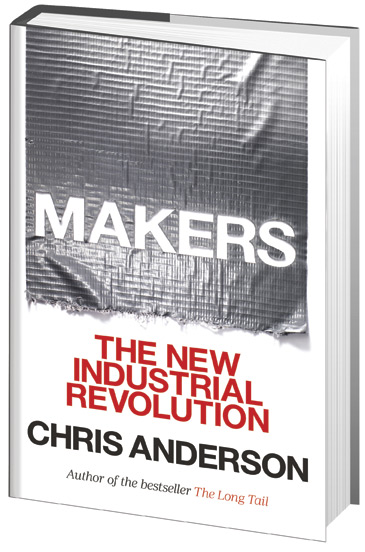
This is a fun book by the former editor-in-chief of WIRED , author of The Long Tailand the co-founder of3D Robotics, Chris Anderson. Part pop culture, part tech-optimist futurism and all DIY business book, Anderson is preaching a revolution, one brought about by the intersection of 3D printing and open source “Maker movement” culture, that he believes will be bigger and more transformative to society than was the Web. One with the potential to change the “race to the bottom” economic logic of globalization by allowing manufacturing entrepreneurs to be smart, small, nimble and global by sharing bits and selling atoms.
Anderson writes:
Here’s the history of two decades of innovation in two sentences: The past ten years have been about discovering new ways to create, invent, and work together on the Web. The next ten years will be about applying those lessons to the real world.
This book is about the next ten years.
….Why? Because making things has gone digital: physical objects now begin as designs on screens, and those designs can be shared online as files…..once an industry goes digital in changes in profound ways, as we’ve seen in everything from retail to publishing. The biggest transformation, but in who’s doing it. Once things can be done on regular computers, they can be done by anyone. And that’s exactly what we’re seeing happening in manufacturing.
…..In short, the Maker Movement shares three characteristics, all of which I’d argue are transformative:
1. People using digital desktop tools to create designs for new products and prototype them (“digital DIY”)
2. A cultural norm to share those designs and collaborate with others in online communities.
3. The use of common design file standards that allow anyone, if they desire, to send their designs to commercial manufacturing services to be produced in any number, just as easily as they can fabricate them on their desktop. This radically foreshortens the path from idea to entrepreneurship, just as the Web did in software, information, and content.
Nations whose entire strategy rests upon being the provider of cheapest labor per unit cost on all scales are going to be in jeopardy if local can innovate, customize and manufacture in near-real time response to customer demand. Creativity of designers and stigmergic /stochastic collaboration of communities rise in economic value relative to top-down, hierarchical production systems with long development lags and capital tied up betting on having large production runs.
Interesting, with potentially profound implications.
[ by Charles Cameron — I thought it might be timely to consider trinary thinking in light of Zen‘s recent post featuring Clausewitz‘ Trinity ]
.
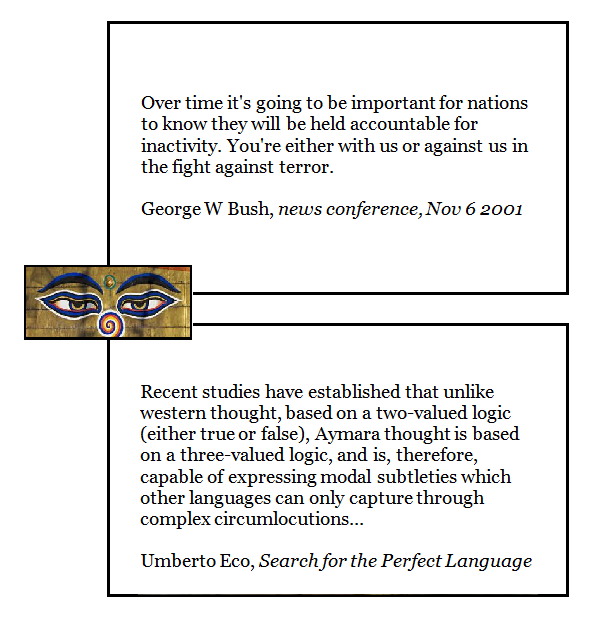
I know, it sounds inherently ridiculous, but what would happen if we thought in threes instead of twos? I mean, we tend to see things in terms of black and white, good and bad. Let’s set up a binary of our own — US President George W Bush vs the Aymara of the Andes and Altiploano:
Two into three won’t go, as they used to say in math class when I was a kid.
Hegel thought otherwise. Hegel thought two needed to move on into three, or we’d be stuck with binaries in stasis for ever. Hegel’s dialectic is about the possibility called three — which opens the otherwise static two up to various kinds of process…
The advantage of asymmetric games lies in the ability to build nontransitive or triangular relationships into the game. Transitivity is a well-defined mathematical property. In the context of games it is best illustrated with the rock-scissors-paper game. Two players play this game; each secretly selects one of the three pieces; they simultaneously announce and compare their choices. If both made the same choice the result is a draw and the game is repeated. If they make different choices, then rock breaks scissors, scissors cut paper, and paper enfolds rock. This relationship, in which each component can defeat one other and can be defeated by one other, is a nontransitive relationship; the fact that rock beats scissors and scissors beat paper does not mean that rock beats paper.
We’re back in play…
**
Here, too, is a bit from m’friend Wm. Benzon, jazz-player, blogger, polymath:
Three against two is one of the most important rhythm ‘cells’ in all of music. What do I mean, three against two? You play three evenly spaced beats in one ‘stream’ in the same period of time you play two evenly spaced beats in another ‘stream.’ It sounds simple enough but, the problem is that three and two do not have a common divisor, making the ‘evenly spaced’ part of the formula a bit tricky. The two patterns coincide on the first beat, but the second and third beats of the three-beat stream happen at different times from the second beat of the two-beat stream. And if you think that’s a lot of verbiage for something that ought to be simple, when then you’re beginning to get the idea.
Noting that the brain has a hard time moving from two to three this way, Benzon quotes old-time piano virtuoso Joseph Hoffman:
In faster motion it is far better to practise at first each hand alone and with somewhat exaggerated accents of each group until the two relative speeds are well established in the mind. Then try to play the two hands together in a sort of semi-automatic way. Frequent correct repetition of the same figure will soon change your semi-automatic state into a a conscious one, and thus train your ear to listen to and control two different rhythms or groupings at the same time.
Those readers already familiar with my insistence on many-voiced (ie polyphonic) listening will quickly grasp that Hoffman is speaking of just that kind of broadening of our mental horizons — of our thinking capacities.
**
I’d like to close part 1 of this two part post within my “Numbers by the numbers” series, with a quote from LtGen Paul Van Riper (USMC Ret.), The Foundation of Strategic Thinking at Infinity Journal:
The United States and its allies need senior civilian officials and military officers who grasp the fundamental nature of systems, are adept at building shared mental models, comprehend the significance of Clausewitz’s paradoxical trinity, understand operational art and can connect strategic thinking with tactical actions through operational design. These are the true competencies of modern defense professionals.
As in conflict, as in Clausewitz, so in conflict resolution: we need to be able to think in trinary — in trinities — and beyond.
More on that — which interested me enough that I once designed a trinary game of my own, played with great splash and delight by three kids in a swimming pool — in the second part of this post.
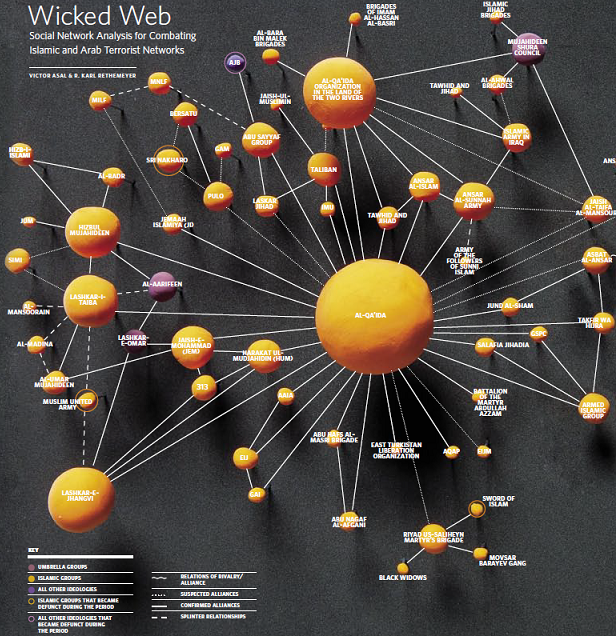
The National Consortium for the Study of Terrorism and Responses to Terrorism—better known as START – is a university-based research center committed to the scientific study of the causes and human consequences of terrorism in the United States and around the world.
Looking through the rest of the report, I’m tempted to say a snazzier, jazzier magazine I’ve seldom seen!
**
I maintain that’s far nicer to look at, but no more comprehensible than, this gorgeous and justly infamous power point slide:
click image for a closer, full size look
Got that one, too? That was a slide used to help GEN McChrystal understand that war he was fighting.
We wish to suggest a structure for the salt of deoxyribose nucleic acid (D.N.A.). This structure has novel features which are of considerable biological interest.
My problem is that I have been persecuted by an integer. For seven years this number has followed me around, has intruded in my most private data, and has assaulted me from the pages of our most public journals. This number assumes a variety of disguises, being sometimes a little larger and sometimes a little smaller than usual, but never changing so much as to be unrecognizable. The persistence with which this number plagues me is far more than a random accident. There is, to quote a famous senator, a design behind it, some pattern governing its appearances. Either there really is something unusual about the number or else I am suffering from delusions of persecution.
The gist of Miller’s piece (and by gist I explicitly mean the always misleading broad strokes version) is that we can usually manage to hold five to nine chunks of thought in mind at any given time, but that if we want to understand more than that, we need to “chunk” our thoughts in such a way that we think of “seven plus or minus two” items (Miller’s “magical number”) but can peer into any one of them and see it divided into lesser portions which we can also comprehend, in what I’ll call a tree > trunk > limb > branch > twig > leaf arrangement — always remembering that a tree may be part of a forest, and that sometimes ee just can’t see the forest for the trees…
Miller explains chunking succinctly thus:
It seems probable that even memorization can be studied in these terms. The process of memorizing may be simply the formation of chunks, or groups of items that go together, until there are few enough chunks so that we can recall all the items.
Neat, hunh? And he concludes, with another pleasant touch of wit:
And finally, what about the magical number seven? What about the seven wonders of the world, the seven seas, the seven deadly sins, the seven daughters of Atlas in the Pleiades, the seven ages of man, the seven levels of hell, the seven primary colors, the seven notes of the musical scale, and the seven days of the week? What about the seven-point rating scale, the seven categories for absolute judgment, the seven objects in the span of attention, and the seven digits in the span of immediate memory? For the present I propose to withhold judgment. Perhaps there is something deep and profound behind all these sevens, something just calling out for us to discover it. But I suspect that it is only a pernicious, Pythagorean coincidence.
**
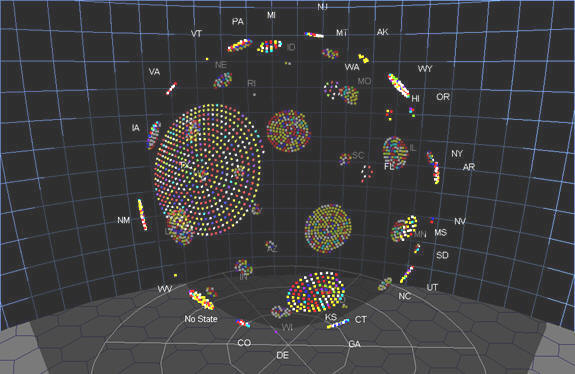
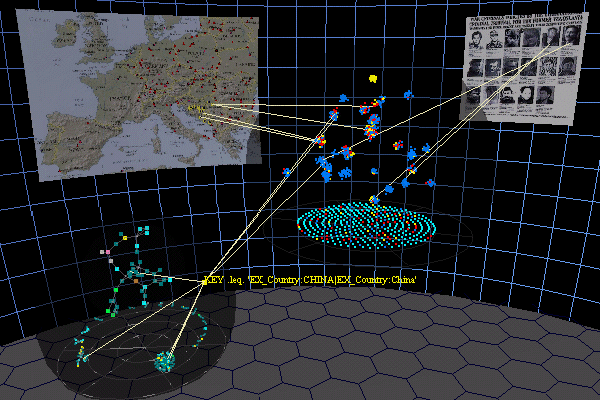
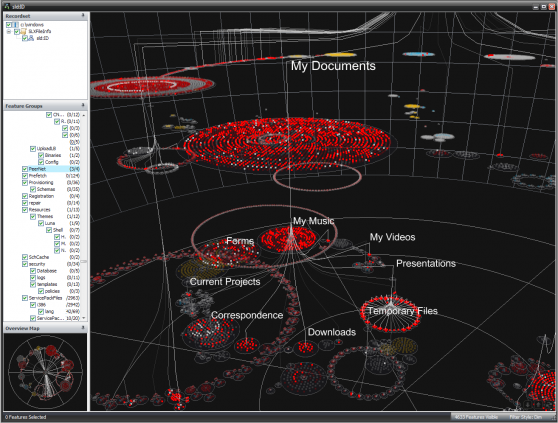
Of course there are high-node graphics programs like Starlight Analytics (from Future Point Systems via Battelle and the Pacific Northwest National Laboratory) which allow you to sample one of a cluster of very similar nodes, or to see where the outliers are and zero in on them…
or to focus in on only those nodes connected to one particular name or place on a map:
But can you find a file you’re looking for any faster by locating it somewhere in this graphic…
than by using your usual search methods?
So okay, high level analytics like Starlight may be useful for analysts who have the costly software and time to pinpoint and track and zoom and annotate and comprehend, become alarmed or calmed, and respond appropriately.
But people reading that glossy report from the START program? People trying to brief GEN McChrystal from a powerpoint slide?
Seven. Seven plus or minus is your number.
**
Once more, with feeling.
The moral of this tale is that graphical presentations of ideas to explain complexities should generally feature seven plus or minus two nodes, maximum, for eye and mind to consider at any one time, with perhaps an additional three or four that the eye can glide across to, forming a second chunk — thus delivering a maximum of 13 nodes without zooming in.
for the direct communication of major drivers in a complex situation — seven nodes plus or minus two is your optimal number.
**
Ah — but see, I forgot to show you the rest of that first image:
You can handle grasping the import of an image two parts, surely, can’t you?
Okay then — if you can, perhaps you can help me out…
[ by Charles Cameron — the serious-minded can safely ignore this post, which is of mainly aesthetic interest, surely a matter of no importance in its own right ]
.
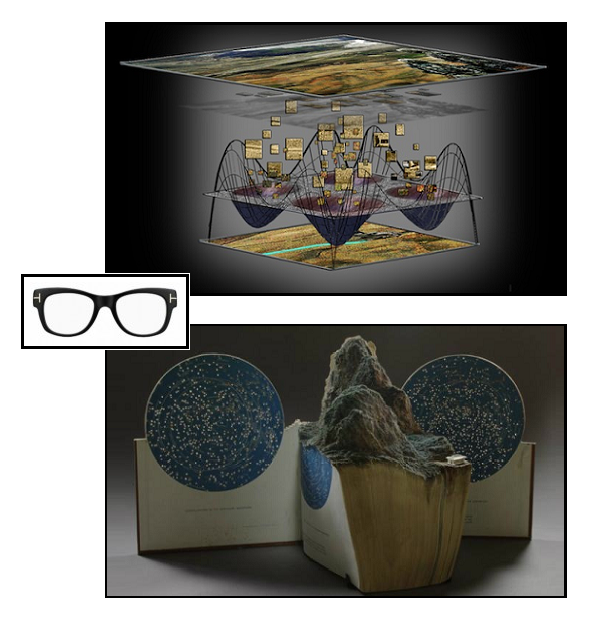
Two graphics caught my eye today, one after another in my RSS feed.
.
The upper image comes from DARPA, and is not really explained in any detail by the otherwise interesting Wired piece that it illustrated — but is easy and intriguing to the eye anyway, and somehow has to do with a return to analog computing:
Through its Defense Advanced Research Projects Agency (Darpa), the DoD is funding a new program called UPSIDE, short for Unconventional Processing of Signals for Intelligent Data Exploitation. Basically, the program will investigate a brand-new way of doing computing without the digital processors that have come to define computing as we know it.
Well, new this time around the block, anyway.
The second (lower image), totally unrelated to the first but almost its twin to my mind’s eye, shows a “literary moonscape” by the artist Guy Laramée, created by sculpting it out of an old book, h/t The Paris Review, Saatchi Gallery and 3quarksdaily.
[ by Charles Cameron — of [almost] no military or intelligence interest, this is a post for computer scientists, historians, scientists, artists, contemplatives and other creatives ]
.
I’ve been on a bit of a binge about medieval and renaissance diagrams recently, putting together an anthology of early “semantic networks” for the Sembl game site – but also thinking about the alternate track of art history which would focus on diagrams rather than paintings (I’m thinking of two dimensions here, hence no mention of sculpture) – an alternate history which may have something to teach our richly diagrammatic and data-visual times.
My interest in all this tracks back at least to my early encounter with an essay by the computer scientist Margaret Masterman in Theoria to Theory (1967).
*
Yesterday brought me a post from Jason Wells, a scientist and bright all-rounder I follow on Google+, in which he posted an image of the cosmos from the Ptolemaic (pre-Copernical) point of view, which I’ve put at the head of this post.
Jason commented on this diagram:
As pretty as this is, this is not how your universe works.
That is all.
The diagram Jason posted purports to be mathematically and astronomically based: it is, if you like, a quantitative diagram. I don’t happen to think it’s pretty, although the two creatures (angels, goddesses?) up towards the top of the circle may be, and the serpent eating its tail around it is nicely done -– I think it has a rather austere beauty to be honest, but I’m likely to concede to Jason that it isn’t “true” in the sense of being an accurate representation of the (abstract) laws of celestial motion.
But then I also think there’s more to truth than accuracy, useful though that may be – there’s also a qualitative element to truth, and perhaps “beauty” is (among other things) a name for it.
*
Yesterday also brought me a news bulletin that ties into that same interest in medieval and renaissance diagrams. From the Vatican Information Service (via Chant Cafe) , we learn that Hildegarde of Bingen (1098 – 1179) is now a saint of the Catholic Church with universal cultus:
Vatican City, 10 May 2012 (VIS) – The Holy Father today received in audience Cardinal Angelo Amato S.D.B., prefect of the Congregation for the Causes of Saints. During the audience he extended the liturgical cult of St. Hildegard of Bingen (1089-1179) to the universal Church, inscribing her in the catalogue of saints.
Consider, then, in contrast to Jason’s mechanistic Ptolemaic diagram, this diagram which today’s fresh-minted saint produced in the late 1140s or early 1150s to illustrate her visionary intuitions of the universe in the first of three books, Scivias:
and these two, from Liber divinorum operum:
and:
These, I take it, are purely qualitative images in contrast to the Ptolemaic diagram — making no propositional claims as to physical or mathematical accuracy, but portraying Hildegarde’s sense of cosmic order. And just as we would not argue whether it is Van Gogh or El Greco who is “right” about the skies in their respective paintings, so I don’t think Hildegarde is worried about which of her diagrams is “right” in its portrayal of the world she lived and prayed in – each one illustrates some aspect of her vision of the world, and one does not necessarily contradict another.
*
Here are two descriptions of Hildegarde’s world, which may give us some insight into the diagrams above. For the top one:
For Hildegard of Bingen, twelfth century German Benedictine abbess, the universe is like an egg in the womb of God. Her view of the universe, conditioned as it is by her times and her education, represents her visionary understanding of God’s motherhood of this sphere that we call the universe. Hers is a view that is organic and holistic, coloured neither by Greek philosophy nor Enlightenment rationalism, refreshing and strikingly “true” in its perceptions around the source of created life.
God created the world out of the four elements, to glorify His name. He strengthened the world with the wind. He connected the world to the stars. And he filled the world with all kinds of creatures. He then put human beings throughout the world, giving them great power as stewards of all Creation. Human beings cannot live without the rest of nature, they must care for all natural things.
It’s probably worth mentioning that three of the “four elements” of the ancients are still known to us, though we call them “states” rather than “elements” at this point — the solid, liquid and gaseous states correspond with what the ancients called “earth”, “water” and “air”, respectively — and it has even been suggested that their “fire” corresponds to the fourth state we now term “plasmas” — not my line of business, however, so who knows?
*
Hildegarde picked up the word “viriditas” from Gregory the Great and made it peculiarly her own. It means greeness, literally, and freshness by extension — but for Hildegarde’s integral view of all that is, it also carries a theological dimension, Christ being the greening of the world for her:
For Hildegard, viriditas was an attribute of the Divine nature, a reflection of God’s goodness and beauty. It stood for vitality, fertility, fruitfulness and growth; in fact all the things that we now associate with the “greenness” of nature. For us today “greenness” is a sign that the Earth is healthy and flourishing. Similarly, for Hildegard, viriditas was synonymous with physical and spiritual health, with the continuing vivifying force of the Holy Spirit.
.
Dr Carmel Bendon Davis, Hildegard of Bingen: Eco-warrior and Superwoman
This greening or freshening is not, for Hildegarde, just a matter of earth and water, of river and forest, it is also infused with fire and air:
I am likewise the fiery life of the substance of divinity. I flame over the beauty of the fields and sparkle in the waters, and I burn in sun, moon, and stars. And with an airy wind that sustains all things with invisible life, I raise them up vitally. For air lives in greenness and flowers, waters flow as if alive, the sun, too, lives in his light, and when the moon comes to her decline she is kindled by his light, as it were to live again… Thus I, the fiery force, am hidden in [the winds], and they take fire from me, just as breath continually moves a man, and as a windy flame exists in fire. All of these live in their essence and are not found in death, because I am life.
Understanding in the soul is like the Veriditas of the branches and the leaves of the tree
It is, in fact, neither exclusively natural nor supernatural, but non-dual.
*
Dylan Thomas, being a Welshman and a poet, thus has an insight that bears a family resemblance to Hildegarde’s, but phrases it in a way that leaves the “force” neither personified nor otherwise… and thus with no necessary doctrinal implication:
The force that through the green fuse drives the flower
Drives my green age; that blasts the roots of trees
Is my destroyer.
And I am dumb to tell the crooked rose
My youth is bent by the same wintry fever.
For Hildegarde, this “force” is also Christ — for he himself is the “the fiery life of the substance of divinity” — and his coming to earth a greening and freshening of a world until then barren of the love he brought.
*
Hildegarde was the abbess in charge of a small flotilla of nuns — but also a mystic, a visionary, philosopher, poet, painter and songstress…
Her song of creation, O Viriditas, bears comparison in spirit with St Francis‘ Canticle of the Sun. She writes to her “green” Christ and his “green” planet:
O greenness of God’s finger
with which God built a vineyard
that shines in heaven
as an established pillar:
You are glorious in God’s preparation.
And o height of the mountain
that will never be dispersed
in the judgment of God,
you nevertheless stand from afar as an exile,
but it is not in the power
of the armed man
to seize you.
You are glorious in God’s preparation.
Glory be to the Father and to the Son
and to the Holy Spirit.
You are glorious in God’s preparation.
And she sets her words to the music of the times:
Indeed, her music is sung even today…
How’s that for a twelfth century statement of what we’d these days call “ecology”?
*
But all this risks getting far too ethereal, I have wandered far along my own epicycles from Jason Wells’ point, and methinks I should bring us back down to earth.
Dennis The Constitutional Peasant, in Monty Python and the Holy Grail, meets King Arthur and complains, “What I object to is you automatically treatin’ me like an inferior.” It’s understandable — but so, perhaps, is king Arthur’s response: “Well, I am king.”
Two worldviews clash here — and in the ensuing debate, Arthurian myth meets contemporary politics:
Dennis’ Mother: Well how’d you become king, then?
Arthur: The Lady of the Lake,… [Angel chorus begins singing in background] her arm clad in the purest shimmering samite, held aloft Excalibur from the bosom of the water signifying by Divine Providence that I, Arthur, was to carry Excalibur. [Angel chorus ends] That is why I am your king!
Dennis: Listen. Strange women lying in ponds distributing swords is no basis for a system of government. Supreme executive power derives from a mandate from the masses, not from some farcical aquatic ceremony.
Arthur: Be quiet!
Dennis: You can’t expect to wield supreme power just ’cause some watery tart threw a sword at you!
Arthur: Shut up!
Dennis: I mean, if I went ’round saying I was an emperor just because some moistened bint had lobbed a scimitar at me, they’d put me away!
Or if some bint told me the universe was a cosmic egg in the womb of God, for that matter — even if Benedict XVI did just add her to the calendar of saints.
*
Here you go, courtesy of YouTube:
*
Frankly I appreciate both modes of thinking — the mythic and the scientific — and believe we’re in the sort of territory here that Nils Bohr was thinking of when he said:
The opposite of a true statement is a false statement. But the opposite of a profound truth may be another profound truth.
Zenpundit is a blog dedicated to exploring the intersections of foreign policy, history, military theory, national security,strategic thinking, futurism, cognition and a number of other esoteric pursuits.