zenpundit.com » china

Archive for the ‘china’ Category

One book calls for another

Wednesday, February 22nd, 2012

[ by Charles Cameron — of books, wars and games, three things seldom far from my mind ]
.

Yesterday I went thrifting with young master David, and found myself a copy of Daniel Johnson‘s White King and Red Queen: How the Cold War Was Fought on the Chessboard.

This happy event makes me anxious to reclaim my copy of Scott Boorman‘s The Protracted Game: A Wei-Ch’i Interpretation of Maoist Revolutionary Strategy from storage.

One of the things about books is that they call to each other.

*

The clock in the SPECS image above is a Sunnywood 3246B Plastic Mechanical Chess Clock.

Syria, Iran and the Risks of Tactical Geopolitics

Monday, February 13th, 2012


Mr. Nyet 

World affairs are much more like spider’s web than the neat little drawers of an apothecary’s cabinet. In the latter,  the contents of each drawer are cleanly isolated and conveniently compartmentalized. What you do with the contents of one drawer today has no bearing on what you do next week with those of another. By contrast, with a spider’s web, when you touch a web at any point, not only do you find it to be sticky in a fragile sort of way, but your touch sends vibrations through every centimeter of the lattice.

Which alerts the spiders.

The great foreign policy panjandrums of the United States and the Western allies – with assorted Middle-Eastern clients who have real skin in the game-  are attempting to muddle through two overlapping but different crises with Syria and Iran through the medium of international diplomatic organizations. In the case of Syria, whose Baathist-Alawite dictatorship of Bashar Assad is trying to crush a widespread uprising by pacing the body count of their atrocities to what CNN viewers can tolerate, the effort by SECSTATE Clinton and Ambassador Rice to rally the UN Security Council to issue a forceful resolution against Syria was itself forcefully rebuffed by the double-veto of Russia and China. A highly predictable event that left Ambassador Rice “disgusted” but we hope, not surprised.

The case of Iran, which incidentally is one of Syria’s few allies, involves the long-running dispute over Iran’s complex and semi-clandestine nuclear activities which, in violation of the NPT and IAEA agreements, appear designed to pressure the West by giving Iran, at a minimum, a “breakout” capacity to make some nuclear weapons.  This decade long “crisis” has recently escalated, with the EU and United States applying punishing new economic sanctions while an unknown party that everyone knows to be Israel is engaging in a campaign of  sabotage and assassination against Iran’s IRGC-run nuclear establishment. Iran for it’s part has taken hostages, blustered about closing the straits of Hormuz and threatened unspecified new breakthroughs in nuclear activities.

To say that Russia and China have been less than helpful in halting Iranian nuclear weapons-related activity is like saying Pakistan’s ISI might be involved with assisting the Taliban.  Another situation the American foreign policy establishment consistently has trouble puzzling out.

The problem with current US policy or it’s advocates is not target selection. Syria, Iran, Libya and various other states have nasty, disruptive and anti-Western regimes. Giving them the heave-ho, in the abstract, makes sense if advancing American interests  (or basic decency in governance) is the objective. However, unlike the aforementioned apothecary cabinet drawers, states and their regimes do not exist in the abstract, moving according to arid principles of conduct, but in the real world with a society of states which constantly are evaluating and re-evaluating each other’s conduct in light of interest. Which means, as with many things, in foreign policy, timing matters.

The West recently dispatched over the objections of two great powers, Colonel Gaddafi, a ruler who was also an unpopular and violent lunatic with a long pedigree of terrorism and cruelty.  That in itself was tolerable and comprehensible, if not welcome, to Moscow and Beijing, but we rubbed salt in the wound in two ways. First, simply stomping on the Realpolitik economic interests of Russia and China in Libya, as Walter Russell Meade eloquently put it:

….Russia has some specific grievances connected to Libya.  What seems to really enrage the Russians is less the overthrow of the Great Loon than the cancellation of his many contracts with Russia and the refusal of the new government to give Russia a slice of the Libyan pie.  Russia always thought the west’s democratic agenda in Libya was a laugh — and the antics of the thuggish new regime and the array of torturers and thieves now running rampant in that country has done little to dispel that view. (Again, the Putin/KGB worldview would suggest that the hard realists at the core of Washington’s power structure released the ninnies to dance themselves into a frenzy of humanitarian and democratic ecstasy while the cold purposes of the DC machine were advanced.)

But what Russia thought it expected and deserved in return for its abstention on the Libya vote was due consideration for its commercial interests in Libya.  France, Britain and Qatar seem to be dividing that pie enthusiastically among themselves and nobody is thinking about Russia’s share and Russia’s price.

Secondly, was icing Gaddafi under the moral banner of R2P, which would seem – in theory of course – to be applicable to governments very much like those run by the allies of….Moscow and Beijing. To say nothing of , Moscow and Beijing themselves, which already see the “color revolutions” as subversive Western elite sock puppets with a democracy stage show kit.  To be frank, Russian and Chinese leaders see R2P as a doctrine or policy that potentially can be used not only against their nation’s interests, but their own hold on power, which they view, accurately, as a violation of sovereignty.

So it can hardly be reassuring to Moscow or Beijing that when the dust has yet to settle in Libya, that the United States and it’s NATO allies are now pressing for new UN resolutions designed to justify military intervention in Syria to overthrow Bashar Assad. Like the late and unlamented Colonel Gaddafi, Bashar Assad is a cold-blooded murderer, but unlike the crazy Colonel, Assad is a client of Russia and close Syrian ties to Moscow go way back to the earliest days of his father’s dictatorship. There’s no way, in such a short amount of time, that an American effort to topple Assad – however justified morally – that Vladimir Putin and to be truthful, many ordinary Russians, would not view that as a Western attempt to humiliate Russia. And R2P would indicate still more humiliations to come! As Dan Trombly wrote:

….that is precisely why the United States should drop even lip service to the Responsibility to Protect. Honestly stayed, the doctrine requires intervention after intervention, and its strategic advantage to the United States relies on consistency, because without consistency the supposed normative benefits it creates quickly evaporates. Yet R2P, far from strengthening the international order, actually demands continually more resources and, each time it is employed or contemplated, calls into question the rest of the international order the United States promulgates. If the goal is to “expand and strengthen an effective international order,” why would increasing the visibility of Responsibility to Protect, a doctrine that divides the United States and Western Europe from Central Europe, the rising democracies of Brazil, South Africa, and India – not to mention, of course, the major powers China and Russia and exhausts an already overburdened and shrinking Western military capability? 

In that context, the idea that Russia and China would support a UNSC resolution to intervene in Syria and depose Assad borders on the bizarre.  Advocates of R2P, like Anne-Marie Slaughter, would counter here, arguing that both Russia and China previously accepted R2P, so their cooperation in support of a UNSC resolution on Syria should have been a manageable enterprise. It wasn’t, largely because the Russians do not seem to give R2P much weight as a part of international law, the Russian Defense Ministry being even more blunt than their diplomatic counterparts:

….Russia’s Defense Ministry on Thursday reiterated its position stated earlier by the Foreign Ministry: Russia will do its best to avoid military intervention in Syria.

 “As for Syria, we see that harsh discussions are going on in New York and we are just giving backup to our colleagues from the Foreign Ministry who are tackling these problems. Of course, we think it is necessary to prevent military intervention in Syria,” Deputy Defense Minister Anatoly Antonov told Vesti 24 TV channel.

 Russia has firmly supported Syrian President Bashar al-Assad during the uprising against his regime. Russia and China vetoed a UN Security Council resolution on Syria, backed by the Arab League and Western nations, to prevent a repetition of “the Libyan scenario.

Joshua Foust, writing in The Atlantic, addressed the situation with admirable clarity:

….A big reason for Russia and China’s intransigence is the NATO coalition that led the intervention, which badly overstepped the range of permissible actions stipulated in the UN Security Council Resolution that authorized intervention. Russia was an early critic of such actions as France’s weapons shipments to the rebels — criticism that could have been accounted for (Moscow never made any secret of its concerns) but which seemed to be ignored in the rush to intervene. President Obama made a rapid transition from saying “regime change is not on the table” last March (part of the bargain to get Russian abstention from the UNSC vote) to publicly calling for his ouster. France and the UK used similar language, ignoring the politics of getting UN approval for intervention.

….Many states, none of whom are free, worry that the West’s renewed love of intervention might one day be focused upon them. This is a critical consequence of rejecting sovereignty and declaring governments unfit to rule through a mixture of expediency and opportunity. Powerful states with poor human rights records — Russia and China included — look at what happened in Libya and see disaster, not freedom. And they are taking steps to avoid it.

The problem is not  intervention per se but an otherworldly posture of Western policy makers that embraces tactical geopolitics – i.e.  each intervention (Libya, Syria, Afghanistan, Iraq), undertaken whenever chance arises somehow exists on it’s own terms, in splendid isolation. It doesn’t, except in NATO capitols. Any nation not seeing itself as safe and impregnable is constantly calculating their opportunities and dangers based on our actions. If we continue to pursue intervention at the current tempo, blind to the perspectives and interests of others, we will get pushback on a more strategic level. And we will rue it.

NATO has been around so long, it is so enshrouded in hazy nostalgia and circumlocational love of diplomatic process, that we forget it was originally a radical departure for Americans and Europeans alike. Soviet postwar behavior under Stalin was so menacing, so intransigent, so relentlessly pressuring that the US set aside it’s traditional isolationism and the French and British their justified loathing of the defeated Germans, to make common cause against Soviet Communism. The West, on the defensive and backed into corner after corner in one tactical scenario after another by Moscow – Poland, Czechoslovakia, Greece, Iran, Berlin – took the conflict with the Kremlin to the next level by forming an enduring supranational, nuclear-armed, military alliance that ensured the next war in Europe meant WWIII.

That turned out to be more conflict than Uncle Joe Stalin was eager to buy.

We are now the ones backing others into corners. Iran, North Korea, Syria, Zimbabwe and other states ruled by kleptocrats and monsters act as buffers for China and Russia. Aside from the benefits these failed states can bring as customers for military hardware or sellers of raw materials, the attention of Western statesmen and human rights activists are diverted by the cause du jour in these hellholes, rather than being focused on what Beijing and Moscow might be up to at home or abroad.  Every dismantling of an anti-Western dictatorship, from their perspective, is a step closer to their direct confrontation with the West’s hyperactive, erratic, morally hypocritical, meddling, ruling elite who will be no more able to ignore “grave injustices” in Wuhai or Kazan than they could in Aleppo or Benghazi.

This is not an argument that we should not press our claims, or not try to keep nukes out of the hands of religious fanatics or refrain from crushing states that attack us with terrorist proxies; we can and should do all of these things with vigor. But when possible, much is to be gained by pursuing our interests in a manner that permits other great powers to at least save face. Destroying Iran’s government because of it’s nuclear activities, for example, is not a strategic “win” if  the way we do it convinces China and Russia to form a military alliance against the United States.

There is no need to forge ahead stupidly just because it is faster not to think matters through to their logical conclusions. America is heading down a road, led by an insular foreign policy clique of lawyers, activists and ex-academics, that eschews the need for maps because all that matters is that we drive well enough to take every short-cut.

Buddhist monks in Geopolitics this week…

Monday, January 16th, 2012

[ by Charles Cameron — Burma, Tibet, impermanence ]
.

Sources:

Hozan Alan Senauke, Burma’s Opening Door, Shambhala Sun, Jan 16, 2012
Robert Saiget, China’s Tibetan Buddhists ‘in vicious cycle’, AFP, January 16, 2012

China cracks down, Myanmar lightens up… the Buddhists call it all “impermanence”.

A poignant week or so in DoubleQuotes

Friday, December 30th, 2011

[ by Charles Cameron — fictitious peoples (Israelis, Palestinians), approved and disapproved scriptures (Hindu, Falun Gong), religious violence (Afghanistan, Nigeria, Bethlehem) ]
.

So, is there some sort of contest going on between Iranian and American ex-Speakers? Perhaps Elliott Abrams‘s response to Gingrich, quoted in the Washington Post piece, applies equally well to Haddad-Adel?

There was no Jordan or Syria or Iraq, either, so perhaps he would say they are all invented people as well and also have no right to statehood.

Next up…

And okay, what’s the point here? Is it that the Russians want to please both the Chinese and Indian governments — or that they don’t like new scriptures but are okay with old ones? Or is the problem that they haven’t decided yet on a “one size fits all” approach to unOrthodox religions?

Sigh. Next…

This is brutal — and apparently intercontinental.

You might think it’s obvious what the wrong answer is, and who’s doing the killing, in Nigeria. But these things can cut both ways:

Even here, it’s not clear who threw the bomb into the madrasa, although one could hazard a guess…

And even the site of the Nativity is infected. The Guardian’s account of events there this Christmas season is harsh in tone — but consider whose Nativity is supposedly being celebrated…

I’d say the Qur’an offers a better image of Christian monks than that experienced by those Palestinian riot police… who, in the event, although they themselves were also assailed with broom-sticks, declined to arrest anyone because, as Palestinian police lieutenant-colonel Khaled al-Tamimi put it:

Everything is all right and things have returned to normal. No one was arrested because all those involved were men of God.

Still, things could be worse. It was a squabble along similar lines in which nine several Orthodox monks were killed that triggered the Crimean War: details in Raymond Cohen, Conflict and Neglect: Between Ruin and Preservation at the Church of the Nativity — h/t Juan Cole, who also has video of this year’s brouhaha.

*

Et in terra pax hominibus bonae voluntatis.

Iconic: compare and contrast

Thursday, December 22nd, 2011

[ by Charles Cameron — iconic images, riot police, compare and contrast, repetition with variation ]
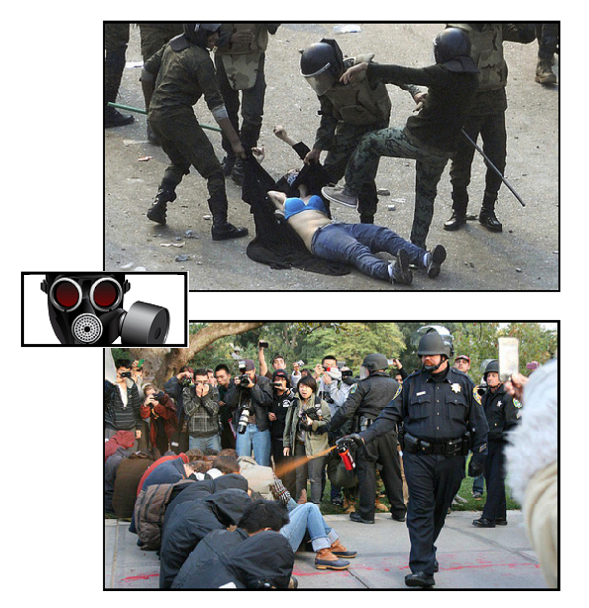
First, let’s be clear that both these images have been widely considered iconic.

Thus NPR reported of the first photo:

There have been countless accounts of violence recorded during the uprisings in Egypt but the image that perhaps has captured the most attention is the most recent. The image has been widely referred to as the “girl in the blue bra.”

While Real Clear Politics quotes Michael Moore on the second:

“The images have resonated around the world in the same way that the lone man standing in front of the tanks at Tiananmen Square resonated. It is an iconic movement in Occupy Wall Street history,” Michael Moore declared on MSNBC’s “Last Word” program.

Moore was referring to police pepper spraying students at an “Occupy” protest at UC Davis.

So we have two similarities between the two images: they both show police in riot gear taking action against demonstrators, and they have both caught the public eye as somehow being representations that can “stand in” for the events they seek to portray.

Beyond that, it’s all compare and contrast territory — or variations on a theme, perhaps — and different people will find different reasons to attack or defend the demonstrators or the police in one, the other, or both cases.

1.

These are, for many of us, “home” and “away” incidents, to borrow from sports terminology, and some of our reactions may reflect our opinions in general of what’s going on in Egypt, or in the United States.

We may or may not know the rules of engagement in effect in either case, on either side.

In a way, then, what the photos tell us about those two events, in Tahrir Square and on the UC Davis campus, may tell us much about ourselves and our inclinations, too.

2.

As I’ve indicated before, I am very interested in the process of comparison and contrast that the juxtaposition of two images — or two quotes — seems to generate. And I’ve quoted my friend Cath Styles, too:

A general principle can be distilled from this. Perhaps: In the very moment we identify a similarity between two objects, we recognise their difference. In other words, the process of drawing two things together creates an equal opposite force that draws attention to their natural distance. So the act of seeking resemblance – consistency, or patterns – simultaneously renders visible the inconsistencies, the structures and textures of our social world. And the greater the conceptual distance between the two likened objects, the more interesting the likening – and the greater the understanding to be found.

I’d like to examine these two particular photographs, then, not as images of behaviors we approve or disapprove of, but as examples of juxtaposition, of similarity and difference — and see what we might learn from reading them in a “neutral” light.

3.

What I am really trying to see is whether we can use analogy — a very powerful mental tool — with something of the same rigor we customarily apply to questions of causality and proof, and thus turn it into a method of insight that draws on our aha! pattern recognition and analogy-finding intuitions, rather than the application of inductive and deductive reason.

And that requires that we should know more about how the mind perceives likenesses — a topic that is often obscured by our strong emotional responses — you’re making a false moral equivalence there! or look, one’s as bad as the oither, and it’s sheer hypocrisy to suggest otherwise!

So among other things, we’re up against the phenomenon I call “sibling pea rivalry” — where two things, places, institutions, whatever, that are about as similar as two peas in a pod, have intense antagonism between them, real or playful — Oxford and Cambridge, say, and I’m thinking here of the Boat Race, or West Point and Annapolis in the US, and the Army-Navy game.

Oxford is far more “like” Cambridge than it is “like” a mechanic’s wrench, more like Cambridge than it is a Volkswagen or even a high school, more like it even than Harvard, Yale, Princeton or Stanford — more like it than any of the so-called “redbrick universities” in the UK — so like it, in fact, that the term “Oxbridge” has been coined to refer to the two of them together, in contrast to any other schools or colleges.

And yet on the day of the Boat Race, feelings run high — and the two places couldn’t seem more different. Or let me put that another way — an individual might be ill-advised to walk into a pub overflowing with partisans of the “dark blue” of Oxford wearing the “light blue” of Cambridge, or vice versa.  Not quite at the level of the Zetas and the Gulf Cartel, perhaps, but getting there…

4.

So one of the things I’ve thought a bunch about is the kind of analogy that says a : A :: b : B.

As in: Egyptian cop is to Egyptian protester as UC Davis cop is to UC Davis protester.

Which you may think is absolutely right — or cause for impeachment — or just plain old kufr!

And I’ve figured out that the reason people often have different “takes” on that kind of analogy — takes so different that they can get extremely steamed about it, and whistle like kettles and bubble over like pots — has to do with the perceptual phenomenon of parallax, whereby some distances get foreshortened in a way that others don’t.

5.

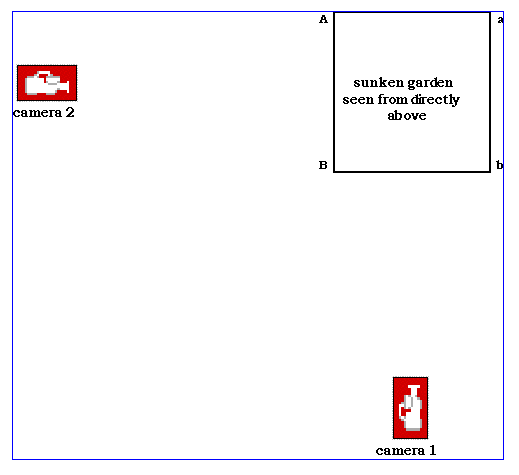
So my thought experiment sets up a sunken garden — always a pleasure, with two video cameras observing it, as in this diagram:
And from the two cameras, the respective views look like this:
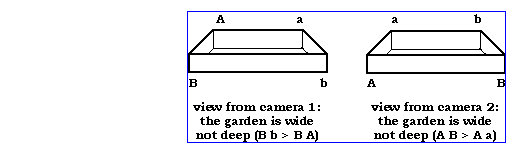
In this scheme of things, Aa (Oxford) seems very close to Bb (Cambridge) seen from the viewpoint of camera 1 — but from camera 2’s standpoint, Aa (Oxford) and Bb (Cambridge) are at opposite ends of the garden, and simply couldn’t be father apart.

6.

Now, my thinking here is either so obvious and simple as to be a platitude verging on tautology — or one of those subtle places where the closer examination of what looks tautological and obvious leads to the emergence of a new insight, a new “difference that makes a difference” in Bateson’s classic phrase.

And clearly, I hope that the latter will prove to be the case here.

7.

What can we learn from juxtapositions? What can we learn from our agreements about specific juxtapositions — and what can we learn from our specific disagreements?

Because it’s my sense that samenesses and differences both jump out at us, as Cath Styles suggested — and that both have a part to play in understanding a given juxtaposition or proposed likeness.

Each juxtaposition will, in my view, suggest both a “sameness” and a “difference” — in much the same way that an arithmetic division of integers, a = qd + r, gives both quotient and dividend.

And then we have two or more observers of the juxtaposition, who may bring their own parallax to the situation, and have their own differences.

8.

Tahrir is to Tienanmen as Qutb is to Mao?

Or is pepper spray just a food additive?

And how do icons become iconic anyway? Are they always juxtapositions, cops against college kids, girl vs napalm, man against line of tanks?  Even in the iconic photo of Kennedy from the Zapruder film, the sudden eruption of violence into the stateliness of a presidential parade is there — a morality play in miniature.

Any thoughts?


Switch to our mobile site