zenpundit.com » wwii

Archive for the ‘wwii’ Category

Miracles and rumors of miracles

Saturday, June 30th, 2012

[ by Charles Cameron — Timbuktu tombs, cultural preservation, WWII, miracle stories, della Robbia ]

.

.

A report on Al Jazeera today is sub-headed:

Al-Qaeda-linked group in northern Mali attacks tombs of Sufi saints just days after sites put on UNESCO endangered list.

**

My friend Michael Robinson just pointed me to this piece by Dr. Laurie Rush on “Cultural Property Protection as a Force Multiplier, from the March-April edition of Military Review:

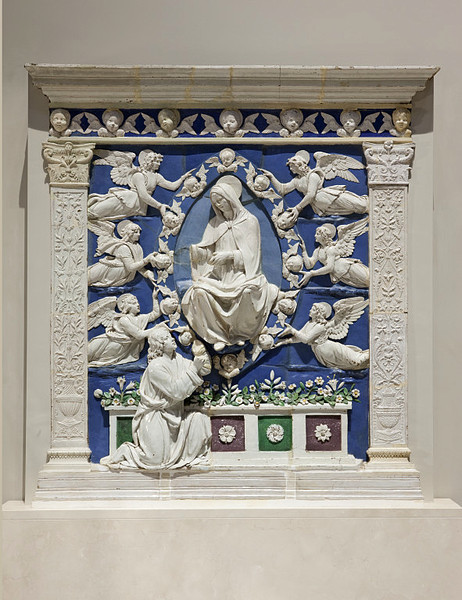
Preservation of cultural property can be critical for social restoration in a devastated community. During World War II, the Germans systematically blew up every single structure in the small town of Pieve Santo Stefano, Italy. Incredibly, they failed to destroy the Andrea della Robbia altarpiece relief, Assumption of the Virgin, in the local church. The MFAA wanted to remove the piece for its own protection, but the prospect of its relocation was unthinkable to the citizens of the community. Instead, the MFAA worked with them to save the altarpiece as part of the town’s restoration. Cultural property that survives war, sometimes miraculously, offers hope when all else seems lost.

**

Miracles and rumors of miracles…

Picking up where I left off last time: people with a non-miraculous worldview are apt to use the word “miraculous” to describe something like that altarpiece surviving, meaning roughly “fortunate” — while those whose worldview includes and welcomes miracles will use the same term in a very different sense, and with very different feeling.

These are differences that make a difference.

**

Here, because I was curious, is another Andrea della Robbia Assumption of the Virgin altarpiece, this one from the Victoria and Albert Museum collection, London:

Miraculous? Me personally, I’d say so.

Between the warrior and the monk (i): my father

Tuesday, May 22nd, 2012

[ by Charles Cameron — a warrior, a monk, and where that leaves me ]
.

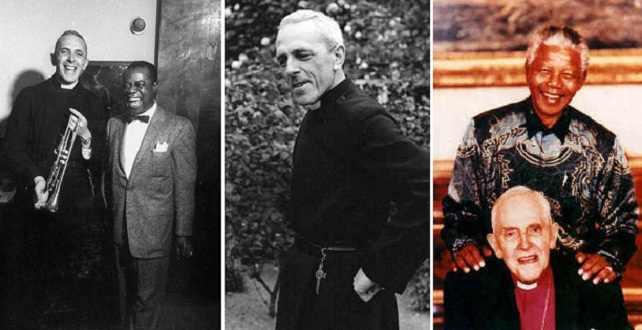
Like one of those toy acrobats who flips up, over and under when you squeeze or release the two sticks he’s strung on, I’m strung between these two fellows…

and flip up, over and under on the string that stretches from war to peace.

So here I am at Zenpundit, and I thought it might be time for me to give you a little more background about myself, where I’m coming from, and where I hope to be going…

*

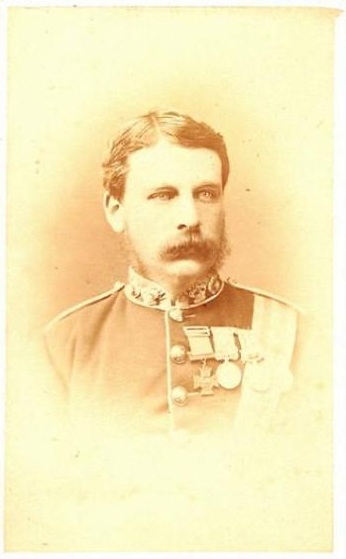
To get to the figure on the left of the image above, Captain Orford Gordon Cameron DSC, RN, my father, we have to track back a couple of generations deeper into family history, to this gentleman whose first name I bear as my own second name.

Col. Aylmer Spicer Cameron, VC, CB, my great-grandfather, earned his Victoria Cross during the Sepoy Rebellion:

For conspicuous bravery on the 30th of March, 1858, at Kotah, in having headed a small party of men, and attacked a body of armed fanatic rebels, strongly posted in a loop-holed house, with one narrow entrance. Lieutenant Cameron stormed the house, and killed three rebels in single combat. He was severely wounded, having lost half of one hand by a stroke from a tulwar.

There’s pride in that, passed down from his son to my father and so on down the line…

*

There’s pride, too, in the story of my own father’s DSC.

HMS Sheffield in Battle of the Barents Sea, stamp design, oil on canvas, Brian Sanders

As gunnery officer of HMS Sheffield in the Battle of the Barents Sea, Lt. Cdr. Cameron’s guns and those of Jamaica crippled the German heavy cruiser Hipper. When the news arrived in Germany, Hitler “with veins standing out on his neck” excoriated Admiral Raeder:

This operation only confirmed what he had instinctively felt all along — that the surface fleet was completely useless and that it was poorly staffed and ineptly commanded. The three battleships Tirpitz ,Schleswig-Holstein and Schlesien , the two pocket battleships Admiral Scheer and Lützow , the battle-cruisers Scharnhorst and Gneisenau , the heavy cruisers Hipper and Prinz Eugen , and the light cruisers Emden , Köln , Leipzig , and Nürnberg would all be decommissioned and summarily scrapped. To the extent possible their guns would be converted to land use. Henceforth, the largest navy ship would be a destroyer and all emphasis would be on the u-boat fleet.

Churchill wrote:

This brilliant action fought by the Royal Navy to protect an Allied convoy to Russia at the end of the year (1942) led directly to a crisis in the enemy’s naval policy and ended the dream of another German High Seas Fleet.

*

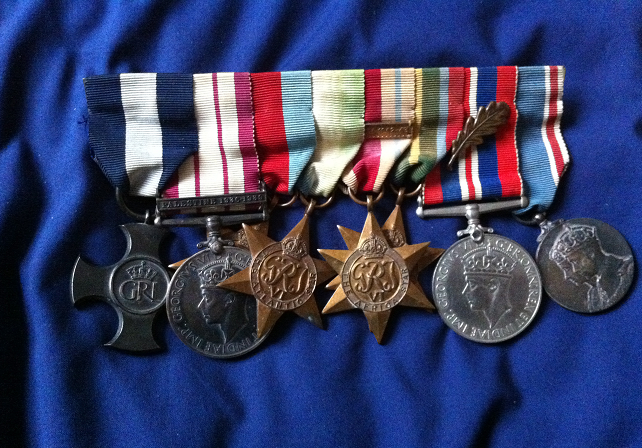
I have been thinking about my father quite a bit recently, since his medals arrived from England about ten days ago:

His DSC, left, was awarded for gallantry in the Barents Sea engagement, for which Cpt. Sherbrooke, on Onslow, was awarded the Victoria Cross, and Rear-Admiral Burnett, on Sheffield, the DSO.

There’s pride there, too.

Gallantry: what a word.

*

And the military strain in the family runs deep…

This photo of my parents’ wedding shows, from left to right in uniform, my grandfather Col. Sir Henry Clayton Darlington KCB, CMG, TD; John Wise; my great uncle Gen. Sir Clement Armitage KCB, CMG, DSO; Jan Newnham (best man); my father, Lt. Cdr. OG Cameron; my grandfather Brig. Orford Somerville Cameron, DSO, RA; my uncle Glenton Roslyn Williams; my uncle Colonel Henry John Darlington, OBE, DL; and Rev. Aylmer Peter Cameron, also my uncle.

Quite the gang — and not a civilian among them, although admittedly the photo was taken in 1942.

My varied aunts — brilliant, eccentric, elegant, delightful, take my word for it — are there too.

*

So that’s my father, and the pole that pulls me towards gallantry and the martial side of things. The other pole is represented by Fr. Trevor Huddleston CR, to the right of my father in the image at the top of this post.

I’ll return to Fr. Trevor in my next installment.

Announcement: “Legacies of the Manhattan Project” May 12-13

Tuesday, May 8th, 2012

From blogfriend Cheryl Rofer as well as Molly Cernicek and Susan Voss at Nuclear Diner, – an event for those interested in nuclear weapons, science, Cold War diplomatic history, national security, strategic theory and American strategists:

Nuclear Diner Teams With Santa Fe Institute To Bring You Legacies of the Manhattan Project 

Next weekend, May 12-13, at the Santa Fe Institute, a hand-picked group of physicists, historians, social scientists, systems theorists, and writers will examine the long-term legacies of the Manhattan Project in a timely discussion of an important event in world history that still influences science and society today. Harold Agnew, who was part of the historic effort to develop the first atomic bomb, will participate in the discussion.

SFI is collaborating with the Nuclear Diner to bring the discussion to you live on Twitter. You can participate before, during, and after by searching for the hashtag #bomblegacy or following @nucleardiner. Before the event, you can also leave questions at Nuclear Diner and the Facebook event page. If you “like” the Facebook page, you will get updates throughout the week and continuing information after the workshop.

The group will discuss new information, review original records, and mine the memories of project participants to present a case study in conflict from an important period in scientific history.

More about the Santa Fe Institute working group, including biographies of the participants and discussion topics, here.

Many of SFI’s founders were senior fellows at Los Alamos National Laboratory. As the Institute has emerged as a leader in complexity science, particularly in working toward a theory of conflict in human and animal societies, the Manhattan Project has become an important case study for understanding conflict. The project’s history also illustrates the occasional tension between pure theoretical research and applied science.

Photo: Harold Agnew holding the core of the Nagasaki bomb.

An excellent opportunity for students, grad students, historians and practitioners in various fields to participate here via twitter.

The uniform, the disruptive, & from Colditz to Mt Kenya

Thursday, May 3rd, 2012

[ by Charles Cameron — out of the box thinking, the blues, prison escape literature and more ]
.

As you’ll see by the time we get to the Colditz segment of this post, I’m not arguing that anyone should change out of uniform.

But oh yes, I do fish for eddies in the currents of words — or to put that the other way around, eddies in the currents of words tend to catch my eye, and when I read this paragraph in Kohlmann‘s Response to the Critics of Disruptive Thinking:

Jon Favreau, the head speechwriter for President Obama, was 27 when appointed. Aaron Schock, a Congressman from Illinois, is 30. Mark Zuckerberg created Facebook when he was still an undergrad at Harvard. Tom Brady won multiple Super Bowls in his twenties. This is a remarkable list, with some household names. Yet, I must ask, where are our young strategic military geniuses in uniform?

it was that last word that grabbed my attention — because somewhere in the back of my mind I have this idea that there’s nothing uniform about genius: it’s supremely individual.

Besides, I’m 67.

*

All of which brings me circuitously to Blind Lemon Jefferson and his Lock Step Blues:

Mean old jailor : taking away my dancing shoes
I can’t strut my stuff : when I got those lock-step blues

Again, I’m not claiming that “military” equates to “prison”, or that marching involves leg-irons… just hop, skipping and dancing from one thought to another, to see whether there’s a creative leap available…

*

And indeed it seems there is.

Thinking about disruptive thinking and uniforms and, well, prison, finally put me in mind of the place where the uniformed are required by their own code to be disruptive — that is, when they’re in POW camps.

There’s a great deal of noise these days about outside the box thinking — as a synonym for creativity — but it has only now occurred to me as I’m writing this post that one of my very first boyhood obsessions was in fact a kind of training ground for thinking outside the box.

And the box in question was Colditz Castle, the POW camp where the Germans sent those who had already escaped from at least one such camp and been recaptured.

I don’t know Emily Short, but in a post at her Interactive Storytelling blog, she describes the German “idea of putting all the most clever and resourceful prisoners together in an old building riddled with hiding places and odd physical quirks” as “not the brightest”, and notes that “those imprisoned found an astounding number of escape possibilities”.

That’s the essence of The Colditz Story, as described by PR Reid in his 1953 book of that name and its sequel, Men of Colditz [link is to double volume]. And I was fixated on Colditz and other World War II escape narratives for a boyish year or two thereafter.

*

Decades after that obsessive interest of mine in military escape literature had faded from view, I ran across another tale that fits the genre: Felice Benuzzi‘e extraordinary 1953 No Picnic on Mount Kenya.

Benuzzi was an Italian POW in a British camp in Kenya, with little to no prospect that even if he could escape the camp he’d be able to avoid recapture:

The idea of escaping is a vital factor in the mind of every prisoner. On our arrival in East Africa I had as a matter of course carefully considered the chances of reaching the nearest neutral territory, Portuguese East Africa; but I had concluded that, for me at least, this would be impossible. The distances one had to cover were enormous, one needed a frightful lot of money, the opportunity of getting a car, knowledge of the country and of the main languages, and faked documents…

But imprisonment is appalling boredom, and boredom didn’t suit Benuzzi’s temperament. One night he saw Mt Kenya from the camp for the first time:

an ethereal mountain emerging from a tossing sea of clouds framed between two dark barracks — a massive blue-black tooth of sheer rock inlaid with azure glaciers, austere yet floating fairy-like on the near horizon. It was the first 17,000-foot peak I had ever seen.

I stood gazing until the vision disappeared among the shifting cloud banks.

For hours afterwards I remained spell-bound.

*

Escape from boredom was imperative, climbing Mt Kenya would be Benuzzi’s return to life.

Fortunately, Bennuzi had a map:

Admittedly it was just the label from a can of “meat and vegetable rations” — but beggars and prisoners can’t be choosers, necessity is the mother of invention, and a meat rations can was what they had.

The dangers they faced were real enough. From the introduction:

“In order to break the monotony of life (in prison) one had only to start taking risks again,” Benuzzi writes as he and his comrades design their escape. The risks are real. Sneaking out of camp, they may be shot. For the first two days they must travel at night, across fields and past settlements. Once in the forest, away from what Benuzzi calls “the human danger-zone,” they will enter the “beast danger-zone.” Finally they will escape into the relative safety of the alpine tundra. Every mountaineer and outdoor person reading this tale will feel kinship to Benuzzi here, when he writes that “all the landscape around us reflected our happiness … green-golden sunrays filtered through the foliage … bellflowers seemed to wait for the fairy of the tale who would ring them. We were now into a world untainted by man’s misery, and bright with promise. Other dangers undoubtedly in store for us, but not from mankind, only from nature.”

Benuzzi avoided the worst that humans and beasts could throw at him, scaled Mt Kenya’s Point Lenana (16,300 ft), with equipment scrounged from around the camp, returned, surrendered himself to the British and to solitary confinement — knowing himself a free man — and lived, as they say, to tell the tale.

*

So what do we learn?

It’s not that uniforms frustrate creativity, it’s that necessity procures it.

As the great Islamic poet Jalaluddin Rumi [quoted in Idries Shah, Tales of the Dervishes, p. 197.] says:

New organs of perception come into being as a result of necessity.
Therefore, O man, increase your necessity, so that you may increase your perception.

That’s where this whole “disruptive thinking” discourse is eventually headed.

Simultaneity I: the palimpsest

Sunday, April 8th, 2012

[ by Charles Cameron — simultaneity in art, life, theology, war and thought ]
.

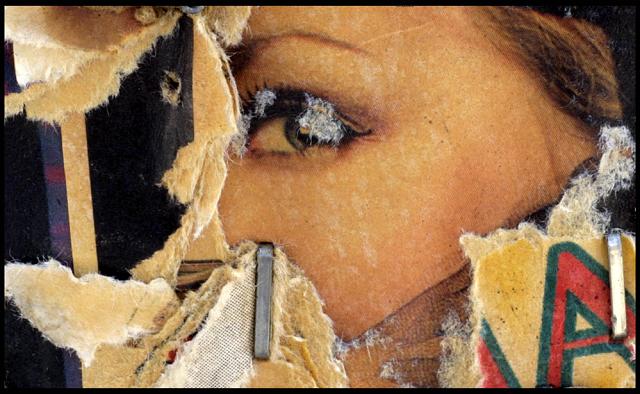
We rip up the past to make room for the present, we staple the present onto the past, we lose much of the meaning our words and images once had in fragments, snatches and colors…


image credit: MR McDonald

Even the staples eventually rust.

*

Still the past can at times be seen in the present, as earlier writing can still be seen in a palimpsest.

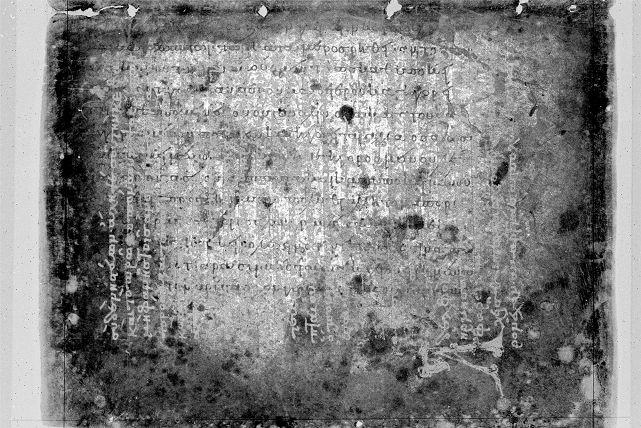
The Archimedes Palimpsest is [and I paraphrase] a Byzantine euchologion or prayer book manuscript, thought to have been completed by April 1229, and probably made in Jerusalem. Much of the parchment the scribes used in making the prayer book came from a earlier book of works by Archimedes, including his “On Floating Bodies” – a treatise of which no other copy survives. It seems the Archimedes manuscript dates back to tenth century Constantinople.


image credit: Archimedes Palimpsest Project

Erase Constantinople from your parchment, cut it and rotate it 90°, and you can build Jerusalem in its place. Peer deeply into prayer using multispectral imaging several hundred years later — and you may find combinatorial mathematics dating back more than two millennia…

What you are seeing in this image above is the workings of a mind two centuries BCE, transcribed in the tenth century CE, and made visible beneath and through other writing from the thirteenth, by twenty-first century tech.

So it is that Archimedes speaks to us today.

*

A palimpsest, then, is a layering of time on time, and the world we walk and talk in is itself a palimpsest.


image credit: MR McDonald

The enduring, you might say, can be seen through the transient — the zebra crossing through the snow.

*

To see two times at once — to see history, accurately or otherwise, as a metaphor for today — is to see simultaneously.

As in Sergey Larenkov‘s celebrated photos, in which World War II and the present day coexist:


image credit: Larenkov, Wrecked tank “Tiger” in Tiergarten park

[ edited to add: Larenkov takes black and white photos from WW II, shoots the same scene in color from the same position today, and masterfully stitches them together digitally to create an image that allows the ghost of the past to seen in the present — brilliant! ]

Here again, as in the magically surreal sculptures of Nancy Fouts, we see the power of mapping one thing onto a kindred other of which Koestler wrote.

*

To tie all this back into the question of Which world is more vivid? This, or the next?Stanley Hauerwas in his book, War and the American Difference: Theological Reflections on Violence and National Identity, suggests:

There is another world that is more real than a world determined by war: the world that has been redeemed by Christ.

He then clarifies his intent in saying:

The statement that there is a world without war in a war-determined world is an eschatological remark. Christians live in two ages in which, as Oliver O’Donovan puts it, “the passing age of the principalities and powers has overlapped with the coming age of God’s kingdom.” O’Donovan calls this the “doctrine of the Two” because it expresses the Christian conviction that Christ has triumphed over the rulers of this age by making the rule of God triumphantly present in the mission of the church. Accordingly the church is not at liberty to withdraw from the world but must undertake its mission in the confident hope of success.

*

Indeed, both Christianity and Zen would say that the greatest palimpsest is the palimpsest in which the transient circumstances of one’s life can all but obliterate the imperishable truth that underlies them — a palimpsest whose deepest layers may be read not with x-rays but by insight.

Christ lived in two times, or more accurately, time and eternity — to him the palimpsest was transparent, and thus he spoke (in John 8:58) what I suspect are the most profound five words in the Gospels:

Before Abraham was, I am.

Happy Easter!


Switch to our mobile site