zenpundit.com » geopolitics

Archive for the ‘geopolitics’ Category

Wikistrat: If Kim Jong-il Died…..

Saturday, February 26th, 2011

Wikistrat is running an interactive futurist simulation on possible pathways of change and regime change of the DPRK. I am participating alongside Thomas P.M. Barnett and HistoryGuy99 and the Wikistrat analytical team. Join us here.

Tom’s take:

New Simulation – The Death of King Jong-Il

…We have just launched our first open community simulation, where our analysts and subscribers explore a shock in the form of the sudden death of North Korean leader Kim Jong Il. Join our subscribers to engage in this live simulation, explore potential scenarios, aftershocks the various impacts of this event on countries’ interests. You can then play the Prime Minister and plan potential strategies for the United States, China, South Korea and many more.

Current ruler Kim Jong-Il turns 70 this year and is allegedly battling pancreatic cancer (very low five-year survival rate) and diabetes, as well as the obvious lingering effects of a stroke that occurred in 2008.

Starting in mid-2009 and culminating in a special party event in the fall of 2010, Kim positioned his under-30 third son, Kim Jong-Eun as his clear successor, although it is widely believed that Kim Jong-Il’s brother-in-law Chang Sung-Taek will play the role of regent for some indeterminate time.

North Korea’s recent military aggressiveness (e.g., ship sinking, artillery barrage of disputed island) suggests a determined effort to speedily credentialize Kim Jong-Eun among the military leadership that now controls much of the government, economy, and – most importantly – mineral exports to, and humanitarian aid from, patron China. Kim Jong-Il was publicly groomed as “founding father” Kim Il-Sung’s successor for roughly a decade-and-a-half, whereas Kim Jong-Eun will likely have had only a restricted public persona for 3-4 years at the time of his father’s death.

When Kim Il-Sung died in 1994, Kim Jong-Il nonetheless was unable to fully claim leadership status until three years had passed.

ADDENDUM:

Interesting article (Hat tip Col. Dave)

N.Korean Protesters Demand Food and Electricity

Small pockets of unrest are appearing in North Korea as the repressive regime staggers under international sanctions and the fallout from a botched currency reform, sources say. On Feb. 14, two days before leader Kim Jong-il’s birthday, scores of people in Jongju, Yongchon and Sonchon in North Pyongan Province caused a commotion, shouting, “Give us fire [electricity] and rice! “A North Korean source said people fashioned makeshift megaphones out of newspapers and shouted, “We can’t live! Give us fire! Give us rice!” “At first, there were only one or two people, but as time went by more and more came out of their houses and joined in the shouting,” the source added.

The State Security Department investigated this incident but failed to identify the people who started the commotion when they met with a wall of silence.

“When such an incident took place in the past, people used to report their neighbors to the security forces, but now they’re covering for each other,” the source said.


Wikistrat: Barnett on US National Military Strategy

Wednesday, February 23rd, 2011

Dr. Thomas P.M. Barnett on the new US National Military Strategy:

To subscribe to WIKISTRAT for their bulletins, interactive futurist simulation models and client-specific analytical services, go here.

Tom did a very nice job with this piece, particularly his reference to the historically underexamined but diplomatically significant Nixon Doctrine. He’s right. The strategic shift is a radical departure from the previous Bush era and is closely following the mammoth budgetary requests of our high tech services that are gearing up, along with industry lobbyists, to battle for every last dollar of a shrinking defense pie ( one reason I recently asked,  Is COIN Dead?). 

However, the military strategy should be driving acquisitions rather than being a shopping list transformed into a strategy ( see Shape the Future Force section) considering we are in at least two wars, perhaps three depending on how you count, from which we have yet to bring to a satisfactory resolution. That there is a shift here is not bad per se – East Asia is certainly far more significant to American security than is Afghanistan but that shift is so heavily laden with major economic and diplomatic variables, which, frankly, are of much greater longitudinal importance than military operational planning or short term force structure.

When Dictators Go Mad – Gaddafi Sentences Libya to Death

Tuesday, February 22nd, 2011

“Any Libyan who lifts an arm shall be punished with death….Any Libyan who undermines the sovereign state will be punished with death.” “Those who commit crimes against the army shall be punished with death. Anybody who works for a foreign company that undermines the country will be punished with death.”

Twitter is absolutely amazing on reporting events on Libya the last few days. What they lose in passing on rumors the make up for by being hours or days ahead of MSM and USG reaction.

Col. Gaddafi, who looks these days like a cross between a has-been rock star in Celebrity Rehab and Ethel Merman in her dotage, is desperately trying to cling to power and has unleashed artillery, naval bombardment, warplanes, helicopter gunships and African mercs on his own people. No word if the honorable member of the UN Human Rights Panel has employed poison gas yet, but the Libyans appear to be holding their own in fierce fighting in Libya’s largest cities.

The USG response has been muted on Libya. This sober restraint may reflect the vulnerability of American oil industry workers trapped in the fighting as well as the discomfort of anticipation of the details of recent deals between Western corporations and former government officials and the Libyan regime coming to light if Gaddafi falls. Or alternatively, Gaddafi tearing lucrative agreements up if he remains in power.

Gene Sharp

Monday, February 21st, 2011

[ by Charles Cameron ]

I was impressed by him in London in the early sixties.

Okay, I was young and impressionable. But others have noticed him more recently, too: Hugo Chavez accused him of being a conspirator with the CIA, and the Iranians thought he, George Soros and John McCain were in cahoots.

gene-sharp.jpg

Gene Sharp has been in the news quite a bit recently [1, 2, 3, 4], because he pretty literally wrote the book on non-violent resistance.

The young leaders of the Egyptian revolt that toppled Mubarak studied tactics with members of the Serbian Otpor youth resistance who topped Milosevic, Otpor studied tactics in the writings of Gene Sharp, specifically his 90-page pamphlet From Dictatorship to Democracy [download as .pdf]. Sharp wrote that handbook for use in Burma, where it was apparently translated at the request of Aung San Suu Kyi — who once cautioned her readers that that phrase they kept hearing wasn’t “jeans shirt”, it was “Gene Sharp”.

And before that, he’d penned his masterful 900-page, three-volume work, The Politics of Nonviolent Action

I told you he was impressive.

Recommended reading:

From Dictatorship to Democracy is now available in Amharic, Arabic, Azeri, Belarusian, Burmese, Chin (Burma), Jing-paw (Burma), Karen (Burma), Mon (Burma), Chinese (Simplified Mandarin), Chinese (Traditional Mandarin), English, Farsi, French, Indonesian, Khmer (Cambodia), Kyrgyz, Pashto, Russian, Serbian, Spanish, Ukrainian, Tibetan, Tigrigna, and Vietnamese.

Return of the Vanished Imam?

Monday, February 21st, 2011

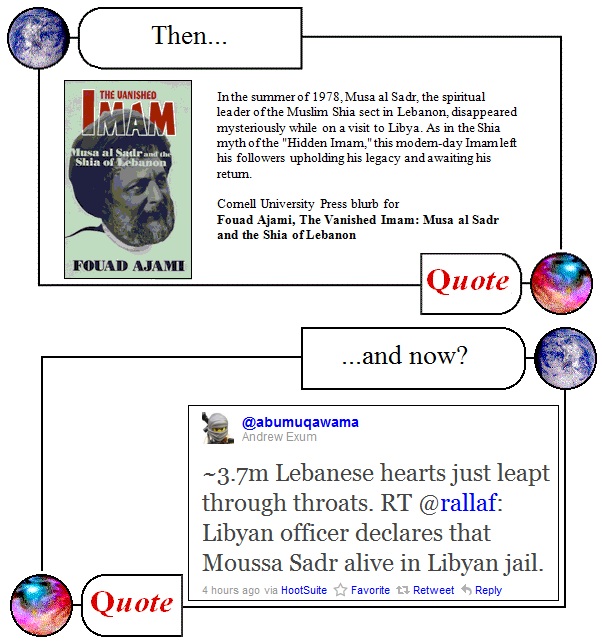
quomusa-al-sadr.jpg

Fouad Ajami’s The Vanished Imam: Musa al Sadr and the Shia of Lebanon was among the first books I read about matters Islamic, and the close parallel between the vanishing of Musa al-Sadr and the vanishing — or, more properly speaking, Ghayba or occultation — of the Twelfth Imam or Mahdi struck me forcibly at the time.

I don’t have my copy to hand, so I can’t tell how strongly Ajami himself made the comparison — but I was certainly not alone. Daniel Pipes, in his review of Ajami’s book writes:

What made the Imam’s vanishing so significant is that it exactly fit the millennial expectations of Shiism, a faith premised on the disappearance of righteous leaders and their reappearance at the end of time.

And now it may be — the report has yet to be confirmed — that Imam Musa is back among us.

@rallaf is an Associate Fellow at London’s Chatham House.

*

The mind sees one thing, which reminds it of something else. It’s the oldest trick in the book, and it depends on the recognition of pattern, or you might say, parallelism.

The return of Imam Musa would be significant not merely for his admirers, not only for what he might have to say or what role — now aged 82, after 30 years in prison — he might yet play, but also, I suspect, for the vivid premonition of the Mahdi his return might stir…


Switch to our mobile site