zenpundit.com » war

Archive for the ‘war’ Category

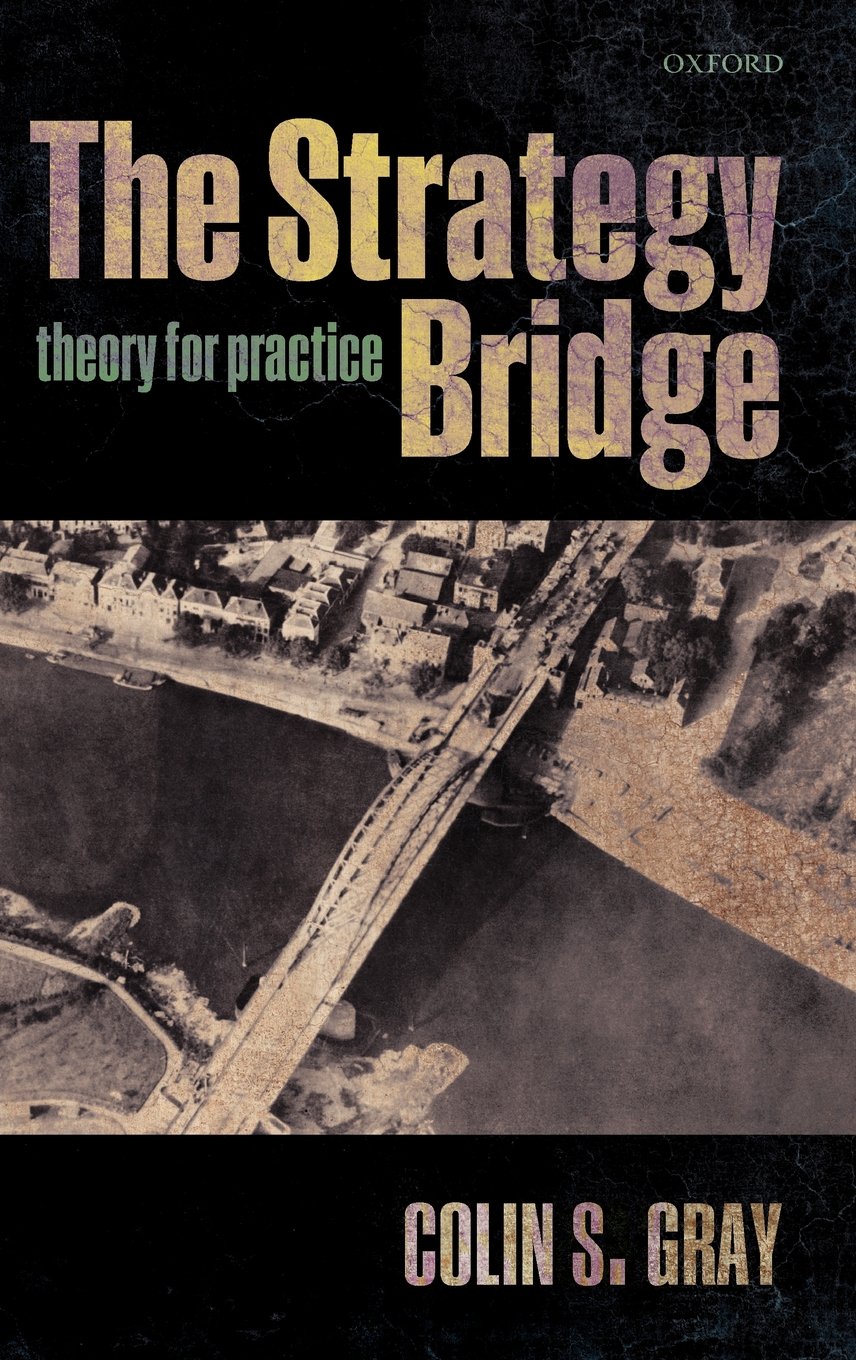
Book Review at Pragati: The Strategy Bridge by Colin Gray

Friday, July 5th, 2013

I have a new book review up at Pragati Magazine this morning, The Strategy Bridge:Theory for Practice by Colin S. Gray which is a must read book for any serious student of strategy.

Pragati, which is a national interest and policy magazine for India is starting to turn greater attention towards the subject of strategy and is also running another article in the same issue on strategy and the Maoist insurgency and recently on Indian grand strategy.

A Bridge over Troubled Waters

The title of The Strategy Bridge is also Gray’s operative metaphor, both for the purpose of strategy and the role of the strategist himself that represents the dialectical dynamic of war and strategy-making, the latter being a shared enterprise, save for some extreme historical outliers where strategy was vested in one man, like the regimes of Napoleon and Adolf Hitler. Strategy is the ‘bridge’ that must be built between policy determined by a national leadership and the operational and tactical behaviors of the military and other arms of national power. The strategist “mans the bridge”, orchestrating all of the elements within a master strategic concept and managing the iterative relationship.

Gray writes “The function of the military strategist, his unique raison d’etre, is to ensure that policy and the military instrument are purposefully connected… The strategist must understand the whole nature of a conflict, including war and warfare if antagonism has escalated thus far, because subject to political control, he has the duty of care over the entire competitive performance of the security community… The mission of the military strategist is to decide how the enemy is to be defeated. It is his task to invent a theory of military victory. That theory has to be expressed in and revealed in plans, which are contingent predictions of an extended kind, and must be commanded by generals to whom the strategist delegates some restricted command authority. Whether or not the strategist wishes or is able to function as a general also, must vary with historical circumstances”

….The Strategy Bridge is subtitled “Theory for Practice” because it is intended as a serious work of theory, a framework for understanding enduring principles of strategy so that a practitioner can thoughtfully apply them in making strategies for the specific context in which they find themselves to provide correct guidance for the operational planners and tacticians who will execute it. Consequently, Gray has not written an introductory text for a novice student but an insightful book for the strategic practitioner of journeyman experience – field grade officers, senior intelligence and foreign policy analysts, academic strategists, think tank researchers and national security advisers to senior government officials – who have a store of knowledge of their own. Hence the repeated invocation of “the bridge” metaphor by Gray; his primary audience are the people “doing strategy” and their success or failure “manning the bridge” will help determine the degree to which government purpose remains connected to action or whether the whole business will go off the rails into a quagmire, as it too often does. 

Read the rest here.

Clausewitz and Center of Gravity

Wednesday, July 3rd, 2013

At Small Wars Journal a provocative essay by Col. Dale C. Eikmeier:

Give Carl von Clausewitz and the Center of Gravity a Divorce

….Because we love Carl von Clausewitz and the center of gravity concept, we need to grant them a divorce- for our sake.  We tried for years to make it work, but it’s time to face reality, together they are just too abstract and confusing for us to embrace.

 The center of gravity concept, a mainstay of the US military “operational art” since 1986[1], has never fully satisfied doctrine’s intent.   According to Dr. Alex Ryan, a former School of Advanced Military Studies instructor, the concept is, “so abstract to be meaningless”[2]  Now if a ‘mainstay’ is so ‘abstract’ that subject matter experts declare it ‘meaningless’ we have a doctrinal problem.  The genesis of this problem is a doctrinal foundation built on dubious authorship and editing, underdeveloped theory, imprecise metaphors, and flawed translations. [3]  This Clausewitzian foundation, which was never very solid, is now collapsing under the weight of 21st century warfare.  For this reason it’s time to end our reliance on Clausewitz’s On War as the authority on the center of gravity concept.

….Crack Four.  Another problem is flawed translations.  Clausewitz never used the term “center of gravity”, or in German, “Gravitationspunkt”, he used the word schwerpunkt, which means weight of focus or point of effort which is different from center of gravity, hubs or sources of power. [9]   But it is easy to understand how an English translator when picturing this point of effort could think of a center of gravity which further illustrates the danger of metaphors.  Milan Vigo in Joint Operational Warfare Theory and Practice provides a detailed analysis of the evolution of schwerpunkt from focus of effort to center of gravity which is summarized below:[10]

  1. Schwerpunkt – main weight or focus or one’s efforts.
  2. Mid 19th century, schwerpunkt is associated with an enemy’s capital as the point of focus. Germans and Austrians used the word schwerpunktlinie to mean a line of main weight or effort that links one’s base of operations to the enemy’s capital. This is where the schwerpunkt as ‘the target’ understanding comes from.
  3. Late 19th century it comes to mean a section of the front where the bulk of one’s forces are employed to reach a decision. Schwerpunkt is now the ‘arrow’ not the target.  This is a subtle shift from the point of focus on a target, to the arrow or what is focused.  Count Alfred von Schlieffen and German military practice used the ‘arrow’ understanding up to WW II.
  4. Colonel J.J. Graham’s 1874 English language translation of On War  mistranslated Schwerpunkt as “center of gravity”[11]
  5. Post World War I German military progressively adds a new meaning using schwerpunkt to mean the focus of planning efforts.  This is a natural evolution of the late 19th century hybrid of ‘the arrow’ and the ‘target’ understandings.
  6. The Bundeswehr (German Army) now uses the English term “center of gravity” while the Austrian Army uses the German term “Gravitationspunkt” which translates to “center of gravity”. 

Hence, English translators took Clausewitz’s “schwerpunkt”, ‘the target or point of focus’ meaning mistranslated it into center of gravity which morphed into the source of power or ‘the arrow’ meaning. 

I’m not understanding Eikmeier’s hostility to the employment of metaphor as a device for learning as it is a conceptual bridge for understanding without which human society would not have made much progress.  Yes, metaphors can be misunderstood or abused but so can just about everything else. Most important ideas were either understood by or are most easily explained by metaphor and analogy.

“Center of gravity” in Clausewitzian theory is often misunderstood by non-experts or incorrectly identified in the enemy in practice in the midst of a war, but the same can be said of many other valuable concepts. Ask people to explain “gravity” itself and see how precisely scientific an explanation you receive, but that hardly means we should abandon the concept.

Regarding translation from On War, Eikmeier may have a more valid point but I am not qualified to assess it. I have a fair grasp of the political-historical context but not the linguistic and cultural nuances of early 19th century German language expression. Maybe Seydlitz89 will care to weigh in here?

Night vision, x-rays – what do we have for the fog of war?

Monday, June 17th, 2013

[ by Charles Cameron — it occurred to me to ask ]
.

I have a question for the assembled horde — but first, the shoes:


Getting your feet x-rayed and fitted for a new pair of shoes, ca. 1950

**

You know the way they say (Elizabeth Kübler-Ross, eg, with no implied claim of veracity here, just interest) that you go through various stages of grief: denial, anger, bargaining, depression and acceptance?

Suppose there are stages of response to terror that governments, agencies, leaders, pundits, analysts & journos tend to go though. Suppose at the start they lean to the vengeful and are therefore prone to see things in black and white, no nuance, confrontational, response intense & military rather than diplomatic — and in later stages get calmer, begin to see motives less single-strandedly, catch details previously missed, suggest responses that are more measured, more proportional, etc.

If we got really clear on how this tends to work, could we begin to have an understanding of the ratio between “heat of the moment” and “after the fog of war clears” thinking, which in turn could allow us to discount initial reactions, look for “next stage” signals in the cognitive periphery, and get a more accurate read through the fog from the start?

We know now, eg, that the first reaction at OKC was to expect Muslim blame, but it become clear that McVeigh did it — and first expectations were dashed. With WMD in Iraq the clearing of the fog took longer, but it still happened.

I’m suggesting that people who have just been affronted or attacked will understand better, later, and that for more appropriate response, some time lag may be required. But does the lag time have formal features, styles of assumption that gradually give way identifiably and reliably to more nuance and accuracy as certain formal issues are addressed — so there could be a checklist, and a kind of 2 week, two month, two year, two decade look ahead / lookback methodology devised, charted, and implemented, eg as a part of scenario planning and / or red teaming?

Is some of this implicit in the second O in the OODA loop? Can we take it usefully further?

**

Yes, when I was a boy, you stepped up to the x-ray machine in the shoe store, pushed your feet in and peered into the viewer at the top of the machine to see how well your new shoes fit your ghost-of-a-skeleton feet.

Later on, this was viewed as an unhealthy way to judge the fit of a shoe, and life and choice in shoe stores became more complicated.

Moral Degeneration in the Crucible of War

Wednesday, June 12th, 2013


The recent post on Is 4GW Dead? stirred a great deal of interest, so I would like to extend the discussion on a point that that is critical not only for those who have responsibility for conducting military campaigns, but for statecraft and policy as well.

One of more important tenets of 4GW was the importance of “the moral level of war”, drawn from Colonel John Boyd’s thinking on the strategic impact of a combatant’s behavior, immoral  or exemplary, on all observers – belligerents, civilian noncombatants, neutral third parties, the media, the combatant’s own soldiers and citizens back home. Here is Boyd:

Morally our adversaries isolate themselves when they visibly improve their well being to the detriment of others (allies, the uncommitted), by violating codes of conduct or behavior patterns that they profess to uphold or others expect them to uphold.

· Morally we interact with others by avoiding mismatches between what we say we are what we are and the world we have to deal with, as well as by abiding by those other cultural codes or standards we are expected to uphold.

In a Reader’s Digest version of Boyd,  heroic, noble and magnanimous  behavior is admirable and attractive while hypocrisy, cruelty and cowardice are repulsive and antagonizing characteristics. While the former won’t guarantee your victory and the latter, unfortunately, won’t ensure your defeat, they will be a significant factor in ameliorating or generating friction.  The impression given by an army impacts the will of the enemy to fight, the morale and discipline of the soldiers, the restiveness of the civilians, the loyalty of allies and the goodwill of neighbors.

Boyd developed his thinking about the moral level of war in Patterns of Conflict  all the way up to grand strategy and above. The rub about the moral level  is that war is a crucible that puts every “cultural code” or “standard” to the test, as well as the character of the men fighting it and their leaders upon whom great responsibility rests.  Even with the best of intentions in policy and careful generalship in the field, the horrors of war can erode moral fiber and military discipline in an army, in a company or in the heart of one man. Nor does every army begin with good intentions and effective discipline – some fighting forces are scarcely to be regarded as “armies” at all while others embrace the darkness as a matter of policy.

In terms of warfare, let us define “moral degeneration” as a degraded state of moral decline where a belligerent has effectively abandoned the operational and tactical restraints on conduct mandated by the Laws of War (i.e. war crimes are SOP) and in some instances, the vestiges of civilization.

A textbook example of this kind of moral degeneration came to light a few weeks ago when a jihadi lunatic in Syria, a rebel commander Khalid al-Hamad, who goes by the name of “Abu Sakkar”, cut out the heart of a (presumably) dead government soldier and ate it on video. Charles Cameron expounded at length upon this minor atrocity here. I am not, to say the least, a fan of radical, revolutionary, transnational Sunni Islamism but I cannot honestly say that its proponents like Abul Mawdudi , Sayid Qutb, Abdullah Azzam, Osama bin Laden and their ilk ever openly advocated cannibalism. It is much more likely that Mr. al-Hamad’s behavior is explained by the ferocity of the civil war in Syria eroding customary norms of the combatants than  it is by Islamist ideology.

Moral degeneration in war seems to spring from two directions:

a) As a calculated act of Policy, from the top down, enforced by the leadership by military discipline and bureaucratic control.

b) As a spontaneous reaction by soldiers or fighters, appearing from the bottom up, without orders and frequently, in spite of them, possibly due to a breakdown in the chain of command, an erosion of discipline or sheer mutiny for the age-old purpose of reprisal, pillage and rapine.

The first category often occur with war as a convenient cover rather than a cause of grave crimes against humanity that leaders and  ideologues had long wished to carry out. The Armenian Genocide, as John Keegan wrote, belongs properly to the history of Ottoman imperial policy than it did WWI; in truth, the Genocide was the greatest and worst in a long succession of vicious pogroms that the Ottomans had launched against their Armenian Christian subjects during the reign of Abdul Hamid and the Young Turks. The Holocaust (which had some inspiration in Hitler’s mind, from the fate of the Armenians) was more closely tied to the evolution of  Nazi war policy but once Operation Barbarossa opened up the vast spaces of Soviet Eurasia, “the East” in Nazi parlance, the war itself increasingly took a backseat to expediting Hitler and Himmler’s ghastly and murderous racial priorities. This is a pattern of a priori planning, an escalating ideological radicalization of society that tends to be present with most of the large scale democides and genocides. It is the organizational powers of  coercion utilized by the state, or a mobilized faction of , it that makes the enormous scale of death possible, not the war.

What is different and also dangerous about moral degeneration from the bottom-up, is that it is cultural evolution driven by the psychological effects of extreme violence at work and, unlike an act of policy, more likely to be diffused widely across society as a permanent change for the worse. Too many German soldiers in WWI, former peasants and artisans and boys from middle-class families, returned from the Western Front morally coarsened and addicted to the adrenalin rush of combat and became in succession Freikorps paramilitaries, Communist streetfighters, Nazi Stormtroopers and SS men. The World War also gave Russia the men of the Cheka, the Red terror and the first Gulags on the Bolshevik Left and brutal and mad warlords on the White Right.

In more recent two decades, the break-up of Yugoslavia unleashed atavistic passions of ethnic hatred and atrocity, while organized society in Western African states and central Africa broke down entirely in transnational regional civil wars with unrestrained massacres and mass rape. As a result, there is little that is political but much that is primeval, at this juncture, to explain Joseph Kony’s motivations; he resembles nothing so much as a 21st century Kurtz. Mexico too is degenerating from the escalating violence of cartel insurgency and narco-cultas – there is not much tactical or strategic value in pagan death cults or human sacrifice but it is spreading:

…Our impression is that what is now taking place in Mexico has for some time gone way beyond secular and criminal (economic) activities as defined by traditional organized crime studies.3 In fact, the intensity of change may indeed be increasing. Not only have de facto politicalelements come to the fore-i.e., when a cartel takes over an entire city or town, they have no choice but to take over political functions formerly administered by the local government- but social (narcocultura) and religious/spiritual (narcocultos) characteristics are now making themselves more pronounced. What we are likely witnessing is Mexican society starting to not only unravel but to go to war with itself. The bonds and relationships that hold that society together are fraying, unraveling, and, in some instances, the polarity is reversing itself with trust being replaced by mistrust and suspicion. Traditional Mexican values and competing criminal value systems are engaged in a brutal contest over the ?hearts, minds, and souls‘ of its citizens in a street-by-street, block-by-block, and city-by-city war over the future social and political organization of Mexico. Environmental modification is taking place in some urban centers and rural outposts as deviant norms replace traditional ones and the younger generation fully accepts a criminal value system as their baseline of behavior because they have known no other. The continuing incidents of ever increasing barbarism-some would call this a manifestation of evil even if secularly motivated-and the growing popularity of a death cult are but two examples of this clash of values. Additionally, the early rise of what appears to be cartel holy warriors may now also be taking place. While extreme barbarism, death cults, and possibly now holy warriors found in the Mexican cartel wars are still somewhat the exception rather than the rule, each of these trends is extremely alarming, and will be touched upon in turn.

The crucible of war either tempers a people or it breaks them.
“We will start the war from right here.”

Thursday, June 6th, 2013

[collated by Lynn C. Rees]

My Fellow Americans,

Last night, when I spoke with you about the fall of Rome, I knew at that moment that troops of the United States and our Allies were crossing the Channel in another and greater operation. It has come to pass with success thus far.

And so, in this poignant hour, I ask you to join with me in prayer:
(more…)


Switch to our mobile site