zenpundit.com » war

Archive for the ‘war’ Category

Elkus on Mad Dogs and Military History

Friday, May 10th, 2013

Adam Elkus has a lengthy and meaty post at Abu Muqawama, inspired by General Mattis, one that you should really read in full:

The Mattis Book Club

….But while gaining an understanding of the nature of war is useful, there are a lot of things it won’t do. This becomes most apparent in the section of the email where Mattis makes specific claims. Mattis repeatedly states that nothing is new under the sun, makes comparisons across big temporal zones (Alexander the Great in Persian Iraq vs. 2004 iraq), and advances specific analytical arguments about military theories. He does so on the basis of a sweeping generalization that 5,000 years of warfare tells us in aggregate that war has not changed. While this makes for a rousing line, it is also a fairly problematic statement. How do we really know that the nature of war has not changed in 5,000 years?

We should recognize that this is an isolated quote, and strive to not take out of context what was a heartfelt letter to a colleague in need of guidance. But the argument itself—as the cumulative product of a process of self-education in the nature of warfare, does merit some critical analysis. It is part of a humanistic conception of war that stresses the unity of military experience across the ages, and puts the fighting man’s will first. What Mattis dashed off in an email has been repeated by others in journal articles, blog posts, essays, and books. The military historian Brian McAllister Linn, in his seminal study of the Army’s cultures, dubbed it the “heroic” style of war. Linn constrasts this humanistic style this with technocratic Managers, defensive Guardians, and other military tribes with differing values and approaches.

So what do we know about 5,000 years of constant violence?

Often times the answer is that it depends. As my Fuller and Liddell-Hart examples illustrate, the quality of historical accounts is extremely uneven. Military history as a modern discipline only started with Hans Delbruck, a civilian who did some basic math and discovered that many of the most prominent chroniclers of pre-modern warfare were flat-out wrong about ancient history’s greatest battles and campaigns. Anthropologists still argue today about the nature of violence in the evolutionary state of nature and whether it can be mapped to violence in settled states. Second, it may be true that war is war in the Clausewitzian sense. But while it is technically true that Alexander’s Iraqi opponents and Sadrist mobs are both humans seeking to use force to impose their will, this in and of itself is not very useful. There are fairly prominent shifts in the character of politics, the international system, techology, wealth, and society that matter too.  

What constitutes politics is a very important point.

Take for example, the Romans. There was a definite shift between the Early-Middle Republican eras and the Late Republic in elite politics and the socioeconomic conditions upon which Roman assumptions about war and the organization and supply of Legions rested.  Growing inequality of wealth was making it harder for Plebian citizens to afford to muster for a campaign, the need for longserving “professional” Legates to maintain “institutional memory” of the “arts of war” of the Legions expanded even as the highly coveted opportunities for Patricians to command decreased. These trends clashed with what the Romans liked to  believe about themselves and the friction between advocates of reforms (often necessary and practical) and the upholders of  centuries of honored tradition made Roman politics increasingly bitter, dysfunctional and subsequently lethal. The early Romans would have been horrified by Marius and Sulla, to say nothing of Antony and Octavian.

In the end, the politics of the Romans, along with their battlefield experiences, changed how they organized and manned their Legions, why and how they fought the wars as they did and continued to shape Roman warfare as long as the empire lasted. Julius Caesar would have been as startled by Late Antiquity’s semi-barbarian “Roman” Magister Militiums as his own career would have dismayed Decius Mus.

Adam goes on to have some useful things to say about the need for combining historical and quantitative  social science  methodologies and the limitations of each. Delbruck’s overstated skepticism of the ancients aside, sometimes we moderns do not count any better in war or politics – or at times,  even worse
Jottings 4: Waiting for the fog to clear

Sunday, May 5th, 2013

[ by Charles Cameron — not much else to say, really ]
.

.

Sources:

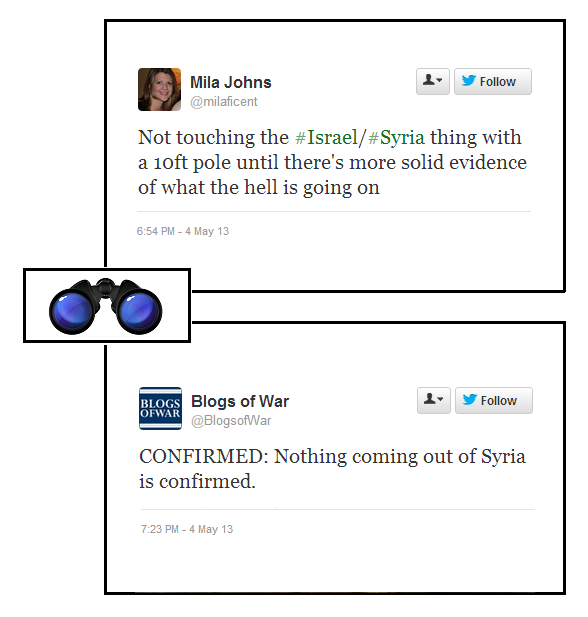
  • Mila Johns
  • Blogs of War
  • Syria, chemicals, Israel: the fast and slow of it

    Sunday, May 5th, 2013

    [ by Charles Cameron — always we need the rapid response, always we need the slow, thoughtful understanding ]
    .

    It’s almost axiomatic, isn’t it, we need two brain speeds, two types of intelligence, two modes of analysis, to handle the moment and the times we live in. Both.

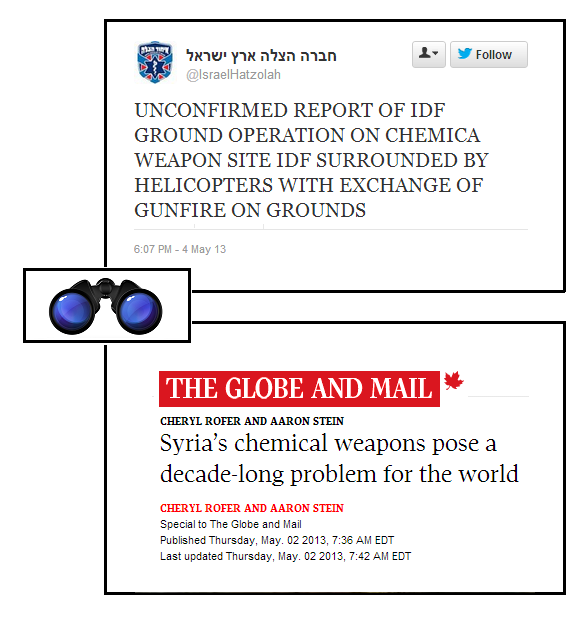
    Chevra Hatzolah Israel has the immediacy of Twitter, Cheryl Rofer and Aaron Stein the longer view from the Globe and Mail. Both.

    **

    Cheryl Rofer, a good friend of this blog, “supervised a team developing supercritical water oxidation for destruction of hazardous wastes, including chemical warfare agents, at the Los Alamos National Laboratory” — bio from the Globe and Mail article. I don’t want to pick and choose excerpts from her piece, I’m certainly no expert on her topic — but as things heat up in Syria, the considerations she describes offer us significant background.

    Read her insights as posted two days ago in Syria’s chemical weapons pose a decade-long problem for the world.

    **

    [ edited 45 mins later to add: ]

    Blake Hounshell’s post a few minutes ago for FP, That awkward moment when … Israel launches airstrikes in Syria, begins to bring the two strands of thinking together — Israel attacks, but cautiously…

    Syrian state TV is claiming that Israel hit a “research center,” while opposition Facebook pages are saying that several elite units on Mt. Qassioun, overlooking Damascus, were the targets.

    Because it’s so difficult, not to mention risky, to destroy chemical-weapons stocks from the air, the next-best thing is to take out Assad’s means of delivering them. And Mt. Qassioun is reportedly where many of the Syrian regime’s best missiles are kept.

    That’s a lot less worrisome.

    **

    As the “fog of war” slowly clears, the longer and slower insights will prove to be the more reliable and enduring.

    Ancestral voices prophesying war

    Thursday, May 2nd, 2013

    [ by Charles Cameron — “And ‘midst this tumult Kubla heard from afar, Ancestral voices prophesying war!” ]
    .

    At 36 minutes and 12 seconds, this video of Bob Dylan‘s Masters of War slowed down “800%” — i.e. to eight times its normal length — may or may not be something you find time for.

    It’s eeeeerie, I can tell you that much. And I’m not the only one to post it either — Wired featured it in their birthday greeting to Dylan last year.

    If you have the meditative patience for Tibetan chanting, you might want to give Dylan at 1/8th speed a try.

    **

    Sources:

  • Coleridge, Kubla Khan
  • Dylan, Masters of War, eight versions…
  • Syria is Not Rwanda

    Monday, April 29th, 2013

    Anne-Marie Slaughter had a short but bombastic WaPo op-ed on Syria and chemical weapons use that requires comment:

    Obama should remember Rwanda as he weighs action in Syria 

    ….The Clinton administration did not want to acknowledge that genocide was taking place in Rwanda because the United States would have been legally bound by the Genocide Convention of 1948 to intervene to stop the killing. The reason the Obama administration does not want to recognize that chemical weapons are being used in Syria is because Obama warned the Syrian regime clearly and sharply in August against using such weapons. “There would be enormous consequences if we start seeing movement on the chemical-weapons front or the use of chemical weapons,” he said. “That would change my calculations significantly.”

    ….But the White House must recognize that the game has already changed. U.S. credibility is on the line. For all the temptation to hide behind the decision to invade Iraq based on faulty intelligence about weapons of mass destruction, Obama must realize the tremendous damage he will do to the United States and to his legacy if he fails to act. He should understand the deep and lasting damage done when the gap between words and deeds becomes too great to ignore, when those who wield power are exposed as not saying what they mean or meaning what they say.

    This is remarkably poorly reasoned advice from Dr. Slaughter that hopefully, President Obama will continue to ignore.
    .
    The President, on the basis of advice very much in the spirit of this op-ed, drew a public “red-line” about chemical weapons use for Bashar Assad, or some variation of that, on six occasions, personally and through intermediaries. On the narrow point, Slaughter is correct that this action was ill-considered, in that the President wisely does not seem to have much of an appetite for jumping into the Syrian conflict. Bluffing needlessly is not a good practice in foreign policy simply to pacify domestic critics, but it is something presidents do from time to time. Maybe the POTUS arguably needs better foreign policy advisers, but doubling down by following through with some kind (Slaughter fails to specify) military intervention in Syria is not supported in this op-ed by anything beyond mere rhetoric.
    .
    First, as bad as the Syrian civil war is in terms of casualties it does not remotely approximate the Rwandan Genocide in scale, moral clarity, military dynamics or characteristics of the major actors. This is a terrible analogy designed primarily to appeal to emotion in the uninformed. Syria is engaged in civil war, not genocide.
    .
    Secondly, the “credibility” argument has been lifted by Slaughter from it’s Cold War historical context where the United States capacity to provide a nuclear umbrella and effective deterrent for allied states was tied to the perception of our political will to assume the appropriate risks, which in turn would help avoid escalation of any given conflict to WWIII. This psychological-political variable of “credibility” soon migrated from the realm of direct US-Soviet nuclear confrontation in Europe to all manner of minor disputes (ex. –Quemoy and Matsu, civil unrest in the Dominican Republic) and proxy wars. It was often misapplied in these circumstances and “credibility” assumed a much greater exigency in the minds of American statesmen than it it did in our Soviet adversaries or even our allies, to the point where American statecraft at the highest level was paralyzed by groupthink in dealing with the war in Vietnam. By 1968, even the French thought we were mad.
    .
    Absent the superpower rivalry that kept the world near the brink of global thermonuclear war, “credibility” as understood by Johnson, Rusk, Nixon and Kissinger loses much of it’s impetus. If “credibility” is the only reason for significant US intervention in Syria it is being offered because there are no good, hardheaded, reasons based on interest that can pass a laugh test.
    .
    The historical examples President Obama should heed in contemplating American intervention in Syria is not Rwanda, but Lebanon and Iraq.

    Switch to our mobile site