zenpundit.com » war

Archive for the ‘war’ Category

Which world is more vivid? This, or the next?

Monday, March 19th, 2012

[ by Charles Cameron — bin Laden, Abu Bakr, Bernard of Clairvaux, Qur’an burning, Tora Bora, David Ignatius, Emptywheel, and impassioned belief ]
.


image: Paulo Uccello (1443) depicts the Resurrection
life after the grave, seen through a glass, darkly

We keep on stumbling over this one.

To the western mind, mostly, this world is axiomatically more vivid than the next. But there are those for whom the next life is axiomatically the more vivid – even if their day to day practices are geared to success and continuity in this life.

And this has consequences for our own lives, in the world around us — and for security.

1.

Some who are of this mind – bin Laden in this video among them — may quote or paraphrase Abu Bakr‘s message to Khosru:

I have come to you with an army of men that love death, as you love life.

That particular quote is from the rich tapestry of Islam – but Jewish history speaks also of Kiddush ha-Shem, martyrdom for the glory of God, which became in the time of the crusades “the exemplary answer of Jews threatened in their life and faith” when offered the options of conversion to Christianity or death.

And in Christendom, there is St Bernard of Clairvaux, who is quoted as writing in his letter to the Templars at the time of the Second Crusade:

The Christian who slays the unbeliever in the Holy War is sure of his reward, the more sure if he himself is slain.

and for good measure in his sermon promoting the Crusade:

Christian warriors, He who gave His life for you, to-day demands yours in return. These are combats worthy of you, combats in which it is glorious to conquer and advantageous to die.

2.

It is with this difference in axiomatic understanding in mind, that we should approach such issues as the relative importance – in our own minds, and in those of many Afghans – of the loss of human life in a night raid, as compared with the burning of copies of the Qur’an [In Reactions to Two Incidents, a U.S.-Afghan Disconnect]:

The mullah was astounded and a little angered to be asked why the accidental burning of Korans last month could provoke violence nationwide, while an intentional mass murder that included nine children last Sunday did not.

“How can you compare the dishonoring of the Holy Koran with the martyrdom of innocent civilians?” said an incredulous Mullah Khaliq Dad, a member of the council of religious leaders who investigated the Koran burnings. “The whole goal of our life is religion.”

And a quick note here — this is an issue I’ve raised before, eg in Burning scriptures and human lives, in Of Quantity and Quality I: weighing man against book, and more recently in On fire: issues in theology and politics – ii.

3.

The same understanding also explains bin Laden’s retreat to the Tora Bora caves. As I said in an early guest post here on ZP, with a hat-tip to Lawrence Wright and his book The Looming Tower:

When bin Laden, at the lowest point of his jihadist efforts, leaves the Yemen for Afghanistan and betakes himself to the Tora Bora caves, he will inevitably remind some Muslims of the Prophet himself, who at the lowest point of his prophetic vocation left Mecca for Medina and sought sanctuary in a cave — where by the grace of his God, a spider’s web covered the entrance in such a way that his enemies could not see him.

Our natural tendency in the west is to see Tora Bora in terms of military topography, as a highly defensible, almost impregnable warren of caves deep within some of the world’s most difficult mountain territory. What we miss may be precisely what Muslim piety will in some cases see — that bin Laden’s retreat there is symbolically aligned with the “sunna” or life of the Prophet, and thus with the life of Islam itself — in much the same way that Christians, in the words of Thomas a Kempis, may practice “the Imitation of Christ”.

4.

It was in fact Emptywheel‘s piece about bin Laden’s comment re killing President Obama (and thus promoting Joe Biden) that caught my attention today and prompted this post.

Emptywheel quoted the same passage from David Ignatius that had triggered my own post On the “head of infidelity” and the tale of Abdul-Rahman ibn Awf late yesterday —

“The reason for concentrating on them,” the al-Qaeda leader explained to his top lieutenant, “is that Obama is the head of infidelity and killing him automatically will make [Vice President] Biden take over the presidency… “

— and commented:

OBL was going to kill Obama not for the sake of killing the US President, but because Biden, who served in the Senate for 36 years, almost 12 of which he served as one or another powerful committee Chair, “is totally unprepared for that post, which will lead the U.S. into a crisis.”

I just don’t think that’s right. I think it’s wrong, in fact, but [and here’s the important part] subtly wrong.

I believe that OBL lived at the confluence of worlds — one that we might call mythic or spiritual, and one that’s the one we call the “real” world. I believe that it was his myth, archetype, spirit based reality that was the more vivid to him, the one to which he was entrained, and that he found means in the practical world of strategies and tactics to adhere to the demands of that other world.

A world that was both invisible to us, and to him axiomatically victorious – at least as much so in death as in life.

The Said Symphony: move 19

Sunday, March 18th, 2012

[ by Charles Cameron – extended analytic game on Israeli-Palestinian conflict — for those who wish to catch up, our game thus far consists of an intro to the game and game board, followed by moves 1-5, 6-9, then moves 10-11 which together constitute a meditation, moves 12, 13-15, 16-17, and most recently before this, move 18 with cadenza ]

Move 19: The view from above

Move content:

Discussing strategy, the very canny LTG (USMC, Ret’d.) Paul Van Riper had this to say:

What we tend to do is look toward the enemy. We’re only looking one way: from us to them. But the good commanders take two other views. They mentally move forward and look back to themselves. They look from the enemy back to the friendly, and they try to imagine how the enemy might attack them. The third is to get a bird’s-eye view, a top-down view, where you take the whole scene in. The amateur looks one way; the professional looks at least three different ways.

A bird’s-eye view, a hawk’s eye view, a top-down view, an overview, a view from 30,000 feet, a God’s eye view, a view from above, a zoom…

If move 18 and its cadenza gave us a view of the depth of vision or insight that is necessary for a full and rich understanding of the world we live in — its qualitative or spiritual scope, if you like — this next move, with its picnic and drone-sight, addresses its breadth in space and time — materially and quantitatively speaking.

The classic expression of the sheer material scope of the universe was put together by Charles and Ray Eames in their justly celebrated film, Powers of Ten, from which the lower of these two images is drawn:

Here are some other relevant scans of the scope of things, in terms of time and space:

The Scale of the Universe 2
A Brief History of The Universe
The Known Universe
A Time-Lapse Map of Every Nuclear Explosion Since 1945

These are impressive videos to be sure, but as an aside I’ll invite you to ask yourselves how well they compare with this zoom in words, a poem by the zennist, ecologist, essayist and poet Gary Snyder, from his book, Axe Handles: Poems:

Such breadth of vision, such craft.

*

If this “material scope of things” too has a cadenza, it would be that all of this is shot through with some primary oppositions, dappled as the poet Gerard Manley Hopkins would have it, with swift, slow; sweet, sour; adazzle, dim — as indicated in the drone-sight and picnic double image at the head of this move.

This dappling, this constant flux of opposites, takes many forms — day and night lead to the more abstract light and dark, which can then be interpreted morally as good and evil, to which we respond with repulsion and attraction as the case may be, building our worldviews from love or fear…

At different scales the opposites that matter most to us may have different names and shadings, but here I’d just like to draw attention to the dappling of our world with:

competition and cooperation
Darwin‘s natural selection and Kropotkin‘s mutual aid
duel and duet (ah! — a favorite phrasing of mine)
war and peace

Provocatively, we find this dappling in scriptures, too, wherein the ripples of such verses as “The LORD is a man of war: the LORD is his name” (Exodus 15.3) dropped like a stone into the pond of the human mind, meet with the ripples of other verses such as “God is love; and he that dwelleth in love dwelleth in God, and God in him” (I John 4.16).

There are times when we take such oppositions literally, perhaps too literally, and times when we begin to see oppositions as abstract and theoretical end-points to what is in fact a yin-yang process continually unfolding…

Which brings me by a commodius vicus of recirculation to this image of the great opposition between war and peace, its dappling, its unfolding:

Links claimed:

To the Lamb, move 18: this move presents the material scope of the universe in counterpoint to its visionary scope as laid out in move 18 with its cadenza.

To Revelation, move 17 — the word revelation means unveiling, as we have seen, and our sciences and technologies, with their spectra of telescopes, microscopes, cameras and zooms, are unveiling and revealing to us much about the physicality of the world we live in — much that was accounted for in other times and places through intuition, vision and poetry.

This scientific and technical revelation of material existence, for many of us moderns, has largely eclipsed the mode of visionary revelation of move 17 — yet it cannot eradicate it. Implicit in this move, then, is the sense that we carry with us both subjective and objective, inner and outer, qualitative and quantitative understandings — though the data that “sight” and “insight” provide us with may be different in kind, and resolving them may be something of a koan to us, the deep problem in consciousness as philosophers of science have named it — and that we can discount neither one if we are to have and maintain a rich sense of our situation.

Comment:

If the two previous moves have shown us the scope of the universe we co-inhabit, perhaps we should now make our own zoom in, much as James Joyce did when he had the schoolboy Stephen inscribe his name and address in his geography book as Stephen Dedalus, Class of Elements, Clongowes Wood College, Sallins, County Kildare, Ireland, Europe, The World, Universe – an address that Stephen then read both forwards and backwards, finding himself in one direction, and finding in the other that he had no means of knowing what might lie beyond the universe…

Imagine then, skipping rapidly from (unimaginable) cosmos via such things as the intriguingly named End of Greatness to galaxy or nebula…

…solar system and planet — whence we can slow down and zero gently in on the Middle (or as my friend Ralph Birnbaum would call it, the Muddle) East, Israel / Palestine, Jerusalem / Al Quds / the Temple Mount / Noble Sanctuary – and to such matters of contemplative vision and tribal passion as the first, second and projected third Temples, the al-Aqsa mosque.

Our increasing focus will bring us, then, to that the rock which Jews believe marks the place where Abraham bound his son Isaac (the Akedah), and which Muslims believe to be the place of ascent of the Prophet to the celestial realms (the Mi’raj) on his Night Journey (Qur’an, Al-Isra).

Here again myth and history collide, and both visionary and material considerations merge in the heart of the what my friend the Israeli journalist Gershom Gorenberg has justly called “the most contested piece of real estate on earth”.

The End and Ends

Tuesday, March 13th, 2012

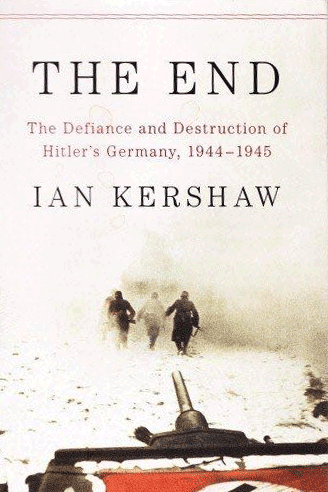
The End by Sir Ian Kershaw

I am currently reading The End, about the last year of the Third Reich and the Nazi death spiral toward Germany’s absolute destruction. It is a fascinating, mass suicidal, political dynamic that was mirrored to an even greater degree of fanaticism by Nazi Germany’s Axis partner, the Imperial Japanese. Facing the prospect of certain defeat, the Germans with very few exceptions, collectively refused every opportunity to shorten the agony or lighten the consequences of defeat and stubbornly followed their Fuhrer to the uttermost doom. It made no sense then and still does not now, seven decades later.

Adolf Hitler’s personal authority over the life and death of every soul in Germany did not end until his last breath. When surrounded by Soviet armies, trapped in his Fuhrerbunker in the ruin of Berlin, all it took for Hitler to depose his most powerful paladins, Hermann Goering and Heinrich Himmler was a word. They still commanded vast military and paramilitary security forces – Himmler had been put in charge of the Home Army as well as the SS, Gestapo and German police – but when Hitler withdrew his support and condemned them, their power crumbled. Goering, the glittering Nazi Reichsmarchal and second man in the state, was ignominiously arrested.

Even in Gotterdammerung, the Germans remained spellbound, like a man in a trance placing a noose around his own neck.

Currently, the chattering classes of the United States are uneasily working their way toward a possible war with Iran, or at least a confrontation with Teheran over their illegal nuclear weapons program (some people will object that, technically, we are not certain that Iran has a weapons program. This is true. It is also irrelevant to the diplomatic dynamic created by Iran’s nuclear activities which the regime uses to signal regularly to all observers that they could have one).  There is much debate over the rationality of Iran’s rulers and the likely consequences if Iran is permitted to become a nuclear weapons state. There is danger and risk in any potential course of action and predictions are being made, in my humble opinion, far too breezily.

In the run-up to war or negotiation, in dealing with the Iranians and making our strategic calculations, it might be useful to recall the behavior of the Germans.

Iran is a classic wicked problem

Saturday, March 10th, 2012

[ by Charles Cameron — Iran, unknown unknowns, Madhyamika philosophy and a blessed unknowing ]
.


.
image from Jackson Pollock / AustinKids
an artist’s representation of a wicked problem to be untangled?

1.

Dr. TX Hammes, who will need no introduction to most ZP readers, wrote a few days back in On Bombing Iran, A False Choice:

While there has been some discussion of Iran closing the Straits of Hormuz, there has been no consideration of other Iranian actions – mining harbors overseas (using merchant ships), major attacks on oil production chokepoints globally or major terror attacks using the nuclear equivalent explosive power inherent in many industrial practices. In short, bombing proponents assume Iran will be an essentially supine enemy and not attempt to expand the conflict geographically or chronographically.

Iran is a classic wicked problem. Any “solution” brings a new set of problems. Lacking a solution, the strategist’s job is to think through how to manage such a problem.

My train of thought now departing the National Defense University on Dr Hammes’ platform will make its way with stops at Hans Morgenthau, Jeff Conklin and Richard Feynman to a final destination deep in the heartland of Buddhist Madhyamika philosophy with Elizabeth Mattis-Namgyel.

2.

Drs. Francis J. Gavin and James B. Steinberg‘s recent Foreign Policy piece The Unknown Unknowns carried the subtitle:

If the past half-century of American political history has taught us anything, it’s that we can’t possibly know the consequences of bombing — or not bombing — Iran

and opined:

Based on our experiences — one of us a former senior policymaker, the other a historian of U.S. foreign policy — we are convinced that the “right” answer, but the one you will never read on blogs or hear on any cable news network, is that we simply cannot know ahead of time, with any degree of certainty, what the optimal policy will turn out to be. Why? Even if forecasters could provide probabilities about the likelihood of a narrow, specific event, it is simply beyond the capacity of human foresight to make confident predictions about the short- and long-term global consequences of a military strike against Iran.

3.

It appears that this sense of unknowing has application beyond the specific question of whether or not to bomb Iran. Blog-friend Peter J Munson just the other day quoted Hans Morgenthau in a short SWJ piece titled Gentile: Realities of a Syrian Intervention — using a Morgenthau quote that he also features as an epigraph to his book, Iraq in Transition: The Legacy of Dictatorship and the Prospects for Democracy.

So that’s Iran, Iraq and Syria — but the Morgenthau quote itself, from his Politics among Nations, is even more general in application:

The first lesson the student of international politics must learn and never forget is that the complexities of international affairs make simple solutions and trustworthy prophecies impossible.

Okay?

4.

And it goes further. Love that quote from Laurence J Peters that Jeff Conklin uses as the epigraph to his seminal paper on Wicked Problems:

Some problems are so complex that you have to be highly intelligent and well informed just to be undecided about them

Next up, here’s the Nobel physicist Richard Feynman speaking in The Pleasure of Finding Things Out, a Horizon / Nova interview, illustrating the approach Morgenthau takes to international relations as applicable to the grand issues of philosophy, religion and science:

I can live with doubt and uncertainty and not knowing. I think it’s much more interesting to live not knowing than to have answers which might be wrong. I have approximate answers and possible beliefs and different degrees of certainty about different things, but I’m not absolutely sure of anything and there are many things I don’t know anything about, such as whether it means anything to ask why we’re here, and what the question might mean.

5.

And how far is that from Elizabeth Mattis-Namgyel, student and wife of the lama Dzigar Kongtrul Rinpoche, writing in her book on Madhyamika, The Power of an Open Question (p. 58):

Maybe experiencing complexity brings us closer to reality than does thinking we’ve actually figured things out. False certainty doesn’t finalize anything. Things keep moving and changing. They are influenced by countless variables, twists and turns … never for a moment settling into thingness. So maybe we should question the accuracy or limitations of this kind of false certainty. Conflicting information confuses us only when we’re trying to reach a definite conclusion. But if we’re not trying to reach a conclusion in the first place — if we just observe and pay attention — we may actually have a fuller, more accurate reading of whatever we encounter.

6.

Zen, too, welcomes this “open ended” approach in its working with koans, those mysterious and / or paradoxical riddles and / or poetic statements and / or legal cases for which such teachers as Dogen Zenji had such affection. In the words of Shozan Jack Haubner:

The searching, open-ended nature of koan work yields the kind of answer, however, that frustrates easy analysis, not to mention that most exquisite of all human pleasures: being “right.” For, ultimately, koan practice teaches that as long as a question is alive in the world around us, it should not — indeed, cannot — be settled once and for all within us. Koan practice does not put life’s deepest issues “to bed.” It wakes these issues up within us, waking us up in the process.

or consider this, from Lin Jensen, An Ear to the Ground: Uncovering the living source of Zen ethics:

Judgments on right and wrong are a nearly irresistible enticement to pick sides. And that’s exactly why the old Zen masters warned against becoming a person of right and wrong. It isn’t that the masters were indifferent to questions of ethics, but for them ethical conduct went beyond simply taking the prescribed right side. For these masters, the source of ethical conduct is found in the way things are, circumstance itself: unfiltered immediate reality reveals what is needed.

Policy-makers, of course, can’t suspend judgment indefinitely — but maybe a contemplative approach in general would make them better prepared for snap judgments and sound intuitions when such are called for. Clausewitz [grinning, with an h/t to Zen here]:

When all is said and done, it really is the commander’s coup d’œil, his ability to see things simply, to identify the whole business of war completely with himself, that is the essence of good generalship. Only if the mind works in this comprehensive fashion can it achieve the freedom it needs to dominate events and not be dominated by them.

7.

And let’s go the distance…

Here’s Elizabeth Mattis-Namgyel again, from an online retreat she gave last year for subscribers to Tricycle magazine:

We need to ask, what is love or beauty or pain before we objectify it? what happens when we can abide without conclusions? you know, these are questions for the practitioner, practitioners questions… and I wanted to use one word in Tibetan that I’ve found very useful for myself… and this is the word zöpa.. this translates usually as patience or endurance or tolerance, but there’s this very subtle translation of zöpa, which is the ability to tolerate emptiness basically, which is another ways of saying the ability to tolerate that things don’t exist in one way, that things are so full and infinite and leave you so speechless, and so undefinably grand – and these are just descriptive words, but you have to use some words to communicate, I guess — the ability to bear that, that fullness, like we’ve been talking about, not turning away, not turning away.

Should I whisper, should I scream? – Abu Musab al-Suri redux, Pt 2

Thursday, March 1st, 2012

[ by Charles Cameron — typology of intelligence failures, analytic blind spot, millennial movements, prophecy as strategy, abu Musab’s end times chronology ]
.

To tie in with the first part of this double-post, let me quote Aaron Zelin again:

I’ll back that up with Jean-Pierre Filiu‘s observation that in Abu-Musab al-Suri’s reading of jihadist history, “events lead on from one another toward the appearance of the Mahdi” — and that in Abu-Musab’s own words, “We shall be alive, then, when Allah’s order comes.”

I’ll give a brief account of the chronology below. Let’s get on with this.

1.

I don’t believe that Richard Landes, my mentor at the Center for Millennial Studies, mentions Abu Musab al-Suri in his Heaven on Earth: The Varieties of the Millennial Experiences (again as with Furnish, I could be wrong) — but if there’s a single book that will convince you of the enormity of our blind spot when it comes to taking millennial movements seriously, it’s this masterwork — simply stunning.

The thrust of his book is that millennial movements have been quite deliberately overlooked twice by the grand narratives of western civilization — first by religious writers who were embarrassed by the repeated cycle of enthusiasm followed by failure of end times prophecies and retroactively marginalized the topic, and more recently by…

secular historians, determined to push religion into the background of their story, [who] were hardly interested in highlighting religious phenomena that even the ecclesiastical historians considered ridiculous.

It is to undo the damage that this two-fold blindedness has caused us that Landes writes his remarkable book, covering in extraordinarily wide-ranging scholarly detail and with insight and wit, that current in human fear and hope he terms “the most protean belief in human history: millennialism.”

2.

In other words, the “the most protean belief in human history” has been consistently disregarded for way too long by academics, pundits and experts.

Put that in the context of this trenchant paragraph from Richards Heuer‘s Psychology of Intelligence Analysis, just recently quoted and indeed highlighted by Clint Watts and John E. Brennan in their paper Capturing the Potential of Outlier Ideas in the Intelligence Community:

Major intelligence failures are usually caused by failures of analysis, not failures of collection. Relevant information is discounted, misinterpreted, ignored, rejected, or overlooked because it fails to fit a prevailing mental model or mind-set.

3.

Rejected and overlooked?

Even the Psalmist (118.22) knows the importance of what’s rejected:

The stone which the builders rejected has become the chief cornerstone.

And just in passing, I’d argue that two of the seven “outlandish, unthinkable, and wholly anomalous” outliers that Watts & Brennan offer as bulleted examples in their paper — the Khomeini and bin Laden events — would have shown up rather more prominently had a subset of analysts been tasked to keep an eye on millenialist and / or specifically mahdist movements.

4.

Very quickly, then, here are some of the recent reports regarding al-Suri from well-informed analysts which seem to pay little mind to the Mahdist strand in his strategic thinking:

  • Raff Pantucci‘s January 26, 2012 post Whither al Suri? focuses on the implications of al-Suri’s release and quotes Brynjar Lia — insightful, but no mention of Mahdism.
  • Aaron Zelin‘s February 3 Foreign Policy post on al-Suri’s release comes closest to mentioning an apocalyptic angle when he writes:

    Additionally, his lore will grow in light of an alleged vision he had this past August, which was relayed by online jihadist Jundi Dawlat al-Islam (“Soldier of the Islamic State”), a member of the important Shamukh al-Islam Arabic Forum. “I have been informed that the Shaykh [Suri] saw in the past days a vision that he will have an important role in Bilad al-Sham (Syria), we ask Allah that it becomes true,” the jihadist wrote. Suri’s release will be seen as a vindication of that vision by his supporters, and no doubt boost his influence.

    The significant role of Shams — “the apocalyptic theater par excellence” — in al-Suri’s narrative is something J-P Filiu emphasized (p. 189).

  • Bill Roggio‘s February 5 piece for Long War Journal is an excellent backgrounder as befits LWJ — but no mention of eschatological strategy there, either.
  • Jarret Brachman‘s February 6 Abu Musab al-Suri Still Matters Online at Chronus Global is a brief note, just a tip-off that al-Suri is still influential…
  • MEMRI‘s February 8, 2012 The Release of Top Al-Qaeda Military Strategist/Ideologue Abu Mus’ab Al-Suri from Syrian Prison – A Looming Threat makes no mention of al-Suri’s eschatological thinking, and neither does their more extensive report on al-Suri, Al-Qaeda Military Strategist Abu Mus’ab Al-Suri’s Teachings on Fourth-Generation Warfare (4GW), Individual Jihad and the Future of Al-Qaeda, to which their February 2012 post links.
  • And the Jamestown Foundation‘s Feb 10 piece by Murad Batal al-Shishani, Syria’s Surprising Release of Jihadi Strategist Abu Mus’ab al-Suri, in their Terrorism Monitor v 10 # 3 doesn’t mention the apocalyptic angle — and Jamestown is where I heard Ali A Allawi speak on Millenarianism, Mahdism and Terrorism: The Case of Iraq back in 2007!

    Curious…

  • Ah well, there’s always Zenpundit [vbg].

    5.

    Okay, it looks to me as though we’re still so focused on the “nizam la tanzim / system not organization” and “lone wolf / leaderless resistance” aspects of al-Suri’s work, significant as they are, that it’s easy to overlook that damned ridiculous “end times” stuff the fellow also considers important, strategically speaking.

    So for the record, here’s the chronology of future events as J-P Filiu recounts it:

    Events will unfold in the following manner: “The Arabian Peninsula will be preserved [from harm] until the destruction of Armenia, Egypt will be preserved until the destruction of the [Arabian] peninsula, Kufa will be preserved until the destruction of Egypt, the city of impiety [mad?nat al-kufr] will be conquered only after the great wars, and the Antichrist will appear only after this conquest.” The concentrically expanding path of apocalyptic devastation will then close in upon Palestine, the sanctuary of Judeo- Crusader “impiety,” where the ultimate confrontation with the Byzantines will take place in and around the city of Acre.

    Well, that’s part of it, but you should read Filiu’s pp 186-191 for a fuller account — and somebody, please send me a reliable translation of those last 100 pages of abu Musab’s Call if you have one!

    Sadly, I don’t read or speak Arabic.

    6.

    Okay, that’s it, I’ve shouted, or whispered or whatever.

    The books at the top of this post are:

    David Cook, Contemporary Muslim Apocalyptic Literature
    Timothy Furnish, Holiest Wars: Islamic Mahdis, Their Jihads, and Osama bin Laden
    Jean-Pierre Filiu, Apocalypse in Islam
    Richard Landes, Heaven on Earth: The Varieties of the Millennial Experience

    All four are worthy of your consideration.


    Switch to our mobile site