Archive for the ‘war’ Category
Monday, December 13th, 2010

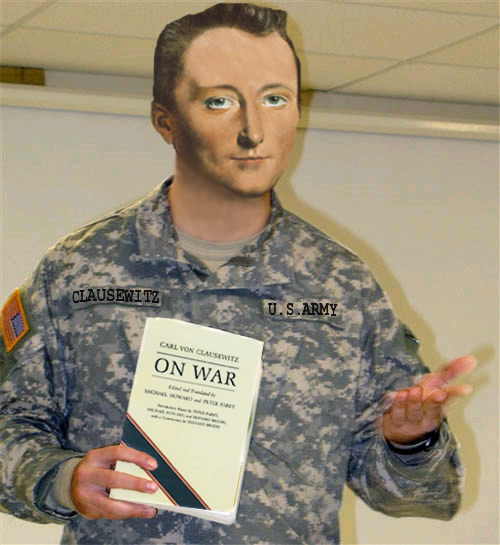
This article at SWJ blog has stirred a lively debate in the comments section with some very able practitioner-scholars weighing in.
….Sun Tzu?s ancient military philosophy of indirectness and gradualism runs counter-culture with much of mainstream western military strategy. Western reliance on superior technology and firepower shaped American counterinsurgency doctrine to be largely lethal in nature and enemy focused. Clausewitz instructed generations of military officers that the destruction of the enemy?s army is the primary goal in all combat1; therefore, all political-military conflict results in offensive action where attrition of the enemy force becomes a universal requirement. Clausewitzian war theory „worked? in both world wars in that the Allies did accomplish their desired goals; however critics such as Israeli strategist Shimon Naveh raise valid questions on whether Clausewitz?s fixation on offensive action and attrition warfare helped or hindered the Allied causes2. Despite Clausewitzian strategy?s seemingly illogical structure, application of his theories in the major 20th century conflicts created an enduring military school of war strategy with „On War? taking a sacred position.
In fairness to Clausewitz, this is over the top.
The US military could use more Sun Tzu; it is far more Clausewitzian in the perspective of the officer corps than it is “Sun Tzuite”, but the armed services are not the Children of Clausewitz. Not even the US Army. We’d probably be better off if the American military was more thoroughly one or the other in terms of strategic culture than the industrial age, bureaucratic, ad hoc, legacy thinking non-strategic hodgepode that currently prevails.
I do not expect that to change. American military organizational culture is driven more by appropriations than by ideas.
Some Related Links:
Sonishi.com Interview with Martin van Creveld on Sun Tzu
Sonishi.com Interview with Chet Richards on Sun Tzu and Boyd
Christopher Bassford on Sun Tzu, Jomini and Clausewitz
Colin Gray on Clausewitz and the Modern Strategic World
The Clausewitz Roundtable
Strategy of the Headless Chicken
Posted in 20th century, 21st century, academia, Afghanistan, America, army, ideas, intellectuals, logic, Luker, map, Marvel, McCain, medici effect, metacognition, military, strategy, Strategy and War, swj blog, theory, war | 11 Comments »
Thursday, December 2nd, 2010

Colonel David Maxwell, who has probably forgotten more about North Korea than I ever knew in the first place, has an insightful analytical piece up at SWJ Blog:
Irregular Warfare on the Korean Peninsula
….This paper is written with the concepts of “military misfortune” in mind. In Eliot Cohen and John Gooch’s seminal work on military failures, they determined that militaries are generally unsuccessful for three reasons: the failure to

learn, the failure to adapt, and the failure to anticipate. This paper will recommend that the ROK-US alliance learn from operations in Afghanistan and Iraq, adapt Irregular Warfare concepts to the security challenges on the Korean Peninsula and anticipate the collapse of the Kim Family Regime and the complex, irregular threats that collapse will bring.
The conventional wisdom would postulate that the worse case situation would be an attack by the north Korean military because surely the devastation and widespread humanitarian suffering as well as global economic impact would be on a scale that would far exceed any crisis that has occurred since the end of World War II. While that could very well be the case, there is little doubt about the military outcome of an attack by the north on the South and its allies and that would be the destruction of the north Korean People’s Army and the Kim Family Regime. Victory will surely be in the South’s favor; however, this paper will argue that the real worse case scenario comes from dealing with the aftermath; either post-regime collapse or post-conflict.
Maxwell’s operative assumptions are particularly good. I especially like:
….The fifth and final assumption is that while some planning has taken place to deal with north Korean instability and the effects of Kim Family Regime collapse, there has been insufficient preparation for collapse. Furthermore, in addition to planning for collapse, actiocan and should be taken prior to collapse in order to mitigate the conditions and deal with the effects of collapse of the Kim Family Regime. Unfortunately, despite some planning efforts tocounter specific irregular threats, the ROK, and the US in particular, has been distracted by the very real and dangerous threat of north Korean nuclear weapons and delivery capabilitiesproliferation of same while at the same time ensuring deterrence of an attack by the north. Deterrence is paramount and the nuclear problem is a critical international problem; however, successful deterrence over time will likely result in the eventual collapse of the regime and the associated security and humanitarian crises that it will bring.
In other words, not only are US and ROK policy makers not preparing for the most probable second and third order effects of a North Korean collapse scenario, but the status quo on the Korean penninsula represents a wicked problem that is essentially a trajectory toward a worst case scenario collapse.
Posted in 4GW, academia, America, analytic, asia, china, Failed State, foreign policy, futurism, geopolitics, government, intellectuals, military, national security, north korea, nuclear, security, state failure, strategy, Strategy and War, war, warriors | 10 Comments »
Monday, November 29th, 2010

An important announcement from my colleague, Lexington Green:
Lexington Green – (1) RESTREPO Monday, 11/29/10 at 9PM ET/PT; (2) Maj.Gen. Scales on Small Unit Dominance
This is the television premier of this extraordinarily film. I wrote about seeing this film here.
Restrepo chronicles the deployment of a platoon of U.S. soldiers in Afghanistan’s Korengal Valley. The movie focuses on a remote 15-man outpost, Restrepo, named after a platoon medic who was killed in action. It was considered one of the most dangerous postings in the U.S. military. This is an entirely experiential film: The cameras never leave the valley; there are no interviews with generals or diplomats. The only goal is to make viewers feel as if they have just been through a 94-minute deployment. This is war, full stop. The conclusions are up to you.
I highly recommend this film to all of our readers.
An information page for Restrepo is here, including video.
RESTREPO, an award winning documentary, was based on (or more precisely, closely related to) the book WAR by Sebastian Junger, which told the story of the war against the Taliban in the Korengal Valley, waged by the soldiers of the 2nd Platoon of Battle Company.
I previously reviewed WAR here and the movie RESTREPO here.
Posted in Afghanistan, America, book, COIN, counterinsurgency, cultural intelligence, Failed State, insurgency, islam.insurgency, islamic world, islamist, lexington green, media, military, military history, movies, non-state actors, Perception, Tactics, tribes, war, warriors | Comments Off on RESTREPO on Television this Monday
Friday, November 26th, 2010
Just picked up a few new reads…..
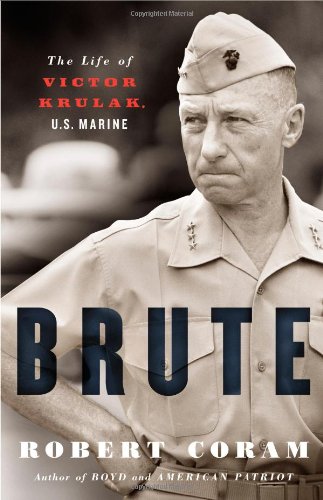
Brute: The Life of Victor Krulak, U.S. Marine by Robert Coram
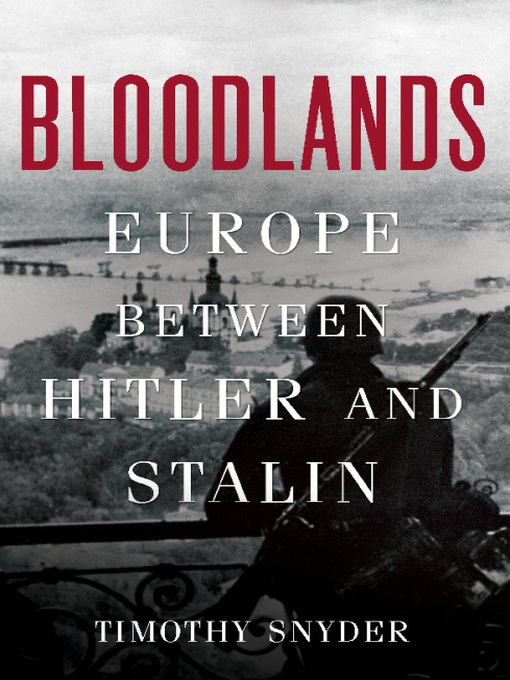
Bloodlands: Europe Between Hitler and Stalin by Timothy Snyder
Robert Coram, whom I had the pleasure of meeting at Boyd ’07, has a new biography of the legendary military visionary and Marine Lt. General Victor “Brute” Krulak, reviewed here by Max Boot and here by Tony Perry (Hat tip to Dr. Chet Richards). Having thumbed a few pages, Krulak appears a complicated man – gifted, dauntless and extremely driven but also possessed of a mean streak, edging at times toward petty cruelty.
Bloodlands I intend to read in a “Hitler-Stalin/Nazi-Soviet Comparison” series along with Richard Overy’s The Dictators: Hitler’s Germany, Stalin’s Russia , Robert Gellately’s Lenin, Stalin, and Hitler: The Age of Social Catastrophe
  , Richard J. Evans’ The Third Reich at War
 and Alan Bullock’s classic dual biography Hitler and Stalin: Parallel Lives
 . I’d also recommend, for those with the stomach for historiographic commentary, Robert Conquest’s Reflections on a Ravaged Century
 and John Lukac’s The Hitler of History
CURRENTLY READING:

Human Face of War by Jim Storr
After reading approxmately a third of The Human Face of War by Dr. Jim Storr, a retired Lt. Colonel, King’s Regiment and an instructor at the UK Defence Academy, I will say that if you are going to read only one book on modern military thought this year, it should be The Human Face of War. It’s that good.
Aside from a reflexive hostility toward John Boyd’s OODA Loop ( though not, strangely enough, toward the substantive epistemology advocated by Boyd that the diagram represented), Storr’s tome is an epistle of intellectual clarity on military theory that deserves to be widely read.
ADDENDUM:
NDU Press recommends, and I concur, this review of The Human Face of War by Col. Colonel Clinton J. Ancker III. Ancker, like Storr, is an expert on military doctrine, so it is a well-informed review by a professional peer.
Posted in academia, authors, biography, book, Character, Clausewitzian, Communism, dictator, dystopia, Epistemology, europe, extremists, genocide, geopolitics, historians, historiography, history, ideas, intellectuals, military, military history, military reform, nazis, politics, social science, soviet union, strategy, Strategy and War, Tactics, theory, totalitarianism, USMC, Vietnam War, war, warriors, wwii | 24 Comments »
Wednesday, November 24th, 2010
At SWJ Blog:
Octavian Manea – Pros and cons on Galula model
In response to the interest raised on the relevance of the Galula model for understanding and dealing with today’s insurgencies, I conducted a brief inquiry with key experts on the topic – Peter Mansoor, Steven Metz, David Betz, and Alex Marshall.
Dr. Peter Mansoor
The Galula model applies in those cases where the population of a country is more concerned about the effectiveness and legitimacy of its government than in its sectarian or ethnic make-up. “Classic” counterinsurgency efforts to improve the legitimacy of a government are then operative. In those cases where sectarian or ethnic identity trumps other factors (e.g., Sri Lanka or Chechnya), then protecting the people will avail the counterinsurgent little in the way of gaining their trust and confidence. In these cases, other strategic or operational approaches need to be considered….
Dr. Steven Metz
To me, the Cold War/Maoist model of insurgency applied in situations where new segments of a society were becoming politically aware or mobilized and thus made demands on the state which it could not fulfill. These demands were both tangible–infrastructure, security, education–and intangible (a sense of identity). That’s why I think it has very little applicability to current insurgencies. Granted current insurgencies attempt to emulate the Maoist strategy because it worked in the past, but I think this will lead to failure.
Dr. David Betz
The work of the French officer David Galula was clearly very influential on the thinking of the authors of FM 3-24 Counterinsurgency. There is certainly a lot to like. For one thing, his book Counterinsurgency Warfare is less than 150 pages long which makes it an easy read-four cups of tea and a Sunday afternoon will get you through it. For another, it’s written in a very aphoristic style which is highly memorable. So if you’re trying to get across to a large number of people a number of ‘best practices’ or paradoxes of COIN then Galula is a very good assigned reading. The truth is though that most COIN best practice would fit on a bumper sticker. In fact the new UK Field Manual on COIN comes with a laminated credit card sized aide memoire on one side of which are printed the principles of COIN and on the other ISAF’s game plan for stabilizing Afghanistan. I’m not criticizing-I think it’s a handy thing; my point is rather that Galula and his interpreters sometimes sound a bit like Kipling’s ‘Just So’ stories. In practice, it’s complicated, as one sees in Galula too if you read his longer, messier, more ambiguous and more rewarding book Pacification in Algeria. Anyway, to get to the point I have three main reservations about Galula…..
Dr. Alex Marshall
My issue with the Maoist Paradigm is really two-fold.
My first reservation, as a historian, is that we lack a definitive English-language study of Maoist insurgency itself beyond some fairly stereotyped notions of a three-stage or five-stage revolutionary process (from political agitation to guerrilla conflict to regular warfare). Galula and Thompson were great generalizers, but one can scarcely call their work proper historical studies-their general view was that Maoist-style insurgencies involved a degree of mass brainwashing for example. We possess some interesting case studies of how Maoist mobilization worked in practice on the ground, in individual villages or Shanghai for example, but there is so much more that could be done. Thus Western writing during the Cold War in general generated a shorthand stereotype, when in reality insurgency practice was often more diverse. The reason was simple I suggest-most successful insurgents aren’t particularly pithy writers (Guevara and Mao were exceptions), most unsuccessful ones are very quickly dead.
My second concern is more overarching however. The majority of discourse on COIN doesn’t take into account the strategic context, remaining locked into the operational level instead…..
Read the whole thing here.
A very productive piece by Manea and the gents above. Galula’s historiographic importance in COIN should be undisputed and his contribution to theory acknowledged and respected. Application of Galula’s framework (or, really, anybody’s) for understanding COIN, in analyzing insurgencies should be used cautiously or lightly until there is enough of an emprical understanding of the structure and motivations of the insurgents and the political deficiencies of the state, to see to what extent the model fits, before the operational assumptions of a military bureaucracy and theater command harden into place.
Lacking the reliable contingency of a superpower patron on an ideological crusade in the 21st century to impose a stamp of identity and tactics on it’s proxies, insurgencies are likely to be as diverse as La Familia is from FARC, the Taliban or the Real IRA.
Posted in 21st century, 4GW, academia, army, COIN, counterinsurgency, ideas, intellectuals, military, military history, social science, strategy, Strategy and War, swj blog, theory, war | Comments Off on More on Galula


