zenpundit.com » obama

Archive for the ‘obama’ Category

US Foreign Policy, Egypt and the Muslim Brotherhood

Wednesday, January 30th, 2013
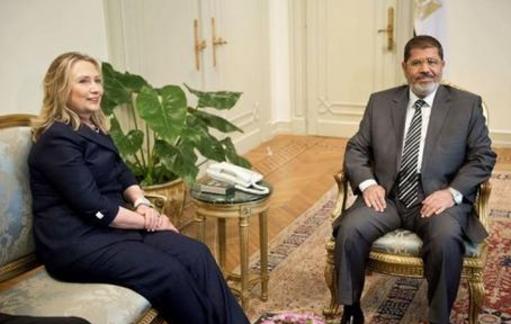
The Obama administration, though they would not characterize it as such nor have much desire to acknowledge it at all, have attempted  a strategic detente with the “moderate” elements of political Islam.

This policy has not been entirely consistent; Syria, for example, is a quagmire the administration has wisely refrained from wading directly into despite the best efforts of R2P advocates to drag us there.  But more importantly, under President Obama the US supported the broad-based Arab Spring popular revolt against US ally, dictator Hosni Mubarak, and pushed the subsequent ascendancy of the Muslim Brotherhood in Egypt and the Libyan revolution against the entirely mad Colonel Gaddafi. These appear to be geopolitical “moves” upon which the Obama administration hopes to build.

I would like to emphasize that there is one legitimate and valid strategic pro to this sub rosa policy; namely, if everything went well, it would provide the United States with powerful triangulation against revolutionary, apocalyptic, radical Islamism as expressed by al Qaida and various Salafi extremist movements. There are reasons, rooted in takfirism, strategy and the politics of lunacy that our terrorist enemies frequently hate and revile the Brotherhood as traitors, apostates or whatever. Isolating the most actively dangerous and violent revolutionary enemies from a large mass of potential allies is, at least, a good strategic goal.

It is also my view, that this “outreach” is as politically sensitive  to the Obama administration as was the China Opening was to Nixon and about which they have been equally opaque and misleading for fear of a domestic backlash. The weird, foot-dragging, dissembling, embittered, kabuki drama inside the Beltway about public statements and intelligence on whether Benghazi was caused by obscure crackpot Islamophobic film makers or a well-orchestrated terrorist attack  is in my view due to a major foreign policy strategy never having been framed in public for what it is. I’m sure people will differ strongly with me on this (which is fine), but I would characterize detente with Islamists as a strategic shift on par with the “Pivot to Asia”.

The downside here is that first, things are not likely to come out well at all, as unfinished revolutions tend to give birth to monsters; and secondly, any detente with “moderate” political Islam is an uncertain gamble based on certain exceptionally optimistic conceptions of not only what the Brotherhood might do, but about it’s very nature.

While the removal of Arab dictators resonated with American values , it was questionable realpolitik while the administration’s de facto support of  Egypt’s Muslim Brotherhood faction over poorly organized secular liberal modernists was an act of realpolitik that required a compromise of the democratic values so recently invoked to justify abandoning Mubarak. This was cynical diplomatic flexibility worthy of Talleyrand.

Unfortunately, the most democratic thing – perhaps the only thing – about Mr. Morsi and his Brotherhood supporters was his election.

The Egyptian people who are subjected now to thuggery from both Morsi’s Islamist stormtroopers and from the security forces of the Egyptian military are less sanguine than are the Brotherhood’s cheerleaders inside the administration. The Egyptian people, in fact, seem to be in revolt against domination by the Muslim Brotherhood’s shadow government.

The first question to ask in assessing if the Obama administration policy here is wise would be “What is the nature of the Muslim Brotherhood?” Americans love to personalize foreign policy, but if  Morsi were to be toppled or die, the Brotherhood will remain what it currently is, the best organized political force in Egypt and one widely influential throughout the Arab world and the West itself.

I am not an expert on the Muslim Brotherhood, nor am I an Arabist by education. Most of us aren’t – a group that I fear includes most of the Obama administration officials involved in shaping this policy. Almost fifty years after King Faisal determined to export Wahhabism, more than thirty years since Khomeini’s Revolution and more than ten years since 9/11 the USG still has less in-house expertise related to Islam than it did about the Soviet Union and Communism a decade after the Berlin Blockade.

Perhaps we all should begin learning more?

Here is an analysis from FPRI; it is extremely critical but it touches on organizational aspects of the Muslim Brotherhood that I have not seen elsewhere (hat tip to David Ronfeldt). Feel free to suggest others, both for and against. The Brotherhood is a very large group with a long history that includes violence , terrorism and subversion on one hand and peacefully representing expressions of pious, middle-class, social conservatism in other places and times:

Lecture Transcript: What Every American Should Know about Egypt’s Muslim Brotherhood, Delivered by Eric Trager 

….Two years ago when I was doing my dissertation fieldwork in Cairo, I sought out interviews with leaders from the Muslim Brotherhood, and I was referred to a man named Muhammad Morsi, now the President of Egypt. At the time, President Mubarak was ill and had gone off to Europe for operations amid a lot of mystery surrounding his health. I asked Muhammad Morsi whether the Muslim Brotherhood would run a presidential candidate if Mubarak died tomorrow. Here is what he said:

[From an audio file played by Trager]

Eric Trager: You don’t see the Muslim Brotherhood nominating a presidential candidate [if Mubarak dies tomorrow]?

Muhammad Morsi: No… because society is not ready… Our society is not ready yet to really defend its worth. We want a society to carry on its responsibilities, and we are part of this society. Another thing, if we are rushing things, then I don’t think that leads to a real stable position.

When he made that statement, I don’t think he was lying, and I don’t think he was being coy. I think that he didn’t expect that he would be faced with this reality in a mere six months. He did not expect that Mubarak would step down six months later and, to be completely honest with you, neither did I. My dissertation was entitled “Egypt: Durable Authoritarianism”—until the revolution.

What did Morsi mean when he said that the Brotherhood was trying to build a society? Let me give you some background on the Muslim Brotherhood. It was founded in 1928 by Hassan al-Banna, who was a schoolteacher in Ismailia. The Muslim Brotherhood’s goal was then—and remains now—to establish an Islamic state in Egypt. The way it pursues this goal is by trying to Islamize Egyptian society. Through social services, education, and the mosque, it sought to make Egyptians more religious and more Islamic as a grassroots strategy for building an Islamic state. That’s very, very different from a strategy that says, “We’re going to run for president, run for the Parliament, and use that power to transform society.” Rather, the Brotherhood says, in effect, “We’re going to Islamize society to build towards power.” It was a long-term strategy; it took them 84 years before they ran for and won the presidency. So Morsi told me in 2010 that the Muslim Brotherhood was not going to run for the presidency because it was not done Islamizing Egyptian society….

Read the rest here.
Gaza negotiations: sincerity and symmetry

Thursday, November 22nd, 2012

[ by Charles Cameron — sincerity and symmetry as the basis for dialog and negotiation ]
.


.

If you read me regularly, you know I’m passionate about form as well as content.

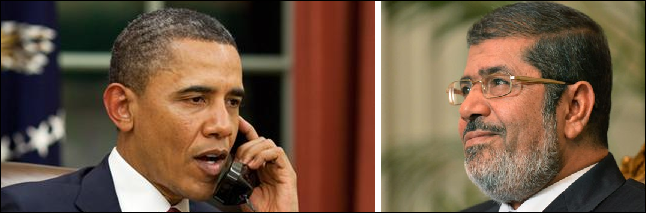
Here’s the New York Times report on the interactions between Presidents Obama and Morsi in the runup to the Gaza ceasefire negotiations:

Mr. Obama told aides he was impressed with the Egyptian leader’s pragmatic confidence. He sensed an engineer’s precision with surprisingly little ideology. Most important, Mr. Obama told aides that he considered Mr. Morsi a straight shooter who delivered on what he promised and did not promise what he could not deliver.

“The thing that appealed to the president was how practical the conversations were — here’s the state of play, here are the issues we’re concerned about,” said a senior administration official who spoke on the condition of anonymity to discuss private conversations. “This was somebody focused on solving problems.”

The Egyptian side was also positive about the collaboration. Essam el-Haddad, the foreign policy adviser to the Egyptian president, described a singular partnership developing between Mr. Morsi, who is the most important international ally for Hamas, and Mr. Obama, who plays essentially the same role for Israel.

“Yes, they were carrying the point of view of the Israeli side but they were understanding also the other side, the Palestinian side,” Mr. Haddad said in Cairo as the cease-fire was being finalized on Wednesday. “We felt there was a high level of sincerity in trying to find a solution. The sincerity and understanding was very helpful.”

**

And here, by way of context, is David Bohm on dialogue:

One way of helping to free these serious blocks in communication would be to carry out discussions in a spirit of free dialogue. Key features of such a dialogue is for each person to be able to hold several points of view, in a sort of active suspension, while treating the ideas of others with something of the care and attention that are given to his or her own. Each participant is not called on to accept or reject particular points of view; rather he or she should attempt to come to understanding of what they mean.

Bohm, Science, Order and Creativity, p 86

**

What interests me here in the Obama-Morsi interaction as described is the dual emphasis on sincerity and symmetry. Sincerity is needed so that each of the two sides — Israel’s POV, as presented by Obama, and that of Hamas, as presented by Morsi — is in fact presented, and not hinted at, watered down or reneged on. And when both sides are in fact sincerely represented, they are mutually present — heard — and there is symmetry.

That symmetry, it seems to me — symmetry of form in the presentations of contents — is the facilitator of successful negotiations.

Graphical footnotes, 2: the mourning after

Thursday, November 8th, 2012

[ by Charles Cameron — an example of the “serpent bites own serpent self” paradox from the 2012 election ]
.

This is offered as a footnote to my earlier post on self-referential aka recursive paradoxes. It is the bottom ten percent, at full width, of the mourning band Pamela Geller put on her Atlas Shrugs 2000 site when she learned of President Obama’s victory in the 2012 Presidential election.


.

For the record, I do not endorse Ms Geller’s entirely negative view of Islam — a vast and vastly diverse world religion with a long and storied history — nor for that matter her commentary on the election —

UPDATE: Obama won. And America, land of the free, home of the brave, died tonight.

nor the header for the post that consisted entirely of the graphic above — with the black extending an unremitting nine more times the height shown here:

THE DAY AFTER AMERICA

To be blunt: methinks the lady jumpeth shark.

**

What does interest me more than a little is the self-reflexive paradox with which she phrases her insight that America just killed itself — an example of the kind of paradox I was talking about in my post Numbers by the numbers: one.

Form is insight: the funnel, part 2

Thursday, October 11th, 2012

[ by Charles Cameron — a post in my importance of form in intelligence series — following up on part 1 with a series of quotes zeroing in from context via analysis to decision — Pakistan, Afghanistan, OBL ]
.

The 2nd funnel is from Duke's Structural Biology & Biophysics Program "folding funnels" page

.

In Part 1 of this post, I introduced the form of the funnel. I want to use this form, this recognizable and repeating pattern in nature, mathematics, and the transfer of oil into car engines, to illustrate a movement in time, an imperative in intelligence, and a loss in nuance. With regard to Obama and Osama.

I shall do this by offering a series of quotes that, in various voices, take us through the zeroing in process, by which an unimaginably complex world gets sorted into a complex analytic understanding and reduced from there to a yes/no decision and a single, definitive (fatal) command.

**

Let’s start here:

The universe is a complex system in which countless causal chains are acting and interacting independently and simultaneously (the ultimate nature of some of them unknown to science even today). There are in fact so many causal sequences and forces at work, all of them running in parallel, and each of them often affecting the course of the others, that it is hopeless to try to specify in advance what’s going to happen as they jointly work themselves out. In the face of that complexity, it becomes difficult if not impossible to know with any assurance the future state of the system except in those comparatively few cases in which the system is governed by ironclad laws of nature such as those that allow us to predict the phases of the moon, the tides, or the position of Jupiter in tomorrow night’s sky. Otherwise, forget it.

Further, it’s an illusion to think that supercomputer modeling is up to the task of truly reliable crystal-ball gazing. It isn’t. … Certain systems in nature, it seems, are computationally irreducible phenomena, meaning that there is no way of knowing the outcome short of waiting for it to happen.

That’s Ed Regis, responding to the Edge Question for 2008, What Have You Changed Your Mind About?

**

What do we do about it? The great (one might say visionary) biologist Francisco Varela has something important to say about that:

Let me try and be clear in the terminology here: for every system there is an environment which can (if we so decide) be looked at as a larger whole where the initial system participates. Since it would be impractical to do this at all times, we often chop out our system of interest, and put all the rest in the background as “environment.” To do this on purpose is quite useful; to forget that we did so is quite dangerous.

**

Moving on and zooming rapidly in, here’s the state of the FBI’s understanding of Al-Qaida very shortly after 9/11.

…the business of counterterrorism intelligence gathering in the United States is akin to the construction of a mosaic. … At this stage of the investigation, the FBI is gathering and processing thousands of bits and pieces of information that may seem innocuous at first glance. We must analyze all that information, however, to see if it can be fit into a picture that will reveal how the unseen whole operates. … What may seem trivial to some may appear of great moment to those within the FBI or the intelligence community who have a broader context.

**

Michael Taarnby gives us a sense of the various drivers in play in his paper, Profiling Islamic Suicide Terrorists: A Research Report for the Danish Ministry of Justice, 2003 — note that he’s working on suicide bombers, but many of the same drivers are at work more generally among jihadists:

It should be stressed that this study was based on a sceptical view of the exclusively religious nature of Islamic suicide terrorism. The purpose was to look for alternative interpretations with an open mind. The complexity related to the importance of these parameters is not related to a hierarchical dimension since it is the interplay between the parameters that produces a suicide terrorist over a period of time. The profiling of suicide terrorists from an exclusively psychological perspective for instance is no longer valid, reality is much more complex. Nor is it just a question of political disagreements. When existing profiling techniques have failed to understand the complex issues that leads an individual to sacrifice his life, it is because of a habit of using a monocausal approach. This is not to say that psychological studies cannot contribute to terrorist profiling …

Terrorism is not moncausal.

**

The war against the Taliban / AQ is complicated, if for no other reason, then because it is inherently self-referential, contains a paradox, pushes what it pulls against. In Steve Coll‘s words:

This could not be a more complicated war. If you think about it, the United States is essentially waging a war against its own ally. The Taliban are a proxy of the government of Pakistan. We are an ally of the government of Pakistan. We are fighting the Taliban. In the end, the Taliban will be defeated strategically when the government of Pakistan makes a strategic decision that its future does not lie in partnership with Islamic extremists.

**

That’s a fairly simple complexity, something a loop diagram could illustrate nicely. But it’s more multifactorial than that, as National Security Adviser James Jones remarked at the Munich Conference on Security Policy in February 2009:

But to move forward, we must understand the terms “national security” and “international security” are no longer limited to the ministries of defense and foreign ministries; in fact, they encompass the economic aspects of our societies. They encompass energy. They encompass new threats—asymmetric threats involving proliferation, involving the illegal shipment of arms and narcoterrorism, and the like. Borders are no longer recognized, and the simultaneity of the threats that face us are occurring at a more rapid pace …

The challenges that we face are broader and more diverse than we ever imagined, even after the terrible events of 9/11. And our capacity to meet these challenges, in my view, does not yet match the urgency of what is required. To be blunt, the institutions and approaches that we forged together through the twentieth century are still adjusting to meet the realities of the twenty-first century. And the world has definitely changed, but we have not changed with it. But it is not too late, and this is the good news …

**

And so we move from the complicated business of analytic understanding to the relative singularity of an individual making a decision — Steve Coll’s words again:

As with much of modern American national security as a whole, the bin Laden raid came down to a complicated decision made by one person. Only one person is asked to simultaneously weigh the certainties, manage all the various domestic, military, diplomatic, legal, and moral considerations, and make a decision Americans will live with for years to come. It is a remarkable — some might argue impractical — burden.

**

That’s the zoom, that’s my funnel, complete in seven quotes.

Let’s take things a bit further, and examine for a moment what has been said about the man making the decision. From The American Conservative:

To read Niebuhr is to relish these tensions, to grip the fundamental balance of the moral universe. “Man’s capacity for justice makes democracy possible,” he wrote. “But man’s inclination to injustice makes democracy necessary.” The concepts gear together like great cosmic cogs. “Goodness, armed with power, is corrupted,” he wrote. But “pure love without power is destroyed.” Much of Niebuhr’s worldview depends on these balances.

Reading Obama yields a similar effect. In 2009, literary critic Andrew Delbanco pointed out in the New Republic that Obama’s books are populated by counterweighted sentences, for instance: “There’s the middle-aged feminist who still mourns her abortion, and the Christian woman who paid for her teenager’s abortion.” Obama expresses his worldview, Delbanco wrote, in sentences “organized around pairs of sentiments or arguments that exert equal force against each other–a reflection of ongoing thinking rather than a statement of settled thoughts.”

To me, that’s reassuring: the issue can still be complex as it reaches the President’s mind, even if his decision and command has to be given in a single, definitive word.

**

What happens if an impoverished understanding is at work, the wrong answer is given, the wrong decision taken? HL Mencken to the rescue with this dismal truth:

For every complex problem, there is an answer that is clear, simple and wrong.

**

And finally — where are we now?

I’ll take my answer from a series of tweets Aaron Zelin made earlier today:

Al-Qaeda has never been dead, neither have they ever been resurgent. They’ve always just hovered. Nimble, patient, and exploitative. The problem is, we are always one step behind, we were fighting the AQ of 9/11 for yrs, now we are fighting the AQ of 2009-2011. As we have changed our tactics they have changed, too. AQ and its affiliates now are not the same as they once were.

Obama’s Foreign Policy Gamble on the Moderate Islamists

Wednesday, September 12th, 2012

As you probably already know, the US Embassy in Cairo Egypt was stormed today by Islamists supposedly angry about a video on Youtube supposedly made or endorsed by anti-Muslim Quran-burner and bigot Rev. Terry Jones. The embassy, deliberately left without sufficient protection by the Egyptian government of Islamist President  Mohamed Morsi, was overrun, Islamists tore down the US flag and hoisted the black flag of al Qaida while a senior Muslim Brotherhood official has called on the US to “apologize”. All on the anniversary of 9/11.

The US Consulate in Benghazi, Libya was attacked by an Islamist militia with RPGs and small arms, sacked and burned, killing at least one American.

The Obama administration has gambled heavily upon a Mideast policy of engagement verging into appeasement and sponsorship of Sunni Islamist groups’ political and even revolutionary aspirations in the hopes of  co-opting “moderate” or “pragmatic” Islamists into a durable partnership with the United States. The new regime of American-educated Mohammed Morsi, represents the cornerstone of this policy, alongside the Libyan Revolution that toppled Gaddafi. This initiative has been delicately balanced, Nixon-style, with a very tough campaign of unapologetic targeted drone strikes on hard-core al Qaida terrorists in Afghanistan, Pakistan, Yemen and Somalia.

If you have a sense of deja vu, you are harkening back to 1979, when another Democratic administration and an arrogantly uninformed group of senior State Department officials severely misread another, that time Shia, Islamist revolution. We lost several embassies then as well and endured a national humiliation of the Iranian hostage crisis.

But give the Carter administration, it’s due: when the embassy in Teheran was seized or the one in Islamabad burned by military-sponsored Islamist mobs, no State Department official at the time responded with quite this level of truckling moral cowardice and incompetence:

@Mbaha2

@USEmbassyCairo you say all humans are equal but the truth is you hate Muslims and describe us as terrorists when u are the real terrorists

@USEmbassyCairo

@mbaha2 No, that’s not true. We consistently stand up for Muslims around the world and talk abt how Islam is a wonderful religion

Perhaps the time for anxiously politically correct FSOs describing Islam as “a wonderful religion” to an online Salafist hater could wait a few days, at least until Egypt restored the American embassy to it’s sovereign status with an apology and the body of the slain American diplomat is returned to their family from Libya for a decent burial?

The administration’s policy teeters on a knife’s edge. Their so far craven and confused response today to two of our diplomatic missions being attacked by the forces they themselves have engaged could potentially cause a snowball effect across the region. Their would-be “allies” are  currently calculating the costs of biting the hand that fed them vice the dangers of their own swarming fanatics in the streets. The administration’s officials as of today seem to have little awareness of the effects of their bizarrely conciliatory words and a stubborn determination to double-down rather than correct their course  have begun to reevaluate at least their rhetoric. The policy is another question.
.
Perhaps for our next hostage crisis, we will see an American ambassador beheaded live on al Jazeera……
.
UPDATE:
.
Events in Libya were worse than news reports yesterday indicated. Ambassador Stevens and three other diplomatic personnel were killed and the security situation in Libya remains dicey.
.
When this terrible incident is examined by Congressional committees, one focus will be on the security provided to the embassy and Ambassador Stevens by the State Department and the government of Libya, whose security minister reported that the government safe house sheltering American diplomatic personnel had been discovered by the attackers. “Where were the Marine guards?” is a question already being asked privately by national security and defense professionals which will soon be put forward in public.
.
UPDATE II:
.
Now policy may be changing sharply in the direction of realism. Good

Switch to our mobile site

