zenpundit.com » politics

Archive for the ‘politics’ Category

New Book- The Envoy: From Kabul to the White House

Friday, March 25th, 2016

[by Mark Safranski / a.k.a  “zen“]

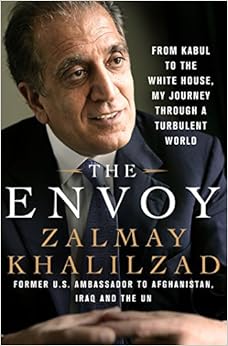
The Envoy: From Kabul to the White House […] by Zalmay Khalilzad

Just received a courtesy review copy of The Envoy, the memoir of Ambassador Zalmay Khalilzad, from Christine at St. Martin’s Press.

Khalilzad was part of a small group of diplomatic troubleshooters and heavy hitters for the second Bush administration, whose numbers included John Negroponte, Ryan Crocker and John Bolton who were heavily engaged during the wars in Afghanistan and Iraq. Like the others, Khalilzad had held a variety of important policy posts at State, the NSC and the Department of Defense before assuming ambassadorial duties; the bureaucratic experience, ties to senior White House officials and the exigencies of counterinsurgency warfare would make these posts more actively proconsular than was typical for an American ambassador.   Indeed, the endorsements on the book jacket, which include two former Secretaries of State, a former Secretary of Defense and a former CIA Director testify to the author’s political weight in Khalilzad’s years of government service.

It’s been a while since I have read a diplomatic memoir, so I’m particularly looking forward to seeing how Khalilzad treats Afghanistan’s early post-Taliban years, given that he personally is a bridge from the Reagan policy of supporting the anti-Soviet mujahedin to the toppling of the Taliban in the aftermath of 9/11 and helping to organize the new Afghan state. Khalilzad is also, of course, an Afghan by birth, giving him greater insight into that country’s complex political and social divisions than most American diplomats could muster.

I will give The Envoy a formal review in the future but Khalizad has given a synopsis of where he thinks American policy went awry in Afghanistan over at Thomas E. Rick’s Best Defense blog.

Small Wars and Big Thoughts

Saturday, March 19th, 2016

[by Mark Safranski / “zen“]


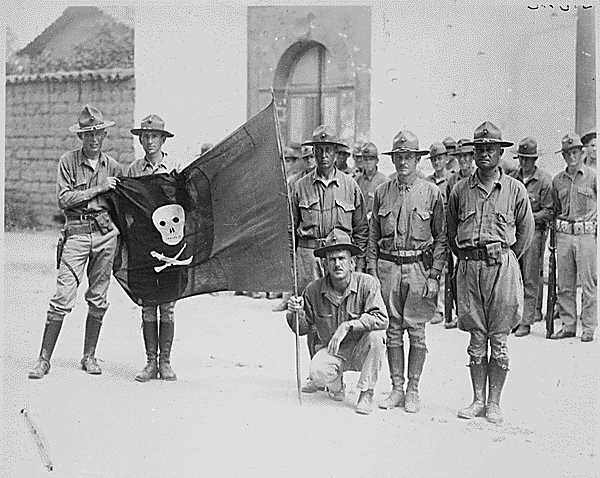
U.S. Marines display captured flag of Nicaraguan rebels led by Augusto Cesar Sandino

While pop-centric COIN may be dead, small wars and irregular warfare will always be with us. We might say they are in the fourth or fifth generation; are an open-source insurgency; or have become “hybrid“; or exist in some kind of mysteriousgray zone“. Whatever we call them, small wars are here to stay.

Two recent publications explore the topic.

The first is a taxonomic work from Robert Bunker at the Strategic Studies Institute:

Old and New Insurgency Forms

….Blood Cultist (Emergent). Strategic implications:  Limited to moderate. This insurgency form can be viewed as a mutation of either radical Islam and/or rampant criminality, as found in parts of Latin America and Africa, into dark spirituality based on cult-like behaviors and activities involving rituals and even human sacrifice. To respond to this insurgency form, either federal law enforcement or the military will be the designated lead depending on the specific international incident taking place. An all-of-government approach will be required to mitigate and defeat this insurgency form, which has terrorism (and narco-terrorism) elements that represent direct threats—especially concerning the Islamic State—to the U.S. homeland […]

I strongly agree with Bunker’s “dark spirituality” angle present in deviant religious-military movements. For example, ISIS, for all its protestations of ultra-orthodoxy in its Salafism exudes a spirit of protean paganism in its words and deeds.

The second is a book, Clausewitz on Small War by Christopher Daase and James W. Davis (Hat tip to Nick Prime). From a book review at the London School of Economics:

….The current generation’s trend in understanding Clausewitz is that of moving beyond On War – an analysis which Clausewitz himself considered incomplete and which was published posthumously. As part of this shift, 2015 alone saw the publication of a new account of his life, together with a biography of his wife and a comparison between Napoleon’s and Clausewitz’s ideas on war, to name a few.

Through Clausewitz on Small War, Christopher Daase and James W. Davis make a significant contribution to such efforts of contextualisation. Yet theirs is quite distinct from other works, in that they translate into English writings that were thus far accessible only to those with a reading knowledge of German. This is precisely where the value of the book lies, as well as being the editors’ primary aim: opening up Clausewitz through translating his own words, rather than in interpreting them. In doing so, they offer the tools through which future analyses can be better informed.

The editors nonetheless do set out a case in the introduction: Clausewitz’s writings on ‘Small War’ are testimony to his continuing relevance. To illustrate this, they offer four chronologically arranged texts – a journey of how his thinking on Small War evolved. Each text was written with a different frame of mind. The first is comprised of lecture notes on small-unit warfare that are informal and rather technical; the second and third are memoranda distributed to military reformers and through which Clausewitz passionately makes the case for militias; and the final is a chapter from On War, again on the arming of the people.

I would add that ZP contributor, Lynn Rees, also had a recent post on the role of Marie von Clausewitz in shaping “Clausewitz” and Clausewitzian thought.

That’s it.

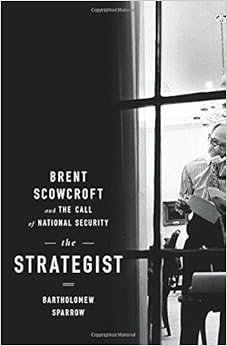
The Strategist: Brent Scowcroft and the Call of National Security

Friday, March 4th, 2016

[by Mark Safranski / “zen“]

The Strategist: Brent Scowcroft and the Call of National Security by Bartholomew Sparrow

In writing The Strategist, Bartholomew Sparrow has demonstrated that his talents as a biographer match his skill as a scholar. Cautious and careful, in telling the life and national security career of the highly regarded Brent Scowcroft, Sparrow never slips into hagiography, or gives Scowcroft a free pass in situations where it would be easy to do so. In retaining his critical eye, Sparrow has consequently permitted Scowcroft’s selfless character and frequently wise judgement to shine on their own merits in the historical record. The result is that The Strategist is a biography of remarkable power, like a great river, there are deep currents of insight below the gently moving surface.

At a sprawling 716 pages, Sparrow had room to investigate Brent Scowcroft’s family heritage in Mormon Utah, his journey at West Point from student to professor, his intellectual and professional mentors (Herman Beukema, William T.R. Fox, George Lincoln, Richard Yudkin, Andrew Goodpaster) and Scowcroft’s unfailing devotion to his wife Jackie, who became an invalid in the years when Scowcroft’s career embraced its largest burdens. It is this context that helps explain the strong ethical core that Scowcroft demonstrated time and again as a military officer, strategist and statesman as he handled brilliant but brittle personalities at the center of national security and foreign policy.

What Sparrow makes clear, time and again, was that it was Scowcroft’s unusually high emotional intelligence coupled with an amazing work ethic that provided Scowcroft with the high opportunities that allowed him to bring his talents as a strategist and manager of national security to bear. Quite simply, Scowcroft connected with people and his relentlessly consistent integrity in dealing with everyone – literally from interns to journalists to Presidents of the United States – was such that his word was regarded as being as good as gold. His equanimity too was almost as legendary as his ethics. ” I never heard Scowcroft get angry” is a frequent refrain of former colleagues. His detractors are few: Dick Cheney, who as Vice-President had a bitter break with Scowcroft over the Iraq War, had nothing but praise to say of his former friend’s integrity and judgement.

Not only did Scowcroft forge an unusually close strategic partnership with two presidents (Ford and Bush I) but he managed to win the respect and trust of so paranoid and aloof a figure as Richard Nixon (it is far less clear that Scowcroft trusted Nixon). Scowcroft’s secret was that inside a Beltway where politics and personalities trended Machiavellian, he operated in a zone of trust. Even the Clinton and Obama administrations sought Scowcroft’s counsel because they were assured of his absolute discretion and impartial judgement.

Asked to compare himself with his former boss, Henry Kissinger, Scowcroft demonstrated that he knew his strengths and his limitations. Sparrow writes:

“….Scowcroft had his own well-developed sense of military strategy and world history. He was also brilliant at questioning and evaluating the merits of his new ideas and policy options as well as a superb bureaucratic operator who knew how to put concepts into practice. But unlike Kissinger, Scowcroft said he was better at reacting to and evaluating ideas than he was dreaming them up; that was why he liked to hire people smarter than himself. ‘I don’t have a quick, innovative mind’ he claimed. ‘I don’t automatically think of good new ideas. What I do better is pick out good ideas from bad ideas.”

Was Scowcroft a good strategist?

The first problem in answering this question, at least from reading Sparrow, is that Scowcroft’s rarely equaled skill as a manager of the NSC decision-making process tends to greatly overshadow and blur his record as a strategist.  Scowcroft’s National Security Council, which worked well under Gerald Ford when the greatest of Washington prima donnas, Henry Kissinger, reigned as Secretary of State, hummed like a machine under George H. W. Bush. One would have to go back to Eisenhower to see such a comparable example of smooth national security decision making. The key was the absolute trust Scowcroft established, as Sparrow records:

“Bush, Baker, Scowcroft and other senior administration officials were able to establish relationships based on trust. ‘One of the reasons why the system worked was that Baker and Cheney totally trusted Brent to keep them informed and to fairly represent their views to the president,’ Gates said. ‘He was the only national security adviser in my view that was ever so trusted by the two other principals’ – and Gates had served under six US presidents at the time he wrote the above, before his time as defense secretary under George W. Bush and Barack Obama.

Scowcroft’s management of the NSC process also worked well because of his creation of other interagency groups to expedite decision making. One of his key innovations (retained by subsequent presidential administrations) was the formation of the Principals Committee which included the Vice-President, the secretary of state, the secretary of defense, the director of central intelligence, the chairman of the Joint Chiefs of Staff, the White House Chief of Staff and the national security adviser – all meeting without the president.”

Scowcroft achieved the holy grail of natsec policy – “whole-of-government” planning and execution. Part of the reason was that Brent Scowcroft was extraordinarily close to the elder President Bush, far closer than in the dysfunctional yet highly successful partnership between Richard Nixon and Henry Kissinger. That accounts for some of it, but Condi Rice was just as close to George W. Bush as Scowcroft had been to Bush’s father yet her tenure as national security adviser is given low marks, not least for being completely unable to rein in Secretary of Defense Donald Rumsfeld or Vice-President Dick Cheney who was virtually the prime minister of the administration in its early years. The difference may have been that Scowcroft could not only speak with the President’s unquestioned authority, he knew better when to do so than Rice and consequently, seldom needed to do it at all.

The second problem in answering “was Scowcroft a good strategist” is that he clearly was not and never aspired to be a grand strategist in the manner of Richard Nixon, George Kennan or Otto von Bismarck.  Scowcroft never approached national security by attempting to reshape the geopolitical calculus despite the regrettable tagline of “new world order”. Instead, Scowcroft’s strategic philosophy was to manage risks as they emerged by peacefully integrating a collapsing rival state system piecemeal into the existing international community status quo at the lowest possible cost of disruption. Maximizing geopolitical opportunities or strategic gains was not his primary yardstick.

This is why as Sparrow, relates, that Scowcroft and the senior President Bush strongly discouraged “triumphalism” in American rhetoric about the Cold War while trying to work with Mikhail Gorbachev to manage the Soviet collapse; and why the break up of Yugoslavia was viewed with such distaste (Scowcroft had served in the embassy in Belgrade under Kennan). Conversely, this is also why  Scowcroft was so eager to use American military force in Iraq, to defend and reinforce post-Cold War international legal norms from Iraqi aggression, but not to march to Baghdad and overthrow Saddam’s dictatorial regime. Brent Scowcroft deserved the credit for both his early insight that force would be required to remove Iraq from Kuwait and the wisdom of the Bush administration to wield overwhelming force with restraint and diplomatic finesse.  When the second Bush administration – an administration filled with his former colleagues – opted to march on Baghdad, it would have been a simple matter for Scowcroft to remain silent, but instead he offered counsel. When his advice was rebuffed, Scowcroft did the harder thing and made his case against the Iraq War public even though it cost him friendships and access to the President of the United States. A rare choice in Washington.

Scowcroft is indeed a strategist by any reasonable measure and something greater, a statesman for whom the country and its national interest always came first.

Strongly Recommended.

Dragging my tail in the mud

Thursday, February 18th, 2016

[ by Charles Cameron — i’m afraid this will be a very Thoreau-Taoist post for this electoral season ]
.

Two browsings recently set me thinking about politics in general — and dragging my tail in the mud in particular:

Shadi Hamid in What is Policy Research For? Reflections on theUnited States’ Failures in Syria

When the basic thrust of policy seems immovable irrespective of events on the ground, how should researchers respond? Should influencing policy be the animating objective of policy research?

and at the pointy end, Matt Cavanaugh at War on the Rocks, The Way Home from ‘a War’:

What is it like to make uncertain judgments with severe moral consequences? For military professionals, being the state’s lethal instrument necessarily entails ethically perilous, life-or-death choices.

**

Here’s the cntext, as I see it..

Wallace Black Elk:

The whole earth is an altar. In church, they have a little slab of marble which they call an altar. But our altar is Grandpa’s altar… Our carpet is the grass, the sacred altar; our ceiling is the stars; our night lamp is the moon; Grandpa the sun is our mystery power.

Thomas Traherne:

You never enjoy the world aright, till the Sea itself floweth in your veins, till you are clothed with the heavens, and crowned with the stars: and perceive yourself to be the sole heir of the whole world, and more than so, because men are in it who are every one sole heirs as well as you. Till you can sing and rejoice and delight in God, as misers do in gold, and Kings in sceptres, you never enjoy the world.

Till your spirit filleth the whole world, and the stars are your jewels; till you are as familiar with the ways of God in all Ages as with your walk and table: till you are intimately acquainted with that shady nothing out of which the world was made: till you love men so as to desire their happiness, with a thirst equal to the zeal of your own: till you delight in God for being good to all: you never
enjoy the world.”

Chuang Tzu:

I will have Heaven and Earth for my sarcophagus, the Sun and Moon shall be my burial insignia, the stars my coffin-jewels, and all Creation shall be mourners at my obsequies. Are not my funeral paraphernalia all in readiness?

Thoreau-Taoism, which she would spell Thurrodowism, is Ursula Le Guin‘s superlative confection.

**

Chuang Tzu:

From Chuang Tzu: Mystic, Moralist, and Social Reformer, tr. Herbert Giles, p. viii:

Prince Wei (B.C. 338-327) of the Ch’u State, hearing of Chuang Tzu’s good report, sent messengers to him, bearing gifts, and inviting him to become Prime Minister. At this Chuang Tzu smiled and said to the messengers, “You offer me great wealth and a proud position indeed; but have you never seen a sacrificial ox:-When after being fattened up for several years, it is decked with embroidered trappings and led to the altar, would it not willingly then change places with some uncared for pigling?

Or from Chuang Tzu, Basic Writings, tr. Burton Watson, p.108:

Once, when Chuang Tzu was fishing in the P’u river, the king of Ch’u sent two officials to go and announce to him: “I would like to trouble you with the administration of my realm.”

Chuang Tzu held onto the fishing pole and, without turning his head, said, “I have heard that there is a sacred tortoise in Ch’u that has been dead for three thousand years. The king keeps it wrapped in cloth and boxed, and stores it in the ancestral temple. Now would this tortoise rather be dead and have its bones left behind and honored? Or would it rather be alive and dragging its tail in the mud?”

“It would rather be alive dragging its tail in the mud,” said the two officials.

Chuang Tzu said, “Go away! I’ll drag my tail in the mud!”

Guest Post: Duncan Hunter and Human Terrain System by Turner

Sunday, February 14th, 2016

[by Mark Safranski / “zen“]

ZP is pleased to bring you a guest post by Pete Turner, co-host of The Break it Down Show and is an advocate of better, smarter, transition operations. Turner has extensive overseas experience in hazardous conditions in a variety of positions including operations: Joint Endeavor (Bosnia), Iraqi Freedom (2004-6, 2008-10), New Dawn (Iraq 2010-11) and Enduring Freedom (Afghanistan 2011-12).

ON REPRESENTATIVE DUNCAN HUNTER’S QUESTIONS ABOUT HTS

by Pete Turner

Today I was sent this USA Today article about Rep. Duncan Hunter (R-Ca) and Human Terrain System with a request for comments. An excerpt:

….A critic of the program, Rep. Duncan Hunter, a California Republican and member of the Armed Services Committee, demanded answers about the program from Acting Army Secretary Patrick Murphy in a letter sent Monday. Hunter noted “striking similarities between the two programs” and called on the Army to explain how the Global Cultural Knowledge Network differed from Human Terrain System. He also asked for an accounting of its cost and the number of people it employs.

“Unless the Army can show real differences between programs, then there should be no doubt that this constitutes a blatant attempt to rebrand and reboot a failed program under another name and a launch it with a reworded mission statement,” Hunter told USA TODAY on Tuesday. “What’s obviously lost on the Army is that it wasn’t just the implementation of HTS that was the problem, it was the whole thing, to include the program’s intent and objective.”

I have no faith in TRADOC’s ability to get Human Terrain System or HTS 2.0 any more right than last time.  The program was full of prima donnas, liars and academics who lacked the ability to relate to the military and commanders.  Also, commanders aren’t trained in how to best use HTS assets either – and that matters. For example:

COL: “Pete, I want you to tell me who the most influential person in our region is….can you do that?”  

Pete: “Yes Sir, I have the answer already…it’s you…until the people recognize their own governmental leaders, police and military, our focus has to be in ramping your influence down while we enable them to ramp up, Sir.”   

That statement is the essence of what an HTS does – we identify and translate the intersection of the ramps.  There is no book on how to do it well. The ground truth is where the best work is done.  It’s a shame that Rep Duncan Hunter and DoD cannot see that.

For those who aren’t familiar with my work, I have 70+ months of time working in combat zones.  I’ve worked most of this time at the lowest level interacting with locals on well over a 1000 patrols.  A great deal of this time I worked in the HTS program mentioned in the article.

Rep D. Hunter questioned the need and was critical of the original HTS program.  Like any program we absolutely had our share of fraud, waste and abuse.  Here’s the thing…the HTS program even when legitimately run is expensive.  Units work hard, long hours and a relentless schedule.  On numerous occasion, I’d work a 20 hour day followed by an 18 hour day followed by a string of 16 hour days.  An 84 hour week is the minimum I’d work.  Working at the minimum pace of 12 hours a day 7 days a week, a person will “max out” on their federal pay for the year and accumulate “comp time” or paid days off.

Since there are always things to do, lives at stake, command directives to pursue…missions to go on, planning to complete, analysis to run, reports to write, meetings to attend…it’s not hard to work 90+ hours a week and be seen as not doing enough.  How about this – some units will practice for a meeting for hours prior to the actual meeting?  If a unit is going to spend 6 hours prepping for and executing a meeting, that’s just ½ of a day…yes, legitimate work will result in paid leave.

If my patrol leaves at 3AM because there is a full moon and we move up and over a mountain arriving at a village before dawn…then spend the rest of the morning patrolling more and finally return to base at 2 in the afternoon…I still have to report on what I saw, a report may take 3-4 hours to write….and then prep for the next day’s patrol…unless your unit is doing 2 patrols a day.

I recall one specific time when a brigade from the 82nd that I was attached to was going to rotate home.  The brigade commander wanted to provide the new unit with the best possible handoff in terms of data, relationships etc.  To facilitate this handoff, my team was tasked to improve a “smart book” of dossiers on prominent Iraqis.  At one point I sat in the same chair for 24 hours writing, rewriting and then updating the book…simply because we HAD to work – the books weren’t getting better, just being constantly reworked.

Why do I bring this up?  Two reasons: First, the 82nd works HARD and if one is attached to them, that person works hard too, or suffers from irrelevance.  The 82nd spent a lot of taxpayer money on HTS people writing those books with the best intentions.  Secondly, the next unit came in and literally, never used the books.  When I asked why,  the new unit said, “we really don’t do that.”

When Rep Hunter originally questioned, the need for the program, I reached out to him to illustrate how when done properly, HTS work saves money and creates the kind of wins that unit’s cannot do without a HTS capability.  I also sent several notices to the my district’s congressional rep Mr. Mike Thompson.  Both he and Mr Duncan are veterans; I thought, surely they’d value my unique “ground truth” based knowledge.  I was wrong, both representatives ignored my offer to provide feedback.

The answer to Rep Duncan’s question about the need for this program is this:

Commanders need an outside element to translate what the US is doing for locals; in this case Afghans.  Meanwhile the HTS person also translates back to the US military what the locals are experiencing.  What an HTS person really does is works as a cultural translator allowing the different sides to understand the reality of their “partner.”

I worked in a valley that had a steep narrow canyon.  The local US Army agricultural development team (ADT) a truly myopic, xenophobic program that commonly created instability more than anything else, decided to build a check dam.  The dam was supposed to elevate the water in the river high enough to charge the irrigation ditches that ran the length of the river valley.  Over the course of 18 or more months the ADT fought with locals to improve the dam, while the locals rejected it and attempted to destroy it on several occasions.

The Dam Project

I was able to talk to locals who reasonably explained why the dam was an issue.  Simply put, they didn’t want it – and it was predicted to fail as soon as the first rain came.  Further, the region had an Afghan leader chosen to handle water issues for the families.  He agreed that the dam was a bad idea; and also predicted it would fail with the first rain.  We never effectively engaged the water elder–instead the ADT insulted this person and ignored his position and influence with the farmers.  A commander can’t know these things without an HTS person on the ground studying the human terrain.

I spoke with the ADT engineer responsible for the final “upgrade” to the dam.  I mentioned the concerns of the people and the water elder about the long term viability of the dam, which was visibly failing – the ADT hydrologist said, the elder may be right. Exacerbating this further, the dam project was done, updated and repaired all without any planning with the local Afghan governor.  All in all, the dam cost well in excess of $100k

Then the first rain came…

If one was to look at the ADT reporting, the dam was a hit.  It was accomplishing great things for the valley’s farmers.  Without an human terrain operator like myself, the ADT and the local US commander likely would never have found out how miserably they’d failed.  Rep Duncan, you want to fix things? Give me a call and I’ll show you where the money is really being wasted.

It gets worse…not only did the dam fail; when locals began to engage the governor about his plan to deal with the dam (this BTW is a small win, as most farmers a month prior saw no benefit from the government) the governor had no capacity to change anything.  This in effect confirmed for many locals that the governor had no ability to help them and therefore,  the Taliban would remain the dominant force in the region.  Ultimately, the ADT had closed the books on the region and meanwhile security further eroded.  Our efforts to create capacity resulted in us undermining the fledgling power of the governor.  Within a few months of my leaving the region, a district once considered to be a model of stability, had three service members assassinated by their Afghan partners.

Without an HTS asset, we never learn these lessons.  This is one of dozens of tales I was able to illustrate as an HTS operator.  Of course, since Reps Duncan and Thompson can’t be bothered with the ground truth – its all fraud waste and abuse, isn’t it?
Switch to our mobile site