THE FIRST EUROPEAN – NOT ENTIRELY HOMO SAPIENS SAPIENS – 35,000 BC
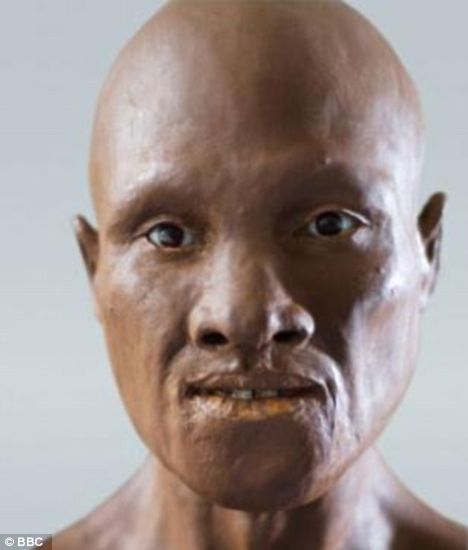
A British forensic scientist, Dr. Richard Neaves, has recreated the head of one of the earliest modern human ( some differences in brain case and teeth) hunter-gathers from fossil remains, in the same manner of reconstructing the identity of homicide victims.
His recreation offers a tantalising glimpse into life before the dawn of civilisation. It also shows the close links between the first European settlers and their immediate African ancestors. To sculpt the head, Mr Neave called on his years of experience recreating the appearance of murder victims as well as using careful measurements of bone. It was made for the BBC2 series The Incredible Human Journey. This will follow the evolution of humans from the cradle of Africa to the waves of migrations that saw Homo sapiens colonise the globe.
….’Richard creates skulls of much more recent humans and he’s used to looking at differences between populations. ‘He said the skull doesn’t look European or Asian or African. It looks like a mixture of all of them. ‘That’s probably what you’d expect of someone among the earliest populations to come to Europe
As with the example of Kennewick Man, efforts at forensic paleo-anthropogy shatter modern racial assumptions regarding our earliest ancestors, regardless of whether those assumptions emanate from archaic stereotypes or modern PC ideology. Kennewick Man bore little or no resemblance to Amerinidian tribal groups that he long preceded, and Native American activists responded to the startling archaeological find by attempting to have the remains seized, scientific analysis of them banned and the site bulldozed. The “First European”in turn, looks nothing like the Aryan mythology of the Nazis or 19th century European racialist agitators. Instead, he appears somewhat like an Africanized Yul Brynner.
These reconstructions demolish our casual, self-referentially anachronistic, projections of our own demographic groups backward in time. We want to see ourselves in the people “back then” just like we wish to imagine that kind of continuity in a far-flung future. I’m dubous that we will look like “us” 100,00 or 250,00 years in the future and wonder if sucha peoplewill even acknowledge their kinship with us any more than we do with Homo Habilis.
If you are like most people in the ‘developed world,’ you don’t have any experience in a true tribal organization. Tribal organizations were crushed in the last couple of Centuries due to pressures from the nation-state that saw them as competitors and the marketplace that saw them as impediments. All we have now it is a moderately strong nuclear family (weakened via modern economics that forces familial diasporas), a weak extended family, a loose collection of friends (a social circle), a tenuous corporate affiliation, and a tangential relationship with a remote nation-state. That, for many of us, is proving to be insufficient as a means of withstanding the pressures of the chaotic and harsh modern environment.
The advantage of tribal structures in my view, compared to hierarchies, markets and networks discussed by Ronfeldt revolves around the certainty of mutual trustas a psychological motivator, especially vis-a-vis “outsiders”. Loyalty to all members of the tribe ( primary loyalty) is paramount which is not the case in hierarchies ( loyalty flows upward, downward not so much), markets ( nonexistent) or networks (potentially non-reciprocal loyalty to hub). As such, tribes function very well at the base of Maslow’s Hierarchy of Needs which means they are good insurance for physical survival. It does not matter if the tribe is one of blood or cultural heritage or artificial political, religious or military brotherhood. Militiaman, monk or gang member is irrelevant; what matters is the establishment of unreserved mutual trust as a core of personal identity.
The implicit trust present within the tribe and the flexible sense of authority gives individual tribesmen room for individual initiative to react, knowing “the tribe has their back”. They are a more centralized unit of power than a network but more fluid and mobile than a hierarchy. A tribe is a safety net or a bodyguard. Great enterprises require something else as an organizational form but behind a great enterprise should be at least some kind of life preserver.
DNIhas an excellent link to a powerpoint from a British military institution ( Defence Academy). The early slides, however poorly constructed from a visual standpoint, have conceptual density. And Dr. Marc Tyrell of The Small Wars Councilgets a special mention in it to boot.
This is muddled and confusing. Human Terrain is “an emerging area of study”? No it’s not. Human “terrain” is a label, a metaphor, for guess what? History, geography, anthropology, sociology, psychology, communications, etc., etc. It’s “major goal is to create operational technologies”? No it’s not. That’s what mathematicians and engineers can deliver on multimillion dollar DoD contracts. Human terrain is, just in case anyone hasn’t read a newspaper or wireclip over the last few years, about people, what they think, their perceptions, their loyalties, the consequences they bear in wartime, the support they may or may not provide to insurgents, the physical, cultural, and informational spaces they create and occupy in times of conflict and crisis.
Freaking mad scientists. They’re everywhere. Technology is a tool, not the answer
and
What is really meant by ‘fragile’ states is ones that have acquired legal sovereignty but that have lost, or more probably never acquired, the effective powers attached to that status. There are more and more such states. How many depends on one’s definition of fragility. The United Kingdom’s government development agency, the Department for International Development (DFID), one of the smartest outfits in the business, estimates that 46 states, over one quarter of the world’s total, fall within its definition of ‘fragile states’. The population of these 46 states is over 870 million. DFID bases its definition of fragility on a state’s record in combating poverty. Others define fragility not by reference to poverty, but to security. Referring to the slightly different concept of ‘failure’, in the United States’ 2002 National Security Strategy, President Bush stated that America ‘is now more threatened by weak and failing states than…by conquering ones’.
“Human Terrain Mapping” is one of those relatively new concepts I’ve been meaning to investigate and CTLab – run by a distinguished trio of scholars and authors Stephen D.K. Ellis, Michael A. Innes and Brian Glyn Williams – fits the bill. Definitely a “blogroll-worthy” site for all of the Intel/COIN/IO/DIME/Foreign Policy bloggers and of interest to the history blogosphere as well since two of the three gentlemen are professional historians.
I look forward to many enjoyable and profitable visits.
UPDATE:
Mike Innes has written in to explain that CTLabs is still expanding their team of SME’s as well as the working on the aesthetic and functionality aspects of the site itself, which will be formally “rolled out” with a higher level of interactivity and collaboration.
Zenpundit is a blog dedicated to exploring the intersections of foreign policy, history, military theory, national security,strategic thinking, futurism, cognition and a number of other esoteric pursuits.
of Africa to the waves of migrations that saw Homo sapiens colonise the globe.
 organizations were crushed in the last couple of Centuries due to pressures from the nation-state that saw them as competitors and the marketplace that saw them as impediments. All we have now it is a moderately strong nuclear family (weakened via modern economics that forces familial diasporas), a weak extended family, a loose collection of friends (a social circle), a tenuous corporate affiliation, and a tangential relationship with a remote nation-state. That, for many of us, is proving to be insufficient as a means of withstanding the pressures of the chaotic and harsh modern environment.
 mutual
 upward, downward not so much), markets ( nonexistent) or networks (potentially non-reciprocal loyalty to hub). As such, tribes function very well at the base of

