zenpundit.com » creativity

Archive for the ‘creativity’ Category

The uniform, the disruptive, & from Colditz to Mt Kenya

Thursday, May 3rd, 2012

[ by Charles Cameron — out of the box thinking, the blues, prison escape literature and more ]
.

As you’ll see by the time we get to the Colditz segment of this post, I’m not arguing that anyone should change out of uniform.

But oh yes, I do fish for eddies in the currents of words — or to put that the other way around, eddies in the currents of words tend to catch my eye, and when I read this paragraph in Kohlmann‘s Response to the Critics of Disruptive Thinking:

Jon Favreau, the head speechwriter for President Obama, was 27 when appointed. Aaron Schock, a Congressman from Illinois, is 30. Mark Zuckerberg created Facebook when he was still an undergrad at Harvard. Tom Brady won multiple Super Bowls in his twenties. This is a remarkable list, with some household names. Yet, I must ask, where are our young strategic military geniuses in uniform?

it was that last word that grabbed my attention — because somewhere in the back of my mind I have this idea that there’s nothing uniform about genius: it’s supremely individual.

Besides, I’m 67.

*

All of which brings me circuitously to Blind Lemon Jefferson and his Lock Step Blues:

Mean old jailor : taking away my dancing shoes
I can’t strut my stuff : when I got those lock-step blues

Again, I’m not claiming that “military” equates to “prison”, or that marching involves leg-irons… just hop, skipping and dancing from one thought to another, to see whether there’s a creative leap available…

*

And indeed it seems there is.

Thinking about disruptive thinking and uniforms and, well, prison, finally put me in mind of the place where the uniformed are required by their own code to be disruptive — that is, when they’re in POW camps.

There’s a great deal of noise these days about outside the box thinking — as a synonym for creativity — but it has only now occurred to me as I’m writing this post that one of my very first boyhood obsessions was in fact a kind of training ground for thinking outside the box.

And the box in question was Colditz Castle, the POW camp where the Germans sent those who had already escaped from at least one such camp and been recaptured.

I don’t know Emily Short, but in a post at her Interactive Storytelling blog, she describes the German “idea of putting all the most clever and resourceful prisoners together in an old building riddled with hiding places and odd physical quirks” as “not the brightest”, and notes that “those imprisoned found an astounding number of escape possibilities”.

That’s the essence of The Colditz Story, as described by PR Reid in his 1953 book of that name and its sequel, Men of Colditz [link is to double volume]. And I was fixated on Colditz and other World War II escape narratives for a boyish year or two thereafter.

*

Decades after that obsessive interest of mine in military escape literature had faded from view, I ran across another tale that fits the genre: Felice Benuzzi‘e extraordinary 1953 No Picnic on Mount Kenya.

Benuzzi was an Italian POW in a British camp in Kenya, with little to no prospect that even if he could escape the camp he’d be able to avoid recapture:

The idea of escaping is a vital factor in the mind of every prisoner. On our arrival in East Africa I had as a matter of course carefully considered the chances of reaching the nearest neutral territory, Portuguese East Africa; but I had concluded that, for me at least, this would be impossible. The distances one had to cover were enormous, one needed a frightful lot of money, the opportunity of getting a car, knowledge of the country and of the main languages, and faked documents…

But imprisonment is appalling boredom, and boredom didn’t suit Benuzzi’s temperament. One night he saw Mt Kenya from the camp for the first time:

an ethereal mountain emerging from a tossing sea of clouds framed between two dark barracks — a massive blue-black tooth of sheer rock inlaid with azure glaciers, austere yet floating fairy-like on the near horizon. It was the first 17,000-foot peak I had ever seen.

I stood gazing until the vision disappeared among the shifting cloud banks.

For hours afterwards I remained spell-bound.

*

Escape from boredom was imperative, climbing Mt Kenya would be Benuzzi’s return to life.

Fortunately, Bennuzi had a map:

Admittedly it was just the label from a can of “meat and vegetable rations” — but beggars and prisoners can’t be choosers, necessity is the mother of invention, and a meat rations can was what they had.

The dangers they faced were real enough. From the introduction:

“In order to break the monotony of life (in prison) one had only to start taking risks again,” Benuzzi writes as he and his comrades design their escape. The risks are real. Sneaking out of camp, they may be shot. For the first two days they must travel at night, across fields and past settlements. Once in the forest, away from what Benuzzi calls “the human danger-zone,” they will enter the “beast danger-zone.” Finally they will escape into the relative safety of the alpine tundra. Every mountaineer and outdoor person reading this tale will feel kinship to Benuzzi here, when he writes that “all the landscape around us reflected our happiness … green-golden sunrays filtered through the foliage … bellflowers seemed to wait for the fairy of the tale who would ring them. We were now into a world untainted by man’s misery, and bright with promise. Other dangers undoubtedly in store for us, but not from mankind, only from nature.”

Benuzzi avoided the worst that humans and beasts could throw at him, scaled Mt Kenya’s Point Lenana (16,300 ft), with equipment scrounged from around the camp, returned, surrendered himself to the British and to solitary confinement — knowing himself a free man — and lived, as they say, to tell the tale.

*

So what do we learn?

It’s not that uniforms frustrate creativity, it’s that necessity procures it.

As the great Islamic poet Jalaluddin Rumi [quoted in Idries Shah, Tales of the Dervishes, p. 197.] says:

New organs of perception come into being as a result of necessity.
Therefore, O man, increase your necessity, so that you may increase your perception.

That’s where this whole “disruptive thinking” discourse is eventually headed.

“No one is really listening, they are just pretending.” – Madhu

Wednesday, May 2nd, 2012

[by J. Scott Shipman]

As mentioned recently, I’m reading Inventing Grand Strategy and Teaching Command, by Jon Tetsuro Sumida. Chapter 2 is complete, however Sumida included one sentence at the end of the Introduction that has been nagging me. Professor Sumida said, speaking of Alfred Thayer Mahan:

“It remains to be seen whether readers exist with the mind and will to accept his guidance on what necessarily is an arduous intellectual and moral voyage into the realm of war and politics.” (emphasis added)

The phrase “whether readers exist with the mind and will” jumped off the page. Over the last few days I’ve seen several articles of warning of the West’s decline, and while many shed light on symptoms that would indicate decline, most are tired old bromides masquerading as “new thought.” For instance, a few days ago, a friend on Twitter (an Army officer) shared a Tweet from The New Atlanticist of an article called, “Why We Need a Smart NATO.” He tweeted, “Call me a cynic, but haven’t we ALWAYS needed a smart NATO?” Good question. In my estimation, “smart NATO” is yet another venture into sloganeering. While it may call into question my judgement, my first thought on reading “smart NATO,” was a line from the cult movie Idiocracy (if you haven’t seen it, get it) and one scene where the time traveling protagonist is attempting to explain the importance of water to plants to people of the future who use a sports drink instead. Here is the clip:

but it’s got electrolytes…

We’re living in a world of unprecedented availability of information, yet our meta-culture seems indifferent to anything that takes more than a few minutes to consume. Among too many military colleagues I know, it is not uncommon to hear the phrase, “I’ve not read Clausewitz through….nobody does…” And I respond, “But if not you, then who will?” If the practitioners of a profession as serious as the profession of arms don’t read and think deeply, who will? And what will become of the timeless principles learned and recorded at the cost of blood and treasure and how those principles translate into how we fight? I have an abiding fear our military, not out of malice but neglect, is cutting the intellectual cord with the past by making it culturally acceptable to be intellectually indifferent and incurious, to sloganeer instead of think, allowing slogans and PowerPoint as woefully inadequate substitutes. There is no app for intellectual development.

We can’t afford to allow the profession of arms to be anything but intellectually robust and challenging. Zen wrote an excellent summation of the recent posts on disruptive thinkers (which may for some have the ring of sloganeering). However these posts are evidence a lot of the young guys “get it” and want more. Good news, but recognition of the problem is not enough; action is required. Action that may damage a career.

I’m a member of the US Naval Institute, and an on-going concern of the Institute is relevance to the young folks. Yep, relevance. Relevance with a mission statement like this:

“To provide an independent forum for those who dare to read, think, speak, and write in order to advance the professional, literary, and scientific understanding of sea power and other issues critical to national defense.”

Reading, thinking, speaking, and writing requires what Sumida referred to as “mind and will.” Leaders create this condition and desire by example, unambiguous expectations, and by listening, adapting, and sharing their knowledge with subordinates and encouraging them to push their intellect. Good leaders will create a space where deep thinking is expected, where curiosity isn’t the exception, but the rule. Many of our folks in uniform compete in the physical fitness arena and do the hard work necessary to be the best physically, but we need more intellectually rigorous competition in both formal schools and at the unit level. Leaders create this environment, for the best leaders want their people to think. Robert Leonhard in his excellent book, The Principles of War for the Information Age said it best:

“The greatest legacy that a leader can leave behind is a subordinate who is not afraid to think for himself.”

While we can’t pretend to be in good condition or physically fit, some may be tempted to pretend on the intellectual front. Which brings me back to Madhu’s quote: “No one is really listening, they are just pretending.” Doc Madhu, a blog friend and frequent commenter at zenpundit, was commenting on an excellent essay by Mike Few at Carl Prine’s Line of Departure. The essay was titled Finding Niebuhr, and Mike reminds us of Niebuhr’s famous Serenity Prayer:

“Lord, grant me the serenity to accept the things that I cannot change, the courage to change the things that I can, and the wisdom to know the difference.”

Courage and wisdom are virtues enabled by a well-developed, well-rounded, curious intellect. “Pretending” in the profession of arms can have deadly consequences, and more often than not, the pretenders are trying to “be someone” instead of “doing something.” More often than not, this is a group effort, enabled by a crippled culture dominated by groupthink.

Boyd’s challenge continues to ring true:

“To be somebody or to do something. In life there is often a roll call. That’s when you will have to make a decision. To be or to do. Which way will you go?”

This is cross-posted at To Be or To Do.

Grace and the Garage

Sunday, April 29th, 2012

[ by Charles Cameron — introducing the world of problem solvers and creatives to the world of theologians and contemplatives and vice versa — and then, Simone Weil ]

.

I believe this is an important post in its own way, though a short one: because it links two areas that I believe are joined at the hip in “reality” but seldom linked together in thinking about either one.

I mean, creativity, as in the guys working away in the garage on something that when it emerges will be the new Apple, and grace, the mysterious and mercurial manner in which inspiration touches down on us…

*

In the first part of this post, then, I would simply like to suggest that those entrepreneurial folk who follow their dreams — typically into garages or caves — and beg borrow and steal from relatives, friends and passing acquaintances the funds they need to continue their pursuit of some goal or grail under the rubric “do what you love and the money will follow” are, in fact, following a variant of a far earlier rubric, “seek ye first the kingdom of God … and all these things shall be added unto you” – and that creative insight or aha! is in fact a stepped down and secular version of what theology has long termed epiphany – the shining through of the eternal into our mortal lives.

But this will get preachy if I belabor the point: what I am hoping to do is to open the literatures of the world’s contemplative traditions to the interest of “creatives” and the literatures of creativity, problem solving, and autopioesis to the interest of theologians and contemplatives…

*

And Simone Weil.

Simone Weil, a philosopher I very much admire, wrote a book of superb beauty and wisdom titled Gravity and Grace. I must suppose that her title was somewhere in the back room of my mind, working quietly away behind the scenes, when the title for this post popped up.

Weil is, shall we say, hard liquor for the mind and spirit — highly distilled, potent, to be sipped, no more than two paragraphs or pages at a time…

A Jew who loved the Mass yet refused baptism, an ally of Communists and a resistance fighter against the Nazis, a factory worker, mystic, philosopher. The poster at the top of this post is for a film of her life: I doubt it will be a comfortable film, but the discomfort will likely be of the inspirational kind.

Before Disruption….Thinking

Monday, April 23rd, 2012

“What you think, you become”

    – Buddha

“We are what we frequently do”

    – Aristotle

There has been a lively and still evolving debate in the milblogosphere regarding “disruptive thinkers”, starting with Benjamin Kohlman’s post at SWJ whose editor Peter J. Munson has done a fine job steering, collecting and commenting upon. A selection:

The Military Needs More Disruptive Thinkers by Benjamin Kohlman

Disruptive Thinking, Innovation, Whatever You Want to Call It is Needed for a Military in Crisis by Peter J. Munson 

The focus on disruptive thinkers coincided with a different but relevant debate over professional military education (PME) when a scathing blast was recently  leveled at the US Army War College by Major General Robert Scales (ret.) , himself the former commandant and a strong advocate of rigorous PME.  A few of the criticisms made by General Scales at a gathering at FPRI were mentioned in a post by Thomas Ricks who believes in shutting down the service academies and war colleges and maybe just sending everyone to Yale, Princeton and Harvard for MBAs. Or something.
.
What was interesting to me is that many authors and their points had less to do with a close examination of cultivating cognitive skills than related topics of changing organizational culture, the perils of groupthink, rehashing ideas from Frans Johanssen’s The Medici Effect and John Kao’s Innovation Nation, the superiority of entrepreneurshiphidebound military bureaucracy and other tangents to indirectly create an environment in which insightful or innovative behavior might happen.  Only Mike Mazarr zeroed in to the heart of the matter, writing:
….We need to improve, for example, in the detail and specificity of critical and creative thinking methodologies that we integrate into the curriculum.
Bingo!
.
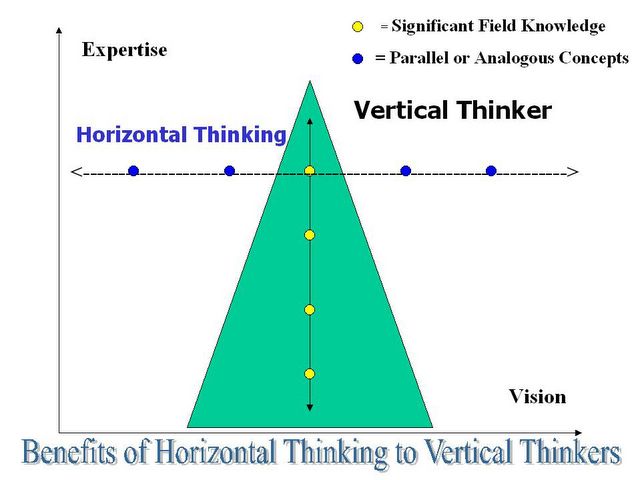
There’s nothing wrong -in fact, much to the good – with the call of Kohlman and others like Joan Johnson-Freese to deliberately combine students and faculty of radically different professional backgrounds. Such a personnel mix is a good base for horizontal thinking to take place, where discussions can range across fields generating insights and analogies and accelerating learning.
However, just assembling a broad mix of talent and putting them together in a building is not enough because it is not any more goal oriented than a MENSA social. Good things might happen, sure, but just as easily not. This is why DARPA is a lot more productive of an organization on an annual basis than the Institute for Advanced Study. There needs to be a mixture of problem-solving and play, free inquiry or experimentation and unifying goals. Communities of interest have to first have a sense of community for the vibrantly sharing and inspiring “minds on fire” effect to take place.
.
If the military or more broadly, American society, wants a larger number of creative, innovative, “disruptive”, strategic or whatever kind of thinker, then the answer is to actively and purposefully teach students creative, critical, insight-generating and strategic thinking skills and to value intellectual curiosity, skepticism, imagination and empiricism over ideology and conformity. The other indirect, “better environment”, stuff certainly improves your chance of success, but systemic improvement will only come about by making such objectives the focus of instruction and learning rather than a haphazard byproduct.
UPDATE:
At Best Defense, Ricks has provided a copy of his prepared remarks on PME as well as a link to the audiofile that I could not pull up the other day. Check out what he has to say.

The Taliban who turned himself in

Wednesday, April 18th, 2012

[ by Charles Cameron — a possible cultural parallel, also an entry for the pattern language of creativity, ourobouros ]

.

.

You’ve read about it in the news already:

U.S. officials couldn’t believe their luck last week when a suspected Taliban commander who heard there was a $100 reward for his whereabouts turned himself into authorities.

Perhaps misunderstanding the meaning of ‘wanted’, Mohammad Ashan sauntered up to police in Sar Howza, Paktika province, with a poster bearing his own face – and demanded the finder’s fee.

There are two things to note here — a parallel, and a pattern.

1.

The parallel is with an incident I mentioned earlier on Zenpundit:

I was also struck by an anecdote Tom Ricks told Fareed Zakariah on the latter’s show recently. He recounted a story first told by John Masters in his book “Bugles and a Tiger”, the memoir of a British officer serving with the Gurkhas in Waziristan in the 1930s. At the end of the war, so the story goes, some Afghans approach the British soldier and ask, “Where are our medals?” “You were the enemy,” he replies. And here’s the punchline, the Afghan respose to that: “No, no. You gave medals to the Pashtuns on your side. We want our medals, too. You couldn’t have had a good war without us.”

Tom Ricks comments, “This is very much the Afghan attitude. This is a kind of sporting event for them in many ways.”

Food for thought.

2.

The pattern is self-reference. Again,it’s something I’ve touched on here before, because it’s always of interest when it crops up:

there’s a special place in my analytic thinking for those representables which are self-referential – the category that gave rise to Douglas Hofstadter’s celebrated book, Gödel, Escher, Bach.

Indeed, I have a special glyph that I use in my games to notate ideas that are self-referential:

We don’t learn anything new about the particular instance of the Taliban walking in to claim his award for identifying himself by noting that it’s self-referential — but it intrigues us because it is, and that’s actually a sign that paradoxes of self-reference are significant at an unconscious level: that they’re a pattern worth watching for, and one that will play a role in the generation of aha! moments — whether they be analytic insights, creative breakthroughs, or (as in this case) just strange and amusing.

Kekulé von Stradonitz‘s basic insight into the structure of the benzene molecule was that it might be a serpent eating its own tail. That’s self-referential paradox at it’s finest — and a key aha! moment in the history of Chemistry.

It is also an archetypal image — the self-devouring serpent (ouroboros) crops up in alchemy (see image above) and in the Norse myth of Jörmungandr, the serpent who encircles Yggdrasil, the world tree.

Such images are important to the care and feeding of the creative mind.


Switch to our mobile site