zenpundit.com » creativity

Archive for the ‘creativity’ Category

Genghis John

Friday, May 27th, 2011

Not John Boyd this time, but John Robb.

John recently gave me a preview of this idea in a much more specific context:

….Here are some of the economic reforms that turned the horde of Genghis Khan into a steamroller than flattened most of the world’s kingdoms/empires.*  He:

  1. Delayed gratification.  He banned the sacking of the enemy’s camp/city until all of the fleeing soldiers, baggage, etc. were rounded up.  This radically increased the loot accumulated and ensured it could be shared among all of the participants (he confliscated the wealth of those men that cheated by looting early).
  2. Systematically shared the loot based on contribution and merit.  He disregarded title or status and systematically rewarded loot to everyone in the horde that earned it (the traditional approach was to let a few take it all — sound familiar?).  Of course, that fairness pissed off the nobility since they were used to backroom dealing and hereditary rights.  However, the benefits of this system, were far greater than the costs.  To wit:  He cemented the loyalty of the men and was able to attract thousands to his banner for every noble lost.
  3. Protected those that make sacrifices.  For men killed in the campaign, he paid their share of loot to their widows/orphans posthumously.  

*of course, the first unsaid lesson is:  attack the places with the most loot.

2011, meet 1997 (and 1995, and 1943…)

Wednesday, May 25th, 2011

[ by Charles Cameron — creativity, IARPA, HipBone Games, h/t Hermann Hesse ]

.
Funny thing, that.

quo-iarpa.gif

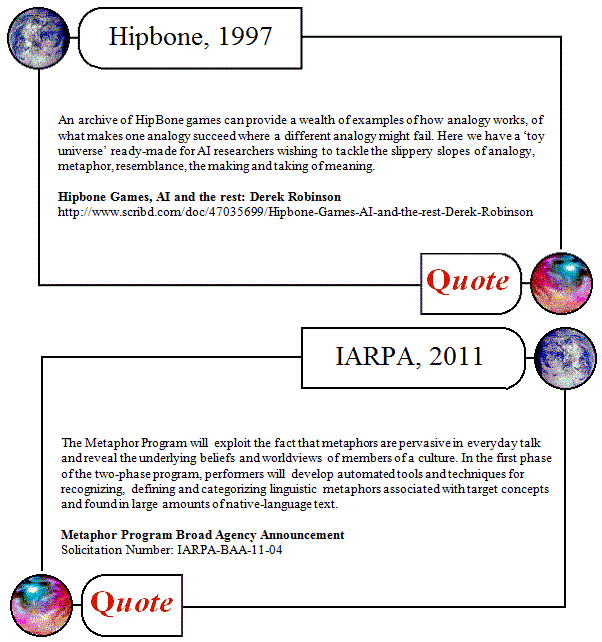
In 1997, Derek Robinson wrote a short piece about my HipBone Games, indicating what they were good for. Read it – then read the IARPA solicitation that just came out.

My approach is to lure people into discovering analogies, metaphors, parallels and oppositions by playing a game which elicits them as game moves — a live process, and one that cuts to the very heart of creativity — IARPA wants an automated version, which will be clunky by comparison. And as Derek points out in his piece — pointed out, that is to say, fourteen years ago, quoting an even earlier (1995) comment from Douglas Hofstadter:

If, instead of using the real world, one carefully creates a simpler, artificial world in which to study the high-level processes of perception, the problems become more tractable.

That’s what my games are — “a simpler, artificial world in which to study the high-level processes of perception” — specifically, “of analogy, metaphor, resemblance, the making and taking of meaning”.

I’ve been working on this stuff for at least fifteen years… inspired by a book Hermann Hesse published in 1943.

*

And oh yes, there’s a “future of search engines” hiding in there, too.

Reputation in the dark

Tuesday, May 17th, 2011

[ by Charles Cameron — Towards a Pattern Language for CT II ]

.

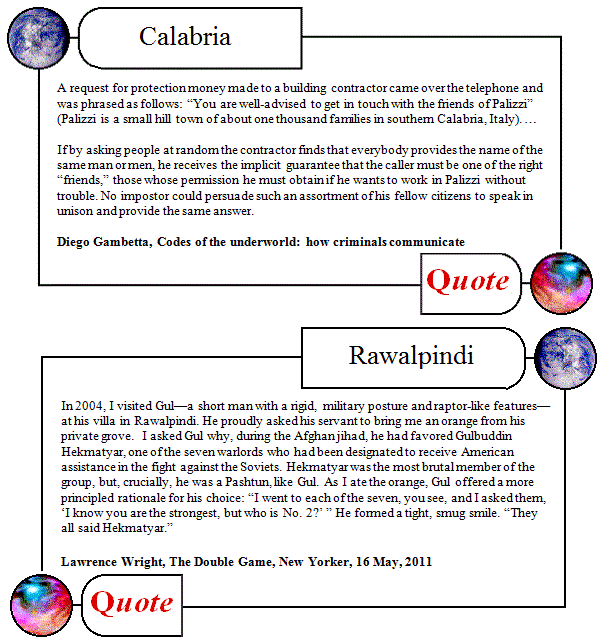
A tip-of-the-hat to Mercutio for pointing me towards Diego Gambetta‘s Codes of the underworld: how criminals communicate in a comment here on ZP today. I went off to see what snippets of Gambetta I might find — and ran across a paragraph which sent me in search of another that I’d read earlier this week, and which I finally located (after devious detective work) in Lawrence Wright‘s summation of the situation with regard to Pakistan.

quo-reputation.gif

There’s a pattern here, and it has to do with the assaying of reputation under, shall we say, precarious circumstances?

You may recall my post of two weeks ago, Towards a Pattern Language for CT? — well, this can be the second in the series.

Creativity and the laughable

Monday, May 16th, 2011

[ by Charles Cameron — creativity, Taliban, Leonardo, pareidolia, Virgin Mary, Kwan-yin ]
*

.
Sharing, as I do with Zen, a keen interest in the creative process, I am used to the idea that an idea that seems trivial at first, the very expression of which risks making oneself a laughing-stock, may well carry the seed of success.

Whitehead is quoted as saying, “Every really new idea looks crazy at first.” Einstein, “If at first the idea is not absurd, then there is no hope for it.” Nils Bohr, “Your theory is crazy, but it’s not crazy enough to be true.” The idea is not even confined to physicists and mathematicians. Mark Twain observed, “The man with a new idea is a crank – until the idea succeeds.” And Winston Churchill, “No idea is so outlandish that it should not be considered with a searching but at the same time steady eye.”

I was therefore intrigued to read this account of the origins of the Taliban’s recent Kandahar prison break:

One of the surprising mujahideen squad in the city of Kandahar, who by his connections gained full knowledge of the inside and outside of the prison, pondered one day whether it could be possible to dig a tunnel from the inside of a house on the other side of the street to the prison as a means to releasing the prisoners. This fantasy and imagination seemed laughable at first even to its owner; he dared not share his opinion with others. But, after more time and continued thinking, he reached a conclusion. On one of these days, while he was riding a motorcycle with two of his comrades, he shared that view with them. They thought it impossible initially and deemed it a fruitless, dangerous attempt. Finally, they placed their trust on God and shared their opinion with the mujahideen high command in Kandahar. With guidelines from the command, the aforementioned four revealed [to] their trusted comrades their decision to implement this plan regardless of its risks and even if it looked impossible.

The sentence that really got my attention was this one:

This fantasy and imagination seemed laughable at first even to its owner; he dared not share his opinion with others.

*

Leonardo da Vinci once wrote of having “a new and speculative idea, which although it may seem trivial and almost laughable, is none the less of great value in quickening the spirit of the invention.”

His “trivial and almost laughable” idea?

It is this: that you should look at certain walls stained with damp or at stones of uneven colour. If you have to invent some setting you will be able to see in these the likeness of divine landscapes, adorned with mountains, ruins, rocks, woods, great plains, hills and valleys in great variety; and then again you will see there battles and strange figures in violent action, expressions of faces and clothes and an infinity of things which you will be able to reduce to their complete and proper forms. In such walls the same thing happens as in the sound of bells, in whose strokes you may find every word which you can imagine.

Essentially, Leonardo is suggesting that we use what’s effectively the Rorschach technique to induce pareidolia (I think that’s the state) and elicit mental contents – images triggered by the mind’s eagerness to sense meaning – thus imitating the universe itself in bringing something out of nothing, out of the potent void.

*

This is, however, the same psychological mechanism that brought us the sale of a grilled cheese sandwich for $28,000 on eBay – because it “looked like” the Virgin Mary

That’s not a note I’d like to end on, however — so I’ll just remind myself that we don’t “know” what the Virgin Mary looks like, and pass on to the rather charming story of a similar pareidolic image, this one possessing the almost miraculous property of looking simultaneously like the Blessed Virgin and the bodhisattva of compassion, Kuan-Yin:

Situated in the East Bay area, near the lovely city of San Francisco, the Purple Lotus School is witnessing yet another miracle. … In April 1996, when the great “Merit Wall” on campus had just been constructed, a mysterious face appeared on the wall immediately after the cement dried. … Buddhists who have witnessed this phenomenon believe this to be the face of the compassionate Bodhisattva Kuan-Yin. … Others have believed this image to be that of the Virgin Mary. Magia and Junia Chou, the daughters of the Purple Lotus Society’s Master Samantha Chou, attend a Catholic elementary school. Upon seeing the image, both called out earnestly and delightedly, “Look! It’s the Virgin Mary!” … With the essence of Enlightenment and universal wisdom in mind, perhaps one can argue that a distinction between the two is not important after all.

*

It’s laughable, I know — but I must confess I like the “meaning” I can draw from that…

Ugliness and holiness

Thursday, May 12th, 2011

[ by Charles Cameron ]

.
I’m taking a break from my usual Zenpundit fare this time around, and posting some poems about the ugliness and holiness I see most evenings.

*

When my capacity for writing about religious violence and apocalyptic fever has abated, and I want to set my mind on pause before I go to sleep, I often watch crime-thrillers: it’s a sort of meditation for me. And because it’s a sort of meditation, I find that odd things – single shots, often the ones film-makers call “establishing shots” – catch my eye and send me into poetry mode, where what I’ve seen triggers a clearer sense of what I intuit.

The secular sacred: i

In the relative darks of early darkness
a train crosses on a raised rail above the houses
where sleeping is beginning, its
windows and windows and windows lit up
with empty interiors, here and there
a person, but windows, mainly, and their
lights passing in sequence with a rhythm like
the rhythm of breathing, of the late train.

And how to get that in poetry, how to get
what the camera sees, the slightest of slightest
parts of the daily routine, entirely secular,
where plain people have transmuted
metal to transportation system? Tta-cha,
this passing of lights, lights, lights in the night.

It goes this way: the films show me something of the scope and range of human activity, and the scope – the sheer size of numerous cities – is so huge, and the range – from the heroic, the creative and even the saintly to the crazed, the dulled, the bereft and the vicious – is so great that my sense of how wide and deep the world is gets expanded way past its limits.

And the part of me that has experienced (and continues to experience) something that I can find no words for outside the religious vocabulary — “grace” and “radiance” – the part of me that is enormously thankful now and always for the privilege of human being, of sight, friends, speech, friends, books, friends, music, travel, the internet… that part of me, precious to me, somehow must come to grips with the gritty, the grimy, the “real”.

I have no theories about heaven, no belief or creed beyond a non-verbal assent, but it’s my sense that the condition of joy we call “heaven” – much like the condition of insight we call “poetry” – reaches “down” from whatever lofty spires or Himalayas we may suppose it abides in, into the dust beneath our wheels, beneath our feet… dust that my mind, at least, could easily sweep under the carpet.

And so, watching thrillers to put my mind on pause, I have to put the films on pause to write the poems…

The secular sacred: ii

How many gravestones can a camera’s eye
pass in a single sweep, and you think
God any less able to see? The sacrament
of cinema surpasses, pushes words
into admission of strange holiness way
past the tolerances of the religious,
way and away past any sense of what sacred
might mean except only the sacred itself,

felt fully in belly and brain of the city, the
splintered, splendored city. Nor, in
these needle-strewn streets, this broken
flesh and blood, is there mercy room
beyond pity of such pettiness, the
shattered dreams — so ugly, small, so holy.

After writing those two on successive nights, I made a note for some friends…

Those two, the “secular sacred” poems, are part of something I’m working towards by watching “gritty” films most nights, and triggered in particular by helicopter long-shots of freeways intercut with goings on at street level — giving me the feeling the world is far larger (and uglier) than (my) religious imagination usually reckons, with holiness in the discarded condoms.

So I’m trying to make room conceptually for a god or emergent world or mirroring pool wide and deep enough for gritty realism in these poems…

The secular sacred: iii

Now you think of it, someone must have
wanted him to walk down those steps from
the whore’s house round the corner
into the shadow and to his car, the street
laid out just the way it happens
in the film, someone put the camera
there or the street corner, setting
up a street corner is less effort than

growing a city from scratch and gives
greater freedom, so there was some intent,
some design to his coming down
those steps at that speed and time with
that look on his face, and directors
are not necessarily lacking in street smarts.

And I’m far from sure what sort of God, mirror or emergence will emerge from all this at the end, but it’s unlikely to have curls in a beard and be supremely nice, at least not just nice…

The secular sacred iv

The fact that there’s holiness in needles
glinting in the sun and discarded condoms in
the shade, and the fact there’s often
more shade than sun, and other facts I
might mention shouldn’t dissuade us from
the glint of clinics and the shade of
discarded habits, there’s holiness there
too, in the turning around of a life, and if

grass needs to break through asphalt to
prove a metaphysical point, you can be sure
some kind of holiness is reaching up
for sky and to get our attention, which,
too, is a locus of the sacred, humming in
time with the heartbeat of world and heaven.


Switch to our mobile site