zenpundit.com » terrorism

Archive for the ‘terrorism’ Category

Profiling Baader-Meinhof

Tuesday, January 15th, 2013

[ by Charles Cameron — fast cars, bumper stickers — and no mention of loose women ]
.

-- I'm not a member of the Baader-Mainhof gang

.
The sentence that drives my title is this one, from How BMW Became A Terrorist Icon In The 1970s (And How It Made Them Cool) on Jalopnik:

police would set up roadblocks and stop only BMWs in an attempt to root out the gang members from the general population.

That’s profiling for you, eh?

**

Here’s a longer excerpt, so you see where this comes from — and how it turned out, at least for as the makers of BMWs:

In the early 1970s, the extreme left wing Baader-Meinhof Gang terrorized the people of West Germany with a campaign of bombings and assassinations aimed at dismantling a capitalist system they considered no better than the Third Reich.

The terrorists’ ride of choice? BMW New Class sedans and coupes, according to this documentary from historian Richard Huffman, an expert on the Baader-Meinhof Gang.

Huffman says cars became so strongly associated with the group’s acts of terror that police would set up roadblocks and stop only BMWs in an attempt to root out the gang members from the general population.

People even started saying that “Bavarian Motor Works” actually stood for “Baader-Meinhof Wagen.” Some BMW drivers even had to slap bumper stickers on their cars specifying that they weren’t terrorists.

You might expect this to have been a major PR crisis for BMW, then a small and nascent regional automaker nowhere near as prominent as it is today. But it wasn’t. That’s because the Baader-Meinhof Gang, later known as the Red Army Faction, enjoyed a surprising amount of support from people in West Germany, especially among young people and members of the left-leaning counterculture. This went a long way toward making the car seem hip in German youth culture.

Then the gang stopped being theoretical revolutionaries and actually started murdering Germans and U.S. soldiers. When the body count began to rise, public support evaporated. As for BMW, they emerged unscathed from the crisis, and started growing into the luxury giant they are today.

**

Now, what kind of analytic model would predict a series of twists and turns and hairpin bends like that?

Madness, Mass Shootings and an Open Society

Monday, December 17th, 2012


Everyone in America has seen the latest results of another dangerously mentally ill loner with family members who were in denial about the severity of his condition or disconnected from him. The killer, Adam Lanza, shot shot his own mother in the face before slaughtering twenty elementary school children and the heroic teachers and their principal who had sought to protect them, belonged in an institutional setting. The same can be said for homicidal schizophrenic Jared Loughner who shot Congresswoman Gabby Giffords, James Holmes, the Colorado shooter, has a gag order on his murder trial but his defense lawyers have already disclosed that their client is mentally ill in blocking access to his diaries under physician-client privilege. Seung-Hui Cho, who committed the Virginia Tech massacre, had previously stalked women, made suicidal threats and been ruled “an imminent danger to himself and others” was set free and unwell to be treated on “an outpatient basis” that never happened.

Predictably, a debate about gun control has erupted in the aftermath of senseless deaths. However, other countries are as heavily armed as the United States (in a few cases, more so). These countries also have severely mentally ill people, yet they don’t have the mass shootings that have become a dark cultural phenomenon we see here in America.  Or when on the rare occasions they do, the shooter is likely not to be insane, but a professional terrorist.

There have also been calls for improved school security ( the Obama administration and Congress cut school security grant funds in 2010 and 2011), stationing policemen in schools and even arming teachers, citing the example of Israeli schools and the Pearl High School shooter who was stopped by an assistant principal with a .45.  While more security is a reasonable precaution and a good idea, short of turning our schools into windowless, prison-like, fortresses and giving the staff AK-47’s,  anybody utterly willing to die in order to kill someone else stands a pretty good chance of success. If all guns vanished tomorrow, the crazies will use car bombs and IEDs instead; mass shootings are a “motivated crazy person” (or terrorist) problem – criminals with economic motives do not carry out these kinds of attacks.

There is no perfect answer here, but here are a few suggestions:

  • We need to revise our attitude toward mental illness with greater public education and access to mental health treatment, especially emergency treatment. Most mentally ill people are NOT dangerous but the warning signs of psychotic breakdown should become as widely recognized as the dangers of cigarette smoking.
  • For the very few people who are mentally ill and violent, we need to have public heath authorities accept that some degree of active supervision is required to ensure they receive treatment and take their medication if they are to live independently, and if they refuse, to institutionalize them temporarily until they do so. The key variable here is *violence* not just mental illness and strong due process safeguards must be in place to protect the individual and ensure they receive appropriate treatment with dignity.
  • Schools need much better training and planning for “active shooter” situations. At present, most schools have safety plans that emphasize locking students in enclosed rooms from which there seldom are any escape routes and the staff passively waiting for instructions from higher school authorities or police. While these plans may be good for unarmed intruders of unknown intent, they are dangerously counterproductive for heavily armed active shooters. Schools generally lack  enough secure rooms with doors that can delay such intruders for more than a few seconds and the standard emergency plan emphasis on “sitting tight” discourages the staff from engaging in reasonable risks to quickly evacuate students when the intruder is elsewhere in the building, or if possible, tactics to evade or if need be, resist, the shooter.

New Book: The Violent Image by Neville Bolt

Friday, December 14th, 2012

The Violent Image by Neville Bolt 

Columbia University Press just sent me a review copy of The Violent Image, by Dr. Neville Bolt of King’s College vaunted War Studies Department.  Initially, I was amused by the colorful book jacket, but flipping through, it belies a very weighty, heavily footnoted, academic exploration of the iterative relationship between propagandistic imagery and insurgency. Even a casual perusal indicates that The Violent Image is a book many readers of ZP will  like to  get their hands on.

From the jacket:

….Neville Bolt investigates how today’s revolutionaries have rejuvenated the nineteenth century “ptopaganda of the deed” so that terrorism no longer simply goads states into overreacting, thereby losing legitimacy. Instead the deed has become a tool to highlight the underlying grievances of communities

A small sampling of some of the section titles:

Strategic Communications:the State
Strategic Communications: the Insurgent
Networks in Real and Virtual Worlds
Images as Weapons
POTD as Insurgent Concept of Operations
Anonymity and Leaderless Revolutions
The Arab Uprisings and Liberation Technology
POTD as Metaphor

Endnotes run slightly over 90 pages and the bibliography tips the scales at 50, for those interested in such things.

Looking forward to reading this and seeing how Bolt presents his case.

Thanksgiving and Kasab: pardon and penalty

Thursday, November 22nd, 2012

[ by Charles Cameron — i suppose this is about the state’s claim to a monopoly of violence, seen from both ends ]
.

I don’t want to go too far with this one, and I’ll start with the turkey and pardon, because pardon and forgiveness and thanksgiving all fit together and might as well be celebrated at this season — but as you’ll see, pardon has its dark side, even if it takes an anthropologist named Magnus Fiskesjö and his pamphlet titled The Thanksgiving Turkey Pardon, the Death of Teddy’s Bear, and the Sovereign Exception of Guantánamo to point it out:
.

But around the same time a turkey gets a reprieve in the US, a terrorist in India gets the death penalty.

I think it’s important to remember the Mumbai atrocities of 2008,and of which Ajmal Kasab (depicted below, and recently deceased) was the sole surviving perpetrator — if for no other reason than because he’s considered a martyr by some, and will be avenged.

But first, let me wish a Happy Thanksgiving! to all Zenpundit’s American readers, and good wishes to all others.

**

The problem with martyrdom… is that it’s a force-multiplier. Okay when the force is purely spiritual, not so much when it runs to violence and terror…

photo credit: Outlook India

Retired Indian intelligence chief Bahukutumbi Raman, whose tweets I often follow to articles on his Raman’s strategic analysis blog, warned us all:

Before the execution of Ajmal Kasab, the Pakistani terrorist of the Lashkar-e-Toiba (LET), who had participated in the 26/11 terrorist strikes in Mumbai, at Pune on the morning of November 21, 2012, our security agencies must have examined the likelihood of retaliation by jihadi terrorists in Pakistan and India and strengthened security precautions to prevent retaliatory attacks.

The LET and the organisations associated with it would want a quick retaliation.

And then he went into detail

Sure enough, Reuters then tells us:

Pakistan’s Taliban movement threatened on Thursday to attack Indian targets to avenge the country’s execution of Mohammad Ajmal Kasab, the lone survivor of the militant squad responsible for a rampage through Mumbai that killed 166 people in 2008. Kasab was hanged on Wednesday amid great secrecy, underscoring the political sensitivity of the November 26, 2008, massacre, which still casts a pall over relations between nuclear-armed rivals Pakistan and India.

“We have decided to target Indians to avenge the killing of Ajmal Kasab,” said Taliban spokesman Ehsanullah Ehsan by telephone from an undisclosed location.

**

In the course of the coronation liturgy for Queen Elizabeth II, the words justice and mercy crop up quite often — justly and justice 8 times, and merciful and mercy 28. It appears to be a sovereign’s right and obligation to administer both, and during the ceremonial they are brought together as a symbolic pair.

The Sceptre with the Cross is given into her right hand, with the words:

Receive the Royal Sceptre, the ensign of kingly power and justice

while the Rod with the Dove is given into her left hand, with the words:

Receive the Rod of equity and mercy.
Be so merciful that you be not too remiss,
so execute justice that you forget not mercy.
Punish the wicked, protect and cherish the just,
and lead your people in the way wherein they should go.

Justice is only fair: it seems, however, that it should be tempered with mercy.

**

Let me simply add that my own preference would be to have remitted the death penalty in Kasab’s case, and given him a life term in which to think about the lives he took. As for the turkey — happy stuffings!

I remember too, today, my friend and mentor Wallace Black Elk, and his wife, Grace Spotted Eagle. It was Wallace who — at least once — said:

They called us “Indians” when they came, so we have a nickname. But we are Earth people, we are original. When they come here, I welcome them with open arms, give them a turkey dinner, corn, and all the vegetables, all the greens.

Because this is a land of abundance…

A Meditation In Time of War: security

Thursday, November 22nd, 2012

[ by Charles Cameron — divine protection in Israel and Kentucky ]
.


.

So who needs an Iron Dome, or Star Wars?

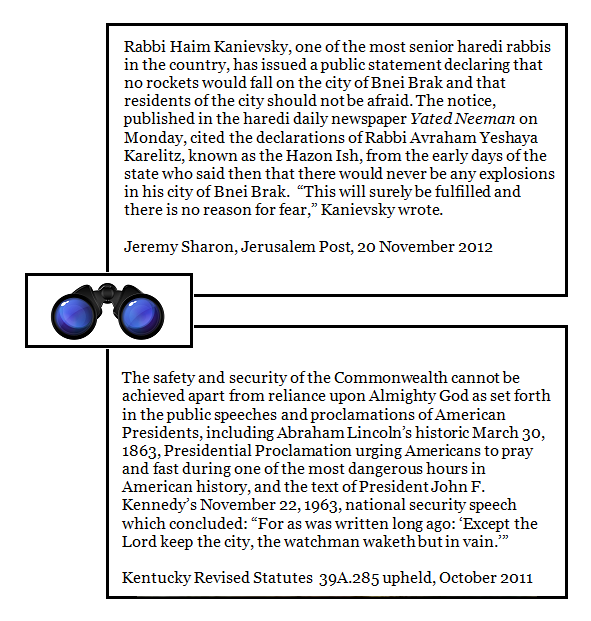
I really don’t have access to the Rabbi’s full and detailed views on the matter, but based on what the Jerusalem Post reports, he appears to be advocating that divine intervention is both a necessary and sufficient form of defense against Hamas missiles.

The Kentucky legislature’s position is somewhat different. The two paragraphs immediately preceding the one I’ve quoted here read:

No government by itself can guarantee perfect security from acts of war or terrorism.

and:

The security and well-being of the public depend not just on government, but rest in large
measure upon individual citizens of the Commonwealth and their level of understanding, preparation, and vigilance.

So Kentucky suggests an admixture of government security measures, public vigilance and divine protection.

**

Let’s skip around a bit. I’m reminded of Abraham‘s discussion of divine judgment and protection in Genesis 18, which begins —

And Abraham drew near, and said, Wilt thou also destroy the righteous with the wicked Peradventure there be fifty righteous within the city: wilt thou also destroy and not spare the place for the fifty righteous that are therein? That be far from thee to do after this manner, to slay the righteous with the wicked: and that the righteous should be as the wicked, that be far from thee: Shall not the Judge of all the earth do right? And the Lord said, If I find in Sodom fifty righteous within the city, then I will spare all the place for their sakes.

Abraham then quizzes God with incrementally lowering figures until God says:

I will not destroy it for ten’s sake.

Scriptures tend to describe acts of God as, well, acts of God – and that’s a category which can include the fall of sparrows, let alone a rain of missiles, a parting of waves, or a pillar of cloud.

Modernity tends to regard missiles, inbound, as acts of human agency, and likewise with missiles sent up to intercept them.

**

Kurt Vonnegut pretty much opens his book, Cat’s Cradle, with the statement:

No names have been changed to protect the innocent, since God Almighty protects the innocent as a matter of Heavenly routine.

I’m sure he meant it with a wink and a nod, but I take some comfort from it all the same. You see, I live in a world of both human and mysterious agency — a world of grace and science, science and grace.

Call me confused, tell me I contradict myself. I can only say with Walt Whitman:

Do I contradict myself? Very well, then I contradict myself, I am large, I contain multitudes.

Oh — and in fact it’s more complex, more nuanced than that.


Switch to our mobile site