Booksbooksbooksbooks….
Monday, August 1st, 2011Two more for the pile….

Another Bloody Century by Colin Gray
Iraq & the Evolution of American Strategy by Steven Metz
Comments or opinions?
Two more for the pile….
Another Bloody Century by Colin Gray
Iraq & the Evolution of American Strategy by Steven Metz
Comments or opinions?

One of the nicest things about ZP is the quality of the commenters. In a post by Charles Cameron, 2083 – Breivik and the Qur’an, deception and warfare, there was this exchange between Joseph Fouche and Seydlitz89 after the latter disputed the utility of looking at the Norwegian mass-murderer Anders Breivik through the lens of strategy:
From Clausewitzian perspective, Breivik’s actions are the conjunction of the three poles of the Trinity, two of which have nothing to with Breivik’s rationality. If CvC can’t be applied to madmen, criminals, mass murderers of children, or men trapped in their own little world, then Van Creveld’s contention that the actions of madmen can’t be considered political (in noted Clausewitzian Christopher Bassford’suse of the word) is correct. War would be “nontrinitarian“.
The words and ideas of murderous stooges have consequences as well as their actions. CvC can shine as much light on them as he can on any other field of human conflict.
Can Breivik’s actions can be considered war? Can an individual wage war? By his own sinister lights, Breivik considered himself at war, the Pied Piper of a host of other Breiviks born and unborn, even if that host only existed in his fevered imagination.
Can an individual have a strategy? Or can an individual only have a strategem? Breivik had a plan that had a tactical expression and apolitical effect (as here we comment on the doings of an otherwise obscure Norwegian). Does the jumbled mass of tissues that connect his evil ends with his evil means rise to the level of strategy?
In her recent book The Evolution of Strategy, noted CvC scholarBeatrice Heuser examines the modern history of the word strategy since Guibert revived it in the mid-eighteenth century. Even the core understanding of the word, the art of connecting political ends with (operational or tactical) military means, has shifted since CvC as the scale and ambitions of campaigns increased. Heuser herself chooses to refer to strategy as understood by Clausewitzians (connecting political ends with military means) with a capital S to differentiate [it] from other current uses.
In that light, was Breivik a Strategist or a strategist? Where do we put the raid on Harpers Ferry or the Beer Hall Putsch, two events that were equally ridiculous and equally consequential? What’s the cutoff point between crime and war? What’s the cutoff point between Strategy and strategy? John Brown’s 21? Herr Hitler’s 100? Or Breivik’s one?
Fouche, who it must be said, is no fan of eminent Dutch-Israeli military historian Martin van Creveld, is referering to MvC’s theory of the decline of the state and “non-trinitarian” warfare of non-state or non-Westphalian entities that van Creveld articulated in The Transformation of War, The Rise and Decline of the State and other books and articles since the 1990’s. The 4GW school adopted van Creveld’s ideas of state decline and to significantly varying degrees, his critical attitude toward Clausewitzian theory (van Creveld’s own assessment of Clausewitz also seems to vary in his works).
Seydlitz89, himself a noted Clausewitzian, responded:
You’re mixing apples and oranges. Clausewitzian strategic theory pertains to collectives, all concepts pertain to collectives – victory, defeat, strategy, tactics . . . and a very particular collective at that – political communities. “War” does not consist of one individual fighting against a political community, that is criminality, and always has been. This is the very definition of what being a criminal, an outcast, or a traitor is all about . . . “War” on the other hand is organized violence within or between political communities which involves once again collectives. These collectives would have to enjoy both moral and material cohesion within them which in turn allows them to use violence as an instrument in their political actions. The Nazis, as repugnant as they were, did gain “legitimacy” (yet another collective concept) over time and formed a political community around them of Germans dissatisfied with the “system” of their time, and their political takeover did constitute a revolution.
ABB is all about ABB and nothing more. Assuming that his “message” or rather mad rant is going to draw an audience and a following is an assumption, based on what exactly? Great knowledge of how “Europeans” feel about immigration? Define “Europeans” and how this act is going to mobilize concerted action against immigrants, draw a political community around it?
Even if he did appeal to a selection of alienated loners who bought his sorry soap, that would not constitute them as a political community nor make their struggle war.
If ABB is a “warrior” fighting a “war”, than so was Charles Manson.
[ Sidebar: Seydlitz has, BTW, previously undertook a formal two-part paper at the old DNI site on this subject, one very much worth reading, that serves as a Clausewitzian rebuttal to van Creveld :The Decline of Strategic Theory – the Influence of The Transformation of War and part II. The Continued Existence of the State: The Clausewitzian Concept of Cohesion ]
The discussion of whether or not an individual can wage “war” is interesting because it takes place largely at the level of fundamentals. Politics, polities, policy, the State, war. All terms with somewhat different meanings depending on the philosophical tradition brought to the table. Or lack thereof. Strategic discussions are frequently impoverished because of the extinction of systematic education in the Western canon in this country, it is almost dead, even at the university level, which means that those interested in matters of strategy and diplomacy need to dedicate themselves to personal programs of professional reading and reflection. Some things need to be read firsthand and more than once to be understood.
Can an individual “wage war”? Can they have ” a strategy”? Some very meandering thoughts from me on the subject [Joseph Fouche and Seydlitz are cordially invited to guest-post here in response, if they so desire]:
Historically, this was usually a moot point. The ability of private individuals to use violence that could have a strategic effect on a whole political community was virtually nil – with one exception – assassination. While seldom fully successful, tyrannicide or regicide was celebrated and feared in the ancient world because in highly personalized polities with absolute rulers, such a decapitation attack could paralyze a society as heirs of the ruler struggled for succession or plunge it into anarchy and civil war. Walter LaQueur devotes the first part of his Voices of Terror to examples of ancient assassination for this reason.
Assassination, it should be said, is still more likely to be associated with personal grievance, mental illness or political protest than strategic intent. Brutus and Cassius and their fellow conspirators had a strategic intent in assassinating Julius Caesar, namely reversing the fortunes of civil war as well as the political intent of ending Caesar’s Dictatorship as a regime and restoring the Republic under the dominance of patrician Optimates. By contrast, Charles Guiteau who assassinated President Garfield was merely insane, while Soghomon Tehlirian’s motive for killing Talaat Pasha was vengeance for the Armenian Genocide.
However, as the potential for using assassination at a strategic level exists, then the possibility that an individual may do so of their own accord, instead of as an agent of a state or out of personal grievance, also exists. It’s just quite rare once a society ascends from the Hobbesian hunter-gatherer stage of development to true chiefdoms or kingdoms because two things change: first, a chiefdom or kingdom is a political community that creates and enforces all kinds of constraints, incentives, rules and specialization of tasks related to warfare on individuals in the tribe. Secondly, the scale of society in a chiefdom or kingdom or state vs. a hunter-gatherer band makes an individual’s one-man war impractical. Society has grown far too large. Even if the head is willing, the reach exceeds the grasp.
Now, this truism of war being a collective endeavor, which Seydlitz rightly identifies as being the case and has been so for thousands of years, is now in jeopardy with the acceleration of technological capabilities and ever cheaper productions costs disseminating them into many hands. This is the theory of the “superempowered individual“, that technology that can permit one person to inflict damage on an enormous scale was becoming too common, as is information about where such technology could be leveraged to best effect. We are not quite there yet, but we have had some serious foreshadowing of SEIs with Ted Kaczynski, the unknown Anthrax mail terrorist and the partially successful WMD terrorist efforts of the Aum Shinrikyo cult. Right now, it is still collectives that are the likeliest culprits for waging a mass casualty attack but those collectives have gotten uncomfortably small in size. Nation-states are far more dangerous and versatile entities, if slow moving and obvious, but they are no longer required if your intent is to inflict strategic damage and eventually, all you will need is one unusually resourceful and intelligent individual.
With individuals and, more commonly, very small substate groups waging war, the nature of warfare will change from the culture of warfare that typified the era of Westphalian nation-states with their centralizing hierarchical bureaucracies, mobilized industrial economies, conventional armed forces and populations bristling with nationalism. Smaller entities that lack the vast resources of states are going to be idiosyncratic in their approach to warfare because their capacity to sustain conflict, what motivates them to stand, fight and die, how they conceive their “Ends” differs from that of states.
Can you use Clausewitz’s general theory to analyze them? Sure, Clausewitz proposed, after all, a general theory of war, but if you operate with the implicit assumption that the non-state adversary will “do strategy”just like a state your analysis is likely to be off. The utility of van Creveld’s theory is his emphasis on their non-Westphalian characteristics of these combatants and their blurring of war with crime, religion, culture and politics which goes to the heart of what might be the nature of warfare in this epoch; where the irregulars are no longer marginal players but represent the new normal and interstate conventional war among great powers is the outlier.
[ by Charles Cameron — deception and warfare, analysis of 2083 manifesto ]
.
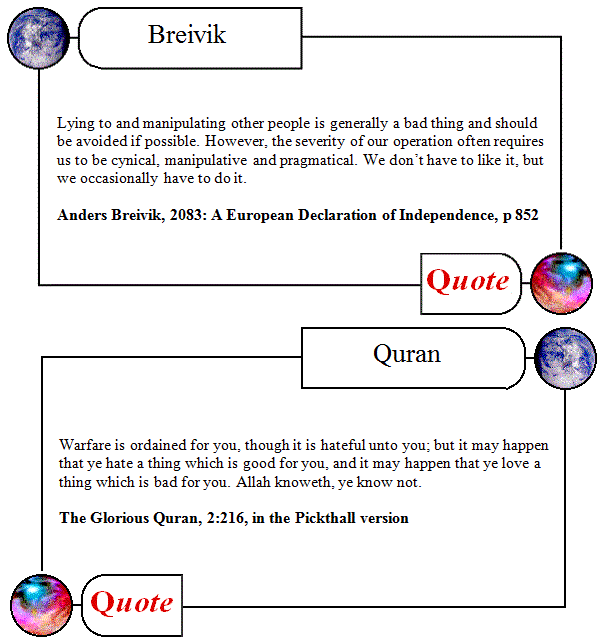
The parallelism of interest here is between two versions of “sometimes you must do what you dislike”.
.
In case anyone might object that Breivik is “only” talking about lying while the Qur’an is speaks of warfare, however, a reminder might be in order that Breivik was in fact waging a crusade and taking numerous lives in accordance with his own rhetoric, and also that one of the aspects of Islam that he most emphasizes is that it permits lying — see (eg) his comments on Taqiyya, section 1.5, p. 78, and his repeated use of the hadith from Bukhari (vol 4, book 52, # 269):
Narrated Jabir bin ‘Abdullah: The Prophet said, “War is deceit.”
[ by Charles Cameron — index of graphics, first 800 or so pages of the “2083 European Declaration of Independence”, with some analysis ]
.
A great deal of work needs to be done on the 2083 European Declaration of Independence, and I thought a useful place to start would be a catalog of images.
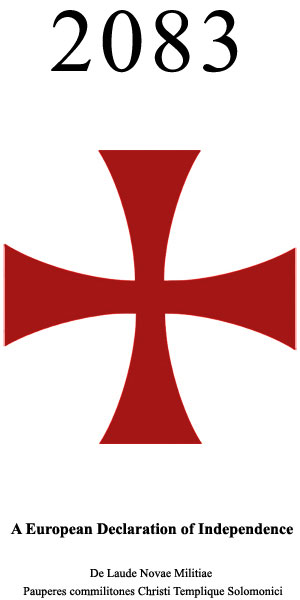
The document opens with a graphical title:
That’s probably the largest single graphic in the entire work, and it puts the work squarely in the context of the Knights Templar — with e Templar cross and the full name of the order, “Pauperes commilitones Christi Templique Solomonic” or Poor Fellow-Soldiers of Christ and of the Temple of Solomon. The Templars were a Western Christian chivalric order strongly associated with the Crusades — and the topic more recently of much historical, occult and fictional speculation.
The date 2083 is a date SFE (in the Science Fictional Era) as was 1984 before it — but it was almost certainly chosen for its echo of the 1683 Battle of Vienna, which is commonly taken to represent the turning back of the Ottomans by the Habsburgs, and thus the victory of Christendom over Islam. Two maps show the Umayyad Conquests:
and the Second Islamic Wave, turned back in Spain and at the gates of Vienna:
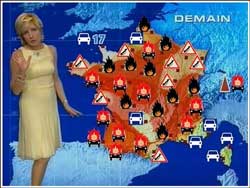
These can fruitfully be contrasted with a map of “tomorrow”:
 — p 487 —
it being the author’s contention that France will be the first European country to fall to Islamic dhimmitude. I suspect much the same is implied in this version of the French tricolore:
 — p 781 —
There are some pointed attacks on leftist intellectuals:
 — p 33 —
and on media perceived as left-leaning, notably the BBC:
 — p 384
— that’s the Saudi flag mashed up with the BBC logo and star and crescent — and:
 — p 804 —
giving both “ancient” and “modern” variants on the theme…
There are some strange items which I’ll drop in here for a breath of fresh air…
 — p 381 —
which appears to be a commentary on the respective attractions of Venus and Mars, since it’s situated in a commentary on Feminism…
this really is a strangely mythic document… and…

with its reference to “mind control agents” — and those whose minds have been controlled are clearly sheep:
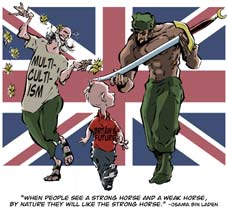
which may be the right moment to mention that the British, too, come in for a measure of contempt, via a quotation from none other than Osama bin Laden:
 — p 707 —
“When people see a strong horse and a weak horse, by nature they will like the strong horse”. Perhaps its unsurprising that the author is something of an admirer of bin Laden’s means, if not his ends.
Of course, that’s largely the fault of the Labour party:
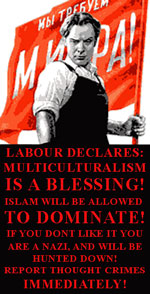
But that’s probably enough for one post — in my next, I’ll consider how weak we are, what the jihadist strategy against us is, and how the new Templars hope to turn the tide…
against:
 — p 674 —
the worst threats to mankind.
[ by Charles Cameron — leads related to Anders Breivik, suspected in Oslo bombings / Utoya shootings ]
.
I may follow this post up with a longer and more detailed version, time permitting – but for now, this presents the lines of inquiry I am following.
The alleged Oslo bomber and Utoya Island shooter, with 90+ deaths to his credit, was not a Muslim jihadist, as many at first suspected, and as at least one Islamist-identified group claimed. Anders Behring Breivik was a Norwegian with strong anti-Islamic views.
Large gobbits of his posts on the Norwegian blog site “document.no” are now available for serious study: there’s an English translation (possibly mechanical) on ScribD and a better one appearing in sections on Leo’s Passagen blog.
Juan Cole titled his blog comment, White Christian Fundamentalist Terrorism in Norway, referencing a Norwegian police spokesman who called Breivik a “Christian fundamentalist”. Breivik was not a Fundamentalist. He was a Protestant – but one who hoped individual Protestants would gradually join the Catholic Church, and one who was himself (paradoxically) active in Freemasonry. But his religious views, as expressed in his document.no postings, were peripheral to his main concerns.
He was an entrepreneur, a millionaire, and a political “conservative” who claimed to be anti-racist. His major political emphasis seems to have been on resisting the “Islamization” of Europe, which he regarded as a form of “demographic warfare” waged by Islamists with passive facilitation by the “multikulti” or multiculturalists. In one of his posts, he suggested the formation of a “cultural Euro-version of a Tea Party movement”.
He was also the owner of a successful farming enterprise, with a reported 700 employees — hence his ability to obtain large quantities (6 tons) of fertilizer of a kind useful in making bombs.
According to the Swedish “Expo” site, he was affiliated with a Nazi web forum.
Two other possible sources for information:
This is not standard evangelical behavior, this is not standard white, male, or white male behavior, this is not standard blogger behavior, this is not standard Norwegian behavior, this is not standard gamer behavior, this is not standard right wing behavior — but it is all too tragically human, this behavior…
There’s a lot to untangle here; this is one complex individual, and we’d do well to get a detailed and nuanced understanding of the various drivers in play…

Zenpundit is a blog dedicated to exploring the intersections of foreign policy, history, military theory, national security,strategic thinking, futurism, cognition and a number of other esoteric pursuits.
Customized Web Site & Blog Design