zenpundit.com » terrorism

Archive for the ‘terrorism’ Category

COIN in the Land of Light

Monday, August 3rd, 2009

Nuristan, “The land of Light” (formerly Kafirstan), was the last pagan region of Afghanistan to accept Islam, only in 1895 after a long struggle with “the Iron Emir” Abdur Rahman Khan. It was also one of the first provinces to rebel against the Soviet invasion. The Taliban fared no better there than did the Russians. More or less, Nuristan and the Korengal valley in Kunar province are “Afghanistan’s Afghanistan”.

The Institute for the Study of War has a recent PDF on American COIN operations in this difficult region. They pick up on Frank Hoffman’shybrid war” concept:

Kunar and Nuristan Report: Rethinking U.S. Counterinsurgency Operations (PDF) by Michael Moore and Maj. James Fussell

Excerpted findngs:

In the Korengal, the presence of U.S. forces exacerbates tensions resulting in hostility and facilitates violence in the region, negating the U.S. efforts to bring stability and security.

A type of hybrid warfare should be implemented in Kunar and Nuristan; a combination of counterinsurgency warfare, with its focus on the populations, and mountain warfare, whereby the U.S. forces seize and hold the high ground.

Additional emphasis must be placed on U.S. forces demonstrating the immediate and tangible benefits of their presence in the region. Short term humanitarian assistance such as medical and dental aid, radios, and blankets must be paired with long term economic development projects.

  • Although counterinsurgency doctrine was successfully implemented in urban Iraq, it has proved more difficult to apply in the sparsely-populated mountains of Kunar and Nuristan.
  • U.S. forces are disproportionately committed to defending marginally significant areas in these remote provinces.
  • U.S missions in eastern Afghanistan, specifically places like the Korengal and Pech River Valley, must be re-examined and forces must be re-deployed to areas where they will have greater effect.
  • The Korengal Valley in Kunar province is the deadliest place in Afghanistan. The population is historically hostile to any outside influence, including any Afghans from outside the valley.
    • The Korengalis have successfully fought off every attempt to subdue their valley, including the Soviets in the 80s, the Taliban rule in the 90s, and currently, the U.S. military. 
  • The presence of U.S. forces in the Korengal generates violence and undermines U.S. efforts to bring stability and security.   
    • The current U.S. force disposition in the inhospitable valleys, like the Korengal, relies too heavily on isolated outposts that require massive amounts of artillery and airpower to defend
    • U.S. forces are not denying the enemy the high ground, allowing insurgents to attack and terrorize the population.  
    • Artillery and airpower are counterproductive in dealing with the insurgency in this part of the country because their use alienates the very population the U.S. is trying to secure.
    • Committing additional forces in order to hold this remote terrain would be tactically and operationally imprudent. The resistance in this area is confined to locals in the valley.  It does not accelerate the insurgency beyond the valley.
  • Counterinsurgency in Afghanistan requires less interdiction on the borders and greater security in the population centers.  Resources must flow to areas that are strategic priorities in order to allow force densities high enough to practice counterinsurgency effectively.      
    • Rather than maintaining positions in the Korengal and many of the small, ineffective posts that dot the Pech river valley, U.S. forces should conduct active patrols in the populated areas of the lower Kunar River Valley.
    • U.S. forces must protect the specific populations that oppose the enemy and support the government, rather than fighting populations that historically resist the government.  U.S. forces in Kunar should concentrate efforts in places like Mara Wara, Sarkani and Khas Konar Districts where the population actually desires U.S. support and presence, unlike the Korengalis. 
  • Counterinsurgency requires short-term economic support, as well as a dense and mobile force presence.  U.S. forces must pair long-term development projects, such as building roads, with short-term, immediate humanitarian assistance and quick-impact projects.
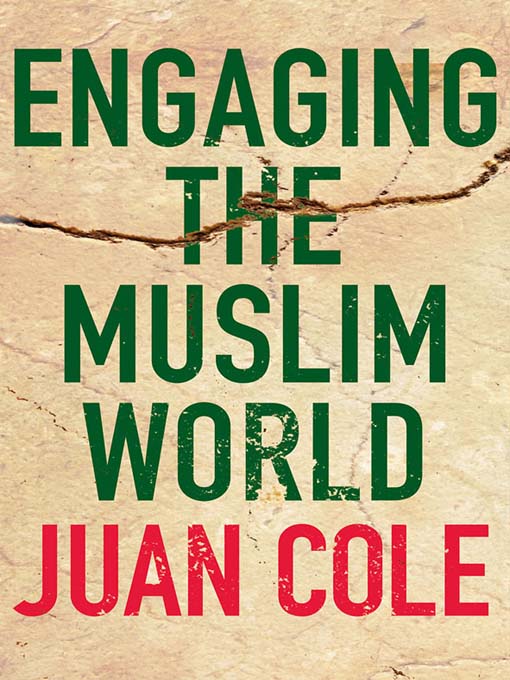
Book Review: Engaging the Muslim World by Juan Cole

Wednesday, July 8th, 2009

Engaging the Muslim World by Juan Cole

I recently finished reading Engaging the Muslim World by Juan Cole, the influential academic, well known liberal-left blogger of Informed Comment, past president of the Middle East Studies Association and occasional media talking head. Cole has written an intriguing book on contemporary foreign policy that is of special interest to those readers concerned with public diplomacy, the Muslim world, terrorism and the domestic politics of American foreign policy, particularly the war in Iraq. I will state straight off that there are arguments in this book presented by Cole that I profoundly disagree with, or, national security related assertions that I consider questionable; but in other instances, when Cole is concentrating on the nuances of the Arab-Muslim world’s political-cultural lens, he is an illuminating and insightful analyst from whom I have learned new things. 

Engaging the Muslim World is…well….engaging. I found Cole’s prose flowed smoothly, as if the author was talking to the reader across a table, and I had a hard time putting the book down, albeit I was frequently scribbling furiously in the margins. This is a polemical -policy book written by an academic for a lay audience and the reader’s reaction to Engaging the Muslim World will depend in part on their own worldview. Liberals will cheer more than they disagree with Cole, while conservatives and supporters of Israel are likely to reject many of the book’s normative assumptions long before they read the conclusions – but Cole also offers some prescriptive advice that center-right COIN and public diplomacy advocates will warmly embrace.

The book  is divided into six chapters. The first, “The Struggle for Islamic Oil:The Truth About Energy Independence” which deals with energy markets, the Cold War history of the Mideast, global warming, environmental policy, alternative fuel technologies and globalization, is a necessary effort to concisely account for the geoeconomic importance of Muslim oil producing states and the future of fossil fuel economies.  Cole argues – correctly, I suspect – that there will be no short or medium term substitutes for oil and gas until solar power technology is cost-efficient enough (and efficient in a physics sense) to compete with fossil fuels in the marketplace. Not being a scientist or an expert in energy market issues, I am poorly placed by professional background to evaluate Cole’s claims in these areas and will leave those to others.

That said, chapter one remains the odd man out. It smacks of having been  compacted by an editor out of two or more chapters and consequently has disparate issues jumbled together with insufficient explanation; as a whole, chapter one fits uncomfortably with the subsequent chapters which flow together naturally and thematically. On the other hand, the topic of oil can hardly be dispensed with either in a geopolitical discussion of the Mideast, so Cole was right to tackle it and the primary problem is really one of sequence, not subject matter.

Chapters two through six are the heart of Engaging the Muslim World, where Juan Cole articulates a theme of “Islam anxiety” permeating Western, particularly American, media and public opinion. Poorly informed about even the most basic information regarding the Muslim world, such as the differences between Shia and Sunnis, secular Baathist nationalists and Islamist radicals, quietists and the politically militant, Arabs and non-Arabs, Cole asserts that Westerners tend to lump Muslims of all shades of political belief, religiousity and nationality into a homogenous, vaguely mysterious but ever dangerous entity. Cole cites as one example, Egypt’s Sunni Muslim Brotherhood, which has foresworn violence and has members who sit in Egypt’s legislature, being lumped uncritically by American commentators with al Qaida and Hezbollah (which is a radical Shiite group).

A better way to understand violent Islamist extremists in relation to normal Muslims, in Cole’s view, would be to see them as analogous to our homegrown, violent, far-Right, white racist underground that produced Timothy McVeigh, who carried out the Oklahoma City bombing or as cult-like movements. While smaller in size than Islamist radicalism, the racist Right shares with violent Islamists the trappings of a fringe, ostracized, quasi-religious, political cult with a conspiratorial worldview that diverges sharply from the nation’s mainstream religious life. Violent Islamists often make themeslves as unpopular with their co-religioinists as do neo-Nazi extremists here, through actions that horrify society, such as the bloody massacre of Western tourists and Egyptian workers at  Luxor, Egypt.

Cole’s analogy with cults and racial extremists I think is a useful one. Radical Islamists are difficult to classify on a traditional political spectrum as their political behavior has definite similarities with those of the fascist and communist totalitarians of the 20th century, but will not fit smoothly with either, given Islamist religious extremism and the fanatical atheism or at least radically secular nature of the Bolsheviks and Nazis. The psychological overlap however is certain, something akin to the 19th century Anarchist-terrorists or what Eric Hoffer captured in his classic work, The True Believer.

On Israel and Iran, Cole bends over backwards, like a circus sideshow contortionist, to try and explain the lunacy (and Cole admits it is, at best, a crackpot worldview) of Ahmadinejad’s violently antisemitic statements about the Holocaust and Iran’s generally defiant behavior toward the international community while giving Israel no similar benefit of the doubt.  Cole argues that Ahmadinejad’s oft-stated “wipe Israel off of the map” is a deliberate mistranslation by the Western media. Ok, possibly so. I do not speak Farsi, so I’ll take Cole’s word here. If it is the case though, Ahmadinejad is well aware of how his repeated statement is being mistranslated by Reuters and AP, yet he keeps using it. Again and again. That is an ominous statement in itself.

This uneveness regarding Iran and Israel will no doubt enrage conservatives and delight progressives, but in fairness to Juan, I must say that despite his partiality toward Iran in his book, as a blogger he was very quick to denounce the obvious stealing of the recent election by Khameini-Ahmadinejad-IRGC and my perception is that Cole views the apocalyptic Mahdist tendency in Twelver Shiism that Ahmadinejad embraces as a kooky deviation from mainstream Shiism. That not just Ahmadinejad holds this belief dear, but also many influential figures in the Iranian security apparatus as well, is in my view, a cause for alarm.

Despite his politics, Cole concludes Engaging the Muslim World with a very pragmatic prescription for American public diplomacy for engaging Arabs and Muslims in a more effective manner than in the past eight or eighteen or eighty years. If I do not agree with every aspect, it is a good deal better than what the State Department and the rest of the USG is doing now:

Once I saw an Iraqi tribal leader interviewed on al-Jazeera. He said. “There is good and bad in America”. I was struck by how pragmatic and realistic his response was, and how different it was from so much of the fundamentalist vigilantee propaganda about the United States posted on radical internet bulletin boards. If Washington could reach out to all Muslims and bring them around to a more nuanced -and clear-view, in which America was not simply demonized, it would be a major accomplishment. The point is not that they should see the West through rose colored glasses, but that they should be willing to see the good and bad.

That would represent a step up by an order of magnitude.

“Political Commissars in Camouflage”

Thursday, July 2nd, 2009

Dr. Tony Corn opens fire at the SWJ with a 33 page broadside against ….well….many targets… of the Defense Department/ military academia/civilian political status quo. I can’t say that I agree with every point in this brutal, turbocharged jeremiad, but some of Corn’s targets deserve the abuse he heaps on them, and he nails a few of my pet peeves, including the chronic neglect of strategy and grand strategy by the American elite (civilian appointees even more than flag officers, in my view).

You will agree and disagree with Corn as he has a high density of concepts and references here, often expressed in polemical terms. He also throws in a gratuitous dose of anti-Clausewitzianism to add salt to the wounds of some readers, if the political angle is not providing sufficient friction 🙂 :

From War Managers to Soldier Diplomats: The Coming Revolution in Civil Military Relations

….There was of course a price to be paid for the failure to distinguish between political partisanship and political literacy. The risk was to end up with an officer corps focused exclusively on tactical and operational matters, and so lacking in political literacy as to be unable to relate military means to political ends, i.e. to think strategically. It did not seem to matter much at the time for two reasons. In the nuclear age, strategic thinking was seen as being too important to be left to the military, and was therefore quickly taken over by civilians. In addition, those same civilians (including Huntington) tacitly shared the conviction famously expressed by Bernard Brodie in 1946: “Thus far the chief purpose of our military establishment has been to win wars. From now on its chief purpose must be to avert them. It can have no other useful purpose.” And indeed, if the main raison d’etre of the military is not to win, but to avert, war, why take the risk of having officers develop an “unhealthy” interest in politics by emphasizing the strategic level of war?

Read the whole thing here.

ADDENDUM:

My take, four years ago, on the emerging class of “soldier-statesmen” (I try to be so far ahead of each curve that it brings me no recognition whatsoever. LOL!)

Horse Soldiers

Friday, June 19th, 2009

Just received a review copy of Doug Stanton’s Horse Soldiers: The Extraordinary Story of a Band of US Soldiers Who Rode to Victory in Afghanistan, which is about the special operations soldiers who infiltrated Taliban held Afghanistan and who were forced to blend the ancient with the postmodern on the battlefield. Horse Soldiers is doing very well on The New York Time’s bestseller list and is up near the very top of that prestigious category.

The promotion people also included the audio book as well in a 7 hour  CD set. I’ve never listened to a “book on tape”, as they used to be called back in the day, so this might be the opportunity to give that format a try and review.

Flipping through the pages, the Horse Soldiers is not at all dry military history but action-packed narrative to which a general audience might relate. Here is an excerpt from the prologue:

Qala-i-Janghi Fortress
Mazar-i-Sharif, Afghanistan
November 24-25, 2001Trouble came in the night, riding out of the dust and the darkness.
Trouble rolled past the refugee camp, past the tattered tents
shuddering in the moonlight, the lone cry of a baby driving high into
the sky, like a nail. Sunrise was no better; at sunrise, trouble was
still there, bristling with AKs and RPGs, engines idling, waiting to
roll into the city. Waiting.
These were the baddest of the bad, the real masters of mayhem, the
death dealers with God stamped firmly in their minds. The city groaned
and shook to life. Soon everyone knew trouble had arrived at the gates
of the city.

Major Mark Mitchell heard the news at headquarters nine miles away and
thought, You’re kidding. We got bad guys at the wire?

He ran downstairs, looking for Master Sergeant Dave Betz. Maybe he
would know what was happening.

But Betz didn’t know anything. He blustered, “One of the Agency guys
came down and told us we got six hundred Taliban surrendering. Can you
believe that?”

Surrendering? Mitchell couldn’t figure out why. He thought the Taliban
had fled from the approaching forces of the Northern Alliance to
Konduz, miles away. American Special Forces and the Northern Alliance
had been beating them back for weeks, in battle after battle, rolling
up territory by coordinating airstrikes from the sky and thousands of
Northern Alliance soldiers on the ground. They now stood on the verge
of total victory. Konduz was where the war was supposed to go next.
Not here. Not in Mazar. Not at Club Mez.

Besides, these guys didn’t surrender. They fought to the death……

Hmmmmm. Note to self. If you want to sell books, write more like this and less like an academic in a dusty cubicle at an obscure think tank.:)

Brief WSJ interview with Gen. McChrystal

Friday, June 12th, 2009

Nothing mind blowing here but the new Afghan commander offers this bit on the congruence between counterterrorism and COIN:

Counterterrorism, effective counterterrorism, is about networking. It’s about building a really effective network so you can gather information and then you can act on it rapidly and precisely. Counterinsurgency still requires the ability to build a network, gather information, understand what you’re trying to do…


Switch to our mobile site
