zenpundit.com » culture

Archive for the ‘culture’ Category

With Greco: two views of Toledo

Monday, June 6th, 2011

[ by Charles Cameron — perception, painting, pre-modern, modern, post-modern, heaven, sky, simulation, John Donne, El Greco ]

.

It is Sunday.

I find it powerfully interesting that the sky as perceived by painters (our “seers” par excellence) used to be filled with supernatural beings and is currently filled with natural ones — a clear sign that our culture has effectively moved from what one might call a theological vision of the world to a meteorological one (with astronomical trimmings under a clear sky)…

And I see that transition captured very precisely in four words, when John Donne writes:

At the round earths imagin’d corners, blow
Your trumpets, Angells, and arise, arise
From death, you numberlesse infinities
Of soules, and to your scattred bodies goe…

The “round earth” is that of modern science, the “imagin’d corners” those of pre-modern maps – and angelology.

*

I have to admit, therefore, that I was surprised yesterday evening to come across an El Greco painting of Toledo that featured the blessed Virgin Mary over the city.

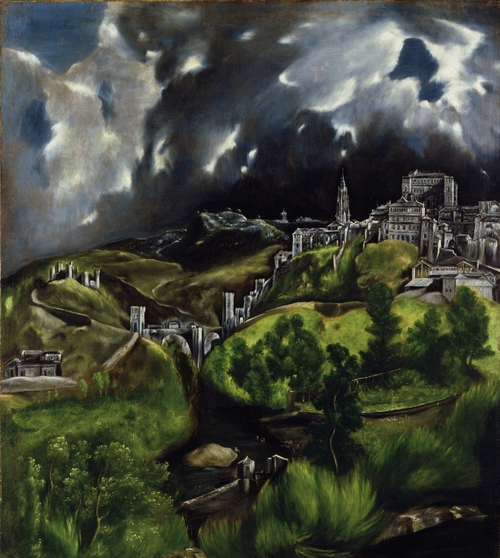
I have long been familiar with his better known View of Toledo, which is entirely naturalistic unless you want to consider storm-clouds as portents of a divine presence —
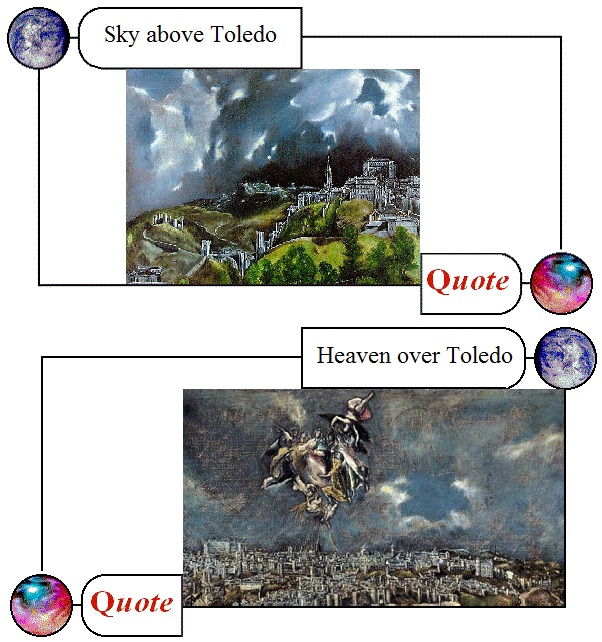
quo-sky-over-toledo.jpg

but the second of these images, from the View and Plan of Toledo, came as quite a surprise…

Here is a detail of the Virgin taken from it, to illustrate the point:
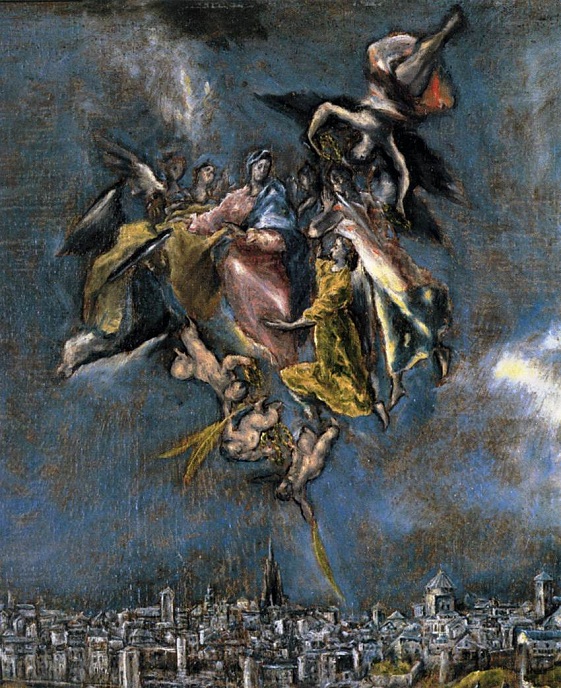
el-greco_view-and-plan-of-toledo_detalhe2_c1610.jpg

*

El Greco is famous for painting heaven-and-earth as a continuum – his great masterpiece, the Burial of Count Orgaz, catches the release of the soul from its bodily sheath as directly as Donne’s “to your scattred bodies goe” does to the return of those souls to corporeality at the General Resurrection:
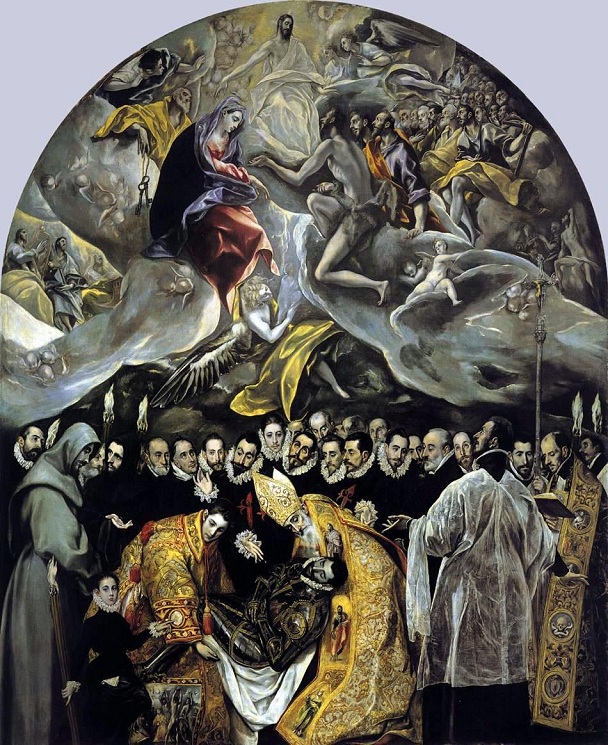
entierro-del-conde-de-orgaz-sm.jpg

*

And yet El Greco, like Donne, sees both – Toledo under storm-clouds, Toledo under the shelter of the blessed Virgin…

But there is more here, in this extraordinary painting. There is a map of the territory

quo-greco-toledo.jpg

*

If I could say in a nutshell what post-modern is, I would say it is recursive. It recognizes our perceived reality to be a simulation, and is thus always playing with maps and models, as Shakespeare was when he penned the words “All the world’s a stage” to be spoken in a theater whose sign and motto was “Totus mundus agit histrionem” – the whole world enacts a play.

Think of Hofstadter‘s Godel Escher Bach. Of Escher himself, and his image of himself holding his own small world in a glass sphere in his hand…

Think of Korzybski, and his dictum: the map is not the territory.

Think of Gregory Bateson, who wrote:

We say the map is different from the territory. But what is the territory? Operationally, somebody went out with a retina or a measuring stick and made representations which were then put on paper. What is on the paper map is a representation of what was in the retinal representation of the man who made the map; and as you push the question back, what you find is an infinite regress, an infinite series of maps. The territory never gets in at all. […] Always, the process of representation will filter it out so that the mental world is only maps of maps, ad infinitum.

Astoundingly, presciently – prophetically? – El Greco is already alluding to this, around 1610, in his View and Plan of Toledo.
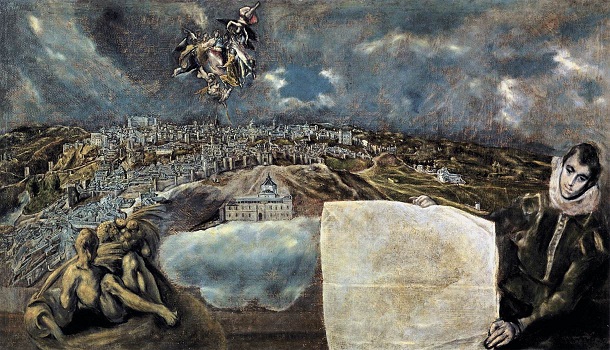
11777-view-and-plan-of-toledo-el-greco-sm.jpg

*

El Greco’s Burial of Count Orgaz is in the Church of Santo Tomé in Toledo.

El Greco’s View and Plan of Toledo is in the Museo de El Greco, Toledo.

Here is the complete text of Donne’s sonnet:

At the round earths imagin’d corners, blow
Your trumpets, Angells, and arise, arise
From death, you numberlesse infinities
Of soules, and to your scattred bodies goe,
All whom the flood did, and fire shall o’erthrow,
All whom warre, dearth, age, agues, tyrannies,
Despaire, law, chance, hath slaine, and you whose eyes,
Shall behold God, and never tast deaths woe.
But let them sleepe, Lord, and mee mourne a space,
For, if above all these, my sinnes abound,
‘Tis late to aske abundance of thy grace,
When wee are there; here on this lowly ground,
Teach mee how to repent; for that’s as good
As if thou’hadst seal’d my pardon, with thy blood.

El Greco’s View of Toledo is in the Metropolitan Museum of Art in New York:
29_1006.jpg

Here we find no blessed Virgin, no angels with their final trumpets — and yet this painting can be viewed as analogous to his Vision of Saint John and the opening of the Fifth Seal — which owes its power to its “otherworldly stormy light” — and thus seen as yet another apocalyptic scene, one which “recalls St. John’s vision of the New Jerusalem in the Book of Revelations … a landscape of unearthly power and drama: a dialogue between heaven and earth conducted appropriately by the cathedral spire…”
Rapturous times, neh?

Saturday, May 21st, 2011

[ By Charles Cameron — apocalyptic movements, best readings, budget shortfalls, lack of support for scholarship in crucial natsec areas — and with a h/t to Dan from Madison at ChicagoBoyz for the video that triggered this post ]
.
.
What with rapture parties breaking out all over, billboards in Dubai proclaiming The End and thousands of Hmong tribespeople in Vietnam among the believers, this whole sorry business of Harold Camping‘s latest end times prediction is catching plenty of attention. I thought it might be helpful to recommend some of the more interesting and knowledgeable commentary on Camping’s failed prophecy.

*

First, three friends and colleagues of mine from the Center for Millennial Studies at Boston University, about which I will have a further paragraph later:

Richard Landes of BU has a text interview here, and a TV interview here. His forthcoming book, Heaven on Earth, is a monumental [554 pp.] treatment of millenarian movements ranging “from ancient Egypt to modern-day UFO cults and global Jihad” with a focus on “ten widely different case studies, none of which come from Judaism or Christianity” — and “shows that many events typically regarded as secular–including the French Revolution, Marxism, Bolshevism, Nazism-not only contain key millennialist elements, but follow the apocalyptic curve of enthusiastic launch, disappointment and (often catastrophic) re-entry into ‘normal time'”.

Stephen O’Leary of USC wrote up the Harold Camping prediction a couple of days ago on the WSJ “Speakeasy” blog. He’s the rhetorician and communications scholar who co-wrote the first article on religion on the internet, and his specialty as it applies to apocalyptic thinking is doubly relevant: the timing of the end — and the timing of the announcement of the end. His book, Arguing the Apocalypse, is the classic treatment.

Damian Thompson of the Daily Telegraph is a wicked and witty blogger on all things Catholic and much else beside — the normally staid Church Times (UK) once called him a “blood-crazed ferret” and he wears the quote with pride on his blog, where you can also find his comments on Camping. Damian’s book, Waiting for Antichrist, is a masterful treatment of one “expecting” church in London, and has a lot to tell us about the distance between the orthodoxies of its clergy and the various levels of enthusiasm and eclectic beliefs of their congregants.

Three experts, three highly recommended books.

*

Two quick notes for those whose motto is “follow the money” (I prefer “cherchez la femme” myself, but chacun a son gout):

The LA Times has a piece that examines the “worldwide $100-million campaign of caravans and billboards, financed by the sale and swap of TV and radio stations” behind Camping’s more recent prediction (the 1994 version was less widely known).

Well worth reading.

And for those who suspect the man of living “high on the hog” — this quote from the same piece might cause you to rethink the possibility that the man’s sincere (one can be misguided with one’s integrity intact, I’d suggest):

Though his organization has large financial holdings, he drives a 1993 Camry and lives in a modest house.

*

Now back to the Center for Millennial Studies.

While it existed, it was quite simply the world center of apocalyptic, messianic and millenarian studies. CMS conferences brought together a wide range of scholars of different eras and areas, who could together begin to fathom the commonalities and differences — anthropological, theological, psychological, political, local, global, historical, and contemporary — of movements such as the Essenes, the Falun Gong, the Quakers, Nazism, the Muenster Anabaptists, al-Qaida, the Taiping Rebellion, Branch Davidians, the Y2K scare, classic Marxism, Aum Shinrikyo and Heaven’s Gate.

And then the year 2000 came and went, and those who hadn’t followed the work of the CMS and its associates thought it’s all over, no more millennial expectation, we’ve entered the new millennium with barely a hiccup.

Well, guess what. It was at the CMS that David Cook presented early insights from his definitive work on contemporary millennial movements in Islam — and now we have millennial stirrings both on the Shia side (President Ahmadinejad et al) and among the Sunni (AQ theorist Abu Mus’ab Al-Suri devotes the last hundred pages of his treatise on jihad to “signs of the end times”)…

Apocalyptic expectation continues. But Richard Landes’ and Stephen O’Leary’s fine project, the CMS, is no longer with us to bring scholars together to discuss what remains one of the key topics of our times. When Richard’s book comes out, buy it and read it — and see if you don’t see what I mean.

Or read Jean-Pierre Filiu‘s Apocalypse in Islam.  Please. Or Tim Furnish‘s recent paper.

*

And while it may not see Judgment Day or the beginning of the end of the world as predicted, what this week has seen is the end of funding of Fulbright scholarships for doctoral dissertation research abroad.  But then as Abu Muqawama points out:

hey, it’s probably safe to cut funding for these languages. It’s hard to see Iran, Afghanistan, Pakistan or anywhere in the Arabic-speaking world causing issues in terms of U.S. national security interests anytime soon.

Right?

So the CMS isn’t the only significant scholarly venue we’ve lost to terminal lack of vision.

Guest Post: Shipman Reviews The New Digital Storytelling by Bryan Alexander

Thursday, May 12th, 2011


J. Scott Shipman, the owner of a boutique consulting firm in the Metro DC area that is putting Col. John Boyd’s ideas into action, is a longtime friend of this blog and an occasional guest-poster.

Book Review: The New Digital Storytelling

by J. Scott Shipman

Bryan Alexander’s  The New Digital Storytelling, Creating New Narratives With New Media is an excellent, highly readable, and comprehensive treatment of storytelling in our digital world. Dr. Alexander manages in 230 pages of text to capture the universe of available methods, processes, resources and tools available to storytellers, as of 2010. His 36 pages of notes and bibliography includes an exhaustive list of websites and sources used.

Dr. Alexander aimed his book at “creators and would-be practitioners,” storytellers looking for new digital ideas, to include teachers, marketers, and communications managers. Whatever your background, he assures in the introduction, “herein you will find examples to draw on, practical uses to learn from, principles to apply, and some creative inspiration.” I can’t speak for those in the target audience, but as one with but a casual interest in storytelling, I can say Dr. Alexander delivered! Over the course of the couple of days of reading, I came up with about a half-dozen ideas and discovered my MacBook Pro has a lot more under the hood than I ever appreciated or used.

That said, Dr. Alexander warns that his book is not a “hands-on manual” on the tech media discussed. In fact, he assumes the reader will not “be a technologist” and the material is presented accordingly. He says:

The New Digital Storytelling straddles the awkward yet practical divide between production and consumption, critique and project creation.”

The book is divided into four parts:

Part I Storytelling: A Tale of Two Generations

In Chapter 1 Dr. Alexander provides an unambiguous meaning to digital storytelling: “Simply put, it is telling stories with digital technologies.” The medium providing this review to you is my digital story about the book. But that is just the beginning; just about every digital device imaginable is being used to tell stories; blogs, social media, videos, and even in Twitter’s 140 character limit, storytelling genres are emerging [readers at zenpudit.com will recall Charles Cameron’s use of Twitter feeds following UBL’s death]. As Alexander points out, “no sooner do we invent a medium than do we try to tell stories with it.”

In Chapters 2 & 3, Dr. Alexander provides a history of digital storytelling in two parts; part one is what he calls “the first wave.” From foundations in the 70’s and 80’s (his reference to the 1983 movie War Games brought back memories) to the evolution and importance of hypertext. Alexander asks, “How do hypertexts work as digital stories? Users—reader—experience hypertext as an unusual storytelling platform. We navigate along lexia (“multiple readable chunks”) picking and choosing links to follow.” This point truly “clicked” for me; one of the pleasures of reading zenpundit.com is the ubiquity of supporting links and how sometimes these links lead to unexpected, but valuable adventures. Often I’ve landed in a place I would never have found if not for the first “story.” Alexander writes that Web 2.0 has allowed for “the ability to create content for zero software cost is historically significant, and now par for the course.” He points out with the ubiquity of hardware (both PCs and mobile devices) and the social element (social media, for example) a means of of delivery and an architecture are in place where potential storytellers have a low barrier to entry—to get their story out. Alexander includes gaming devices (mobile and console) in the review of the Web 2.0 phenomena.

Part II New Platforms for Tales and Telling

Chapter 4 is a comprehensive review of Web 2.0 storytelling and the fragility of systems existing today, but perhaps gone tomorrow. Dr. Alexander covers distinct types of blogs used in sharing stories; blogs are ubiquitous and the barriers to entry negligible. He covers epistolary novels and diary/journal-based stories and provides numerous examples. One example was News from 1930, which “posts selections from each day’s Wall Street Journal” during the early days of the Great Depression—in essence, a blog as a realtime history lesson. But as we know, the blogosphere is bigger than history, there also exists a market for various fictional stories which include reader interaction/collaboration. Also included are examples of character blogging (as Alexander notes: “Bloggers are characters”) where personalities are revealed over time in a serial nature. Twitter has developed into a unique format for storytelling, forcing the user to pack as much as possible in precious few words/characters. Wikis, social images and Facebook are also covered and explained in ways that made me think about “how” I use social media.

Chapter 5 covers in detail social media storytelling…and this is one of my favorite chapters. Alexander explains podcasts in a way that was accessible and in a way that made me want to “do” a podcast! A podcast is limited to audio, but a web video places a whole new spin on our ability to digitally tell our stories. Chapter 5 is rich in resources and insight.

In chapters 6 and 7 Alexander discusses gaming and storytelling. This may be the part of the book that was over my head (I’m dubious of the real utility of “gamification” in a meaningful/productive way). One sentence did jump off the page: “One key aspect of game-based storytelling is the immersion of the player in the story’s environment.” Indeed, “intimacy” is an enormous missing ingredient in more than storytelling and absolutely necessary in proficiency in just about any endeavor. One other sentence made a big impression: “Children also learn a deep secret about art, which is that the less detailed the representation of a character, the easier it is for us to identify with him or her.” I believe guys like the internet Oatmeal guy and the creator of Zen’s recent post  have figured out this phenomena isn’t limited to children.

Part III Combinatorial Storytelling; or, The Dawn of New Narrative Forms

Chapters 8 through 11 covers the networked book, mobile devices, and alternate reality games. The networked book resonated with me because of something from my distant career on submarines (early 80’s); we would write a story where periodically storytellers would add a sentence and half to an evolving text. The results were always amusing and never predictable. Networked books sound very similar to our collaborative efforts 30 years ago, but with the ubiquity of digital tools, opportunities abound. For example “transmedia storytelling,” where “story content is distributed across multiple sites and media; the movie trilogy, an anthology of animated films, comics, computer games, a massively multiplayer online game, Web content, and additional DVD content.” This dispersion of story content and the variety of venues allows users a more “immersive experience”—-the intimacy Alexander described earlier. Mobile devices are literally changing just about every aspect of our world from political meetings, classrooms, clinics “now that those present can hit the Web for fact checking or peer support.” An excellent recent example was the squashed attempt of the United States Naval Institute’s board to change the organization’s mission. Platforms like Twitter, Facebook, and LinkedIn were used to get the word out to members who took action. New tablet devices will continue to drive this phenomena. Alexander’s treatment of alternate reality games revealed “worlds” created with our world by game participants of such products as Second Life.

Part IV Building Your Story

In the final chapters, Dr. Alexander provides example of “how to” build a digital story, using the classic Center for Digital Storytelling workshop model. For me, this was the most thought-provoking section. The description of how a workshop is conducted, the questions used to prompt creative/insightful “story-able” thought is worth the price of the book. Alexander inventories the software available for audio, images, video editing, publication, concept mapping, and other production tools. This inventory of tools describes the appropriateness of each with respect to the level of experience of the storyteller. Digital storytelling in education is covered in Chapter 14 and is a rich resource for parents and educators who want to leverage the digital world.

The New Digital Storytelling should be the standard guide for anyone who wants to use all the new digital gadgets available to tell their story; this book is an excellent one-stop resource. I plan to use what I’ve learned in the expansion of my family tree history to an A/V platform and have already built a to-do list to get started.

One closing thought; the irony isn’t lost that this “book” about digital storytelling is made of paper, glue, and ink. I can only imagine what an adventure this would be if presented digitally where all the links were connected…a digital story on how to tell digital stories.

The New Digital Storytelling comes with my highest recommendation. Get this book, use those tools, and tell your stories.

This Story Made My Day

Wednesday, April 27th, 2011

From the respected gents at BLACKFIVE:

Westboro Baptists Defeated

SSgt-Jason-Rogers-278x300

USMC Staff Sgt. Jason Rogers, 28, was killed in action by an IED while saving a fellow Marine in Helmand Province, Afghanistan on April 7.  Sgt. Rogers was assigned to the 2nd Combat Engineer Battalion, 2nd Marine Division, II Marine Expeditionary Force, out of Camp Lejeune, N.C.  This was his fifth combat tour in Afghanistan.  His fifth.

….Sgt. Rogers was buried in Brandon, Mississippi last Saturday.  Above is the view of Mississippi Highway Patrol Trooper Elmo Townsend as he escorted Sgt. Rogers from Airport Road and along U.S. 80 through a gauntlet of hundreds of local patriots who turned out to honor his sacrifice. 

The human vermin of the Phelps family, venomous traitors who style themselves the Westboro Baptist Church, who insult decent people from coast to coast by shouting vile slander at the funerals of heroes, threatened to protest this funeral as well.  Yet, not a whiff of their stench fouled the air anywhere near the procession nor funeral.  Therein lies the story….

Read the rest here.

If you are old enough to have ever lived under “old school” rules, you will love this story. More of this, please (Hat tip to Alyson the Good).

More on Where Good Ideas Come From

Tuesday, April 19th, 2011

Dr. Von weighed in on Steven Johnson’s Where Good Ideas Come From with an extensive book review last December( I posted on Johnson here. On a related note, read Charles Cameron’s comment about the limitations of linear thinking here):

Where do New Ideas come from?

….But what exactly are innovation and creativity? The dictionary definition of innovation is ‘the introduction of new things or methods,’ while creativity is ‘the ability to create meaningful new ideas, forms or methods’ that are original and imaginative. So the key notion is the development of new ideas in whatever field one is working. A question naturally develops, which is where do new ideas come from? How do we begin preparing children now to be creative and innovative in the future? In the past, many would have first thought about the arts as being the training ground for creativity. Now, we realize that the development of the abilities and mindsets and skills necessary to be creative in every field of study is necessary.Steven Johnson’s new book, Where Good Ideas Come From: The Natural History of Innovation, provides the argument that there are seven common themes that have led to the vast majority of great ideas throughout history. He gives numerous examples of such ideas, ranging from Darwin’s development of the theory of evolution to the of the GPS system, from Google to the creation of the first mechanical computing devices centuries ago, and so on. It is an interesting read.Here is a summary of the seven themes that lead to good ideas. Keep in mind there is certainly some degree of overlap and relationships between the themes, but overall they can be thought of as distinct concepts.1. The Adjacent Possible: Even if you have an interest in some topic or problem, if there is not a good environment conducive to presenting the necessary pieces to solve the problem, good ideas will almost certainly not develop. You may be brilliant with some of the information (i.e. pieces of a puzzle) in your mind that is necessary to solve a problem, but if your surroundings are not able to provide the remaining pieces of information or experiences, you will endlessly search for them to no avail. If you are isolated from others who know something about your problem or issue, or if there is no means of gathering further information (which is becoming less of a problem with the advent of the Internet), or if your environment does not provide the physical infrastructure or supplies to finish building a new physical device, you will be unable to develop the Idea or solution to your problem.

2. Liquid Networks: Great ideas can develop when information is allowed to flow through a larger network. One possible network is a social network, or often and more specifically, a professional network. The focus of this is the ability to collaborate to solve problems. It turns out that there are almost no great ideas throughout history that have been developed in isolation or by an individual who did not need any help in the development of that great idea. One may think Newton or Einstein did their work in isolation, but this is not entirely true. Those two individuals come about as close as you can get to not needing a network to develop the laws of motion or relativity, but they relied on some level of feedback, reading others’ work, and ultimately talking and discussing issues with close colleagues and friends.
An interesting study was done that looked at how research groups reach the coveted ‘Eureka!’ moment, where a new discovery is made. It turns out that these rare moments of discovery or problem solving almost never happen in the lab! Instead, the ‘Aha!’ are yelled out at the conference table, where members of the group are throwing ideas around and sharing results of their latest work over the past week. The person who figures it out needs to have input they have not thought about from the larger group or network, before the grand idea is formed….

Read the rest here.


Switch to our mobile site