zenpundit.com » warriors

Archive for the ‘warriors’ Category

New Look at SWJ Blog

Saturday, August 6th, 2011


Congrats to Dave Dilegge, Bill Nagle, Robert Haddick and Mike Few for the bold new look at Small Wars Journal, stil the best site for military and national security affairs on the web!

Users will now need to create an account or, if they are active on the Small Wars Council, there are instructions for resetting your password. Don’t get left out of the discussion.

Here is more from Dave and/or the Editors:

Welcome to SWJ 2.0

…. Site Sections

We are live now with the SWJ Blog and Journal. All posts, articles, and user comments have been migrated into our new system. You can still find feeds of recent activity on our Home page, more recent activity on the main pages of the SWJ Blog and Journal sections.

The Journal and SWJ Blog are now separate features instead of a cross-threaded stream. Search is site-wide and the home page gives a cross-site view, but the archives views within the SWJ Blog and Journal sections are section-specific. We will be evolving out publishing over the next few months to place more commentary and Op-Ed in the SWJ Blog, and the analytical and/or feature length works in the Journal.

The Library section as it exists now is a shadow of its former relevance but a placeholder for future greatness.  We brought the old Reading List and Reference Links pages into the library are outdated and full of dead links, yet they are not completely useless so we didn’t completely destroy them. More below on future changes there.

Almost There Items

All the existing SWJ content has been migrated, but it will take us some time to get some of it out of its legacy format and into the new system.

  • The new system has much better support for guest author bylines and author archives. Over time, we’ll move the author’s byline, bio, etc. in the old content out of the article out of the body content and into the new system. We will reach out to past authors soon to provide info on how to submit any updates you want to provide.
  • The new system will support us publishing Journal Articles fully in-the-system rather than as PDF links. We hope to be doing that within a few weeks. Readers will have the option of generating print-optimized or PDF versions on-the-fly, content will be more searchable, and we’ll be able to offer full length Journal Articles via a Kindle feed. We are not sure how far back into the legacy articles we’ll update things, but we should be rid of PDFs for future articles.
  • We will continue to publish Journal Issues as a PDF.  Our new Journal Issues feature an automatic index of the month’s individual articles, plus the cover, table of contents, and download link for the PDF Journal when it exists for a given month.  The index portion is live now, and we should have the PDFs added within a week or so.  We hope to bring more features into future Journal Issues.
  • The way-back issues of the Journal (2005-2007) are only available here for now, and the articles are only in the PDF.  We will eventually get those articles into the system as individual articles and a complete issue.
  • Of course there are tons of little things that need doing for your usability and our efficiency. Kai zen, and all that.

Coming (Soon?)

As we move in and clean up in our new site, we’ll also be taking advantage of new features.  Look for these developments in the future:

  • We will have a new content section on Latin America where we integrate content published here and from all over. We have a lot of talented people signing on for the effort and we are very excited about this new feature on a hugely important topic.
  • In the next few months we will be changing the way we publish the News, moving from the blog-based Roundup to a more effective and user friendly display. We know that feature is very popular, and we’ll do you justice with it while making it something that is more sustainable for us.
  • Library 2.0 is coming. Instead of updating our dusty old flat files, we’ll be moving the Library into a system that allows for mutliple views, tagging, search, your comments and ratings, editors picks, etc.  That will be rolled out with new News section, and will continue to grow as we do.

Book Review: The Profession by Steven Pressfield

Monday, July 25th, 2011

The Profession by Steven Pressfield

We should begin this review with “Full Disclosure“:

I just finished reading The Profession by Steven Pressfield, which I enjoyed a great deal. Steve sent me an earlier draft doc of the book and I consider Steve a friend. Furthermore, in an extremely gracious gesture, Steve granted me (or at least zenpundit.com) the novelist’s equivalent to a walk-on cameo appearance in his book. Therefore, if you the reader believe that I cannot review this book objectively…well….you are right. It’s not possible 🙂 . Here are some other reviews by Shlok Vaidya, Greyhawk of Mudville Gazette and Kirkus if you want greater impartiality.

Nor am I going to delve into the mechanics of the plot structure and action sequence in The Profession. For one, I think too much of the story in a review of a work of fiction spoils the enjoyment for the group of readers who would be most interested. And you can get the blow by blow elsewhere.

Instead, I would like to draw your attention to how Pressfield has written this novel differently. And why that matters.

There is plenty of action in The Profession and the book really moves. It is violent, but not at a Blood Meridian level of cruelty and the murky political intrigue that surrounds the hero, the mercenary’s mercenary and “pure warrior” Gilbert “Gent” Gentilhomme, is a nice counterpoint to physical combat and technical military details. Many people will enjoy the novel on this level and The Profession would make for an exciting action film. Or perhaps a series of films along the lines of The Bourne Identity or those Tom Clancy movies with Harrison Ford. All well and good. But that is not why The Profession is worth reading – that’s merely why it is fun to read.

What surprised me initially about The Profession was how unlike Killing Rommel it was. Killing Rommel also had war and adventure, but it was a deep study in the character development of Chap, the protagonist, who had enough of a textural, cultural, authenticity as a young gentry class British officer of the WWII period as to make Killing Rommel seem semi-biographical. As a reader, I didn’t much care if Chap and his men succeeded in killing Rommel, only that I would be able to continue to see the story unfold from Chap’s perspective. Many artists believe characters and character interaction are the most important element in a story, from Saul Bellow to Quentin Tarantino. Their stories are captivating even though their narratives are not always particularly logical or centered on a grand conflict.

The Profession is not like that at all. In my view, Pressfield turned his creative energies, his knowledge for military affairs and his formidible ear for history away from character development and toward theme. This difference may or may not explain his own reports of difficulty in wrestling with this novel.

Reaching back to the lessons learned from late Republican Rome, Thucydides, Xenophon and seasoning it liberally with Machiavelli, Pressfield’s 2032 near-future is also jarringly allegorical with America of 2012. Like Rome of the 1st century BC or Athens after it’s defeat in the Peloponnesian War, America in The Profession is strategically paralyzed, politically polarized and teetering on the precipice of decay and decline. These historical inspirations have been mashed up with a dystopian 4GW world, filled with mercenary PMCs like Force Insertion and The Legion, terrorists, drones, tribes, criminal corporations and and a devious and cowardly global financial elite. A future more evenly distributed from the present.

The antagonist against whom the plot is structured is not the story’s nominal villain terrorist, but Gent’s Homeric father-figure, former Lieutenant General James Salter, USMC,  “the crawling man” who was martyred, disgraced, exiled and redeemed as the new master of Force Insertion’s Mideast deployed “armatures” (combined arms divisions) and the book’s geopolitical apex predator, who boasted:

” I was obeying a more ancient law” 

This marks a drastic shift in Pressfield’s use of characters from people existing in themselves with humanistic nuances to their use as philosophical archetypes to better express the theme, more like the technique of Fyodor Dostoyevskii, Victor Hugo or Ayn Rand.

The interplay between the kinetic Gent and the increasingly totemic Salter elucidates a theme that is creating tectonic political shifts in America and the world; a theme which is expressed explicitly to Gent at one point by the ex-Secretary of State, Juan-Estebaun Echevarria. The ex-Secretary plays Cicero to Salter’s Caesar, but Gent is ultimately cast in the role of a very different Roman by the manipulative Salter. Pressfield, in honing the various characters, including AD, Maggie Cole, El-Masri and others, is also drawing on Alcibiades, Critias, Livy, Homer, Robert Graves, Joseph Conrad and the pattern of mythic epics. Salter is at once a pagan chieftain and a philosopher-king, a civilized Kurtz or a barbaric John Galt, who after continuous dissembling, in a brutally honest speech, gives his followers, his enemies, Gent and even himself, no opportunity to morally evade what he has become or his reasons for what he proposes to do. A speech that resonates with the negative trends we see today.

The Profession is a cautionary tale outfitted in kevlar.

2083 Graphics — a first look

Sunday, July 24th, 2011

[ by Charles Cameron — index of graphics, first 800 or so pages of the “2083 European Declaration of Independence”, with some analysis ]

.

A great deal of work needs to be done on the 2083 European Declaration of Independence, and I thought a useful place to start would be a catalog of images.

The document opens with a graphical title:

000-2083-cross-tp.jpg — title page —

That’s probably the largest single graphic in the entire work, and it puts the work squarely in the context of the Knights Templar — with e Templar cross and the full name of the order, “Pauperes commilitones Christi Templique Solomonic” or Poor Fellow-Soldiers of Christ and of the Temple of Solomon.  The Templars were a Western Christian chivalric order strongly associated with the Crusades — and the topic more recently of much historical, occult and fictional speculation.

The date 2083 is a date SFE (in the Science Fictional Era) as was 1984 before it — but it was almost certainly chosen for its echo of the 1683 Battle of Vienna, which is commonly taken to represent the turning back of the Ottomans by the Habsburgs, and thus the victory of Christendom over Islam.  Two maps show the Umayyad Conquests:

umayyad-conquests-p-228.jpg — p 228 —

and the Second Islamic Wave, turned back in Spain and at the gates of Vienna:

243-1683-second-islamic-wave-p-243.jpg — p 243 —

These can fruitfully be contrasted with a map of “tomorrow”:

demain-p-487.jpg — p 487 —

it being the author’s contention that France will be the first European country to fall to Islamic dhimmitude.  I suspect much the same is implied in this version of the French tricolore:

flag-face-p-781.jpg — p 781 —

There are some pointed attacks on leftist intellectuals:

033-academic-reform-p-33.jpg — p 33 —

and on media perceived as left-leaning, notably the BBC:

bbc-flag-w-crescent-p-384.jpg  — p 384

— that’s the Saudi flag mashed up with the BBC logo and star and crescent — and:

804-bbc-02-p-804.jpg  — p 804 —

giving both “ancient” and “modern” variants on the theme…

There are some strange items which I’ll drop in here for a breath of fresh air…

free-pluto-equal-gravity-for-all-planets-p-381.jpg  — p 381 —

which appears to be a commentary on the respective attractions of Venus and Mars, since it’s situated in a commentary on Feminism…

this really is a strangely mythic document… and…

global-warming-voidka-p-657.jpg

with its reference to “mind control agents” — and those whose minds have been controlled are clearly sheep:

wake-up-p-803.jpg — p 803 —

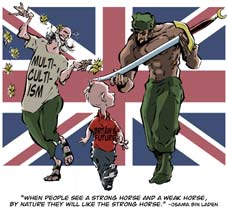
which may be the right moment to mention that the British, too, come in for a measure of contempt, via a quotation from none other than Osama bin Laden:

when-people-see-a-strong-horse-p-707.jpg  — p 707 —

“When people see a strong horse and a weak horse, by nature they will like the strong horse”.  Perhaps its unsurprising that the author is something of an admirer of bin Laden’s means, if not his ends.

Of course, that’s largely the fault of the Labour party:

labour-declares-multiculturalism-is-a-blessing-p-373.jpg

But that’s probably enough for one post — in my next, I’ll consider how weak we are, what the jihadist strategy against us is, and how the new Templars hope to turn the tide

against:

worst-threats-to-mankind-p-674.jpg — p 674 —

the worst threats to mankind.

Now Reading….

Friday, July 15th, 2011

booksx.jpg

The Profession by Steven Pressfield 

Tequila Junction: 4th Generation Counterinsurgency by H. John Poole

Steve’s novel The Profession I have mentioned previously, but I confess that I am puzzled by the choice of book jacket on Tequila Junction, which looks somewhat like a children’s illustrated guide to COIN in 1980’s El Salvador. H. John Poole is a respected veteran and tactical expert and Tequila Junction carries the warm endorsements of General Anthony Zinni and William Lind. Maybe his grandson drew it? Odd.

In any event, small unit tactics are not a subject I pretend to know much about, so it will remedy a gap in my knowledge base.

Carl Prine’s Rebuttal to “Be honest: Who actually read FM 3-24?”

Wednesday, July 13th, 2011

My amigo and SWJ News co-columinst Crispin Burke recently put forth a very interesting and provocative jeremiad “Be honest: Who actually read FM 3-24?” and one of his targets, journalist and Iraq war veteran Carl Prine, has been duly provoked, Prine has responded in great detail yesterday at Line of Departure:

Starbuck is wrong

Starbuck is wrong.

And in his drive to keep getting it wrong, he’s trying to rewrite FM 3-24, the military’s chief doctrinal publication on counterinsurgency.

But that just makes him more wrong.

He’s wrong about me.  He’s wrong about what I believe.  He’s wrong about the literature that informs FM 3-24.  He’s wrong about what the manual says and he’s wrong about what it left out.  He’s wrong about historiography.  He’s wrong about how a caste of top officers and diplomats came to understand “strategy” in the wake of the occupation of Iraq.

Let’s help get him right.  Or, at least, less wrong.  He’s a good man.  We need to turn him and ensure he quits taking shots at me I don’t deserve!

….The problem to anyone who studies Malaya, however, is that since the publication of the memoirs of exiled communist leader Chin Peng a dozen years ago, we now know that the civic, military and political policies under the British “hearts and minds” approach didn’t defeat the revolution.

Instead, the revolt was irreparably broken by brutal operations against the guerrillas, then a most coercive “screwing down the people” phase that dispossessed or killed thousands of Chinese, followed by draconian “population control” measures that, as Peng put it, starved the guerrillas in the bush because they snapped their rat lines and cut off their rice.

The “hearts and minds” initiatives designed to bring medical care, education, social welfare and other aid to the resettled Chinese and woo them to the colonial government’s side from 1952 – 1954 didn’t crack the back of the insurgency, a point now pretty much beyond dispute.

Why?  Because the previous “hearts and minds” claptrap as the cause of pacification in Malaya was contradicted by the Malayan Chinese, most especially those guerrillas who took up arms against the British regime!

You know, the people targeted by a population-centric counterinsurgency.  The people most counter-insurgents in their pop-centric fantasies almost never discuss except as abstractions, the human yarn wefted and warped by their long needles of war.

One finds “Hearts and Minds” prominently mentioned 11 times in Dr John Nagl’s valentine to Templer and colonial Malaya, Eating Soup with a Knife; to Nagl it’s the stuff of police services and economic development and whatnot with the psychology of the people being the center of gravity those reforms are meant to snatch.

And Nagl would like the best burglar of hearts and minds to be a learning, nimble and evolving military-political institution such as the U.S. Army.  It’s no small wonder, then, that Nagl became a dominant voice in FM 3-24 and that many of this thoughts in Eating Soup came to dominate the manual, too.

Or, as the introduction to FM 3-24 echoes soupily, “by focusing on efforts to secure the safety and support of the local populace, and through a concerted effort to truly function as learning organizations, the Army and Marine Corps can defeat their insurgent enemies.”

This is mere euphemism and wasn’t worth the ink that it cost taxpayers to print it.  But it sets the stage for the rest of FM 3-24, which follows a hearts and minds template that Starbuck doesn’t apparently realize is borrowed from mid-century….

Ouch. Note to self: if I ever decide to square off against Carl, I will make sure to do my homework. Read the rest here.

First, I would point out to readers here for whom some of this in both essays is inside baseball, that the tone is less harsh and the substantive distance between Burke and Prine less great in  the comments sections of both blogs than it first appears in reading their posts. It is a healthy, no-holds barred exchange and not a flame war.

Secondly, it is an important exchange, tying together COIN disputes over theory, historiography, empirical evidence, operational and tactical “lessons learned”, strategy, policy (Clausewitzian sense), politics (colloquial sense) and personalities that have raged for five years across military journals, think tanks, the media, the bureaucracy and the blogosphere. In some ways, these essays can serve as a summative of the debate. I say “some ways”, because what is the most important element or effect of America’s romance with COIN will differ markedly depending on whom has the floor. My own beef is not with doing COIN, it is with not doing strategy.

As Crispin and Carl’s vignette about General Creighton Abrams demonstrated, American historians are still having savagely bitter arguments about the war in Vietnam. For that matter, everyone who lived through the era did and still does. It is a wound that never seems to heal and has crippled our politics to this day, even as the veterans of Vietnam now turn to gray.

The 21st century COIN wars have not ripped American society apart down to the soul the way Vietnam did. As with the Korean War, the soldiers and marines in Afghanistan and Iraq fought bravely, at times desperately, to a general and mild approbation back home that sometimes looked a lot like indifference. Even the anti-war protestors mostly made a point of stating they were not against the troops, the venemous public malice of the 1960’s New Left radicals in the 2000’s was a property only of the lunatic fringe.

But COIN itself will be a historical argument without end.


Switch to our mobile site