zenpundit.com » philosophy

Archive for the ‘philosophy’ Category

Two wrongs make a right or wrong — in theory?

Sunday, November 15th, 2015

[ by Charles Cameron — on the (Pythagorean) arithmetic of morals ]
.

Extermination_of_Evil_Sendan_Kendatsuba 600

Sendan Kendatsuba, one of the guardians of Buddhist law, banishing evil, Tokyo National Museum

**

What’s right is generally supposed to be positive, while what’s wrong is seen as negative — and as they saying goes, two wrongs don’t make a right.

In effect, that’s saying two negatives don’t make a positive. And if you add them, that’s correct.

But if you multiply two negatives, you get a positive — hunh?

So two wrongs can indeed make a right — that’s the mathematics of vengeance — multiplicative:

And thine eye shall not pity; but life shall go for life, eye for eye, tooth for tooth, hand for hand, foot for foot.

— Deuteronomy 19.13

And it is also true that two wrongs don’t make a right — that’s a mathematics that denies vengeance — additive.

And then there’s the mathematics of forgiveness :

Be not overcome of evil, but overcome evil with good.

— Romans 12.21

Patient men, desirous of the Face of their Lord, who perform the prayer, and expend of that We have provided them, secretly and in public, and who avert evil with good — theirs shall be the Ultimate Abode

— Qur’an 13.22

And what’s most interesting to me in all this, is that the mathematical formulations, additive and multiplicative alike, don’t make a feature of time — where as their moral equivalents tend to introduce time into the equation / situation — in each case, it’s the response to evil, real or potential, that is considered.

On the events in Paris, Rod Dreher and the Benedict Option

Sunday, November 15th, 2015

[ by Charles Cameron — contrasting the ideal with “this pragmatical, preposterous pig of a world” ]
.

A few weeks back I read a piece by Rod Dreher around the concept of a Benedict Option recently, and liked it well enough that it sits in a special folder I have labeled 3 Major Papers, waiting for me to find the time to write it up in detail, offering my own suggested buttresses and side chapels to Dreher’s overall quasi-monastic structure. The Option itself derives from a paragraph in Alasdair MacIntyre‘s book, After Virtue:

What matters at this stage is the construction of local forms of community within which civility and the intellectual and moral life can be sustained through the new dark ages which are already upon us. And if the tradition of the virtues was able to survive the horrors of the last dark ages, we are not entirely without grounds for hope. This time however the barbarians are not waiting beyond the frontiers? they have already been governing us for quite some time. And it is our lack of consciousness of this that constitutes part of our predicament. We are waiting not for a Godot, but for another — doubtless very different — St Benedict.

**

Here’s my koan, as of yesterday, hearing the news of the multiple attacks in Paris and following Twitter to peer and pierce as best I could through the immediate fog towards the kernel of the matter. It takes the form of two tweets, the second in response to the first:

and:

**

My immediate reaction, dismayed at Dreher’s tweet, is to agree with Laura Seay‘s response. And I’m far from alone in this, as a glance at some other responses to Dreher easily confirms:

and:

**

So that’s the koan, the paradox — and that’s the way I lean on it.

Except that Dreher in a piece titled Refugees & the Paris Attacks, wrote again, today, and made some points that tip me towards the other side of the koan / coin:

Hesepe, a village of 2,500 that comprises one district of the small town of Bramsche in the state of Lower Saxony, is now hosting some 4,000 asylumseekers, making it a symbol of Germany’s refugee crisis. Locals are still showing a great willingness to help, but the sheer number of refugees is testing them. The German states have reported some 409,000 new arrivals between Sept. 5 and Oct. 15 — more than ever before in a comparable time period — though it remains unclear how many of those include people who have been registered twice.

Six weeks after Chancellor Angela Merkel’s historic decision to open Germany’s borders, there is a shortage of basic supplies in many places in this prosperous nation. Cots, portable housing containers and chemical toilets are largely sold out. There is a shortage of German teachers, social workers and administrative judges. Authorities in many towns are worried about the approaching winter, because thousands of asylum-seekers are still sleeping in tents.

The contrast between the ideal and the real couldn’t be greater: God’s in his heaven — and the devil is in the details.

**

As for that “pragmatical, preposterous pig of a world” — WB Yeats in his poem, Blood and the Moon is describing Bishop Berkeley:

                                                      that proved all things a dream,
That this pragmatical, preposterous pig of a world, its farrow that so solid seem,
Must vanish on the instant if the mind but change its theme…

It amuses me that when I look the phrase “pragmatical pig” up to make sure I quote it accurately, Google wants to correct it to “pragmatic pig” — doesn’t that massive AI know its Yeats well enough at least to have caught on to his marvelous catch-phrase?

**

More on Rod Dreher and the Benedict Option as time permits and place allows..

It is always good to find oneself in good company

Friday, October 30th, 2015

[ by Charles Cameron — Aristotle, the Ismailis, CG Jung ]
.

Two is the first number:

From the tenth-century Rasa’il Ikhwan al-Safa’ (Epistles or Treatises of the Brethren of Purity) as found in Seyyed Hossein Nasr & Mehdi Aminrazavi, eds., An Anthology of Philosophy in Persia, vol. 2, Ismaili Thought in the Classical Age:

We say that one is the source and generator of the numbers because when one is removed from existence all the numbers are removed with it, but when the numbers are removed from existence, one is not removed. We say that two is the first whole number because numbers are a plurality of ones, and the first plurality is two.

**

I am delighted to find myself in the company of the Ismailis, having written in On two, one, seven plus or minus, and ten – towards infinity:

When I worked as senior analyst in a tiny think-shop, my boss would often ask me for an early indicator of some trend. My brain couldn’t handle that — I always needed two data points to see a pattern, and so I coined the mantra for myself, two is the first number.

One isn’t a number until there are two, because it’s limitless across all spectra and unique, and because it is its own, only context.

One isn’t a number unless there’s a mind to think of it — in which case it’s already an abstraction within that mind, and thus there are, minimally, two. At which point we are in the numbers game, and there may be many, many more than two — twenty, or plenty, or plenty-three, or the cube root of aleph null, or (ridiculous, I know) infinity-six…

Go, figure.

Two is the first number, because the two can mingle or separate, duel or duet: either way, there’s a connection, a link between them.

And in Of a non-comparative use of the DoubleQuotes method:

Putting it bluntly, one point is pointless — things could go anywhere from there. Two points suggest a line, a link, a connection — a possible, maybe even plausible, trend.

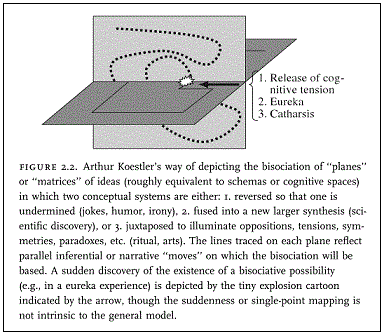
It’s that sense I have of two being the beginning of thought that makes me so fond of the DoubleQuotes format — and of Arthur Koestler‘s insight about creation occurring at the intersection of two spheres..

koestler-model

If I’m a fundamentalist about anything, it’s the notion that it takes two to tango!

**

Furthermore..

From CG Jung, A Psychological Approach to the Dogma of the Trinity, in Psychology and Western Religion:

The number one claims an exceptional position, which we meet again in the natural philosophy of the Middle Ages. According to this, one is not a number at all; the first number is two. Two is the first number because, with it, separation and multiplication begin, which alone make counting possible. With the appearance of the number two, another appears alongside the one, a happening which is so striking that in many languages “the other” and “the second” are expressed by the same word.

And from Leonardo Tarán, Speusippus of Athens: A Critical Study With a Collection of the Related Texts and Commentary:

Now we know that Speusippus did consider one to be the first odd number, whereas Aristotle thinks that two is the first number and explicitly denies that one is a number. [ … ]

Concerning the One, then, the differences between Speusippus and Aristotle amount to this: For the latter the One is not a number, nor a separately existing entity, but the principle of number because, each number being a plurality of abstract monads, the One is its measure.

**

As Emerson wrote:

The world is young; the former great men call to us affectionately.

Military Reform through Education

Tuesday, October 20th, 2015

[by Mark Safranski, a.k.a. “zen“]
Photo of Don Vandergriff instructing with a map

Don Vandergriff facilitating Adaptive Soldier/Leader exercises at Fort Benning

Fred Leland at LESC Blog recently had a guest post up by Dan Grazier from the Project on Government Oversight regarding the important work Don Vandergriff is doing to reform professional military education and training:

Military Reform Through Education: From The Straus Military Reform Project, Something We In Policing Can Learn From

….I had the privilege of experiencing this process with a group of 30 soldiers and Department of Defense (DoD) civilians learning about adaptive leadership and mission command. All were teachers from various courses at Fort Benning sent by their senior leaders seeking to infuse new ideas into their organizations. They spent a week learning how to incorporate adaptability into their courses during a seminar taught by CDI military advisor Don Vandergriff and his colleagues with Yorktown Systems Group.

The Adaptive Soldier/Leader Training & Education (ASLTE) seminar aims to move the Army away from outdated assembly-line training methods that teach soldiers to mindlessly execute checklists. Instead, the seminar shows soldiers how to incorporate creative and interactive methods that challenge both students and teachers. This results in empowered soldiers at all levels able to adapt to any situation. [….]

….Don Vandergriff, a retired Army major, has been on the front lines of personnel reform for many years. While he is most noted for his work at the service level, these seminars seek to transform the Army from the bottom up.

Approximately 20 soldiers and 10 civilian educators spent the week learning various teaching methods through experiential learning, which flips the traditional method military students are used to. Most training today follows the “crawl, walk, run” theory all service members are familiar with. Students are generally expected to complete reading assignments, sit through a PowerPoint lecture, and then finally conduct field training to reinforce what they have learned.

The seminar exposed students to new methods by putting the practical exercises first. For example, the seminar uses several Tactical Decision Games (TDGs) to encourage students to rapidly develop a plan for a military problem presented by the facilitators. TDGs can be created for nearly any kind of a situation, but this course mostly used actual battlefield problems like how to capture a bridge or defeat an enemy force entrenched on a hilltop. While working through these problems, the students are exposed to such concepts as Mission Command and the Observe, Orient, Decide, and Act decision cycle, commonly called the OODA Loop or Boyd Cycle.
It is only after the practical exercises that they receive reading assignments about those concepts. Because they’ve encountered them during the exercises, the concepts become more tangible. The OODA Loop, for instance, explains an individual’s or an organization’s decision-making process. It is a difficult concept to truly understand, but it becomes easier when one first sees how it works and then reads about it. The idea is to give them a moment of discovery, that “Ah ha!” moment. Success using such methods is to have a student say, “So, that’s what you call that,” while reading.

Don is making use of several powerful learning methodologies in his Adaptive Leadership philosophy – and I saying “learning” and not “teaching” because Don has properly put the emphasis on the student actively thinking and doing rather than on passively listening to a lecture or discussion. Lecture has a place in education, to explain or to set the student up for new learning experiences, but it should be used sparingly and in short bursts of time when the instructor has carefully set up a “teachable moment”. By having the students doing active problem solving first, they come to Vandergriff armed with their own questions, eager to have feedback.

The use of games are also a very powerful learning tool, perhaps one of the most effective because the situational learning. tends to be transferrable rather than be compartmentalized and isolated information. The right kind of decision games are serious practice for life. This was noted by RAND social scientists way back during the early days of the Cold War:

“The gamers argued that insights arose from immersion in play. In 1956 Joseph Goldstein noted that the war game demonstrated ‘ the organic nature of complex relationships’ that daily transactions obscured.War-gaming gripped its participants, whipping up the convulsions of diplomacy ‘ more forcefully…than could be experienced through lectures or books’.”

” A team from the Social Science Division [ at RAND ] posed a number of questions which they hoped the unfoldig month of gaming would resolve. Chief among them was whether gaming could be used as a forecasting technique ‘ for sharpening our estimates of the probable consequences of policies pursued by various governments’. Would gaming spark “political inventiveness“, and more importantly, how did it compare to conventional policy analysis? Did gaming uncover problems that might otherwise be neglected? And invoking the emerging touchstone of intuition, did the experience impart to policy analysts and researchers “ a heightened sensitivity to problems of political strategy and policy consequences?”

  Sharon Ghamari- Tabrizi, The Worlds of Herman Kahn

Back to the article:

….Vandergriff’s teaching method incorporates recent research into adult learning, designed “to engage students in direct experiences which are tied to real world problems and situations in which the instructor facilitates rather than directs student progress.” This creates a situation where the students learn from one another. Unlike most other military classes, the ASLTE teachers use very few PowerPoint presentations. They also end up speaking far less than the students themselves.

Vandergriff ran the class through the first TDG and led the discussion afterward. From that point forward, students took turns leading the class through After Action Reviews. Students gained confidence in leading such an exercise while the rest of the class bounced ideas off each other. The interactive nature of this kept the entire class engaged and gave all of them ownership of their own learning.

The concept of ownership was a consistent theme throughout the seminar. According to Vandergriff, a good teacher “works to make his students better than himself and encourages them to take ownership of their development, to make them life-long learners.”

Here Don is making use of the social pressure and reinforcement of a Peer to Peer (P2P) dynamic to maintain maximum student engagement while having them practice critical intellectual reflection, something that is a vital constituent of a professional culture of learning. A true professional embraces an honest discussion of ideas and both accepts and gives critical feedback on performance in hopes of learning and improving.

Read more regarding Don Vandergriff’s adaptive leadership methods here and here.

Analogies of game and play, life and death

Tuesday, September 8th, 2015

[ by Charles Cameronno trump — a situation in which no suit is designated as trump ]
.

SPEC DQ Trump & Monopoly

Sources:

  • Trump, Trump Tower at City Center
  • Monopoly, EA Brings iOS Hit Monopoly Hotels to Google Play
  • **

    There are at least three major analogies for life to be found within life itself: dreams, games, and plays — and in each case, there’s the possibility of an infinite regression, of dreams within dreams, games within games, and plays within plays.

    Shakespeare has the play within a play motif down nicety, but it traces back if I’m not mistaken to Plotinus, if not before. There’s that favorite remark of mine in the Enneads:

    Murders, death in all its guises, the reduction and sacking of cities, all must be to us just such a spectacle as the changing scenes of a play; all is but the varied incident of a plot, costume on and off, acted grief and lament. For on earth, in all the succession of life, it is not the Soul within but the Shadow outside of the authentic man, that grieves and complains and acts out the plot on this world stage which men have dotted with stages of their own constructing. All this is the doing of man knowing no more than to live the lower and outer life, and never perceiving that, in his weeping and in his graver doings alike, he is but at play; to handle austere matters austerely is reserved for the thoughtful: the other kind of man is himself a futility. Those incapable of thinking gravely read gravity into frivolities which correspond to their own frivolous Nature. Anyone that joins in their trifling and so comes to look on life with their eyes must understand that by lending himself to such idleness he has laid aside his own character. If Socrates himself takes part in the trifling, he trifles in the outer Socrates.

    **

    We can move from theater to dream with almost suspicious ease via Pedro Calderón de la Barca, whose play La Vida es Sueño plays (in what is more a “game” sense than a “theatrical” one) with the idea of life as a dream — the idea embodied in his play’s very title.

    Indeed, as the translator Michael Kidd suggests in his Introduction to the play:

    To emphasize the illusory nature of this existence, the Spanish Baroque relied on three central metaphors: life as art, life as theater, and, most important for Calderón, life as a dream.

    Here, then, is the heart of Calderón:

    We live in such an exceptional world that living is no more than dreaming; and experience teaches me that he who lives dreams what he is until waking. The king dreams that he’s king, and he lives under this deception commanding, planning, and governing; and his acclaim, which he receives on loan, is scribbled in the wind and turned to ashes by death. What grave misfortune! To think that anyone should wish to govern knowing that he will awaken in the sleep of death! The rich man dreams of more riches, which only bring him more worries; the poor man dreams that he suffers in misery and poverty; the man who improves his lot dreams; the man who toils and petitions dreams; the man who insults and offends dreams. And in this world, in short, everyone dreams what he is although no one realizes it. I dream that I’m here, weighed down by these chains, and I’ve dreamt that I found myself in more flattering circumstances. What is life? A frenzy. What is life? A vain hope, a shadow, a fiction. The greatest good is fleeting, for all life is a dream and even dreams are but dreams.

    And for recursion — an earlier translator of those lines about anyone who might “wish to govern knowing that he will awaken in the sleep of death” renders them thus:

    Who would wish a crown to take,
    Seeing that he must awake
    In the dream beyond death’s gate?

    Why, we are almost in the realm of Chuang Tzu..

    Once Chuang Chou dreamt he was a butterfly, a butterfly flitting and fluttering around, happy with himself and doing as he pleased. He didn’t know he was Chuang Chou. Suddenly he woke up and there he was, solid and unmistakable Chuang Chou. But he didn’t know if he was Chuang Chou who had dreamt he was a butterfly, or a butterfly dreaming he was Chuang Chou. Between Chuang Chou and a butterfly there must be some distinction! This is called the Transformation of Things.

    **

    Oho — do we imagine we have escaped moral necessity by viewing life as a dream?

    Calderón again:

    I want to do what’s right, for it pays to do what’s right even in dreams.

    **

    Ah, but games.

    It was the quote that follows, about death and games, that drove me to write this post, and I believe it takes us deeper into the mystery of these analogies of life and death: Gabby DaRienzo is writing about “ussing game mechanics to encourage players to think about death and mortality” in her piece, Death Positivity in Video Games:

    Death serves multiple mechanical roles in videogames — it is most commonly used as a thing you want to avoid, a goal you need to accomplish, or as a narrative device. While death is prominent in many videogames, we generally give it much less thought and treat it with much less seriousness than actual death, especially when it comes to the player.

    And there we have it — the recognition that we care less or more, proportionately, about some things in games than we do in “RL”.

    Some of that difference, it would seem is to do with the mechanics and “inworld” motivations of particular games — but it would be an interesting landscape to plot, game by game or genre by genre. Flight simulators need to be in close correspondence with the realities they are represnting in terms of turbulent air flows, fuel consumption, and landing strips, for iunstance — but if their clouds are visually a bit less than realistic, it’s no big deal. A Tibetan mandala-based game, on the other hand, might want to get the scrolled cloud-work so characteristic of Tibetan art and the Thirty-two Excellent Signs of a Buddha’s Enlightening Body exactly right — in Tibetan cultural terms. Strage, but true:

    Each hair of a Buddha’s eyebrow is exactly the same length.

    **

    Money, then.

    In Monopoly, it’s everything — and life?


    Switch to our mobile site