zenpundit.com » philosophy

Archive for the ‘philosophy’ Category

Book Review: The Profession by Steven Pressfield

Monday, July 25th, 2011

The Profession by Steven Pressfield

We should begin this review with “Full Disclosure“:

I just finished reading The Profession by Steven Pressfield, which I enjoyed a great deal. Steve sent me an earlier draft doc of the book and I consider Steve a friend. Furthermore, in an extremely gracious gesture, Steve granted me (or at least zenpundit.com) the novelist’s equivalent to a walk-on cameo appearance in his book. Therefore, if you the reader believe that I cannot review this book objectively…well….you are right. It’s not possible 🙂 . Here are some other reviews by Shlok Vaidya, Greyhawk of Mudville Gazette and Kirkus if you want greater impartiality.

Nor am I going to delve into the mechanics of the plot structure and action sequence in The Profession. For one, I think too much of the story in a review of a work of fiction spoils the enjoyment for the group of readers who would be most interested. And you can get the blow by blow elsewhere.

Instead, I would like to draw your attention to how Pressfield has written this novel differently. And why that matters.

There is plenty of action in The Profession and the book really moves. It is violent, but not at a Blood Meridian level of cruelty and the murky political intrigue that surrounds the hero, the mercenary’s mercenary and “pure warrior” Gilbert “Gent” Gentilhomme, is a nice counterpoint to physical combat and technical military details. Many people will enjoy the novel on this level and The Profession would make for an exciting action film. Or perhaps a series of films along the lines of The Bourne Identity or those Tom Clancy movies with Harrison Ford. All well and good. But that is not why The Profession is worth reading – that’s merely why it is fun to read.

What surprised me initially about The Profession was how unlike Killing Rommel it was. Killing Rommel also had war and adventure, but it was a deep study in the character development of Chap, the protagonist, who had enough of a textural, cultural, authenticity as a young gentry class British officer of the WWII period as to make Killing Rommel seem semi-biographical. As a reader, I didn’t much care if Chap and his men succeeded in killing Rommel, only that I would be able to continue to see the story unfold from Chap’s perspective. Many artists believe characters and character interaction are the most important element in a story, from Saul Bellow to Quentin Tarantino. Their stories are captivating even though their narratives are not always particularly logical or centered on a grand conflict.

The Profession is not like that at all. In my view, Pressfield turned his creative energies, his knowledge for military affairs and his formidible ear for history away from character development and toward theme. This difference may or may not explain his own reports of difficulty in wrestling with this novel.

Reaching back to the lessons learned from late Republican Rome, Thucydides, Xenophon and seasoning it liberally with Machiavelli, Pressfield’s 2032 near-future is also jarringly allegorical with America of 2012. Like Rome of the 1st century BC or Athens after it’s defeat in the Peloponnesian War, America in The Profession is strategically paralyzed, politically polarized and teetering on the precipice of decay and decline. These historical inspirations have been mashed up with a dystopian 4GW world, filled with mercenary PMCs like Force Insertion and The Legion, terrorists, drones, tribes, criminal corporations and and a devious and cowardly global financial elite. A future more evenly distributed from the present.

The antagonist against whom the plot is structured is not the story’s nominal villain terrorist, but Gent’s Homeric father-figure, former Lieutenant General James Salter, USMC,  “the crawling man” who was martyred, disgraced, exiled and redeemed as the new master of Force Insertion’s Mideast deployed “armatures” (combined arms divisions) and the book’s geopolitical apex predator, who boasted:

” I was obeying a more ancient law” 

This marks a drastic shift in Pressfield’s use of characters from people existing in themselves with humanistic nuances to their use as philosophical archetypes to better express the theme, more like the technique of Fyodor Dostoyevskii, Victor Hugo or Ayn Rand.

The interplay between the kinetic Gent and the increasingly totemic Salter elucidates a theme that is creating tectonic political shifts in America and the world; a theme which is expressed explicitly to Gent at one point by the ex-Secretary of State, Juan-Estebaun Echevarria. The ex-Secretary plays Cicero to Salter’s Caesar, but Gent is ultimately cast in the role of a very different Roman by the manipulative Salter. Pressfield, in honing the various characters, including AD, Maggie Cole, El-Masri and others, is also drawing on Alcibiades, Critias, Livy, Homer, Robert Graves, Joseph Conrad and the pattern of mythic epics. Salter is at once a pagan chieftain and a philosopher-king, a civilized Kurtz or a barbaric John Galt, who after continuous dissembling, in a brutally honest speech, gives his followers, his enemies, Gent and even himself, no opportunity to morally evade what he has become or his reasons for what he proposes to do. A speech that resonates with the negative trends we see today.

The Profession is a cautionary tale outfitted in kevlar.
2083 Graphics — a first look

Sunday, July 24th, 2011

[ by Charles Cameron — index of graphics, first 800 or so pages of the “2083 European Declaration of Independence”, with some analysis ]

.

A great deal of work needs to be done on the 2083 European Declaration of Independence, and I thought a useful place to start would be a catalog of images.

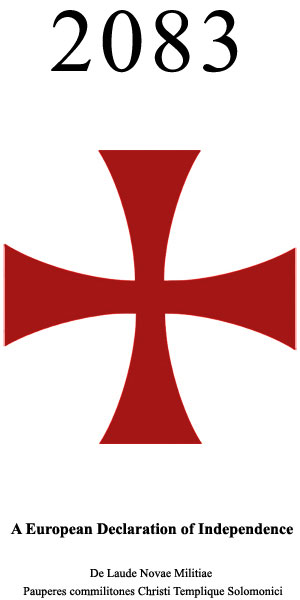
The document opens with a graphical title:

000-2083-cross-tp.jpg — title page —

That’s probably the largest single graphic in the entire work, and it puts the work squarely in the context of the Knights Templar — with e Templar cross and the full name of the order, “Pauperes commilitones Christi Templique Solomonic” or Poor Fellow-Soldiers of Christ and of the Temple of Solomon.  The Templars were a Western Christian chivalric order strongly associated with the Crusades — and the topic more recently of much historical, occult and fictional speculation.

The date 2083 is a date SFE (in the Science Fictional Era) as was 1984 before it — but it was almost certainly chosen for its echo of the 1683 Battle of Vienna, which is commonly taken to represent the turning back of the Ottomans by the Habsburgs, and thus the victory of Christendom over Islam.  Two maps show the Umayyad Conquests:

umayyad-conquests-p-228.jpg — p 228 —

and the Second Islamic Wave, turned back in Spain and at the gates of Vienna:

243-1683-second-islamic-wave-p-243.jpg — p 243 —

These can fruitfully be contrasted with a map of “tomorrow”:

demain-p-487.jpg — p 487 —

it being the author’s contention that France will be the first European country to fall to Islamic dhimmitude.  I suspect much the same is implied in this version of the French tricolore:

flag-face-p-781.jpg — p 781 —

There are some pointed attacks on leftist intellectuals:

033-academic-reform-p-33.jpg — p 33 —

and on media perceived as left-leaning, notably the BBC:

bbc-flag-w-crescent-p-384.jpg  — p 384

— that’s the Saudi flag mashed up with the BBC logo and star and crescent — and:

804-bbc-02-p-804.jpg  — p 804 —

giving both “ancient” and “modern” variants on the theme…

There are some strange items which I’ll drop in here for a breath of fresh air…

free-pluto-equal-gravity-for-all-planets-p-381.jpg  — p 381 —

which appears to be a commentary on the respective attractions of Venus and Mars, since it’s situated in a commentary on Feminism…

this really is a strangely mythic document… and…

global-warming-voidka-p-657.jpg

with its reference to “mind control agents” — and those whose minds have been controlled are clearly sheep:

wake-up-p-803.jpg — p 803 —

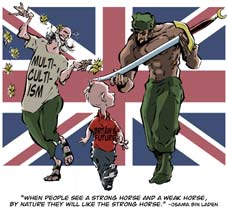
which may be the right moment to mention that the British, too, come in for a measure of contempt, via a quotation from none other than Osama bin Laden:

when-people-see-a-strong-horse-p-707.jpg  — p 707 —

“When people see a strong horse and a weak horse, by nature they will like the strong horse”.  Perhaps its unsurprising that the author is something of an admirer of bin Laden’s means, if not his ends.

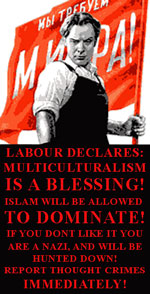
Of course, that’s largely the fault of the Labour party:

labour-declares-multiculturalism-is-a-blessing-p-373.jpg

But that’s probably enough for one post — in my next, I’ll consider how weak we are, what the jihadist strategy against us is, and how the new Templars hope to turn the tide

against:

worst-threats-to-mankind-p-674.jpg — p 674 —

the worst threats to mankind.

Wylie’s Military Strategy

Saturday, July 23rd, 2011

 by J. Scott Shipman

Wylie

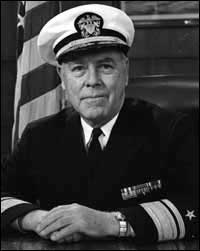
Military Strategy, by Rear Admiral J.C. Wylie, Jr., USN (1911-1993)

This is a very brief review and recommendation for a book that I discovered recently. Admiral Wylie’s short Military Strategy (about 85 pages in the original edition) was published in 1967, but written in the mid-fifties while Wylie was “at sea in a single-screw low-speed amphibious cargo ship.” He remarked these ships were “not demanding  of a captain’s attention as is, for instance, a destroyer.”My copy was published in 1989 by the  Naval Institute Press  as part of their Classics of Seapower series and has an excellent preface by John B. Hattendorf that will give those unfamiliar with Wylie’s life experience a good foundation. This copy also has a postscript written by Wylie “twenty years later” and three related essays published previously in Proceedings magazine.

Given Military Strategy’s brevity, I’ll resist the urge to provide long quotes. Wylie and an associate’s search for articulating the relevance of the navy in the never-ending budget battles brought them in contact with the famed mathematician John von Neumann of Princeton. Wylie used a paraphrase of von Neumann as a starting point: “With respect to strategy as a subject of study, its intellectual framework is not clearly outlined, and its vocabulary is almost nonexistent. These two primary tasks are badly in need of doing…” He sets out to do just that and does a nice job.

Wylie defines strategy as: “A plan of action designed in order to achieve some end; a purpose together with a system of measures for its accomplishment.” He discusses the military mind and strategy, and how often the military focuses on principles to the exclusion of real strategy. Wylie outlines methods of studying strategy that are simple and well thought-out. Wylie makes a compelling case for a general theory of strategy. He says: “A theory is simply an idea designed to account for actuality or to account for what the theorist thinks will come to pass in actuality. It is orderly rationalization of real or presumed patterns of events.” Further, he continually stresses the importance of assumptions being based in reality, and not wishful thinking or the last war/battle.

His chapter on existing theories is worth the price of the book. He provides a type of Cliff’s Notes overview of the four theories he sees as core: the maritime, the air, the continental, and the Maoist. Of the last, he masterfully lifted sections from Mao’s On Guerilla Warfare, Che Guevera on Guerilla Warfare, and Vo Ngugen Giap’s People’s War People’s Army. He observed of the later, “these books are not only theory, the portray a hard reality of contemporary warfare.” To our people in uniform, in particular, unfamiliar with these books, Wylie provides an accessible and informative introduction to the type of war being waged by Islamic jihadists and how they attempt shape the battle field.

He develops a brilliant point that destruction doesn’t necessarily translate into control, and that often destruction is driven more by emotion than strategy.

Wylie goes on to provide a general theory of strategy that, using his words, has “substance and validity, and practicality.” As Seydlitz89 said in a recent comment thread here: “Wylie is amazing.  So many ideas in such a small book!  He misread Clausewitz and overrated Liddell Hart – which are probably connected, but overall?  He comes up with some very basic ideas about strategic theory which are ever sooooo useful.  I’ve re-read his small book several times and always come up with something that either I’d forgotten or that I had missed earlier.  Wylie’s basic approach to theory is as a practitioner, not as an academic, much like Clausewitz before him.”

Indeed, Wylie provides a nice scaffold for any type of strategy, military or business. For me his approach was refreshing in a genre where, more often than not, dogma and ego walk hand-in-hand.  Time and again, he offers that his ideas may be wrong and encourages readers to think and wrestle with the concepts provided. Wylie writes in his postscript: “As far as I know, no one as ever paid attention to it [the book]. I don’t know whether this is because it is so clear and obviously valid that no one needs to, or because it is of no use at all. I suspect it could be the latter, but I really do not know.”

This little book comes with my highest recommendation. If you’re in uniform and just getting started with strategic concepts/thinking, this is an excellent place to start.

Interesting referenced titles:

Military Concepts and Philosophy, Henry E. Eccles 

The Military Intellectuals in Britain, 1918-1939, Robin Higham 

An Introduction to Strategy, General Andre Beaufre 

Theory of Games and Economic Behavior, John von Neumann 

Strategy in Poker, Business and War, John McDonald 

Sacred space and the imagination

Sunday, June 19th, 2011

[ by Charles Cameron — no mil/intel stuff — the sacred, architecture, nature, books, imagination ]

.

This post began with a photo my friend William Benzon took of an abandoned passenger terminal in Liberty State Park:

abandoned_passenger_terminal_libery_state_park.jpg

*

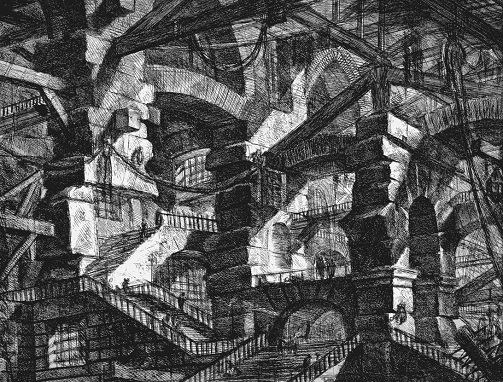
Without the greenery, I don’t think I’d feel this was “special” in quite the same way.  I might see it as prison-like, akin to those magnificent Piranesi prints in his Carceri series:

piranesi_carcere_xiv.jpg

… vast, haunted — the anti-cathedral.

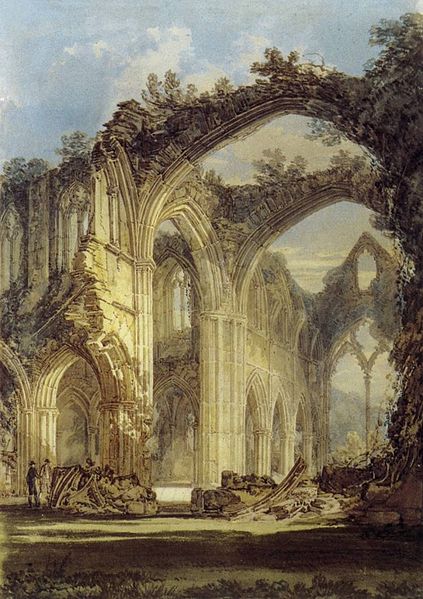
Yet the grasses and small trees are there in Benzon’s photo, green and vibrant — and in their presence, the prison becomes a cathedral… not unlike the great ruined abbeys of England, Tintern, Calder, Whitby, Walsingham, Fountains.

Here’s Tintern Abbey by JMW Turner, for a sense of how ruins were viewed in his day:

423px-turner_tintern1.jpg

Somehow, in the workings of the human mind and heart, nature’s grasses can keep a ruined space sacred…

*

But what of books?

bookstore-interior-design-in-the-former-dominican-church-by-merkxgirod-1.jpg

The effect is austere by comparison, but the hush of the library slips into the high-vaulted silence of the cloister, and when I saw Bill Benzon’s photo above, this photo of a bookstore in Holland was the first analogy to cross my mind…

The Selexyz Dominicanen bookshop is housed in an old church in the centre of Maastricht. A beautiful listed building, this former Dominican church was transformed into a bookstore by architects Merkx+Girod, resulting in an extraordinary combination of bookselling complex and church interior, preserving the unique landmark setting. It was praised by British newspaper The Guardian as ‘possibly the world’s finest bookshop’. Earlier, Selexyz Dominicanen had already received the prestigious Lensvelt Architecture Interior Award 2007 for the décor of the store.

Of course, not everyone thinks a bookstore is sacred, and a lot might depend on what books you browsed, or caught your neighbor browsing. Here’s one negative report:

When your church community gets bored of reaching out with the love of Christ and doesn’t like to meet together anymore, don’t cry over it! Build a bookstore and coffee shop out of your unwanted worship space. The chancel is great for a cappuccino… And the worship space would house a nice collection of bargain-priced books, and kitten calendars:

So next time you despair that the church has lost its way, relax and sooth your aching conscience with a steaming latte – you can even sit at the crucifix table and plug into the WiFi. There are so many uses for old churches, why bother with renewal in the Church at all?

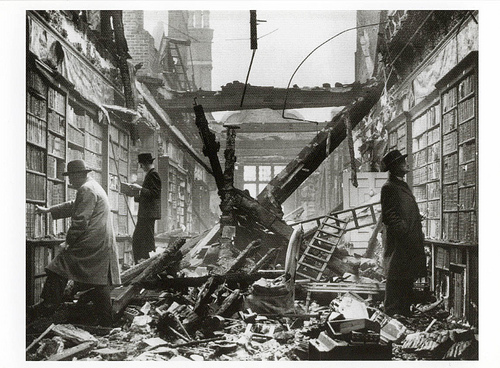
Even a ruined bookstore can have something of a sacred quality, though, as this London library photo clearly shows:

london-library-bomb-damage.jpg

Surely, that’s the last word in books — what more could one ask for?

*

Still — look.  There’s some sort of disaster, atrophy, ruin or sea-change in each of these images.  What happens when an architect — as skilled as the folks from who designed that bookstore — builds a chapel in the forest?

With all the contemporary emphasis on modern sustainable architecture, sometimes we seem to forget that environmentally friendly architecture has existed for a long time. Built in 1980, Thorncrown Chapel was created with the idea of highlighting the natural setting, which was, and still is, an attractive natural setting for tourists in the area. The owner of the site, Jim Reed, hired well known architect, Frank Lloyd Wright alumni E. Fay Jones to design and build the site which used native timber to match the setting around it, and the result was a fantastic expression of architecture that was awarded the “Twenty-Five year award” by the American Institute of Architects.

It is as lovely by winter light:

snow_fs1.jpg

as it is by light of spring and summer:

thorncrown-chapel.jpg

and yet I’d say there is something not ascetic but arid there: it has tried a great deal, but not died a little.

*

Nothing there is any which way ruined.  And it is out of ruins that our hopes grow these days, as grass at times breaks through tarmac.

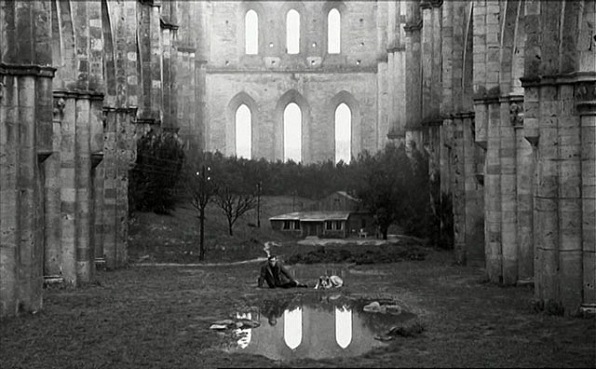
Tarkovsky’s great film Nostalghia closes with a breathtaking shot…

nostalghia11.jpg

a sacred space in pure, delivered, imagination — a single shot which to my mind, having seen the film and left the movie theater speechless, must be accounted the greatest single work of surrealism yet…

in which the protagonist, a Russian exiled in Italy, sees finally the lonely Italian abbey that has come to symbolize his loss of hearth and home, all loss, all absence — with his home nestled inside it, the little pond, himself, his dog…

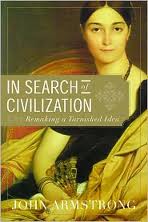
In Search of Civilization, a review

Saturday, June 18th, 2011

 [by J. Scott Shipman]

civilization.jpg

In Search of Civilization, by John Armstrong 

In Search of Civilization is a refreshing and erudite examination of civilization, how it developed in the past, negative present day connotations, and why it remains importance and relevant today. What follows is a detailed overview of Part One, and with any luck, the teaser will be enough to convince you to read this important book. For me, this is a truncated review. Normally, I would provide a 1200-1500 hundred word overview, but like Zen, I’ve been busy and wanted to share what I had with you. This books makes a nice foil for John Gray’s Black Mass, which I read recently but probably will not review.

Also, some books have wonderful finds in the bibliography. Back in the early 80’s I chased footnotes for about two years—and have no memory of what the original book was, but I went from one reference to another. Going forward, I’ll provide the titles from the bibliography that piqued my interest, which may also provide the you a little more insight on the works that influenced the author. Please let me know if this is or is not useful to you.

Part One Civilization as Belonging

Armstrong’s quest to define civilization began as he was reading a bedtime story to his son, and he advances that “with the possible exception of God, civilization is the grandest, most ambitious idea that humanity has devised.” From that introduction, Armstrong makes a compelling case for civilization.  He notes that it is difficult to get one’s mind around the concept since “civilization” touches everything. As a result, he offers that our ideas about “civilization tend to be rather messy and muddled.”

Armstrong goes on to frame civilization as “a way of living,” a level of political and economic development, “the sophisticated pursuit of pleasure,” and finally, “a high level of intellectual and artistic excellence.” Separately each of these, what I’ll call working definitions, made sense. But Armstrong rightly attempts to define, frame, contextualize civilization, not from historical perspective, but rather the philosophical in a way that is relevant to our times.

The actual word “civilization” is, according to Armstrong, not “fashionable” in our globalized world, particularly among those one would expect to be the “defenders.” He offers that civilization carries a “moral implication” whereby one society is somehow better than another, “fully human” or “superior.” And nations often advance the idea that they are better, more civilized, etc. Those defenders (in the arts and humanities) mentioned above have become “wary and negative” with respect to civilization. I’ll call this standard-less ambivalence based primarily on fear. Fear of “what,” you may ask. Fear of offending. Harvey Mansfield in City Journal made an excellent point with respect to political correctness:

“When there is no basis for what we agree to, it becomes mandatory that we agree. The very fragility of change as a principle makes us hold on to it with insistence and tenacity. Having nothing to conform to, we conform to conformism—hence political correctness. Political correctness makes a moral principle of opposing, and excluding, those of us who believe in principles that don’t change.”

Principles are a big part of civilization.A brief review of Samuel P. Huntington’s classic The Clash of Civilizations follows. Armstrong reminds of Huntington’s words: “In coping with an identity crisis, what counts for people are blood and belief, faith and family.” Armstrong recounts Huntington’s view of civilization a sense of “loyalty” and “shared identity.” Armstrong calls this an “organic conception of civilization;” witness the identity politics of the in the aftermath of 9/11 where it seemed the US, for once, stood as one. The phenomena can be found around the world, regardless race, religion, or ethnicity.  If there is a community of people, chances are there will be shared identities, but is this “sharing” civilization?

One of the strongest parts of the book is the emphasis he places on the “quality of relationships.” With the aforementioned “sharing” and “loyalty” Armstrong rightly asks about the quality of individual relationships and the impact on civilization. He compares the loyalty of religious believers to their faith to their loyalty to their civilization. Armstrong believes, and I agree, we share much more in common than one might, on first glance imagine. He says, “The rich achievements of any civilization are not in violent conflict, and in fact are on the same side in a clash between cultivated intelligence and barbarism. The irony is that such barbarism too often goes under the name of loyalty to a civilization.” Armstrong believes that a “true civilization is constituted by high-quality relationships to ideas, objects, and people.” In high quality relationships there is love and Armstrong sees civilization as “the life-support system for high-quality relationships.” Civilization sustains love; I like the implications.

The cultivation of high quality relationships tends to bring out the best in people.  He goes on to discuss the paradox of freedom—as we in the West live in cultural democracies. He asserts that vulgarity is “triumphant” because of our democratic ideals; the majority rules. Freedom comes with great responsibilities, greater responsibilities than living in a coercive state. At the level of the individual we make choices, satisfy appetites. “The civilizing mission is to make what is genuinely good more readily available and to awaken an appetite for it.”

Part Two Civilization as Material Progress, Part Three: Civilization as the Art of Living, Part Four: Civilization as Spiritual Prosperity 

References you may find of interest:

F.R. Leavis, The Great Tradition

C.P. Snow, a lecture “The Two Cultures and the Scientific Revolution

Matthew Arnold, Culture and Anarchy  A free online copy here.

 Kenneth Clark’s BBC television series Civilization

Bernard Berenson, The Florentine Painters of the Renaissance (1896)

T.S. Elliot, an essay called “Tradition and the Individual Talent


Switch to our mobile site